
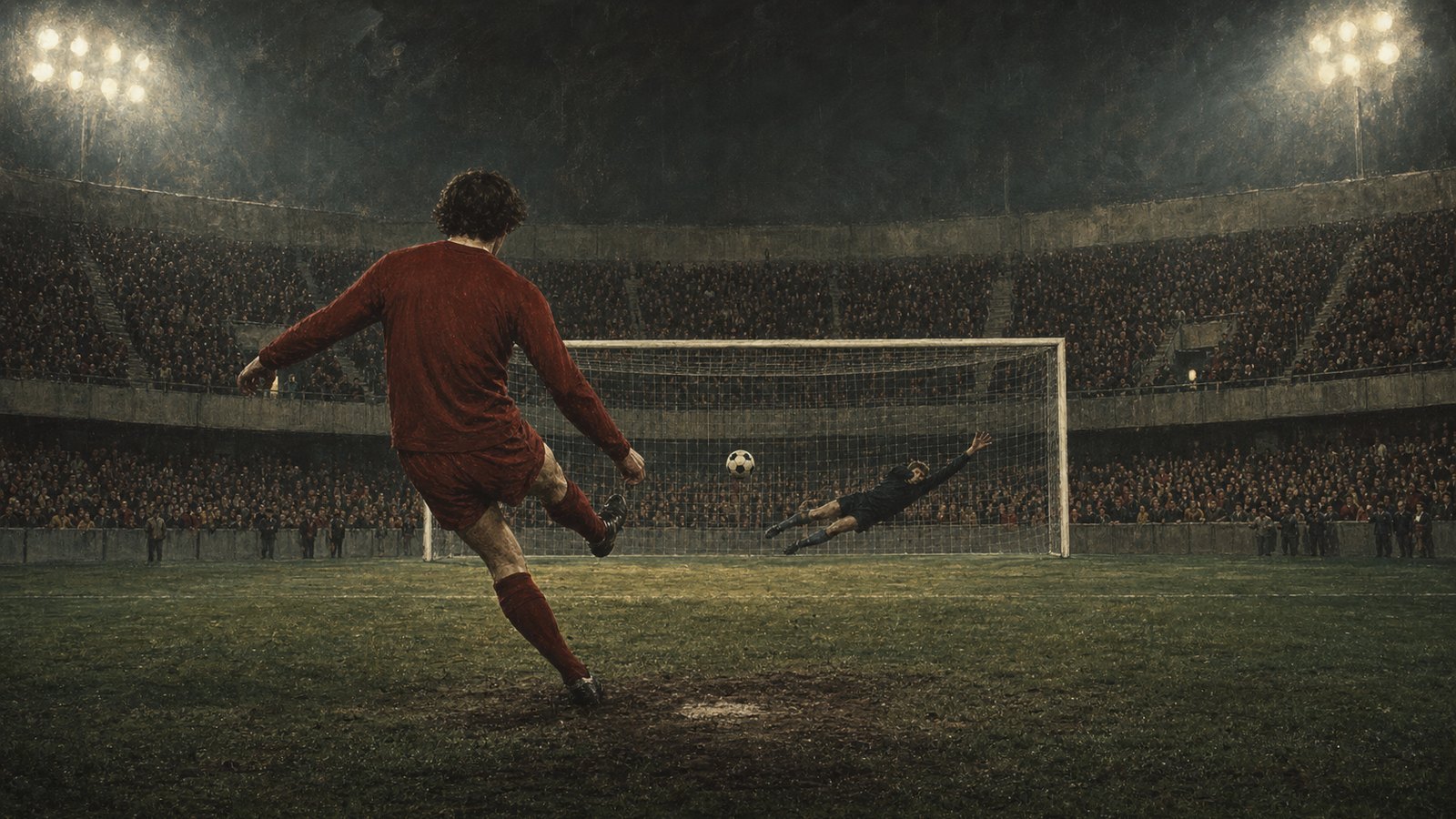
One kick in Belgrade changed the vocabulary of football. On 20 June 1976, Antonín Panenka ran toward the penalty spot with Czechoslovakia one successful strike from the European Championship. Sepp Maier, West Germany’s celebrated goalkeeper, prepared for power. Panenka instead lifted the ball softly through the space Maier had just abandoned.
The finish looked spontaneous, almost insolent. It was neither. Behind that floating ball were two years of small wagers after training, a goalkeeper who kept winning them, and a playmaker who studied the rules of a duel played twelve yards apart. Panenka’s real invention was not the chip itself. It was a way of turning the goalkeeper’s anticipation against him.
The final nearly had a second match
West Germany reached the final as both the defending European champion and reigning world champion. Czechoslovakia had survived a violent semi-final against the Netherlands, winning 3–1 after extra time. In Belgrade, the underdog then struck first. Ján Švehlík scored in the eighth minute and Karol Dobiaš made it 2–0 after 25.
The favourite did not disappear. Dieter Müller pulled one back three minutes later. Czechoslovakia protected the lead through most of the second half, but Bernd Hölzenbein equalised in the 89th minute. Extra time produced no winner. The match records show a 2–2 draw in front of 30,790 spectators, but the procedure that followed was not always guaranteed.
The original plan had been a replay two days later. Panenka later recalled that the German association asked to use penalties instead, with players’ booked holidays among the reasons offered. Czechoslovakia accepted. A replay would have given the deeper favourite another full match; a shootout compressed the contest into isolated decisions.
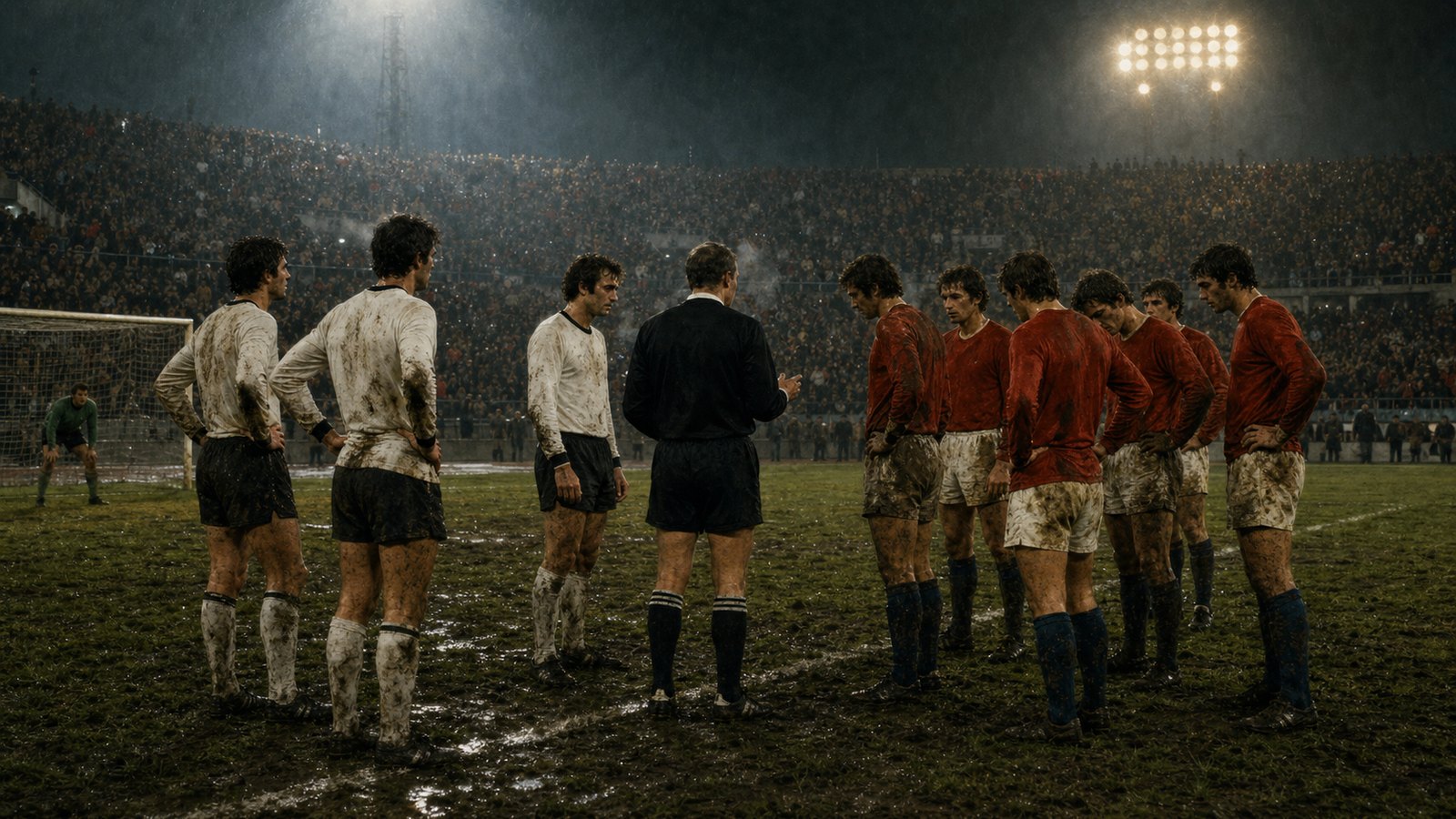
The change was historically significant. Radio Prague describes the sequence as the first penalty shootout used to settle a major international tournament final. What now feels like a standard ending was an unfamiliar frontier. The players entered it without decades of televised shootout habits, specialist analysts or databases of preferred corners.
A daily wager became a laboratory
Panenka’s preparation began at Bohemians Prague with goalkeeper Zdeněk Hruška. They stayed after training and held a private contest. Panenka took five penalties. To win, he had to score all five; Hruška needed to save only one. The loser bought beer or chocolate. The rules gave the goalkeeper a durable advantage, and Panenka later remembered paying too often.
That frustration made the training ground a laboratory. Panenka noticed that a goalkeeper facing a hard penalty usually delayed, read the approach and then committed left or right. The keeper’s need to reach a corner created an empty area in the middle. If the taker could disguise his intention until the commitment, force was no longer essential.
The answer required more than simply kicking gently. A casual run-up would warn the goalkeeper to hold position. Panenka used speed and body language that promised a firm strike, then changed the contact at the last moment. The deception created the space; the delicate touch used it. Repetition made those two movements part of one action.
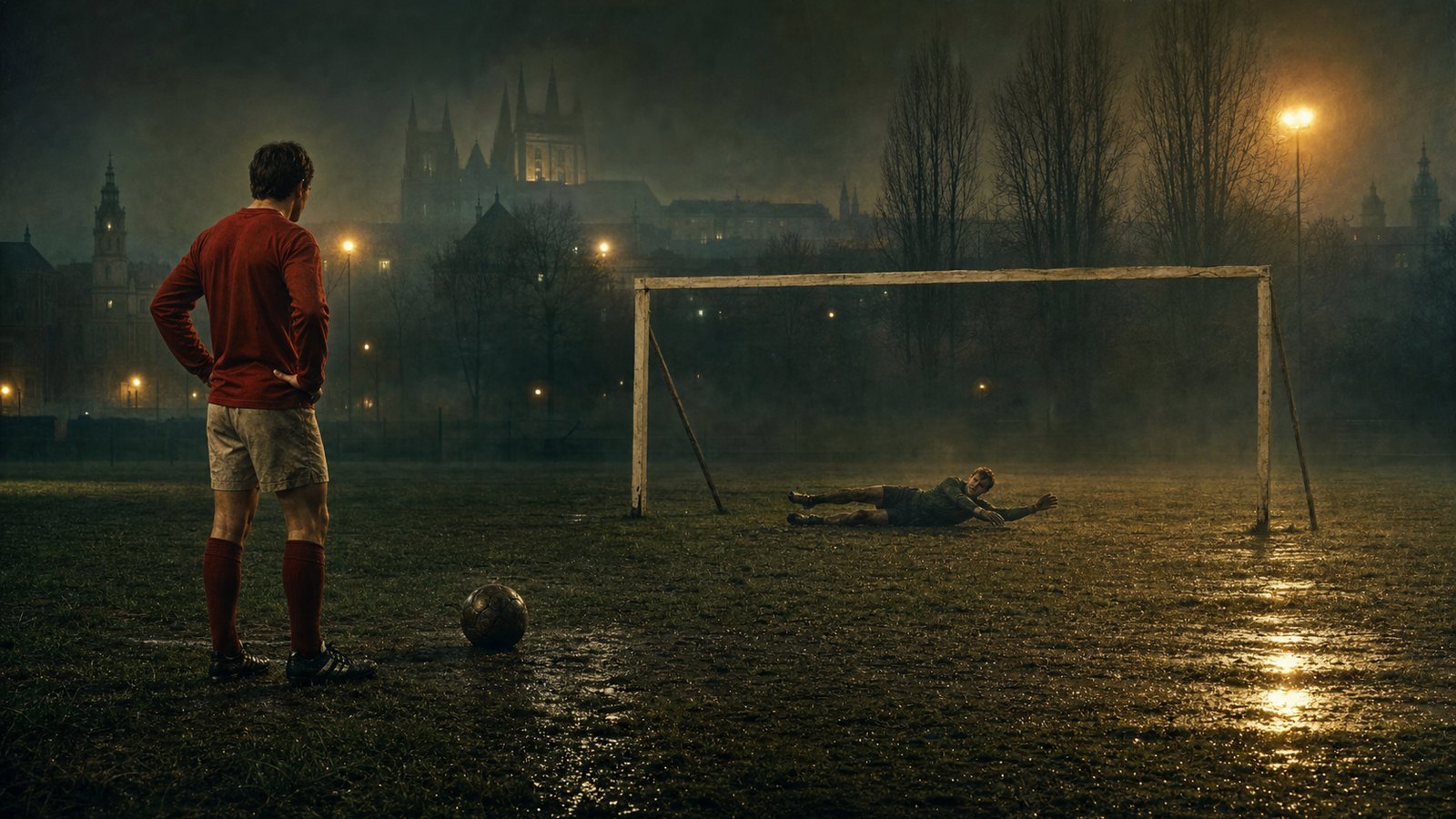
He did not hide the experiment forever. According to his later account, he progressed from training to friendlies and then used the technique in a competitive match against Dukla Prague shortly before the tournament. Czech football knew the possibility. West German football did not study Bohemians closely enough for that knowledge to reach Maier.
Four perfect rounds created the opening
The first eight takers in Belgrade did their jobs. Marian Masný scored for Czechoslovakia and Rainer Bonhof replied. Zdeněk Nehoda and Heinz Flohe made it 2–2. Anton Ondruš and Hannes Bongartz advanced the sequence to 3–3. Ladislav Jurkemik then scored Czechoslovakia’s fourth.
Uli Hoeneß had to answer. His shot went over the bar, the first miss of the shootout. Czechoslovakia now led 4–3 and Panenka could finish the final before West Germany took a fifth kick. The order matters: this was not an early flourish with room for repair. It was the decisive action created by eight previous penalties and one failure.
Maier had rational reasons to move. A goalkeeper who stays central against a conventional, forceful strike risks looking passive while the ball flies into a corner. Panenka’s aggressive approach reinforced the conventional signal. Maier dived, and the centre of the goal opened exactly as the training-ground theory predicted.
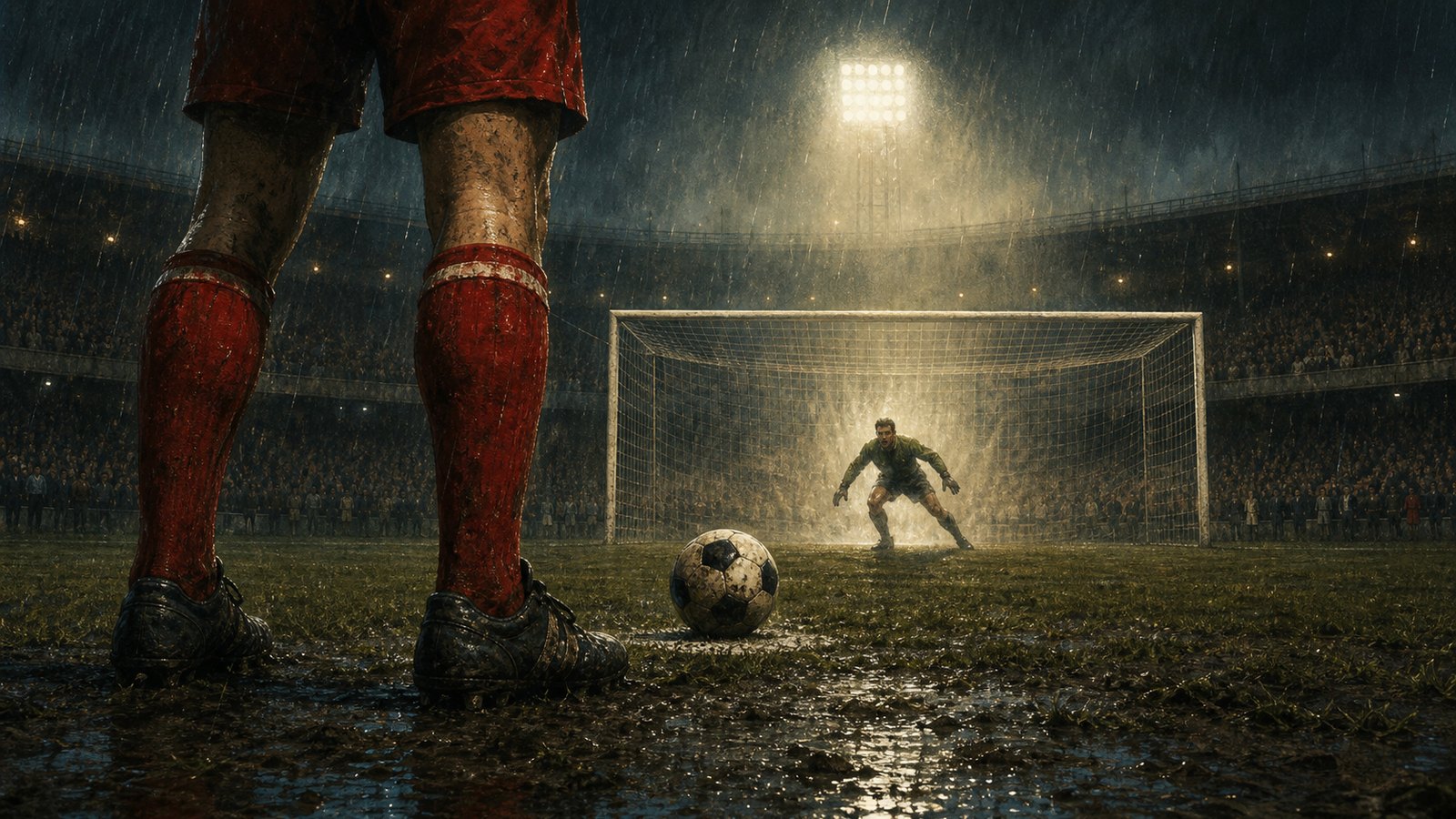
Panenka clipped the ball down that middle space. The official shootout score became 5–3. Czechoslovakia had its only European Championship title, while a technique acquired its inventor’s name in the same instant. The visual contrast made it unforgettable: maximum competitive pressure resolved by minimum visible force.
The risk was technical, not theatrical
Later retellings often frame the kick as courage bordering on madness. Panenka’s practice suggests a colder interpretation. He had identified a repeated behaviour, designed a counter, and tested it across progressively more serious settings. The final made the stakes extraordinary, but the decision itself came from accumulated evidence.
The technique still carries a special failure mode. A forceful penalty can be saved despite good contact. A chipped central ball can be caught by a goalkeeper who waits, making the taker appear foolish as well as unsuccessful. Panenka himself recalled one later miss in a rain-soaked friendly when the goalkeeper remained in the middle. The method works only when the behavioural read is right.
That is also why copying the surface is not enough. The famous ball flight is the final fraction of the action. The run-up, the taker’s posture, the goalkeeper’s expectations and the match context determine whether the centre will be empty. Remove the convincing threat of power and the chip becomes an invitation rather than a trap.
A surname became an instruction
Players across later generations repeated the idea on major stages. Zinedine Zidane used it in the 2006 World Cup final, his shot striking the crossbar before crossing the line. Andrea Pirlo used it against England in the Euro 2012 shootout. The list also contains failures, which preserve the technique’s tension: everyone knows what a Panenka is, yet the goalkeeper must still decide whether this is the moment it will appear.
Panenka’s broader career included 59 Czechoslovakia appearances and 17 goals, according to the BBC’s profile. He was a creative midfielder rather than a specialist built around one kick. Yet the invention overwhelmed the rest of his public identity. His surname became both a noun and an instruction understood far beyond the team and political system in which he developed it.
That linguistic afterlife reveals the scale of the idea. Football already had chipped shots, disguised passes and goalkeepers gambling on direction. Panenka combined those familiar parts inside the penalty’s strict geometry. Twelve yards, one stationary ball and one committed opponent were enough to produce a new option that future goalkeepers could never completely forget.
Belgrade did not prove that the centre is always the best target. It proved that anticipation has a cost. Every goalkeeper leaning toward the corners creates a possibility behind his own decision. Panenka saw it during small post-training bets, refined it for two years, and trusted it when one soft touch could decide a continent’s championship.
Sources
RSSSF, European Championship 1976 — Final Tournament Full Details
BBC Sport, Panenka — the penalty that killed a career and started a feud
Radio Prague International, Fifty years ago, the “Panenka” was born
The Guardian, “That penalty changed my life”: Panenka’s pride 50 years on
UEFA, How the Panenka got its name