
River Plate’s La Máquina Was Not a Nickname. It Was a Warning About Motion.
La Máquina is one of those football names that survives because it sounds too perfect to need explanation. The Machine. River Plate. 1940s Buenos Aires. A forward line remembered with a kind of smoky glamour: Juan Carlos Muñoz, José Manuel Moreno, Adolfo Pedernera, Ángel Labruna, and Félix Loustau. But the nickname matters only if it is treated as more than decoration. It was not just a compliment for scoring goals. It was a warning about movement, timing, and the danger of defenders trying to mark positions that had already disappeared.
The simple version says River had great attackers, so River scored beautiful goals. The better version is that the attack made greatness harder to defend because the players did not behave like fixed pegs on a board. Pedernera could drop, Moreno could appear where a midfielder expected safety, Labruna could arrive as the final knife, and Loustau’s width could stretch the whole picture. In an era when formations were often described more rigidly than they were played, La Máquina turned fluidity into identity.
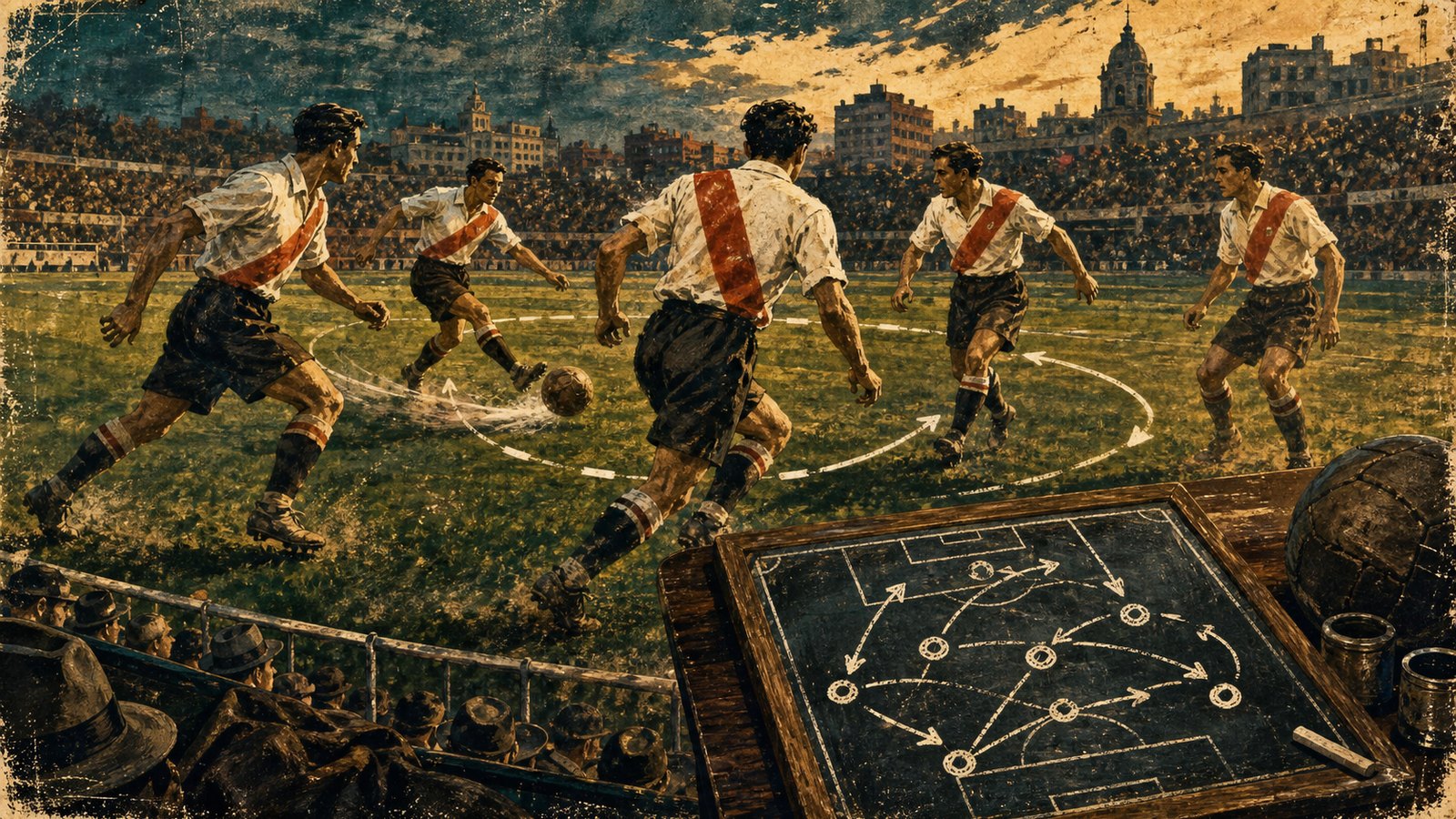
A Forward Line That Refused to Stand Still
The power of La Máquina was not that every move was improvised. It was that the improvisation had shared grammar. River’s attackers understood each other’s habits well enough to rotate without dissolving into chaos. If one man left the expected lane, another could occupy the consequence. The result was not five soloists taking turns. It was a forward line that could seem to breathe together, pulling defenders into choices that became wrong a second later.
That is why the nickname stuck. Machines are usually imagined as cold, but this machine was rhythmic. The passes were short enough to invite pressure and quick enough to punish it. A defender stepping toward the ball could open a channel behind him. A half-back following a dropping forward could leave the penalty area exposed. The drama was not only in the goal. It was in the sequence that made the goal feel inevitable after the opponent’s shape had been teased apart.
Buenos Aires Made the Myth Louder
River’s 1940s side was also a cultural object. Buenos Aires football already had its own debates about elegance, street craft, and superiority. A team that moved with such swagger naturally became more than a results machine. It became proof of a style people wanted to believe in: clever, technical, collective, and theatrical enough to turn a league match into a performance. The old Monumental setting helped the legend, but the legend lasted because it had a tactical core.
The names mattered. Moreno’s charisma, Pedernera’s intelligence, Labruna’s finishing record, Loustau’s wing play, and Muñoz’s balance gave supporters figures to remember. Yet the line is strongest as a unit. Remove the relationships and the myth becomes a list. Keep the relationships and the nickname makes sense. La Máquina was the sound of a crowd realizing the ball was not simply being passed; it was being carried through a moving pattern that defenders could feel but not hold.
Why It Still Sounds Modern
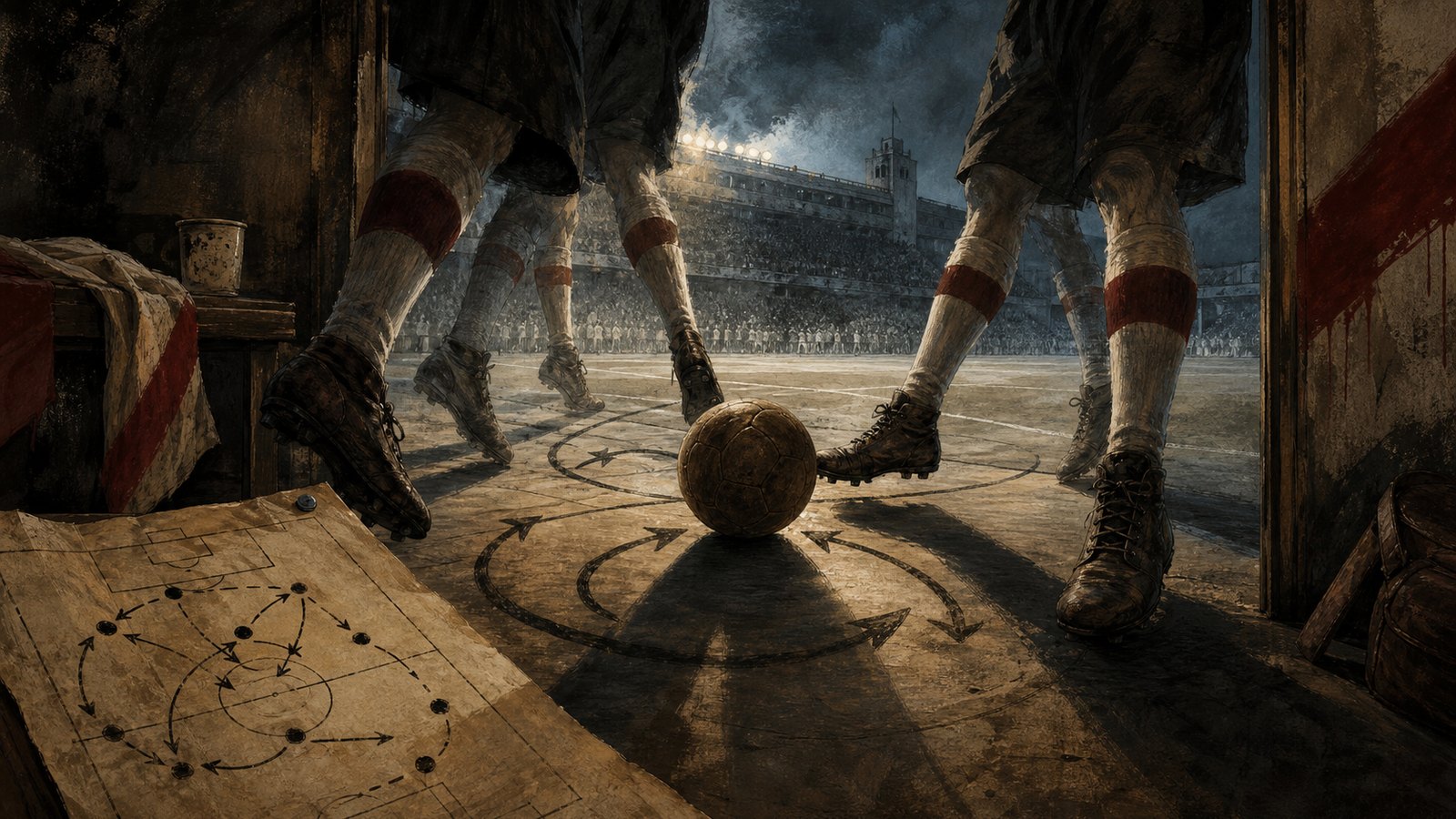
Modern football is full of language that would make La Máquina easier to describe: rotations, third-man runs, positional interchanges, overloads, occupation of zones. River’s team did not need that language to practice the behavior. The lesson is not that the 1940s were secretly the same as today’s game. The pitches, pressing, fitness, and defensive structures were different. The lesson is that football’s tactical future often appears first as a feeling before it becomes a diagram.
Supporters and writers could sense that something unusual was happening even if the vocabulary was different. The forwards were creating advantages by refusing to let their shirt numbers define them. When that works, it makes a defense look slow in thought before it looks slow in legs. The opponent is not just beaten by a faster pass. He is beaten by the realization that the player he was supposed to track has become someone else’s problem, and that problem has already become a shot.
The Machine Was Human
There is a danger in making La Máquina sound too perfect. No team glides through history without rough matches, selection changes, and the normal mess of competitive football. The famous forward line did not start every match forever as a preserved museum piece. Football memory simplifies. But simplification is not always false. Sometimes it protects the thing people correctly understood: that River had built an attacking idea so distinctive that it became a reference point for generations.
That is the real legacy. La Máquina was not simply a golden-age nickname from Argentina. It was an early reminder that the most frightening attacking teams do not only collect talent; they teach talent to move in relation to other talent. The machine was human, emotional, and technical, but it was still a machine in the most dangerous football sense. Once it started moving, the defender was already late.
The Risk Behind the Romance
The romantic memory can hide the risk. A fluid forward line only looks effortless when the relationships are right. If one player drops and nobody attacks the emptied space, the movement becomes decorative. If too many players come toward the ball, the opponent can compress the same area and turn elegance into congestion. La Máquina worked because its rotations still carried threat. The motion was not a parade of touches. It kept asking whether the defender wanted to follow, hold, or pass responsibility to a teammate who was already late.
That is why the side belongs in tactical history rather than only in club mythology. River showed that attacking positions could be reference points instead of cages. The centre-forward did not have to spend the whole afternoon as a fixed target. The inside forward did not have to stay in one channel. The winger’s width could be both a starting point and a weapon saved for the moment the defense had narrowed. Those ideas now sound familiar because modern football has built entire systems around them.
The difference is that River’s machine lived before video libraries and analyst departments could turn every pattern into a clip. Its lessons travelled through memory, reports, coaching conversations, and the awe of people who saw it. That makes the myth hazier, but not weaker. Some teams leave behind statistics; others leave behind a phrase that becomes tactical shorthand. La Máquina did both because its football gave the phrase a body.
The name also survived because the players gave supporters repeatable images. A forward arriving late. A pass slipped before the tackle. A winger stretching the pitch just long enough for the middle to open. These details are small, but they are how a team becomes an argument. River did not merely win admirers; it made people think differently about what an attack could be.
That influence should not be overstated as a neat family tree. Football ideas rarely travel in straight lines. They echo, disappear, and return under new names. La Máquina’s echo is the conviction that movement can be a team’s primary weapon. Before the opponent can measure the danger, the danger has changed shape.
Sources
- River Plate historical records
- Jonathan Wilson, Angels With Dirty Faces
- RSSSF Argentina championship records
- CONMEBOL historical features
- Contemporary Argentine football histories