
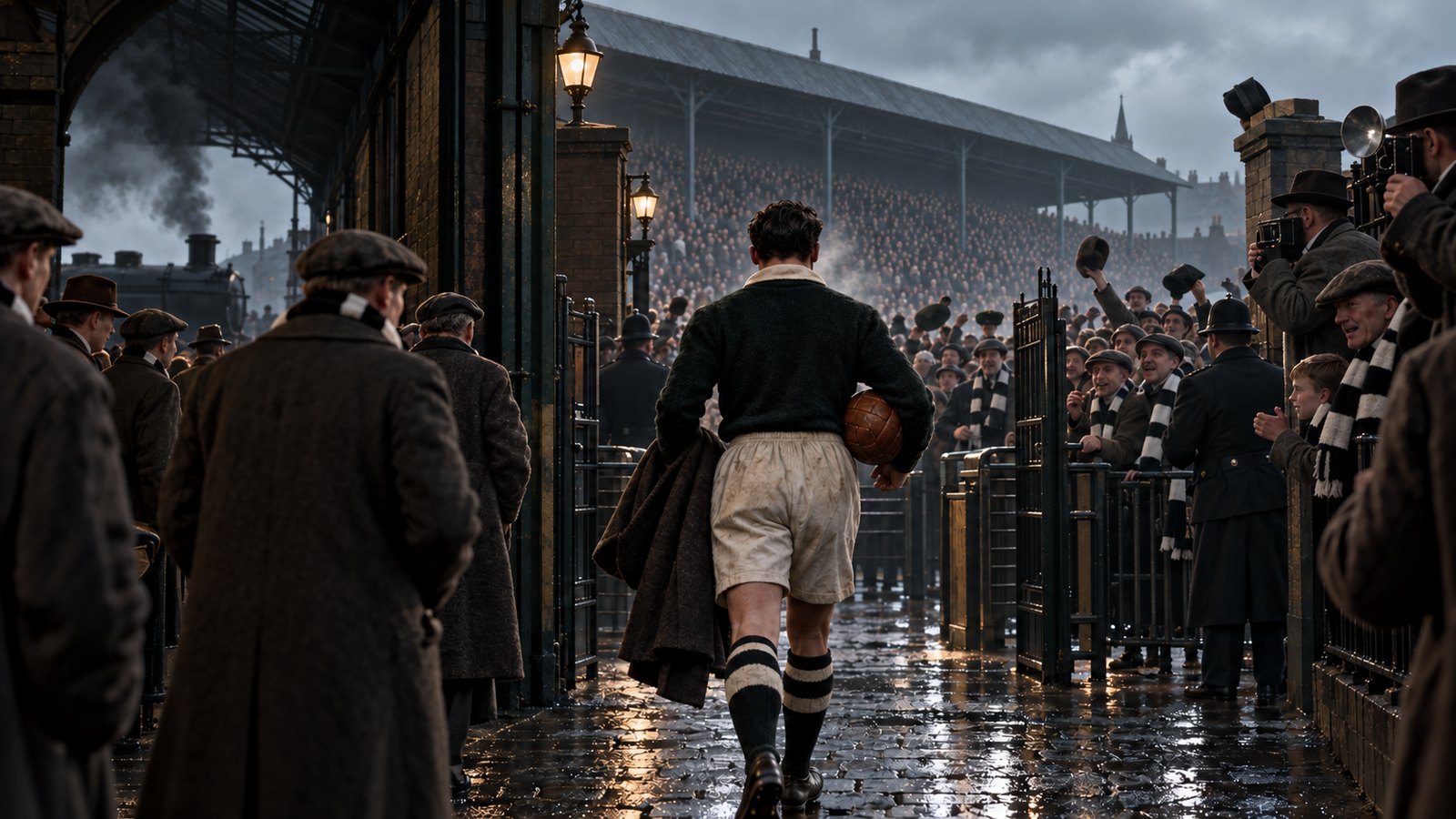
On 13 November 1947, England’s centre-forward moved from Chelsea to Notts County for £20,000. The fee set a British record. The destination supplied the shock: County were playing in the Third Division South, two levels below the First Division football Tommy Lawton had just left.
Lawton was 28, had scored in each of his first six England appearances and had broken Chelsea’s league scoring record with 26 goals in 1946–47. A record transfer would normally carry a star toward a richer stage. This one took him to Meadow Lane because status was only one part of the bargain. A personal promise, the maximum wage and Lawton’s strained relationship with Chelsea made a third-tier club a credible choice.
A Transfer List With One Impossible Choice
Lawton had already built a career dense with disruption. He became a professional at Burnley at 17, joined Everton for £6,500 and led the First Division scoring chart in both 1937–38 and 1938–39. Everton won the league in the second of those seasons. Then the Second World War removed six full seasons from the official league record just as he entered his early twenties.
He still played wartime football and served in the Army Physical Training Corps, but those matches could not restore the uninterrupted club career he might have had. When normal competition resumed, his relationship with Everton had frayed. Chelsea signed him in November 1945, and his one complete league campaign at Stamford Bridge produced 26 goals in 34 matches.
The output did not settle the relationship. England Football Online records that Lawton declined a Chelsea tour of Scandinavia because of mental and physical fatigue. A transfer request followed. The Independent’s obituary describes the race for his signature as hectic, which is what one would expect when the established England number nine became available at 28.
Yet the decisive choice was not a leading First Division club. Notts County’s league position made the move look like a sporting demotion, while the £20,000 valuation made it the most expensive transfer Britain had seen. Those two facts belonged to the same transaction. County were buying a footballer and the right to become nationally interesting overnight.

The Handshake Behind the £20,000 Deal
The personal connection ran through Arthur Stollery, often rendered Strollery in contemporary retellings. He had worked as a masseur at Chelsea and became a confidant during Lawton’s difficult period there. England Football Online’s biographical account says Lawton promised that he would sign for him if the opportunity arose. Once Stollery was in charge at Notts County, the old handshake acquired practical force.
The final deal was reported as £17,000 plus Bill Dickson, valued together at £20,000. That detail matters because the record was not simply a pile of banknotes handed across a boardroom table. It was a negotiated exchange in a tightly controlled labour market, built from cash, a player and a relationship that had begun inside another club.
The maximum wage changed Lawton’s calculation. The Independent noted that dropping divisions did not require the financial sacrifice a modern elite player would face. A First Division star could not negotiate an open-market salary that reflected the crowds he drew. Lawton could therefore compare trust, location and sporting authority without surrendering an enormous top-flight wage.
That did not make the decision safe. International selectors could treat third-tier football as weaker evidence, and the standard of weekly opposition would change. Lawton was exchanging the visibility of Chelsea for a project whose credibility depended heavily on him. The move resembles John Obi Mikel’s disputed route between Manchester United and Chelsea only in one useful respect: the announced destination never tells the whole story of who possessed leverage and why.
Meadow Lane Became a National Attraction
Lawton’s arrival altered the scale of Notts County’s matches. He was not merely a famous name approaching retirement. He remained England’s centre-forward, a powerful striker whose heading had become the defining physical image of his game. Opponents in the Third Division South now had to prepare for a player who had scored 22 times in 23 official England appearances.
His style made the attraction easy to understand from the terraces. The Independent described a six-foot forward who combined strength with quick movement and exceptional timing in the air. Long before slow-motion replays could isolate a leap, spectators could read the contest directly: cross, jump, forehead, goal. Lawton gave a lower-division crowd an elite action it could recognise in a second.
He also delivered over time. England Football Online credits him with 90 league goals in 151 appearances for County. In 1949–50, Notts County won the Third Division South championship and promotion. The move therefore produced more than attention at the gate. The expensive centre-forward became the attacking reference point of a side that escaped the division he had voluntarily entered.
The sequence is different from a benefactor briefly attaching glamour to a small club. County had to turn the celebrity purchase into points across several seasons. Lawton had to keep treating third-tier fixtures as serious work after the novelty of his signature faded. The championship supplied the proof that both sides had obtained sporting value from an arrangement many observers initially regarded as eccentric.

Promotion Cost Him His England Place
The transaction also imposed a real price. Lawton’s final official England appearance came against Denmark in September 1948, less than a year after the transfer. He was still only 28. His international record stopped at 23 caps and 22 goals, numbers compressed by war and then by the selectors’ reluctance to rely on a player outside the top divisions.
The Independent obituary says many supporters believed he was doing himself an injustice. That reaction captures the old hierarchy of evidence. International selection depended not only on ability but on where that ability was tested each week. By choosing County, Lawton had made his club football more personally coherent and his national case harder to sustain.
There were other forwards arriving, including Jackie Milburn and Nat Lofthouse, and England did not need to build its attack around a third-tier exception. Lawton’s goals at Meadow Lane could lift County toward promotion without reopening the international door. Success in one institution did not cancel the status rules of another.
That tension distinguishes the story from the familiar record-transfer arc. A record fee usually confirms that a player has reached the centre of the sport. Lawton’s fee measured how badly a club outside that centre wanted to move closer. The price went up while his international visibility went down.

What the Record Fee Actually Bought
Notts County bought 90 league goals, a promotion and national attention. Lawton received a club choice shaped by trust rather than league rank alone. Stollery’s departure later weakened the relationship, and County eventually sold the striker to Brentford in 1952. The partnership had limits, but it lasted long enough to change the division and both men’s reputations.
Lawton’s career then moved through Brentford, Arsenal and Kettering Town. His late arrival at Arsenal finally supplied the prestigious destination that conventional logic might have predicted in 1947, although he was nearly 34 by then. The archived Arsenal profile and his wider record show how much of his path had been diverted by war, employment rules and choices that did not maximise divisional status.
The £20,000 record belongs beside the world-record move that later took Luis Suárez from Barcelona to Inter, but it reveals an earlier transfer economy. Suárez’s fee helped shift an elite player between elite projects. Lawton’s fee allowed a third-tier club to purchase elite attention while the maximum wage kept personal salary from rising in step with market value.
That imbalance is the mechanism hidden inside the headline number. Clubs could place record prices on registration while the player’s weekly wage remained capped. Lawton used the leverage still available to him: he requested a move, chose the relationship he trusted and accepted the sporting consequences of that choice.
In November 1947, Britain’s most expensive footballer did not climb the pyramid. He crossed it. The move worked because Notts County understood that one centre-forward could alter gates, expectations and results, while Lawton understood that the highest division did not own every form of ambition.
Sources
England Football Online, Tommy Lawton biography and international record; Ivan Ponting, The Independent, “Obituary: Tommy Lawton”; RSSSF, English League leading goalscorers; Arsenal historical player profile preserved by the Internet Archive.