
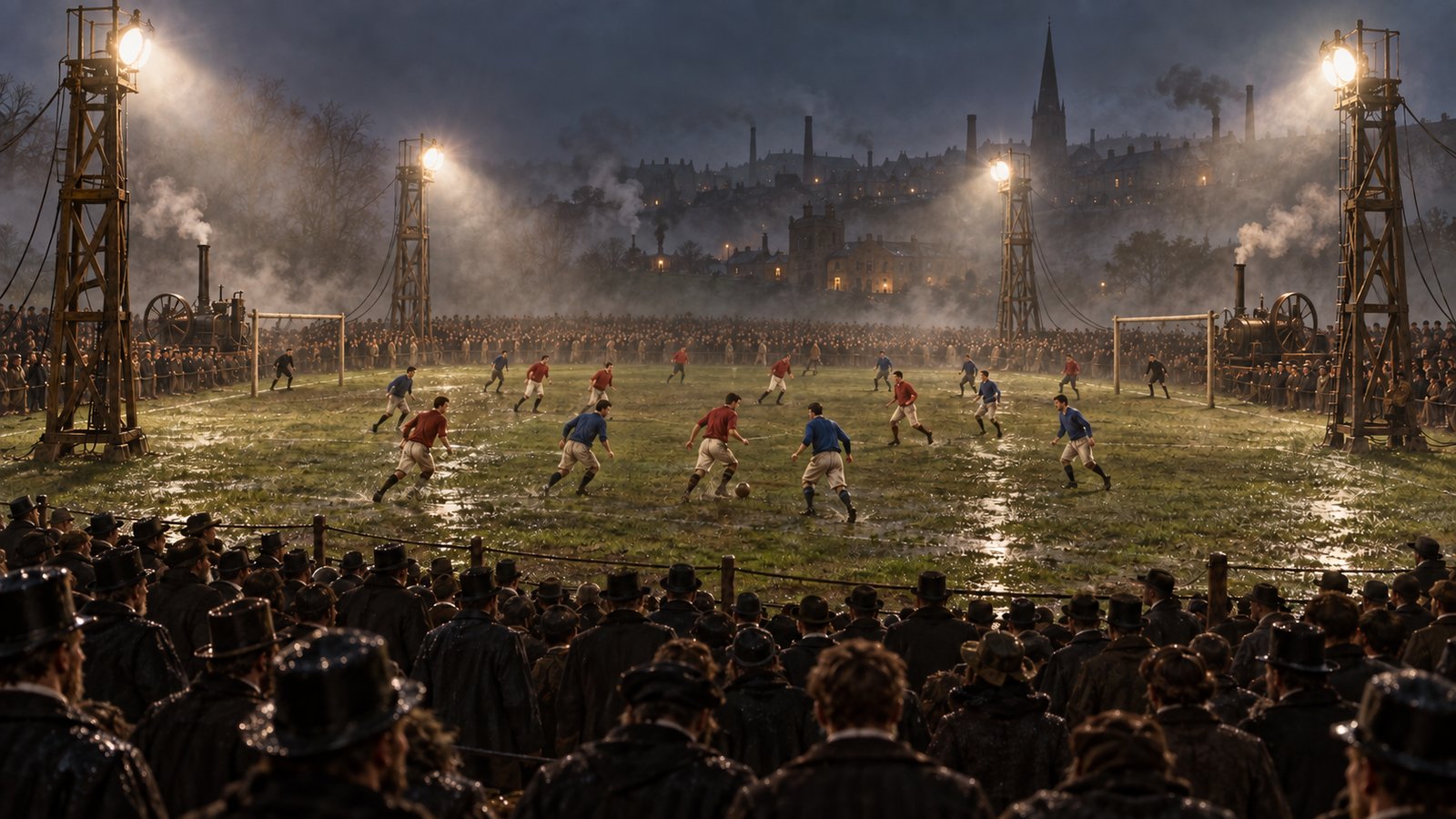
At Bramall Lane on 14 October 1878, the football was only half the attraction. Four electric lamps burned above the ground on wooden stages, portable engines worked behind the goals, and the roads outside filled with people who wanted to see whether night itself could be made playable.
The experiment arrived before the Football League and before the electric light bulb became an ordinary domestic object. It also exposed a problem that every later floodlit match would have to solve: making a pitch visible is not the same as making the ball easy to judge. Sheffield’s players entered a spectacle in which the apparatus changed the game as surely as the darkness did.
Sixpence Bought a Look at the Future
The exhibition was advertised as Blues against Reds rather than as a league fixture between established clubs. Its real contest was between electric light and an autumn evening. Gas-lit athletic displays were familiar enough, but electricity still carried the excitement of a public demonstration. A football ground offered something a laboratory could not: a large space, a moving ball and thousands of witnesses able to judge the result at once.
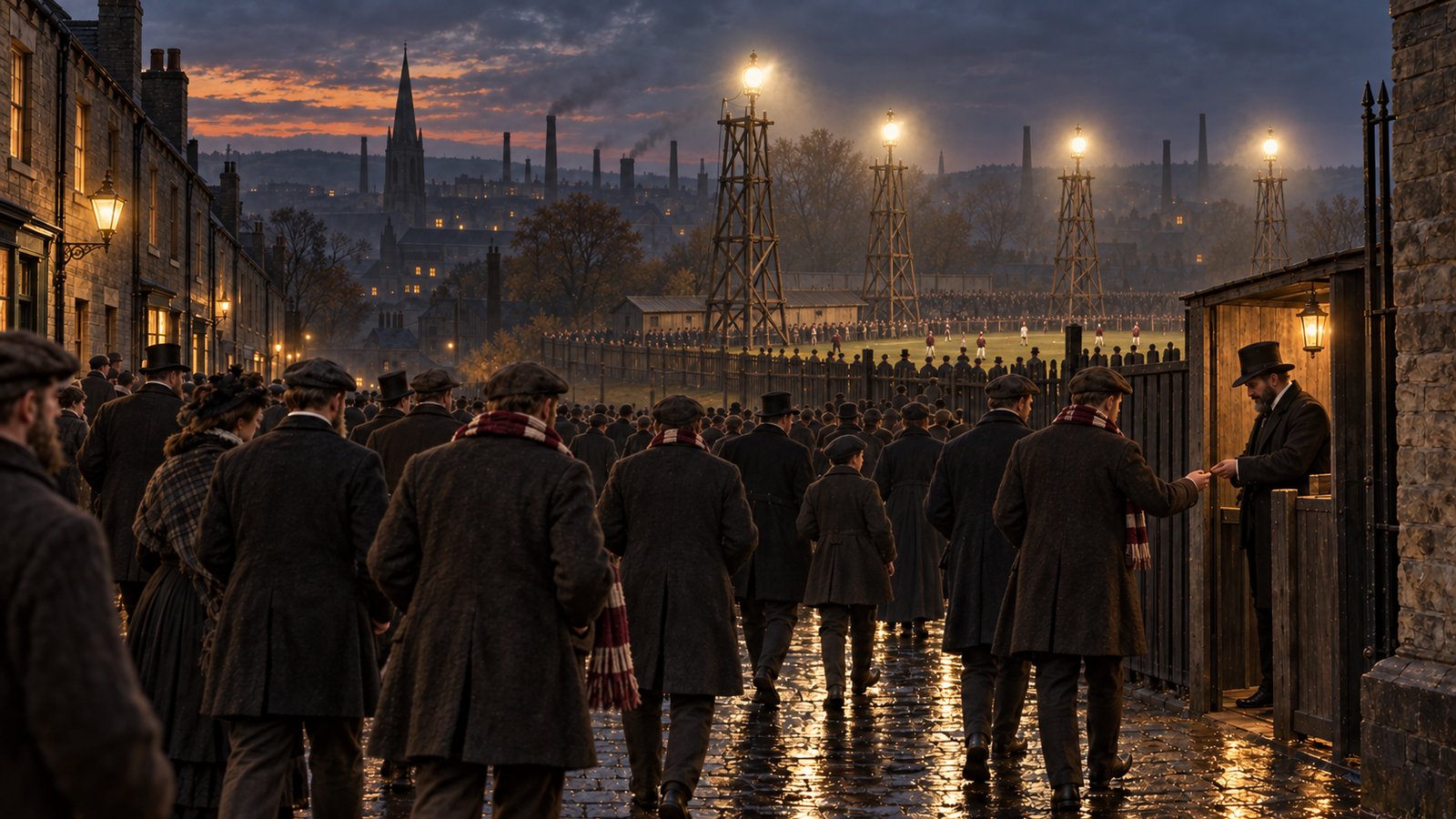
According to the Sheffield and Rotherham Independent account later quoted by MoneyWeek, 12,000 people paid sixpence to enter. The same report estimated that roughly as many again found their way inside under cover of darkness without paying. Even if the second figure was necessarily imprecise, it captures the scale of the curiosity. This was not a technical test conducted before a few officials. It became one of Sheffield’s biggest public shows.
The approach roads were “completely besieged,” the newspaper reported, with an apparently endless stream heading toward Bramall Lane. The crowd had no settled vocabulary for floodlit football because the event itself was helping to create it. Spectators were buying admission to a match, yet they were also paying to inspect a new relationship between sport, machinery and time.
Bramall Lane made the demonstration unusually legible. The ground already gathered a football audience in one bounded space. Once darkness fell, the pitch became a canvas for the lamps. Every bright patch and every shadow could be compared against the movements of the players below.
Four Wooden Stages Carried 8,000 Candlepower
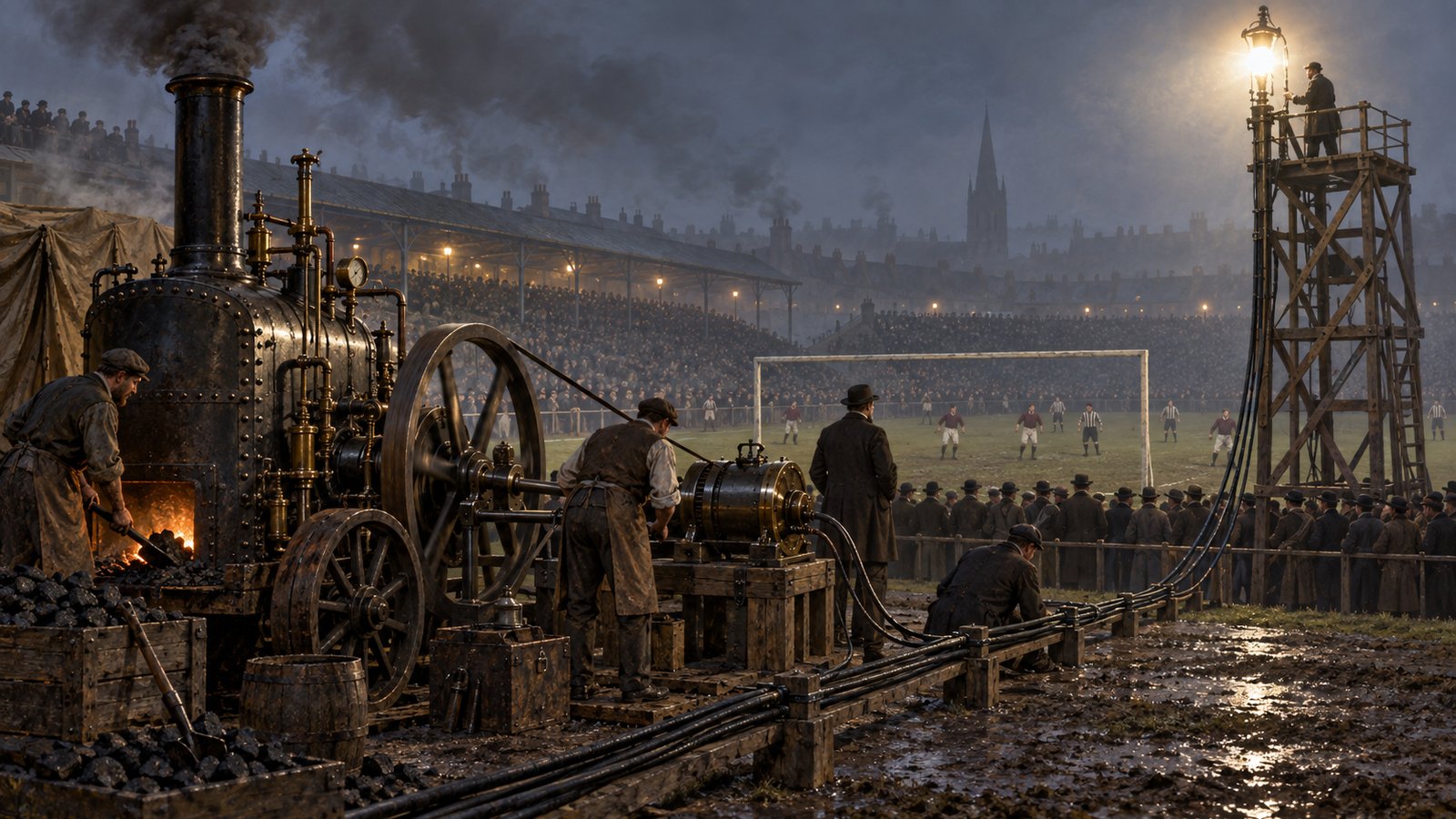
The lighting arrangement was conspicuous rather than hidden in a modern roof. Four lamps stood on wooden stages about 30 feet high. Behind each goal, a portable engine supplied power. Together the lights were described as producing 8,000 candlepower, a unit that made the unfamiliar technology understandable by comparing it with the familiar flame.
Those details reveal the event’s physical effort. Electric light did not arrive by touching a switch connected to a national grid. Engines had to be brought to the ground, the elevated stages had to be built, and power had to be generated where it was used. The night match depended on temporary industrial architecture assembled around a football pitch.
The arrangement also had to illuminate a far larger and more irregular field than a theatre stage. Players crossed the beams at speed. The ball rose above head height, dropped toward the turf and passed through zones of unequal brightness. A lamp could appear brilliant to a spectator while still leaving a footballer with a difficult change of contrast.
The surviving newspaper record matters because it preserves both sides of the experiment. The Independent called the light “most brilliant and effective.” That judgment describes the achievement visible from the stands: electric equipment had turned a dark ground into a venue where a large crowd could follow play. It does not mean every movement became natural.
The Light Dazzled the Players
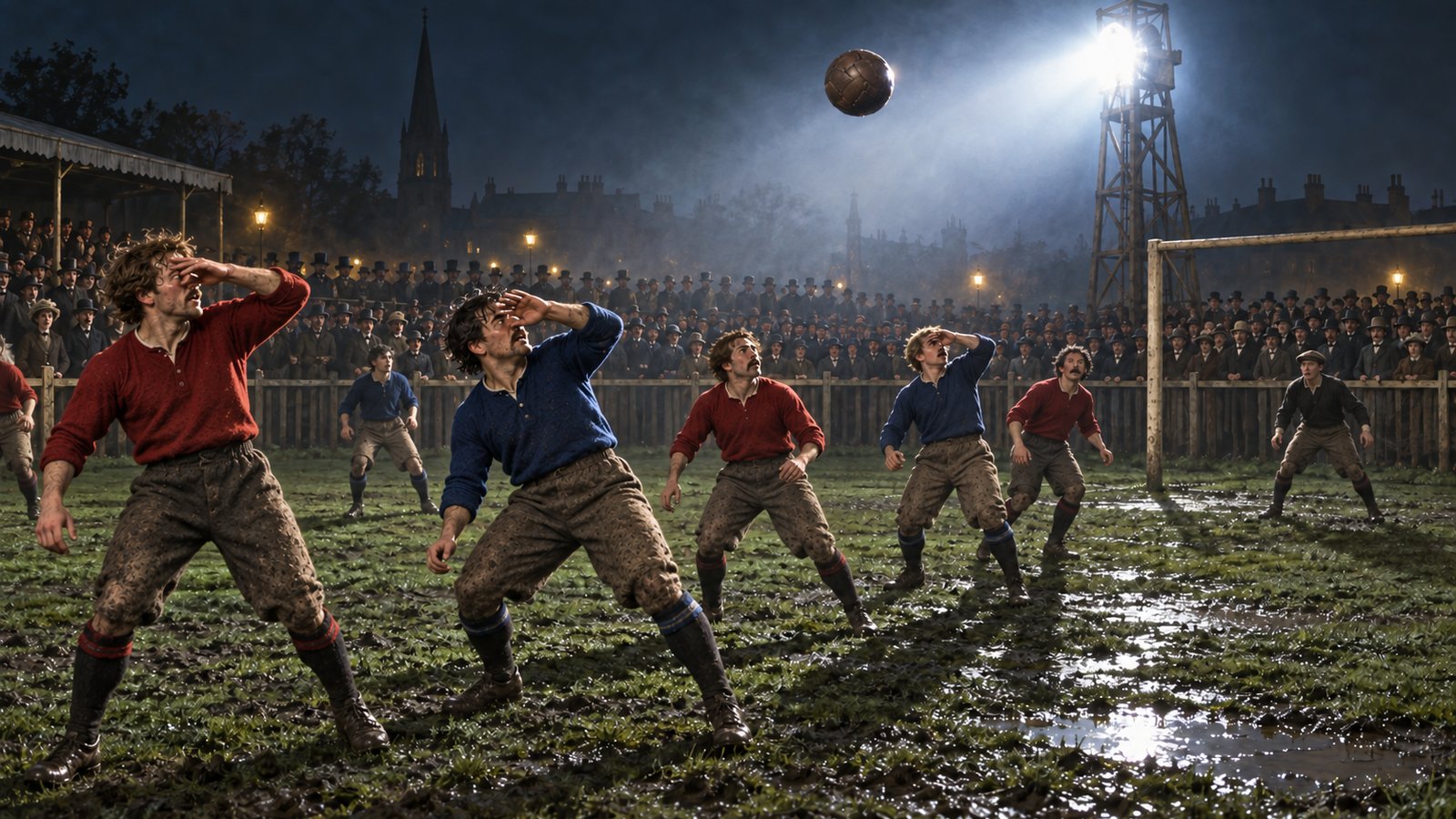
The Times noticed the complication. Its report said the brilliance dazzled the players and sometimes produced strange blunders. The phrase cuts through any easy story of invention followed immediately by perfection. More light could solve one problem while creating another. A player looking across the ground might see the ball, then lose it against a lamp or misread its flight after moving from shadow into glare.
Football makes that weakness especially visible. A runner can adjust to the patch of ground directly ahead, but a footballer must track several depths at once: the turf, opponents, teammates and a ball that can travel high through the air. The 1878 apparatus illuminated the area without providing the even distribution expected from later stadium systems.
The mistakes were therefore evidence, not merely comedy. They showed engineers and promoters what a successful night match required. Brightness had to be spread, glare controlled and shadows reduced. The technology had passed the test of spectacle before it passed the test of competitive normality.
That distinction still shapes how football remembers difficult visibility. The mechanisms differ, but the question is familiar from Ajax’s 1966 European Cup victory over Liverpool in dense fog: what does a match become when players and spectators do not receive the same visual information? At Bramall Lane, the obstacle was not too little technology but technology whose effects were still being learned.
Night Football Had to Wait for More Than a Good Review
The favourable public response did not instantly create a floodlit calendar. The demonstration proved that electric light could command attention and make evening football imaginable. It did not supply clubs with cheap permanent equipment, a reliable grid or competition rules ready to treat night fixtures as ordinary.
That gap between exhibition and routine is the central mechanism of the story. Innovations in football often arrive first as special events. They gather a crowd because they are unusual, then disappear while infrastructure, regulation and cost catch up. Only later do they become so normal that supporters stop noticing the machinery behind them.
The 1878 date places the experiment ten years before the Football League began in 1888. Organised league football had not yet built the weekly system that floodlights would eventually extend. The lamps were offering extra usable hours before the sport possessed the national competition structure that could make systematic use of those hours.
Even the crowd’s unpaid entries reveal a practical limit. Darkness made the show possible, but it also made control around the ground harder. The same condition that increased the value of the lamps helped people evade the gate. Electricity could reshape the product on the pitch while creating new work at the perimeter.
Later floodlights would change training, winter scheduling, broadcast presentation and the emotional grammar of European nights. Bramall Lane’s experiment did not achieve all of that in one evening. Its importance lies in separating possibility from adoption. Sheffield showed that football could be staged after daylight; the sport still had to build the systems that made doing so repeatable.
The Spectacle Became Invisible Infrastructure
Modern supporters usually experience floodlights as part of the ground rather than as the reason to attend. They notice a failure, a dramatic beam in rain or the sudden darkening of a stadium, but not the ordinary act of illumination. That invisibility is a mark of technological success. An apparatus once displayed on 30-foot wooden stages became an assumed condition of the game.
The 1878 crowd stood at the opposite point in that process. They arrived because the equipment was visible, temporary and uncertain. Portable engines, elevated lamps and glare were not background services. They were characters in the evening’s drama, capable of delighting the stands and confusing the players in the same moment.
That makes the match more than a trivia answer about the first floodlit fixture. It was a negotiation over who football’s night belonged to. Promoters saw extra hours and a paying audience. Spectators saw a technological marvel. Players discovered the difference between a bright field and a readable one.
Football would repeatedly absorb inventions in this way: novelty first, friction second, normality last. The Christmas Truce kickabouts of 1914 show the game emerging in a place where no formal fixture had been planned. Bramall Lane shows the opposite movement, with machinery and promotion deliberately stretching the place and time in which a fixture could exist.
On 14 October 1878, the lamps did not simply reveal a pitch. They revealed a future business model and a new sensory form of football, while their hard glare exposed how unfinished that future remained. The crowd had come to watch electricity perform. The players made sure everyone could see that the experiment was real.
Sources
Sheffield and Rotherham Independent contemporary report; The Times contemporary match report; MoneyWeek, “14 October 1878: the first football match played under floodlights”; London Hearts newspaper archive; Sheffield United, Bramall Lane venue history.