
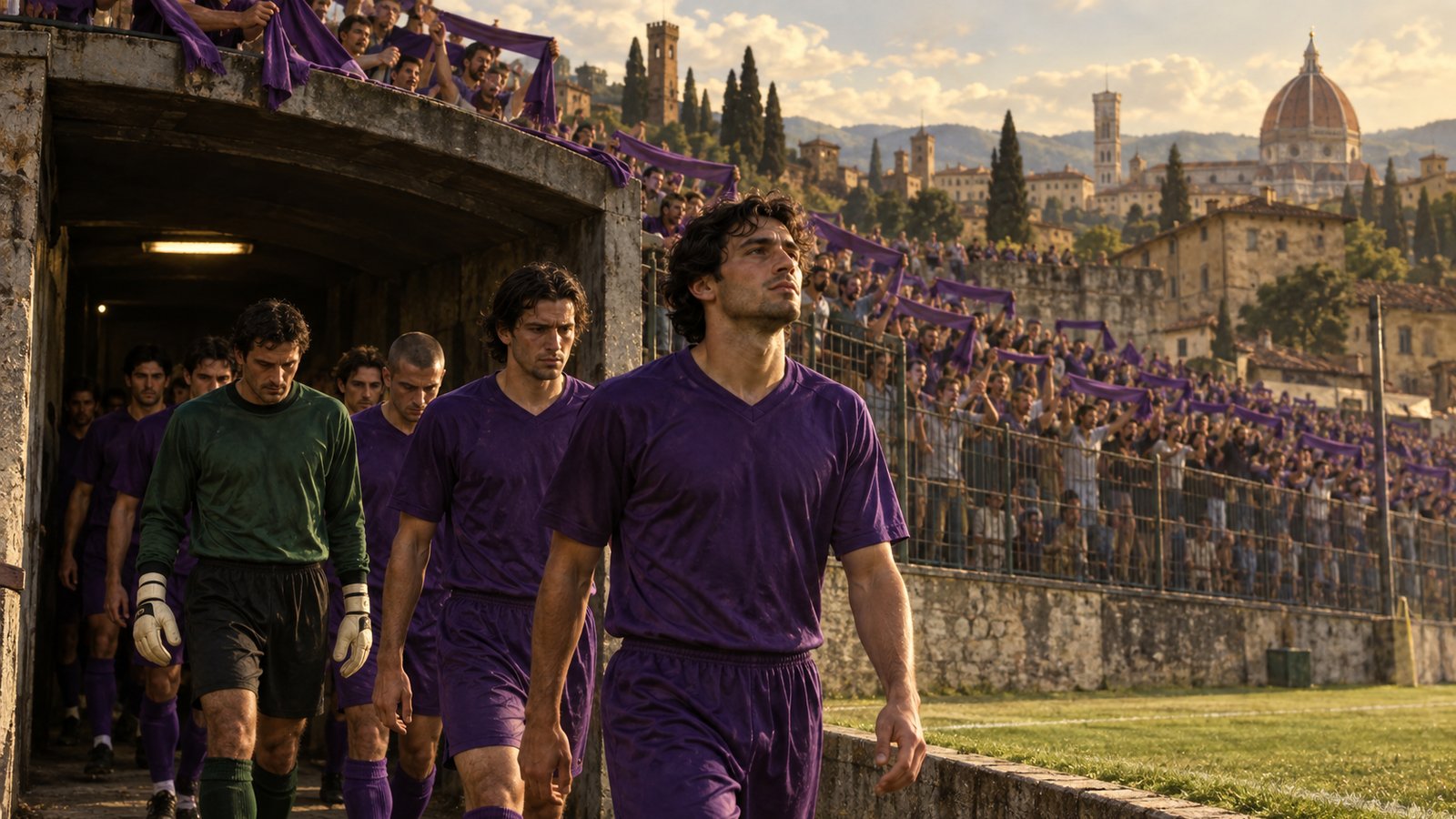
The name Fiorentina was missing, the famous purple shirt was no longer legally theirs, and Italy’s second division had shut the door. In August 2002, Florence’s replacement club entered Serie C2 carrying almost none of the old squad. It had a new company, a temporary name and four divisions between itself and the stage its supporters remembered.
Less than two years later, Fiorentina were back in Serie A. The speed makes the journey look smooth in retrospect. It was anything but: one loyal veteran, a 30-goal striker, a league reorganisation and a two-leg playoff all had to connect before the city could claim its old place again.
The Purple Shirt Outlived the Company
Fiorentina entered the new century with recent memories of Gabriel Batistuta, Rui Costa and Champions League nights. The club had beaten Arsenal at Wembley and Manchester United in Florence in 1999–2000, then lifted the Coppa Italia the following season. Those results hid a balance sheet that could no longer support them.
By 2001, the financial position had become public and severe. Wages could not be met, while debts were reported at roughly $50 million. Batistuta had already left for Roma. Other valuable players followed as owner Vittorio Cecchi Gori tried to raise money. The sales reduced the sporting strength without solving the underlying crisis.
Relegation arrived at the end of 2001–02. In June, the club entered judicially controlled administration. It was then refused a place in Serie B for the following season. This was more than the ordinary punishment of dropping one division: the old company could no longer carry Fiorentina into the competition at all.
That distinction matters because a football club is several things at once. It is a company registered to compete, a squad under contract, a name and shirt held as commercial rights, a stadium routine and a body of supporters. In Florence, those pieces separated. The company failed, but the public attachment to the purple club did not disappear with it.
Serie B Closed Its Door, So Florence Built a New Entry
In August 2002, shoe and leather entrepreneur Diego Della Valle backed a new entity. It could not initially enter under the old club’s familiar identity. The replacement was called Florentia Viola and was admitted to Serie C2, then the fourth tier of Italian football.
The temporary name captured the awkward legal reality. “Viola” preserved the colour in speech, yet this was not simply the same registered club continuing one rung lower. The rights to the Fiorentina name and shirt design still had to be recovered. Supporters were asked to follow a team whose connection to their history was emotionally obvious but institutionally unfinished.
The venue made that mismatch visible. Home dates still drew the rituals of a major football city, but the fixture list now carried the names of fourth-tier opponents. The stands could preserve scale and memory; registration determined which competition appeared on the ticket. Every weekend placed inherited expectation beside the limited status of the new company.
The sporting reset was just as stark. Angelo Di Livio was the only player from the former squad to remain. He had played for Italy, Juventus and Fiorentina in Serie A and the Champions League; now he was preparing for fourth-tier grounds. His presence supplied a living bridge that paperwork could not. When supporters looked at the new team, at least one footballer had crossed the rupture with them.
Other collapsed clubs have faced the same argument between legal identity and lived continuity. Rushden & Diamonds lost four divisions after their 2011 crisis, while Bury’s expulsion unfolded through deadlines and ownership evidence. Florence’s version was unusual because the descent and reconstruction were compressed into a frantic two-season climb.
Thirty Goals Made a Temporary Name Feel Competitive
Serie C2 Group B did not care about Fiorentina’s European pedigree. Florentia Viola still had to win on small pitches against opponents for whom the visitors were the season’s largest attraction. The new club played 34 league matches and won 20 of them, drawing nine and losing five.
The decisive figure was Christian Riganò. He scored 30 league goals, more than half of the team’s total of 56. That output gave a hastily assembled side a repeatable route through matches that might otherwise have become emotional traps. Florence could bring a large following and a famous memory; Riganò supplied the goals needed to turn both into points.
The final table was convincing rather than theatrical. Florentia Viola collected 69 points, conceded 20 goals and finished five points ahead of Rimini. Di Livio represented continuity, but the campaign could not survive on symbolism alone. It required the ordinary discipline of a promotion season: recover from five defeats, protect narrow leads and keep scoring after the novelty of the new journey had worn off.
Winning the group would normally have delivered promotion to Serie C1. At that stage, the route back appeared long but legible: climb from the fourth level to the third, then attempt another promotion. Italian football’s administrative crisis rewrote the map before Florentia Viola could take that next step.

A 24-Team Serie B Removed One Whole Division
The 2003 Catania case triggered a reorganisation that expanded Serie B from 20 clubs to 24. Florentia Viola were admitted directly to the enlarged second tier for what was described as sporting merit. Serie C1 vanished from their itinerary.
The decision shortened the climb by a year, but it did not place Fiorentina back in Serie A by decree. It placed them in an enormous 46-match Serie B season. During the same off-season, the new company reacquired the right to use the Fiorentina name and familiar shirt design. ACF Fiorentina had returned on paper; the team still needed to earn the final promotion on the field.
Fiorentina finished sixth with 73 points. Under that season’s exceptional structure, sixth place led to a playoff against Perugia, who had finished 15th in Serie A. The contrast was sharp: Perugia were trying to preserve top-flight status, while Fiorentina had begun the previous campaign in the fourth tier under another name.
Enrico Fantini scored in a 1–0 first-leg victory at Perugia. The second leg in Florence ended 1–1, enough to complete a 2–1 aggregate win. The promotion depended on neither a runaway league title nor the club’s historical reputation. It came through two tense matches at the end of a season nearly one-third longer than the Serie C2 campaign before it.
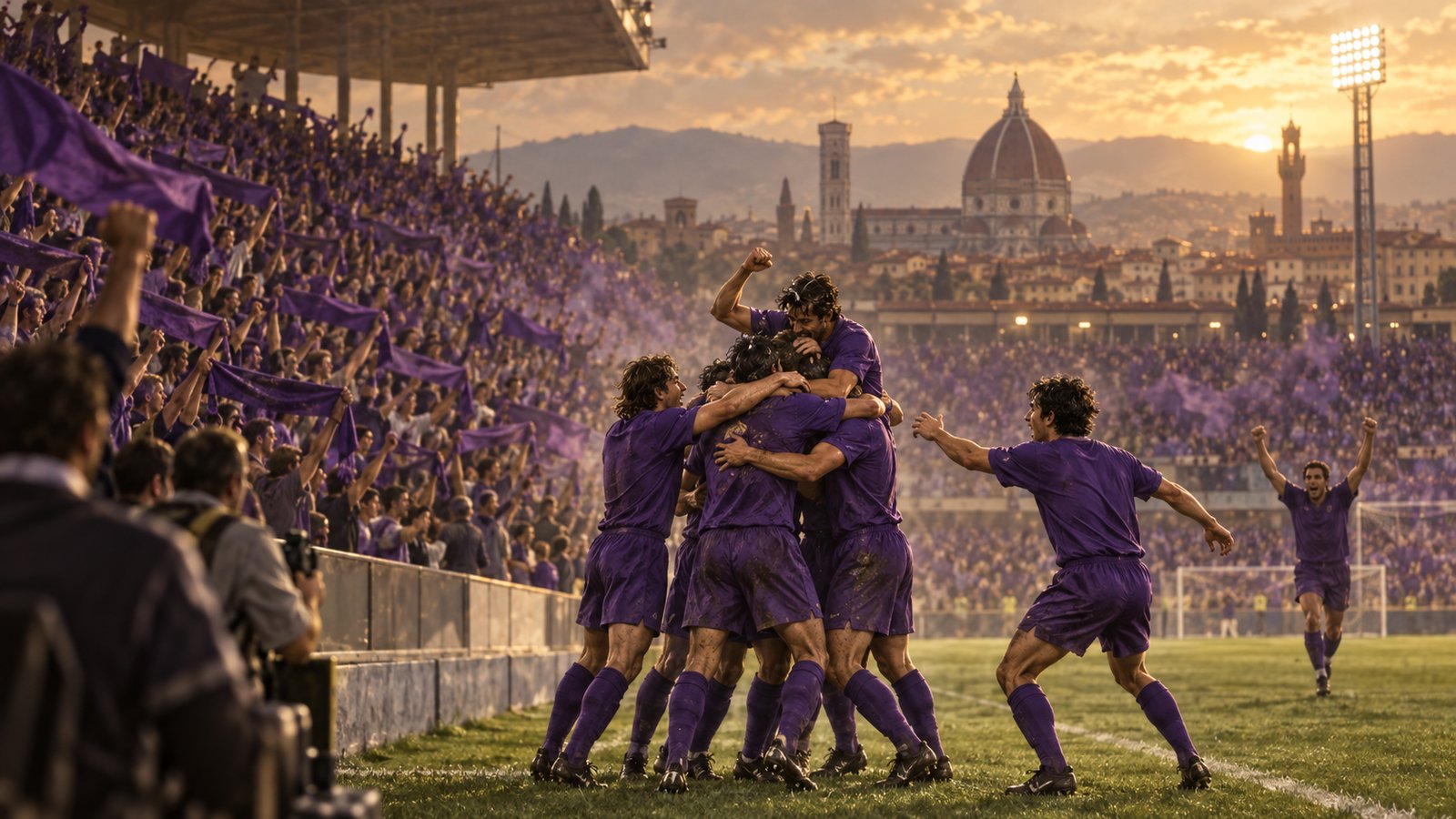
Two Years Changed What “The Same Club” Could Mean
By June 2004, Serie A football was returning to Florence less than two years after Florentia Viola had been created. The schedule encourages a neat resurrection story: bankruptcy, fourth tier, two promotions, home. Yet every stage tested a different part of the club’s identity.
The old company could not enter Serie B. The new one initially could not use the old name. Almost every player left. Di Livio stayed, Riganò supplied 30 goals, and supporters treated Florentia Viola as theirs before the legal branding caught up. Federation decisions then changed the ladder itself, lifting the team into a 24-club Serie B without erasing the need to beat Perugia.
Fiorentina’s official honours still list championships from 1955–56 and 1968–69, six Coppa Italia victories and the 1960–61 Cup Winners’ Cup. Those trophies belonged to the tradition that the failed company had carried. The rebuilt club did not manufacture a new audience or a new past in August 2002; it assembled enough legal, sporting and cultural pieces for the old story to continue.
The most revealing part of the return is therefore not its speed alone. It is the order in which continuity was rebuilt: supporters first, one veteran on the pitch, a winning team, the name and shirt, then top-flight status. Fiorentina came back because those layers converged. None of them, by itself, would have been the club.
Sources
ACF Fiorentina official honours archive; RSSSF Italian league tables for 2002–03 and 2003–04; ACF Fiorentina historical record.