

During the 1966 World Cup, England manager Alf Ramsey had to ask FIFA a basic question about his own players: had Bobby and Jack Charlton been cautioned? Newspaper reports said they had, but the referee had not shown anything that made the decision unmistakable to the stadium. A disciplinary act had occurred without becoming a public event.
Ken Aston kept thinking about that gap. While driving along Kensington High Street, he stopped at a traffic signal and saw a code already understood across languages: amber meant caution; red meant stop. Football did not need a longer speech from the referee. It needed color.
Yellow and red cards entered the World Cup in Mexico in 1970. They did not create the power to caution or dismiss a player. They made those decisions visible at the same instant to the player, the benches, the crowd and anyone watching on television. Aston’s insight was administrative, but it changed how conflict looked on a football pitch.
Santiago Taught Aston What Words Could Not Control
Aston was a schoolteacher before he became an international referee. Born in Colchester in 1915, he joined Newbury Park School in Essex in 1935 and began taking charge of matches. He qualified as a referee in the mid-1930s, served during the Second World War and eventually became the school’s headteacher in 1953.
By 1960, he had risen far beyond local football. He refereed the first Intercontinental Cup, including Real Madrid’s 5–1 victory over Peñarol. At the 1962 World Cup in Chile, his controlled handling of the host nation’s opening 3–1 win against Switzerland led FIFA to assign him a far more volatile fixture: Chile against Italy.
The match became the Battle of Santiago. Political and national hostility had accumulated before kick-off. Armed police came onto the field three times. Aston dismissed two Italian players and repeatedly separated fights as Chile won 2–0. He later compared the job to umpiring military manoeuvres rather than refereeing a game.
Santiago demonstrated the limits of a referee’s voice amid anger, noise and different languages. Aston got the match to its conclusion, but authority depended on gestures, escorts and repeated intervention. The experience did not immediately produce cards. It did give him a severe education in how quickly spoken instructions could lose clarity.
Wembley Exposed a Quieter Communication Failure
Aston refereed the 1963 FA Cup final and then retired from on-field officiating. FIFA brought him into tournament administration three years later. At the 1966 World Cup, he was responsible for refereeing matters and again found himself inside a match whose discipline became the story.
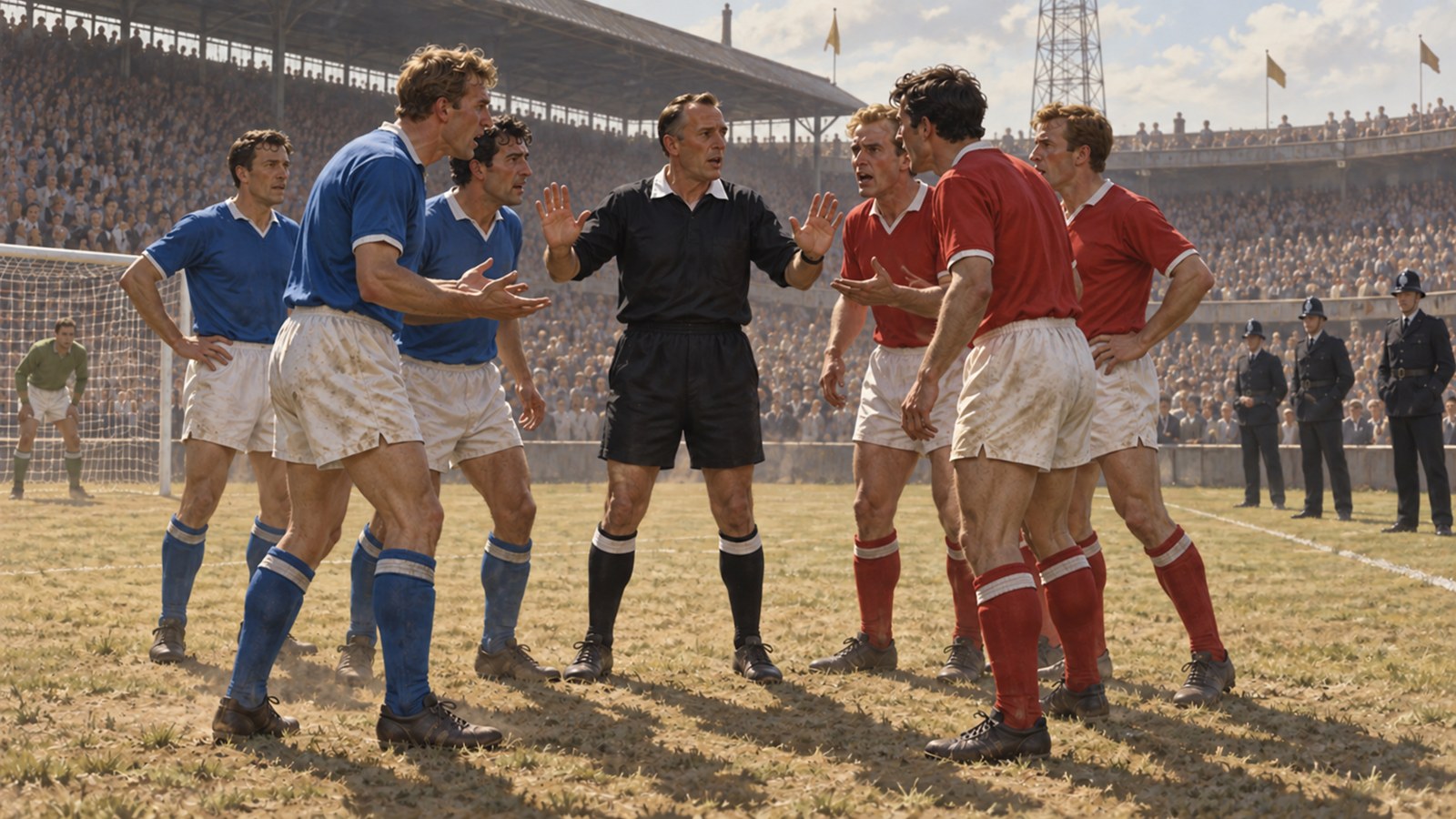
England’s quarter-final against Argentina at Wembley turned on the dismissal of captain Antonio Rattín. Aston used diplomacy to help calm the confrontation and prevent the game from being abandoned. Yet the problem that followed was less dramatic and more revealing. Reports stated that the Charlton brothers had also been booked. The referee had not communicated those cautions in a way that made them obvious, so Ramsey approached FIFA for confirmation.
A referee’s notebook could contain the correct record while nearly everyone else remained uncertain. That uncertainty mattered competitively because a player needed to know he had crossed a disciplinary threshold. It mattered administratively because coaches and officials required an accurate public account. It also mattered to spectators, who otherwise had to infer punishment from a conversation they could not hear.
International football magnified the flaw. A spoken warning could be misunderstood because of language, distance or crowd noise. A hand gesture could be missed or interpreted differently. What was needed was not a new legal category but a shared display.
Kensington High Street Supplied the Vocabulary
The solution arrived outside football. Aston was driving through London when the traffic light on Kensington High Street changed. The sequence compressed a complete disciplinary logic into two colors. Amber did not end the journey, but it demanded care. Red required an immediate stop.
That mapping was powerful because it did not depend on football terminology. A player did not need to hear the referee’s language to understand a yellow rectangle held above a crowd. A coach on the far side of the pitch could see it. So could a newspaper photographer and, increasingly, a television audience.
The physical card also forced the decision into a deliberate ritual. The referee reached into a pocket, selected a color and raised it. The pause gave shape to authority. A warning no longer vanished into a knot of players; a dismissal no longer relied on a pointed finger and a disputed explanation.
The two colors also divided consequences without requiring a complex symbol set. Yellow preserved the player’s place in the match while recording that conduct had crossed a line. Red removed him. That opposition was easy to teach, easy to reproduce with inexpensive material and difficult to confuse at distance. The design did not ask each football culture to adopt an English phrase; it asked officials to display a road signal already associated with caution and stopping.
Aston’s idea resembles the best changes to football’s laws, including the creation of the penalty kick. The innovation appears simple after adoption because it attaches a clear procedure to a recurring problem. Before that attachment exists, the game tolerates confusion as normal.

Mexico Made Discipline Visible
FIFA introduced yellow and red cards at the 1970 World Cup in Mexico. The colors formalized a distinction already present in the laws: caution versus dismissal. Their novelty lay in broadcasting that distinction instantly.
That changed the relationship between private record and public understanding. The referee still wrote down the player’s identity and offence. The notebook remained the administrative record. But the raised card became the common signal, allowing everyone to witness the decision without waiting for a post-match report.
The card system also worked at every scale. In a vast World Cup stadium, color carried farther than speech. On a local pitch, it reduced arguments about what the referee had actually decided. On television, it gave commentators and viewers a precise visual cue. One compact action served several audiences without changing the underlying offence.
For tournament administrators, the display also aligned the visible match with the written report. A caution could still be entered incorrectly, but it was no longer meant to remain known only to the referee and player. Witnesses saw the category of decision as it happened, which made later disciplinary accounting easier to question and verify.
Its success can make the pre-card game difficult to imagine. Today, even the phrases “yellow card” and “red card” operate beyond sport as shorthand for warning and expulsion. That cultural reach came from an object designed to remove ambiguity, not to decorate authority.
Aston Kept Redesigning the Referee’s Job
The cards were Aston’s most famous contribution, but they fit a longer pattern. He is credited with introducing a black referee uniform with white trim in 1946. The following year, he advocated bright linesmen’s flags instead of flags in home-team colors that could disappear against the stadium background. Both choices improved visibility before the traffic-light idea did. Clarity was his recurring craft.
He joined FIFA’s Referees’ Committee in 1966 and chaired it from 1970 to 1972. Later, he spent years teaching referees in the United States. The schoolmaster and the official were not separate careers: his influence came from treating communication as something that could be taught, standardized and designed.
Aston described a match as a two-act play with 22 players and the referee as director. The director, in his formulation, did not know the ending and existed to help provide enjoyment. That philosophy places the official inside the performance without making him its central character.
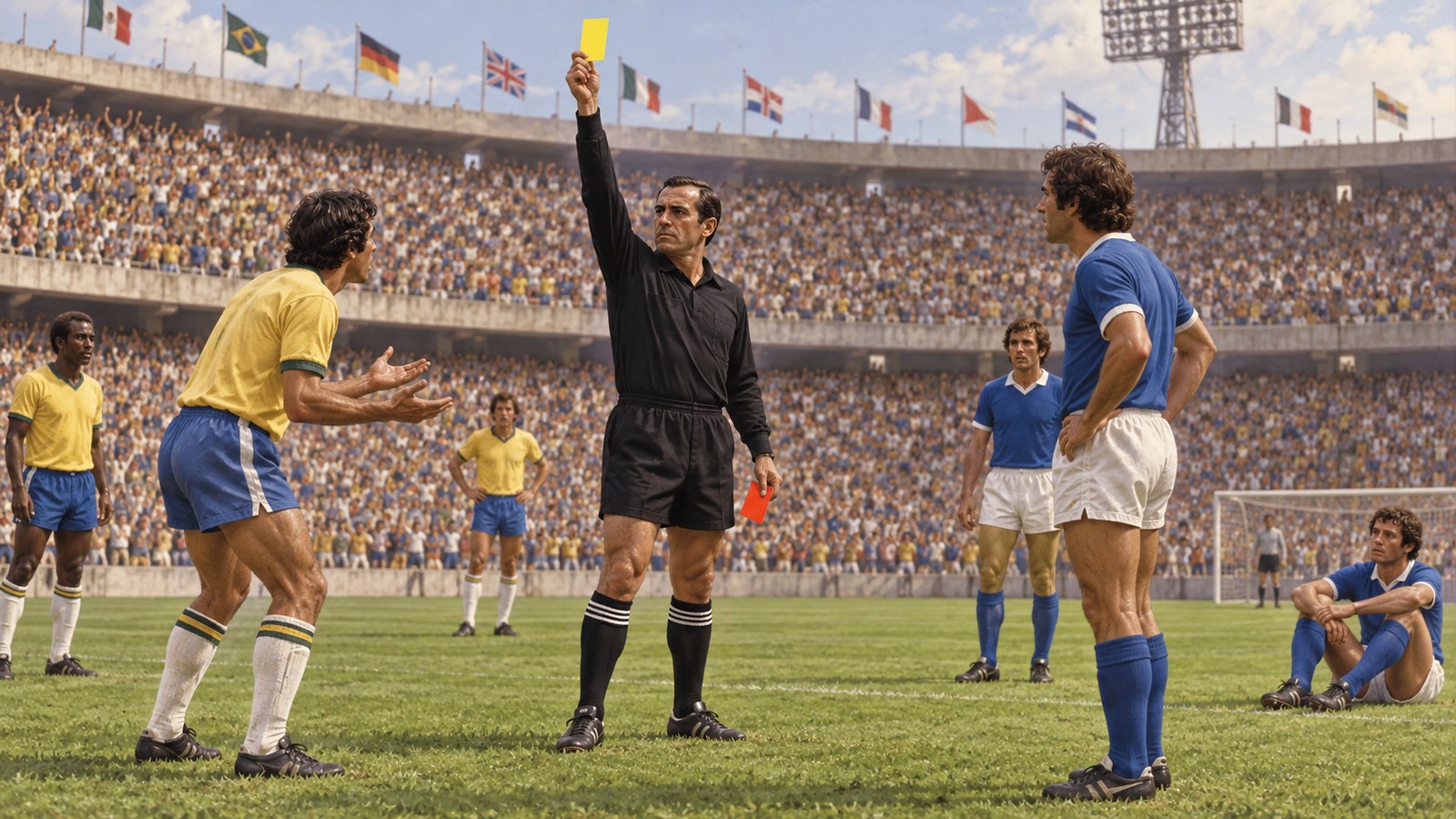
He received an MBE in 1997 and died in 2001 at 86. His lasting object is almost aggressively plain: two small rectangles, one yellow and one red. Their importance lies in what they prevent. The manager no longer needs to ask whether a caution happened. The stadium sees the answer when the referee reaches into his pocket.
Sources
FIFA historical archive; Ilford Recorder; Ken Aston memorial archive.