
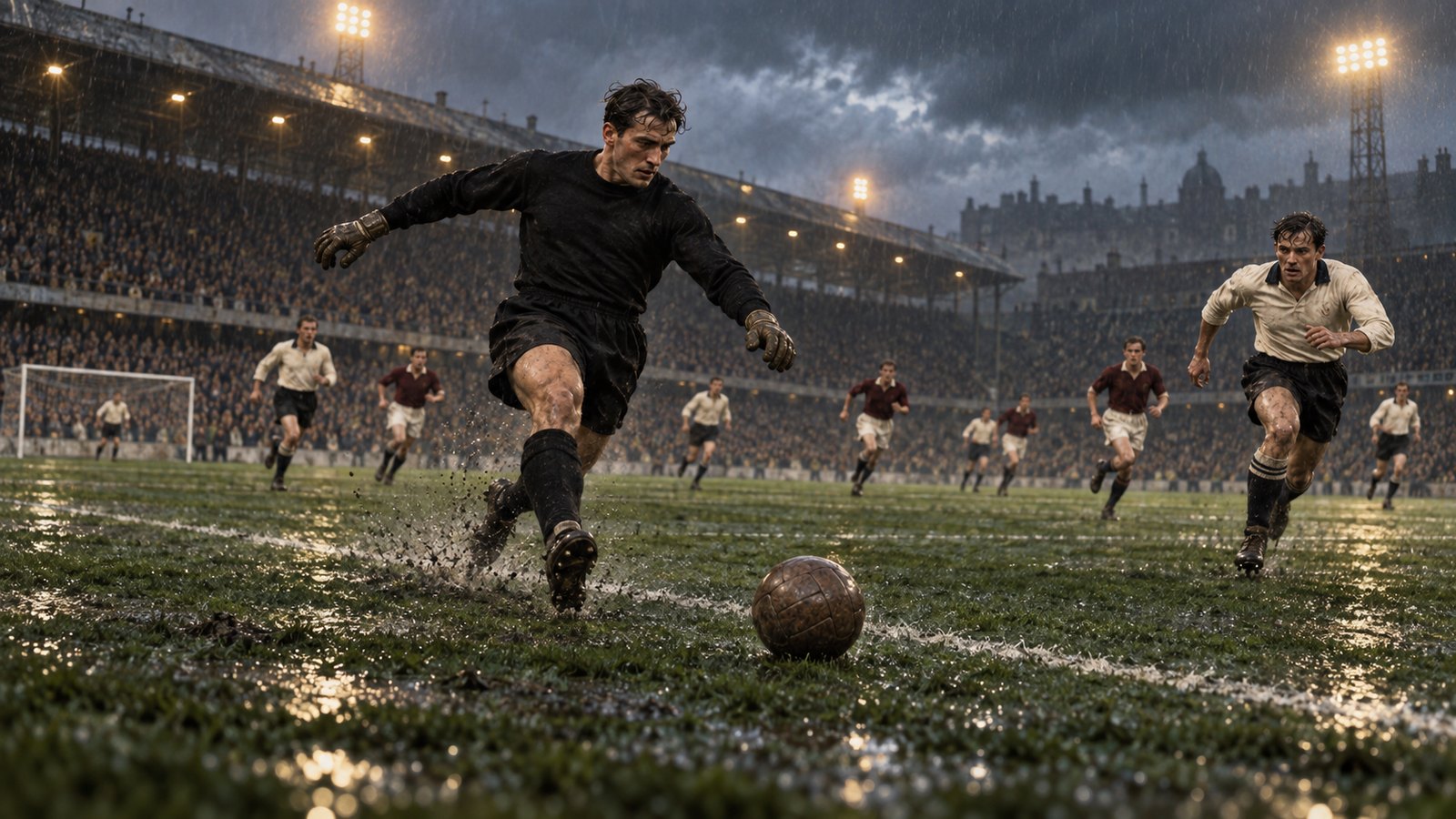
Gyula Grosics was easiest to notice when he was standing where a goalkeeper was not supposed to be. Hungary’s defenders could advance, space could open behind them, and the man in black would leave his line to meet the danger before it became a shot. He was 178 centimetres tall, quick across the ground and willing to treat the territory outside his penalty area as part of his job.
That movement gave him a name that survived the team around him: the Black Panther. The black jersey supplied the image, but the important part was the distance he covered. Grosics did not wait for every attack to arrive at his goal. He collected loose balls, cleared passes and acted as an extra defender for a Hungary side whose shape depended on players exchanging conventional positions.
His career therefore holds two different kinds of freedom. On the pitch, he widened the goalkeeper’s map. Away from it, communist authorities restricted where he could play, removed him from the sport and blocked the transfer he wanted at the end. The contrast explains why Grosics belongs in tactical history and political history at the same time.
A Missing Goalkeeper Put a Fourteen-Year-Old on the Train
Grosics was born in Dorog in 1926. His mother wanted him to become a priest, and his service as an altar boy later became part of the story he told about his all-black playing kit. Football did not begin with immediate proof of genius. He remembered conceding nine in one youth match and being told by a coach to stay away from the pitch.
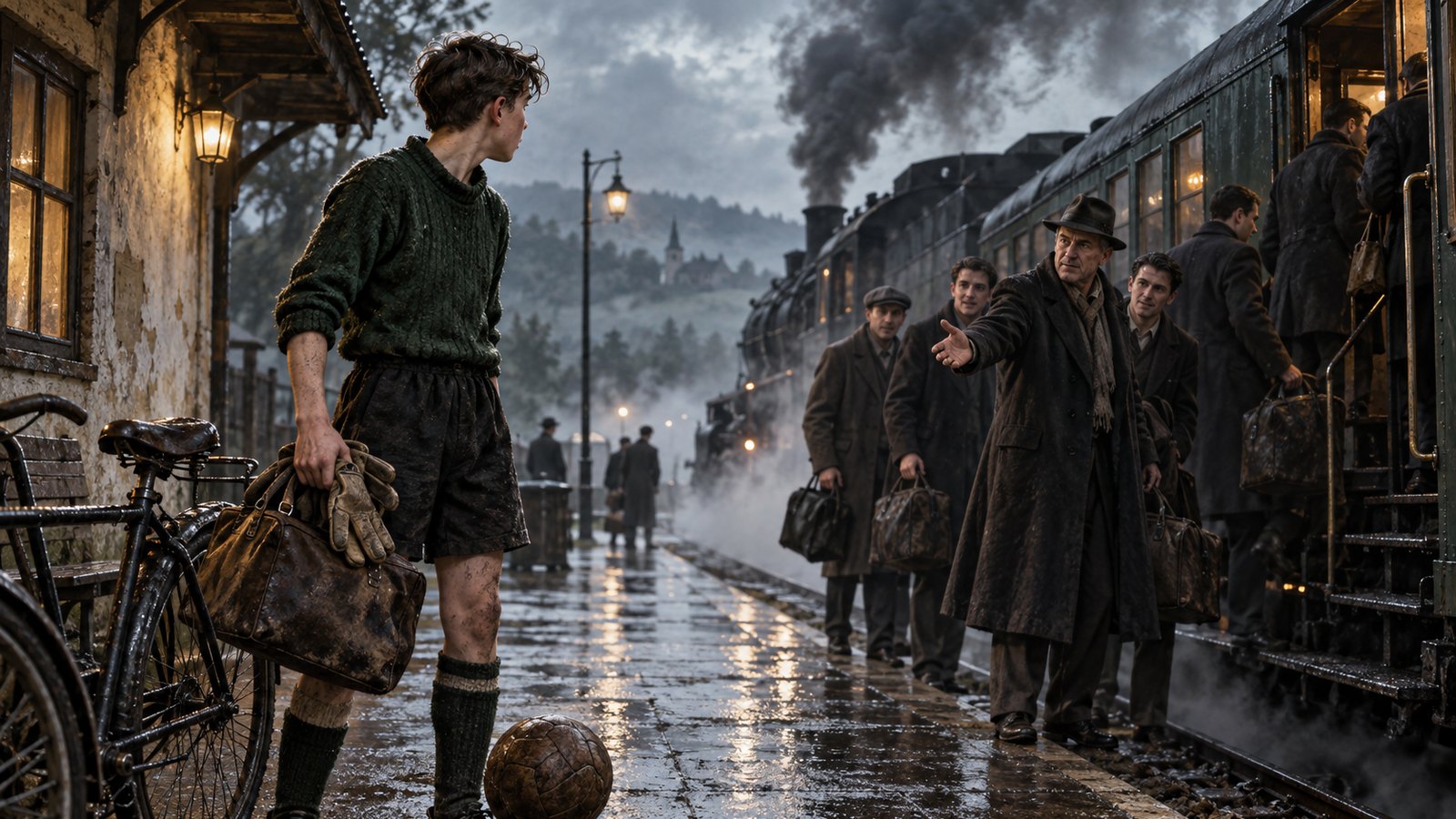
War created the opening. In 1940, Dorog’s senior side learned on the way to a second-division match that both goalkeepers had been taken by the military draft. Fourteen-year-old Grosics happened to pass the station on his bicycle. The captain recognized the youth keeper and brought him along. Dorog won 2–1, and the emergency selection became a place in the senior side.
That scene contains the physical qualities that later mattered. Grosics was not built around reach alone. He was fast enough to play outfield on the wing as a young player and comfortable crossing the boundary between goalkeeper and footballer. Dorog reached the first division in 1945. Two years later, he made his Hungary debut in a 3–0 away win over Romania.
The Black Shirt Moved Beyond the Penalty Area
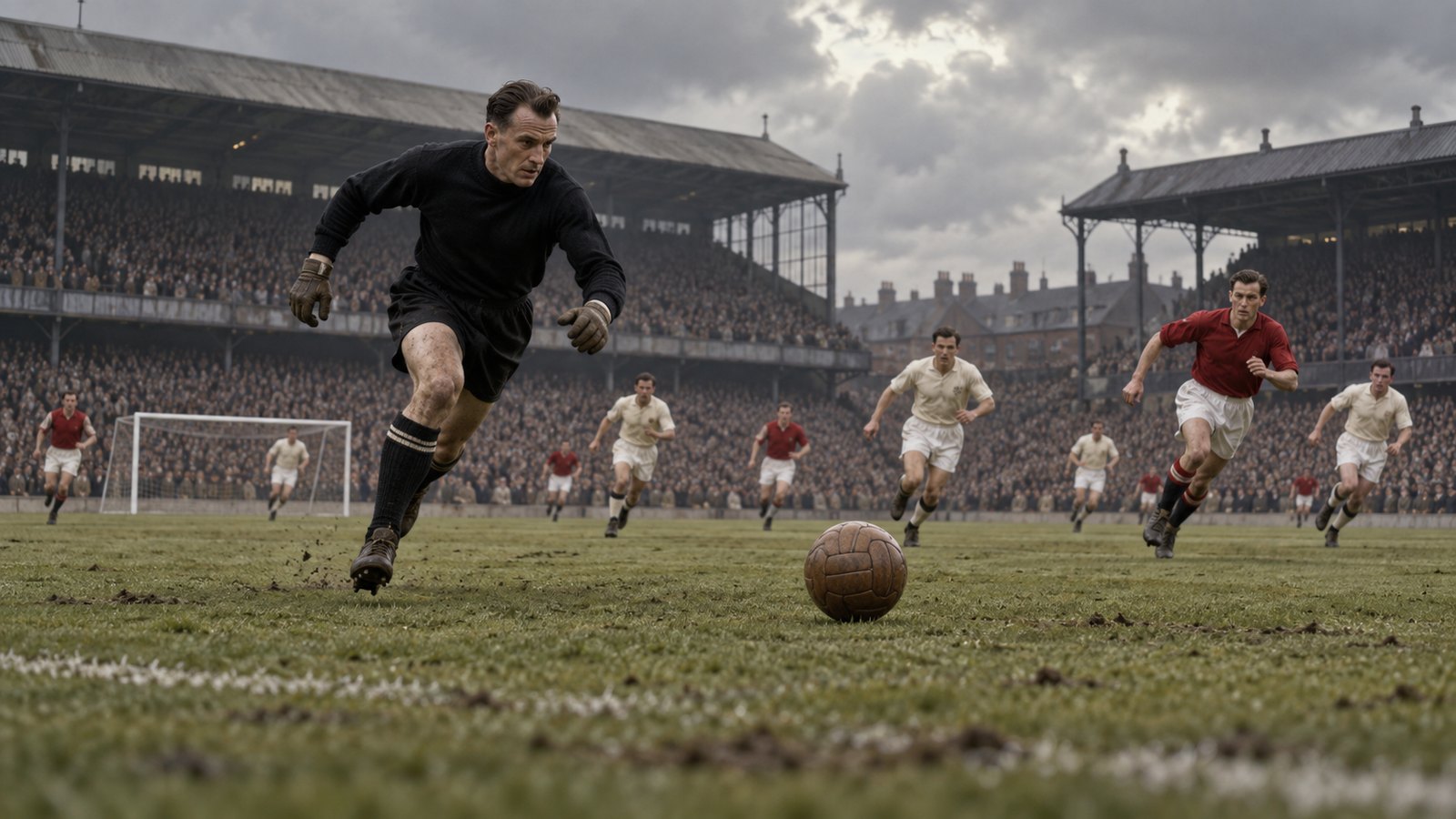
Grosics’s role is often shortened to “sweeper-keeper,” a modern label that can hide the actual problem he solved. Hungary committed players forward and asked defenders to occupy ambitious positions. A goalkeeper rooted to his line would leave a long corridor between himself and the back line. Grosics used anticipation and speed to enter that corridor.
He came out to collect through balls, cleared danger before a forward could control it and offered the defence another participant behind the press. The action was not decorative. It reduced the area opponents could use and allowed Hungary to hold a more assertive shape. His plain black kit made those interventions visually stark: a dark figure leaving the goal while everyone else moved toward it.
Budapest Honvéd gathered many of the national team’s central figures after Grosics joined in 1950. József Bozsik, Sándor Kocsis and Ferenc Puskás gave Hungary passing, movement and finishing. Grosics supplied depth behind them. He won four Hungarian league titles with Honvéd, while the national side went unbeaten from 1950 into the 1954 World Cup final.
The role anticipated later goalkeepers who defend space as much as the goalmouth. Readers can compare the recognition given to Lev Yashin’s complete goalkeeping authority, but Grosics’s importance was specifically collective: his starting position allowed teammates to begin theirs farther from their own goal.
Helsinki and Wembley Made the Geometry Visible
At the 1952 Olympics, Hungary reached the final against Yugoslavia. Grosics kept a clean sheet in a 2–0 victory, placing an Olympic gold medal inside a run that already looked exceptional. International football had no European Championship until 1960, so the Olympic tournament carried a weight that is easy to underestimate from the present.
The clearer demonstration came at Wembley on 25 November 1953. England had never lost at home to a team from outside the British Isles. Hungary won 6–3. The match is remembered for Nándor Hidegkuti’s movement and Puskás’s famous drag-back, but the visitors’ structure began behind them. Grosics helped Hungary compress the pitch rather than retreat into a deep shell after taking control.
Six months later, England visited Budapest and lost 7–1. The two scorelines made Hungary’s superiority impossible to dismiss as a single English misreading. Grosics was the goalkeeper for both, yet the value of his work cannot be read only through saves. His willingness to leave the box affected passes that were never completed and attacks that never reached the final shot.
Bern Changed His Career Beyond the Score
Hungary entered the 1954 World Cup as the outstanding international team. The group stage included an 8–3 win over West Germany and a 9–0 victory over South Korea. Brazil and defending champions Uruguay followed in the knockout rounds. The final brought West Germany back for a second meeting.
Puskás and Zoltán Czibor put Hungary 2–0 ahead, but the lead disappeared quickly. West Germany equalised and Helmut Rahn scored again late for a 3–2 victory. It was Hungary’s first defeat in four years. Grosics was blamed for goals by some supporters, although the result was not a simple goalkeeping failure. Its consequences expanded far outside the match.
Grosics had already attempted unsuccessfully to defect in 1949. After the World Cup, authorities suspected him of treason and espionage. He was kept away from league and international football for roughly two years and moved from Honvéd to Tatabánya without his consent. The goalkeeper who had been permitted to roam across a football field was being told where his career could exist.
The political aftermath also complicates the familiar story of the Magical Magyars as a team that simply vanished after one final. Grosics returned. He played at the 1958 and 1962 World Cups and remained an international well beyond Bern. Hungary’s violent 1954 quarter-final against Brazil shows another part of that tournament; Grosics’s later career shows how the state continued to shape its players after the crowds went home.
Eighty-Six Caps Could Not Secure One Last Transfer
Tatabánya initially felt like exile, but its closeness to Dorog also made Grosics a local figure rather than a disgraced celebrity in Budapest. He re-established himself and returned to the national side. By October 1962, he had reached 86 appearances for Hungary, a total that made him one of the country’s most-capped goalkeepers.
He wanted to finish with Ferencváros. The sports authorities refused to approve the transfer, and Grosics retired at 36. The denial was a final reminder that an athlete’s reputation did not create control over his employment. Even a goalkeeper central to an Olympic title, Wembley’s 6–3 and three World Cups could be stopped from choosing his last club.
His life continued through coaching work in Hungary and Kuwait, football administration and an unsuccessful run for parliament after democratic government returned. Those chapters broadened the biography, but the enduring football image remained the goalkeeper leaving his line.
Modern football treats that decision as a tactical requirement. Goalkeepers train to receive passes, cover space and support a high defence. Grosics performed the underlying work before the vocabulary became common. He did not make every later goalkeeper a copy of himself. He demonstrated that the position’s boundary was tactical, not painted into the grass.
Sources
Olympedia; Associated Press; Hungarian Conservative.