

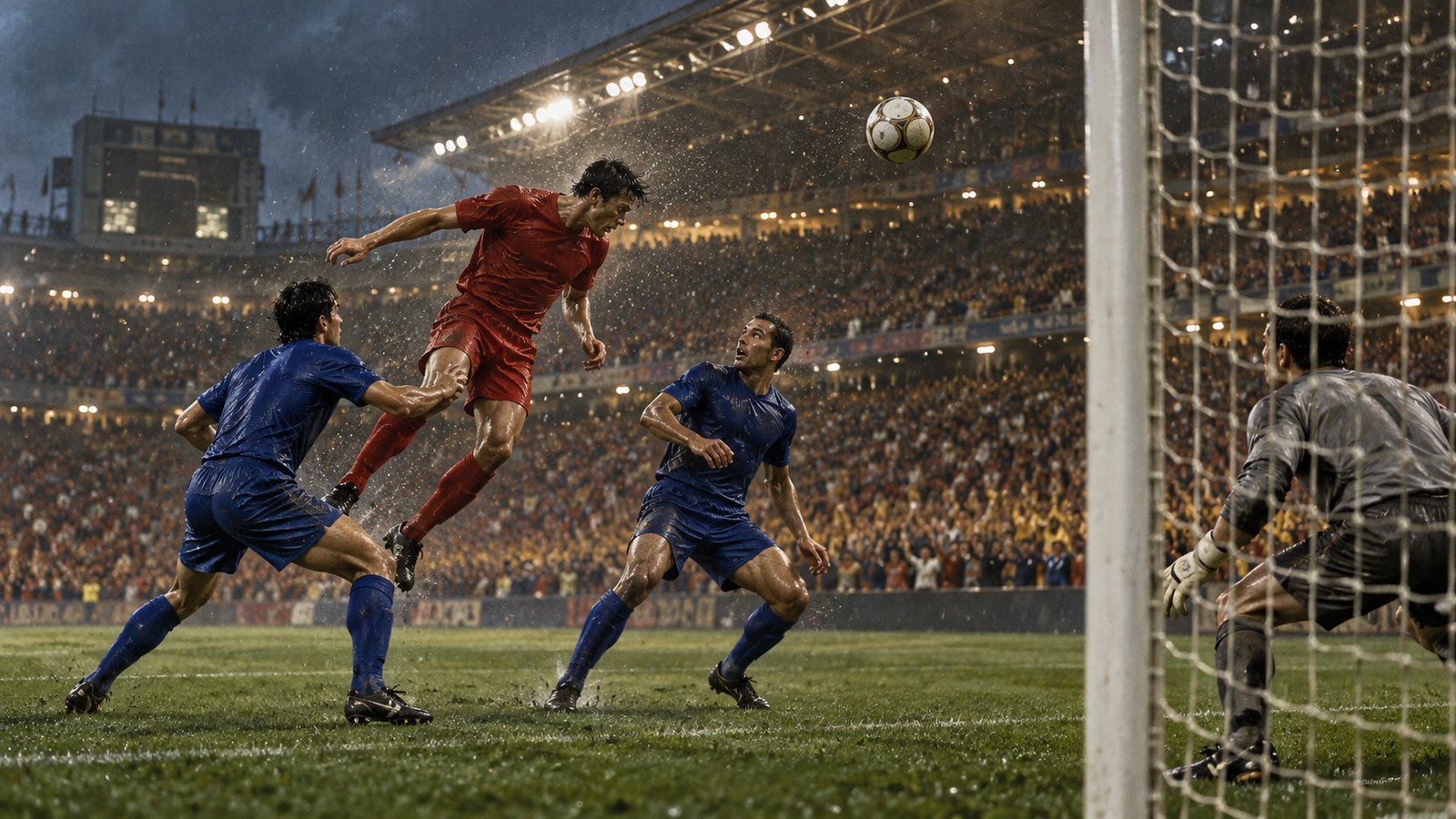
Ahn Jung-hwan had already missed a penalty when the ball returned to him in the 116th minute. South Korea and Italy were level in Daejeon, four minutes from the end of extra time. Lee Young-pyo crossed from the left. Ahn rose between defenders and directed his header inside the far post.
Under the golden-goal rule, there was no restart. South Korea had won 2–1 and reached the World Cup quarter-finals. Italy were out. Ahn’s employer was in Italy.
Within a day, Perugia chairman Luciano Gaucci was quoted saying the forward would never set foot at the club again. Within a week, Perugia was claiming that it had exercised an option to buy him. Ahn’s representatives said he would not return. The header is remembered as a national sporting moment, but the reaction around it also became a transfer story in which an owner’s public anger collided with the quieter mechanics of a loan, an option and a three-party agreement.
Two Seasons in Umbria Preceded One Night in Daejeon
Ahn joined Perugia on loan from Busan I.cons in the summer of 2000. Serie A offered prestige and difficulty in equal measure. He was not an automatic starter. By the 2002 World Cup, contemporary reports credited him with five goals in 29 appearances for the Italian club.
South Korea’s preparation suggested that his international role might be larger. In May, a crowd of more than 50,000 watched the co-hosts beat Scotland 4–1. Ahn came on at half-time, scored with a twenty-yard shot and later stepped over the ball before participating in the move for another goal. The performance placed him inside a team growing confident under Guus Hiddink rather than presenting him as a lone overseas celebrity.
That distinction matters. Perugia’s evaluation was built from two club seasons. South Korea’s use of Ahn was shaped by a short national-team tournament in which different teammates, responsibilities and emotional conditions applied. The same player could occupy a bench in Umbria and become central in front of a home World Cup crowd without either record being imaginary.
The Missed Penalty Did Not Remove the Next Chance
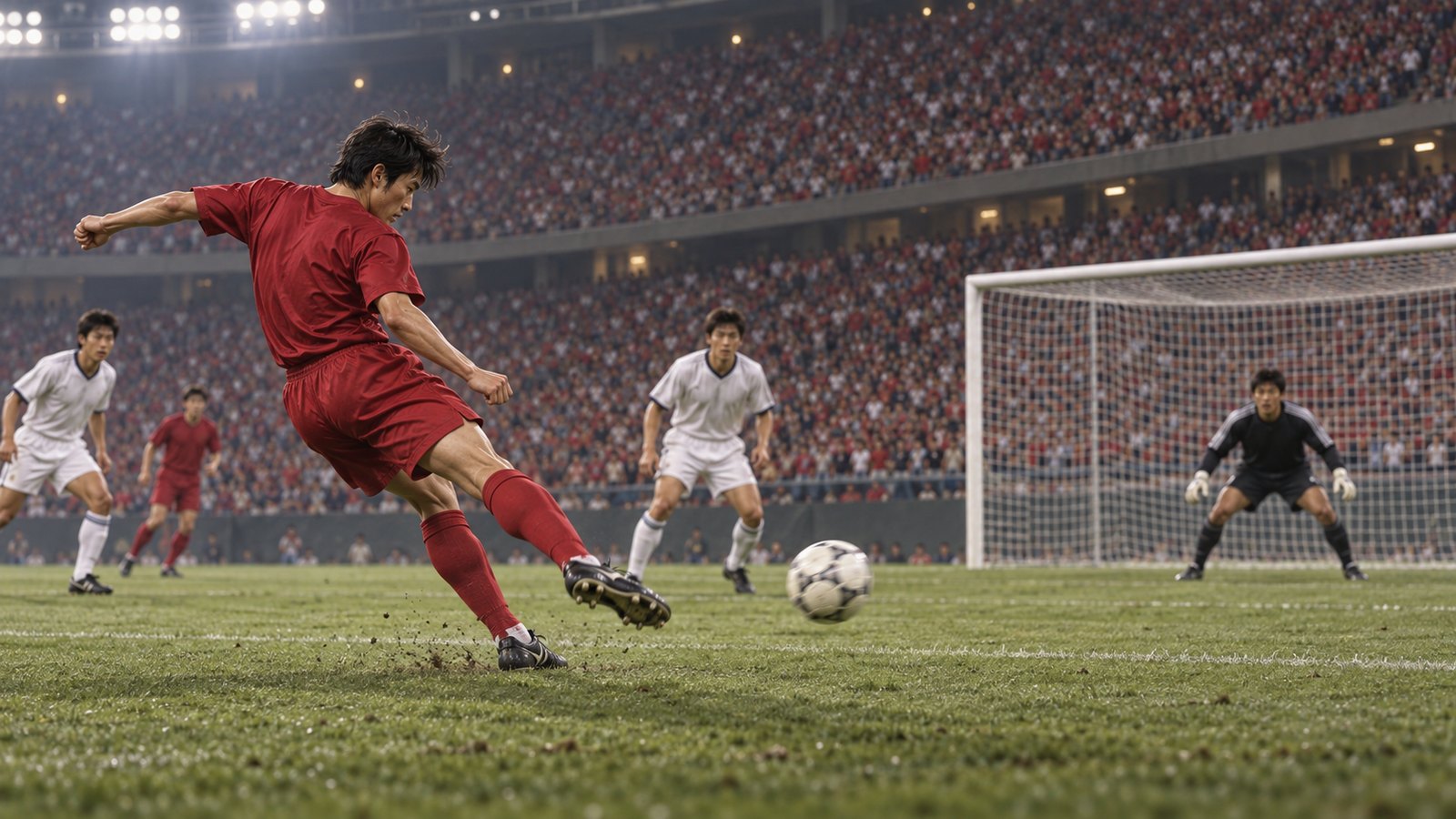
Italy arrived in the round of 16 as three-time world champions. South Korea had never previously reached the knockout phase. Early in the match, Ahn was given the clearest possible opportunity and failed to take it: his penalty was saved. Christian Vieri then put Italy ahead.
The match continued toward an Italian victory until Seol Ki-hyeon equalised late in regulation time. Extra time brought the golden-goal condition. Unlike a normal winning goal, the next score would not leave an opponent minutes to respond. It would close the match at the instant the ball crossed the line.
In the 116th minute, Lee Young-pyo delivered the cross and Ahn beat Paolo Maldini in the air. His header ended the contest. The sequence joined two opposing images of the same player: the penalty taker denied early and the forward trusted enough to remain involved when the decisive chance arrived.
The sudden ending also amplified the shock. There was no ceremonial final whistle after a defensive stand and no last Italian attack. The goal itself performed the administrative act of ending the fixture. For more on the rule that created that abrupt boundary, see how one score was permitted to finish extra time immediately.
A Chairman’s Anger Became a Contract Announcement
The next day, Gaucci’s reported words shifted attention from the match to Ahn’s employment. He said the player would never return to Perugia and declared that he would not pay someone he blamed for damaging Italian football. The language treated international competition as a test of loyalty to the country where Ahn worked.
A Perugia spokesman added a different explanation: the club had virtually decided to release Ahn before the Italy match. That claim attempted to separate the contractual judgment from the goal. Yet it arrived beside a chairman’s intensely national reaction, making the distinction difficult to preserve in public.
The episode exposed how much power a dramatic quotation can appear to carry. A chairman can pronounce a relationship finished in a newspaper. A football contract does not necessarily end because the sentence is memorable. Ahn was on loan from Busan, and Perugia still had an option that could affect the player’s registration and value after the tournament.
That gap between public position and legal route is why this was more than a burst of bad temper. Transfer systems create layered relationships among player, lending club and borrowing club. Andy Webster’s later contract dispute involved different rules, but it reveals the same basic point: the headline is rarely the whole mechanism by which a footballer becomes free to move.
Perugia Reversed Course, but Ahn Could Also Say No
Within a week, Perugia’s position changed. The club claimed it had exercised the option to buy Ahn from Busan. Its spokesman referred to a three-party contract that would take effect on 30 June 2002. The forward first described as someone who would never return was now being treated as an asset the club had chosen to acquire.
The calendar makes the reversal sharper. The match was played on 18 June. Gaucci’s exclusion was reported on 19 June. By the follow-up published on 26 June, Perugia was pointing toward an agreement due to take effect four days later. Public finality had lasted less than a week before the club’s own account returned to signatures, dates and an option price.
Ahn’s management group answered that he had rejected the offer. Their statement said he would no longer discuss a move to Perugia because the club had attacked his character instead of congratulating him. The Asian Football Confederation also reacted, threatening to advise Asian players to avoid Perugia.
Perugia later described Gaucci’s initial response as emotional and said the club’s decision had been made independently of the World Cup result. That explanation did not erase the sequence. It confirmed that two processes had run side by side: an emotional public verdict after Italy’s elimination and a contractual calculation about a player whose profile had just expanded enormously.
The Goal Raised His Value Without Choosing His Destination
World Cup breakthroughs are often narrated as clean transfer launches. A player performs before a global audience, larger clubs notice and the next contract follows. Ahn’s route was messier. Perugia’s reversal did not produce reconciliation, and later interest elsewhere did not immediately create a stable landing. Blackburn Rovers withdrew from a proposed deal.
The uncertainty does not reduce the significance of the header. It separates sporting consequence from employment consequence. On the pitch, the result was immediate and irreversible: South Korea advanced, Italy were eliminated and the golden-goal rule left no time to negotiate with the score. Off the pitch, every declaration opened another dispute about what had already been agreed and who could determine the next move.
Perugia’s earlier sample still mattered: five goals in 29 appearances did not vanish because one header reached a global audience. But the World Cup changed the bargaining context. A player the club could describe as expendable before the match now carried a moment recognized across Asia, and the option to buy him had an obvious transfer value beyond the next team sheet.
Ahn’s story therefore resists the simplest version told from either country. He was not dismissed merely because of one goal without any prior club judgment; Perugia said it had already considered letting him go. Nor was the response a routine transfer decision untouched by nationalism; the chairman’s own reported words made that impossible to sustain.
The durable image is Ahn in the air at 116 minutes. The more revealing sequence begins after he lands: exclusion, justification, reversal, rejection. One header ended a World Cup match instantly. It took much longer to determine what the scorer’s club relationship meant.
Sources
The Guardian; FIFA match records; Rec.Sport.Soccer Statistics Foundation; Sky Sports.