
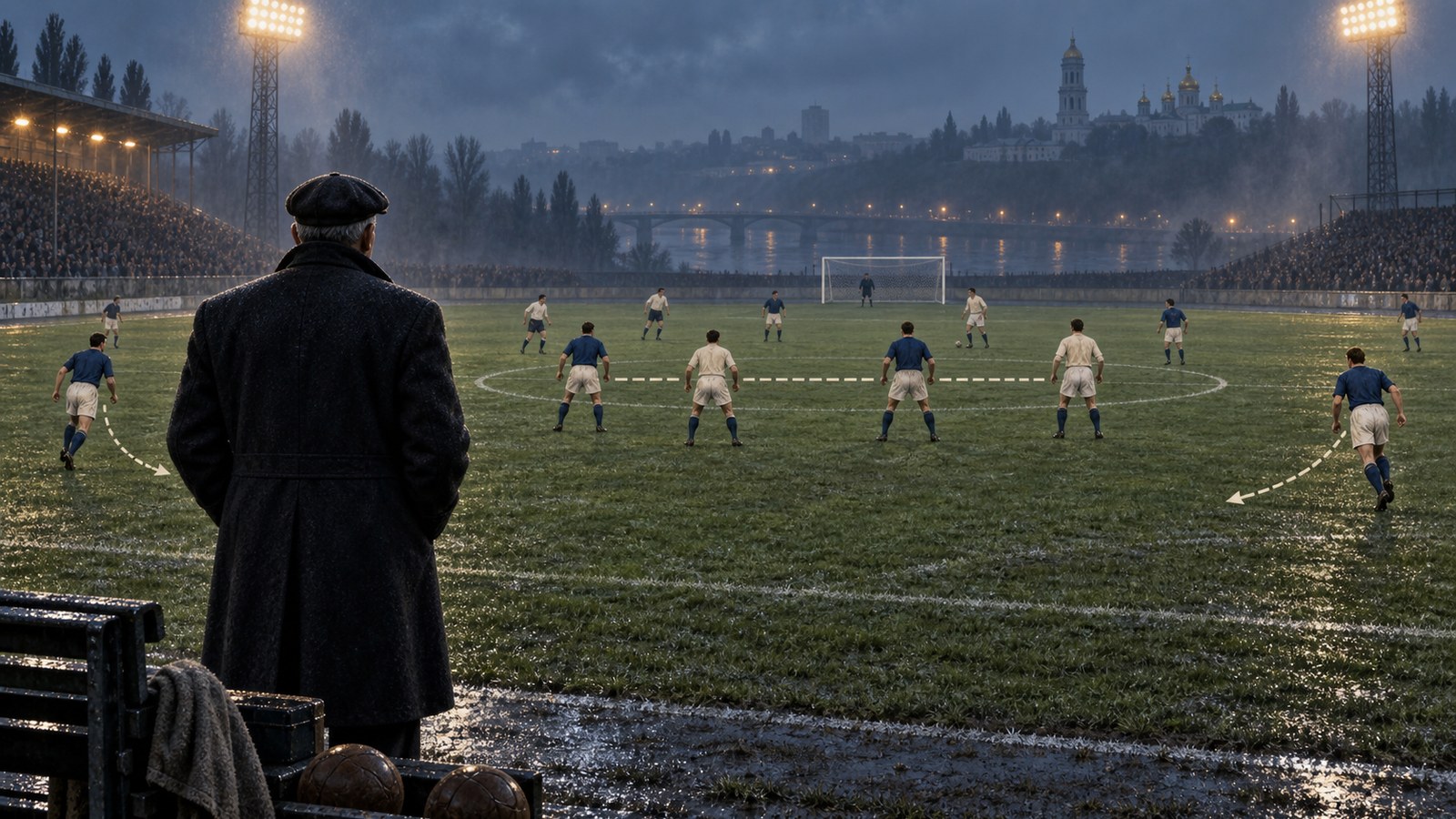
On a training pitch in Kyiv, the most consequential movement was away from goal. Two wide attackers who would once have waited high beside the forwards were asked to retreat. Their new starting positions made a line of four across midfield. The adjustment looked conservative on a static board, yet it gave Viktor Maslov’s Dynamo Kyiv more players around the ball, more ways to close passing lanes and more support for attacks arriving from deeper positions.
Dynamo then won the Soviet championship in 1966, 1967 and 1968. The three titles did not make every later 4-4-2 a copy of Maslov’s design. They did show that withdrawing forwards could create a more aggressive collective. His idea worked because formation, marking, fitness and trust were treated as parts of the same problem.
The Popular 4-2-4 Left a Tempting Gap
Maslov had spent much of his playing career as a midfielder for Torpedo Moscow. He captained the club before retiring in 1942, then began the long, uneven transition from player to coach. An early spell in charge ended badly enough that he reportedly learned of his dismissal from cleaners. When Torpedo brought him back, the second attempt produced the 1960 Soviet league title and established him as a coach capable of changing a team rather than merely selecting one.
His route to Kyiv also ran through SKA Rostov-on-Don. Maslov spent two seasons building a side that would finish second in the Soviet league in 1966, behind the Dynamo team he had gone on to reshape. The sequence matters: his ideas were not conceived during one sudden championship run. By 1964, Dynamo were hiring a coach who had tested them through repeated appointments, dismissals and rebuilds across more than two decades.
By the time Dynamo Kyiv appointed him in 1964, international football had a persuasive model. Brazil had won the 1958 World Cup with a 4-2-4 whose width came from two advanced wingers. The shape could overwhelm a back line, but its midfield base was narrow. If the wingers stayed forward, two central players had to connect defence and attack while covering a large amount of grass.
Maslov attacked that geometry. One withdrawn winger could make a midfield three; he brought both back and made four. Against opponents organised around two central midfielders, Dynamo could crowd the ball without abandoning width completely. The former wingers still had attacking work, but they began from positions that made them responsible for the space in front of their own full-backs.
Four Midfielders Needed Jobs, Not Coordinates
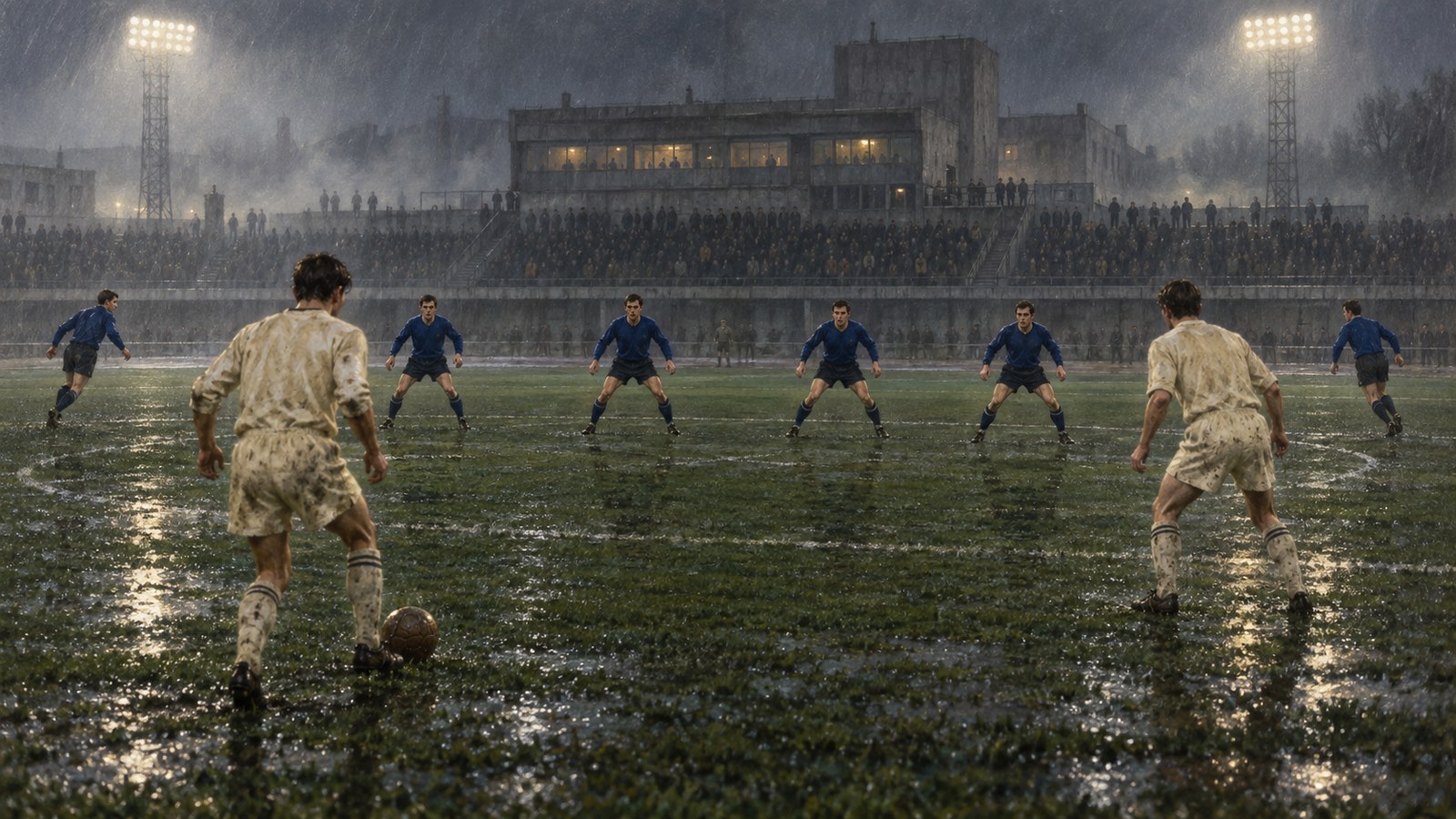
The label 4-4-2 can make Maslov’s work sound like a diagram discovered once and repeated forever. His midfield was more specific. One player held a deeper position to protect the defence. Another carried greater responsibility for creation. The wide midfielders occupied the channels in front of the full-backs, while those defenders received permission to advance when the move allowed it.
These roles gave Dynamo different routes through a match. A full-back could move forward with cover nearby. A wide midfielder could support centrally instead of remaining fixed to the touchline. The advanced playmaker could receive with a holder behind him. Removing two permanent attackers therefore did not simply add bodies to defence; it changed where attacks began and how many players could take part in the transition.
Maslov also moved away from strict man-marking. A defender or midfielder chasing one opponent could pull the entire side apart. Zonal responsibility asked each player to protect an area, pass runners between teammates and react to the ball as part of a connected block. The distinction mattered most when Dynamo lost possession. Four midfielders standing in a line achieved little by themselves. Four midfielders shifting together could reduce the field available to an opponent.
Pressing Gave the Shape Its Edge
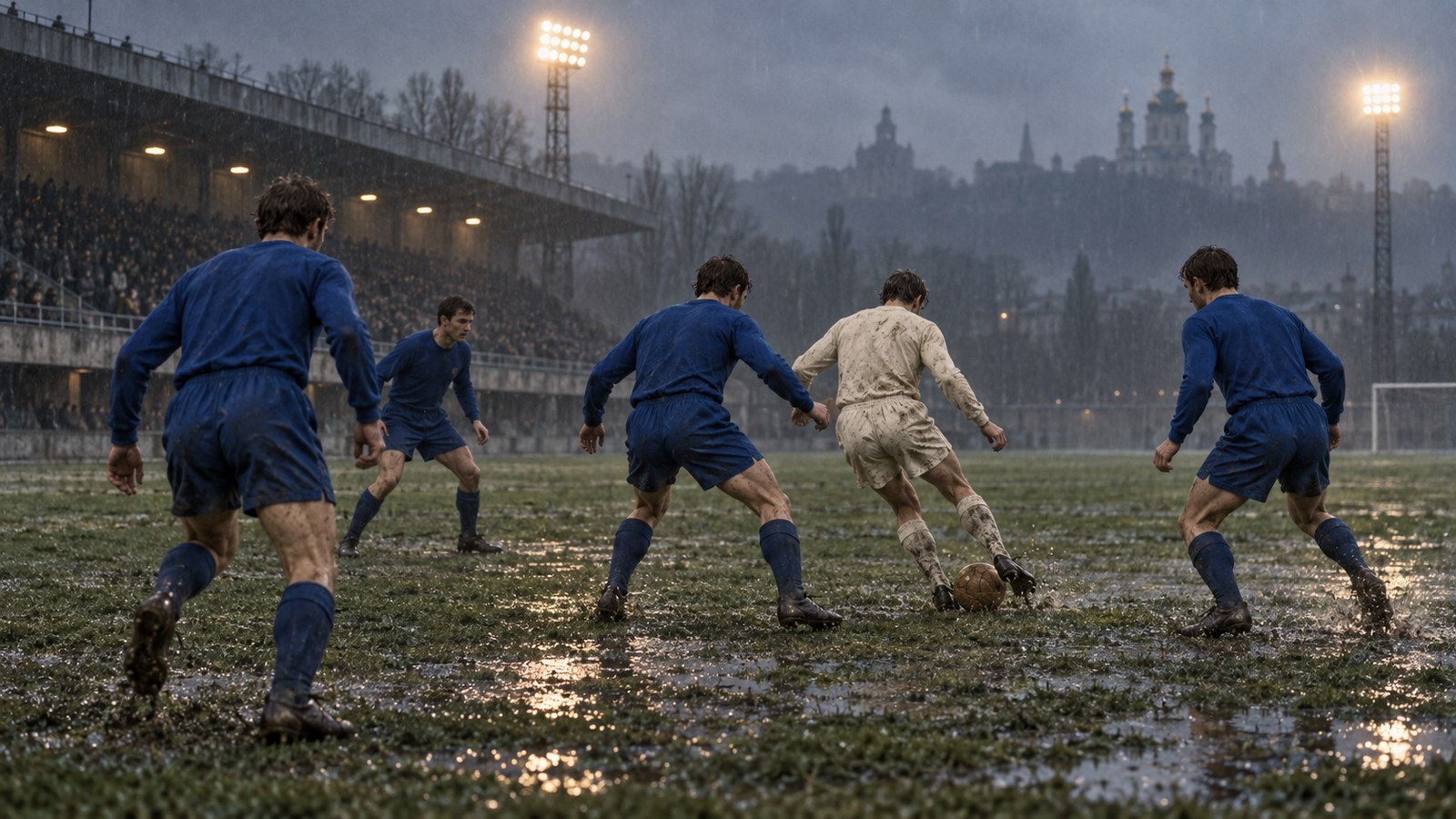
Jonathan Wilson has described Maslov’s work as a birth point of modern football because the formation was joined to pressing. Dynamo tried to deny time rather than retreat and wait. The nearest player approached the ball; teammates closed the next options; the team attempted to recover possession high enough that the following attack started close to goal.
That demand exposed any weak link. If one player pressed while the rest stayed still, a single pass could remove him and open a larger space. If the defensive line dropped while midfield advanced, the team split in two. Maslov’s zonal approach supplied the shared reference points needed for pressure to travel across the pitch.
The physical cost was considerable. Repeated accelerations, recoveries and lateral movements required preparation different from conserving energy in an assigned duel. Maslov intensified conditioning and paid attention to nutrition and recovery when neither subject had become routine club infrastructure. The tactic on Saturday depended on what players ate, how they trained and whether they could repeat the same short sprint late in the match.
Grandad Asked the Dressing Room to Think
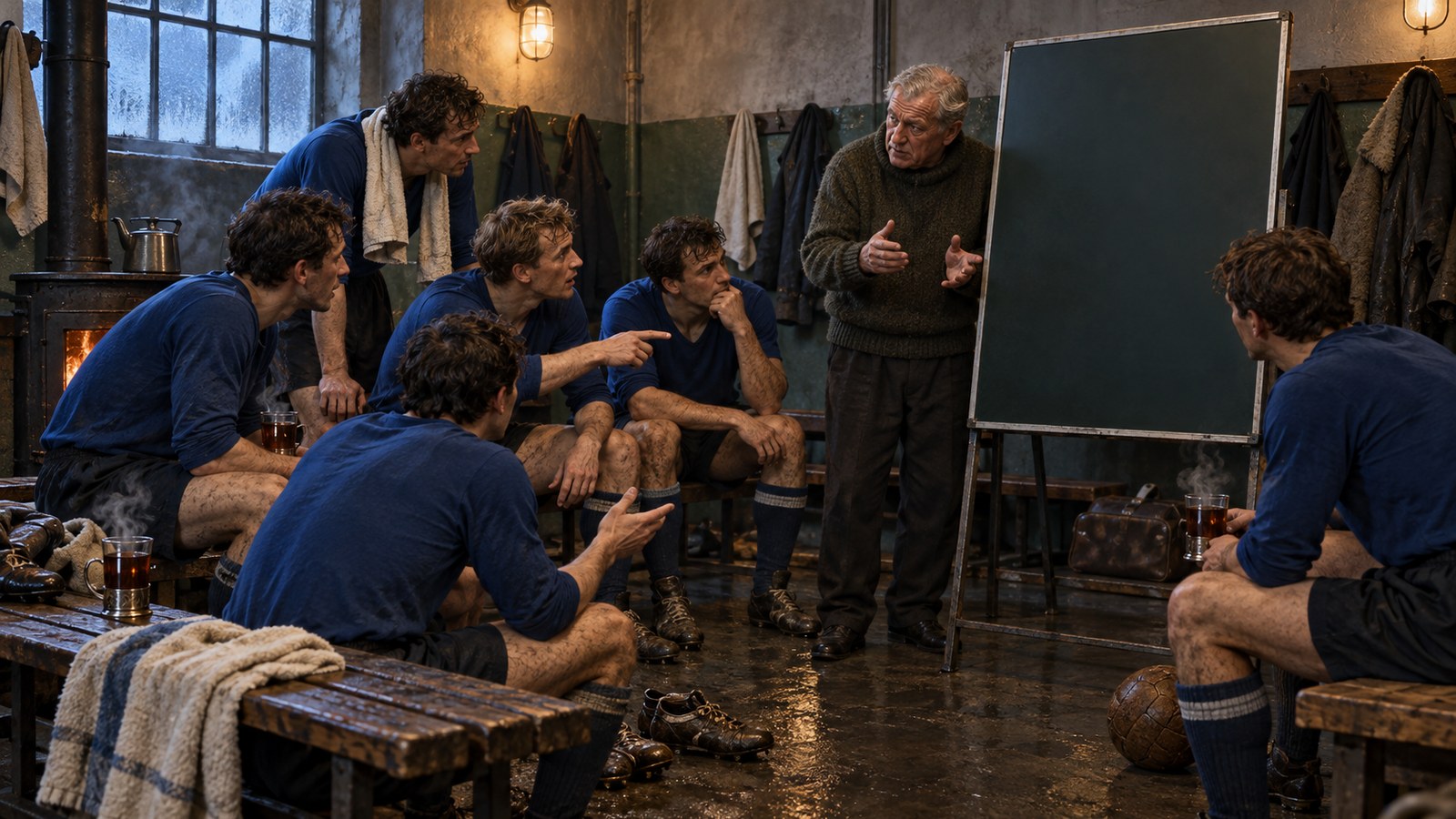
The collective did not mean players were treated as interchangeable parts. Maslov gathered his squad before matches, explained the intended plan and asked players and staff for their opinions. The affectionate nickname “Grandad” reflected a relationship that could carry demanding instructions without turning every tactical disagreement into defiance.
That consultation helped because zonal pressing contains decisions no coach can make from the touchline in real time. A player has to judge whether to jump toward the ball, protect the pass inside or cover a teammate who has moved. The answer changes with the opponent’s body angle and the position of everyone nearby. Shared principles mattered more than memorising a trail of footsteps.
The competitive return arrived in 1966. Dynamo finished nine points ahead of SKA Rostov-on-Don and became the first club outside Moscow to win the Soviet league in five years. They retained the championship in 1967 and again in 1968. Three straight titles moved domestic power toward Kyiv while giving Maslov’s tactical argument a result that could not be dismissed as an interesting experiment.
English football would later make 4-4-2 feel culturally familiar after Alf Ramsey’s 1966 World Cup victory. Maslov’s version had already emerged through a different route. It was less a national template than a response to the spare space left by 4-2-4 and the possibility of controlling it with coordinated movement.
The Titles Ended Before the Ideas Did
Dynamo’s run did not make Maslov untouchable. Players were lost to the 1970 World Cup, the squad lacked enough reserves, and the club fell to seventh. He was dismissed after seven seasons. He later returned to Torpedo and won another domestic cup, but his most influential work had already been done in Kyiv.
The successor who became more famous was Valeriy Lobanovskyi, one of the players Maslov had coached. Lobanovskyi’s later Dynamo teams pushed measurement and physical science much further; The Ghost Goal has examined the training science behind Dynamo’s 1975 press. The connection is not a simple handover of one finished method. It is a shared belief that spacing, workload and collective behaviour could be trained deliberately.
Maslov expressed football’s direction through an image from aviation: as velocity rises, resistance grows, so the head must become more streamlined. The comment anticipated fewer fixed forwards and more players contributing to both phases. His two withdrawn wingers were an early practical answer. They sacrificed advanced starting positions and gained control over the centre, shorter routes to pressure, and better support for the players behind them.
That is the mechanism behind the three championships. Dynamo did not win merely because four names appeared in midfield on a team sheet. Maslov made those four defend zones, close space, exchange responsibilities and arrive in attack from positions opponents found difficult to match. The familiar numbers survive in football language. The radical part was teaching an entire side what to do between them.
Sources
These Football Times; The Guardian; WorldFootball.net; Transfermarkt; Soviet Top League season records.