
Dynamo Kyiv 1975 Was a Pressing Laboratory Before Pressing Had a Global Name
Dynamo Kyiv’s 1975 season can look, from a distance, like a simple line on a trophy list: Cup Winners’ Cup winners, then European Super Cup winners, with Oleg Blokhin exploding into continental fame. That summary is too small. The deeper story is not that one Soviet club had a brilliant forward and a good year. It is that Dynamo became one of football’s clearest early examples of a team treated as an engineered system, where running loads, spatial discipline, collective cues, and psychological obedience mattered as much as dribbling or charm.
Valeriy Lobanovskyi did not invent hard work, and Kyiv did not invent pressing in the broad sense. What made the 1975 side feel modern was the way effort was organized. Players were not simply told to run more. They were asked to run in patterns, to squeeze space together, to make the next pass predictable, and to attack the moment after the opponent thought possession had been secured. In an era still narrated through stars and national styles, Dynamo offered something colder and more repeatable: football as a coordinated experiment.
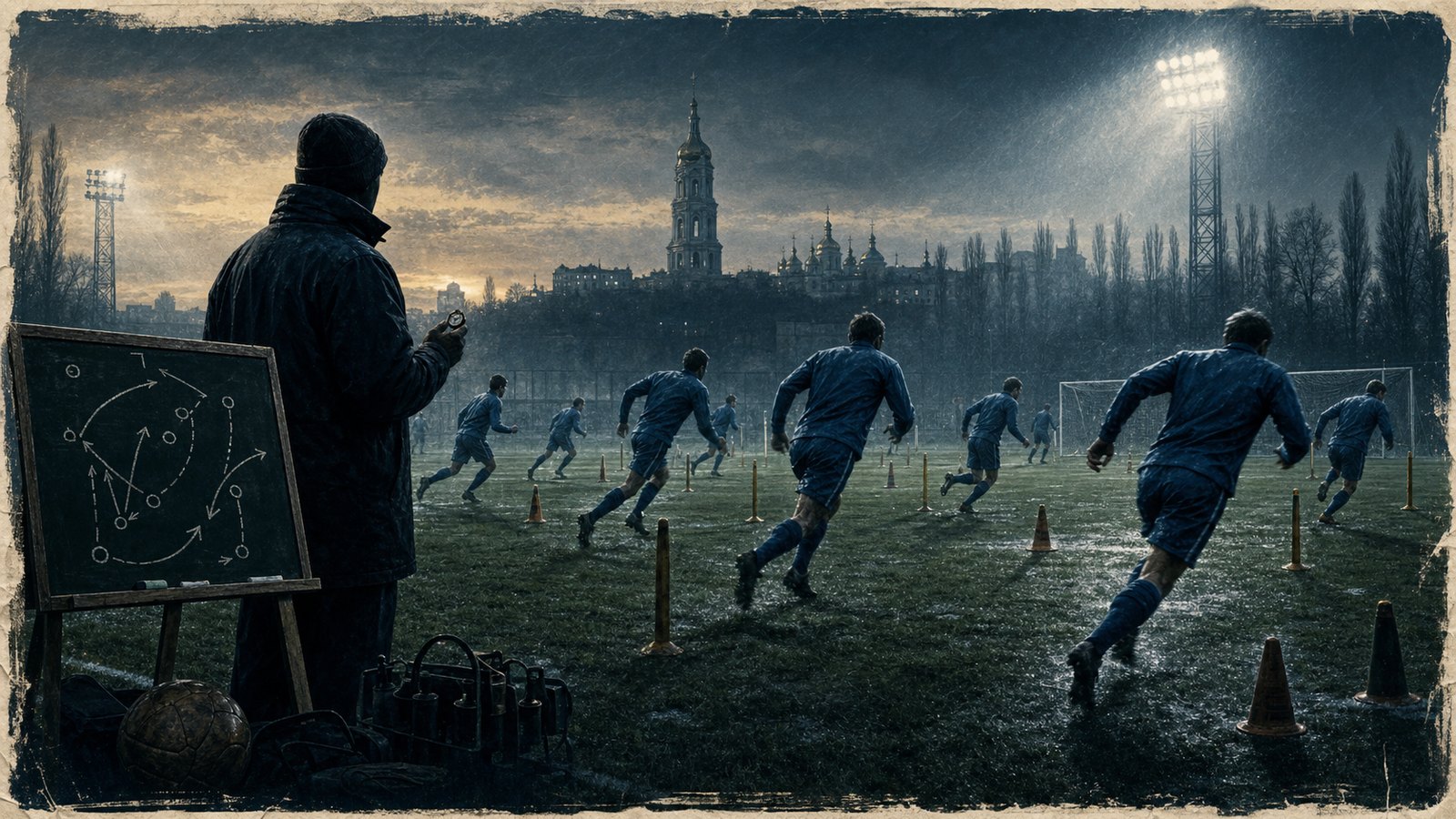
The Stopwatch Was Part of the Tactics
Lobanovskyi’s reputation has always been tied to science, but the important point is not that he surrounded the game with numbers. The point is that the numbers served a tactical idea. Kyiv wanted to reduce the chaos between losing the ball and winning it back. Fitness testing, training repetition, and careful analysis all pushed toward the same match behavior: compress the pitch, make teammates predictable to one another, and force opponents into hurried solutions.
That is why Blokhin’s speed mattered differently inside this team than it might have in a looser side. He was not only a runner released into space. He was the sharp edge of a collective structure. When Kyiv broke forward, the movement behind him had already narrowed the opponent’s choices. When they defended, the front line was not detached from the midfield. The side could feel like a spring: coiled without the ball, then suddenly released into the open field. The Cup Winners’ Cup run gave that idea a European stage, and the Super Cup matches against Bayern Munich made it harder to dismiss as a domestic curiosity.
Beating Bayern Changed the Scale of the Argument
Bayern Munich in the mid-1970s were not just a famous opponent. They were the reigning European Cup power, loaded with the aura of Franz Beckenbauer, Sepp Maier, and Gerd Mueller. Dynamo’s Super Cup victory over Bayern therefore carried more symbolic weight than another medal. It suggested that a team from the Soviet league could impose a planned rhythm on the most decorated club side in Europe, and it made Lobanovskyi’s methods visible beyond the Iron Curtain.
The details matter because the result can be misremembered as an upset built on heroic resistance. Kyiv were not merely hanging on. They were capable of making Bayern uncomfortable by the way they occupied space and accelerated transitions. Blokhin’s goals became the memory, especially because the Ballon d’Or followed in 1975, but the goals were a surface expression of the mechanism beneath them. The forward could look devastating because the collective had already stressed the opponent’s balance.
A Soviet Team With a Club Identity
There was also an institutional layer that made Dynamo unusual. Soviet football often blurred club, state, and republic identities, and Dynamo Kyiv carried Ukrainian meaning inside a Soviet sporting structure. The players were not operating inside the same commercial club model that later European fans would recognize. Selection, training, travel, and prestige sat within a broader sports system. Yet that structure gave Lobanovskyi time and authority to build habits that a more impatient environment might have disrupted.
The side’s discipline was not romantic. It could be demanding, repetitive, and severe. But its legacy is easy to see in later football language. Modern analysts talk about pressing triggers, counter-pressing, rest defense, collective distances, and load management. Kyiv did not use all of today’s vocabulary, and it would be wrong to pretend there is a straight line from one team to every later pressing side. Still, the 1975 team belongs in that ancestry because it treated the footballer as part of a synchronized group rather than an isolated performer.
The Legacy Was a Method, Not Just a Medal
The most durable thing about Dynamo Kyiv 1975 is that the team made system football feel dramatic. There is a risk, when discussing Lobanovskyi, of making his football sound like a spreadsheet with boots. The matches were not sterile. They had rain, noise, speed, and the shock of a blue-shirted team punching through Europe with a different kind of confidence. The beauty was in the coordination: one player’s run meaningful because four others had already moved to make it possible.
That is why the season still matters. It sits between older stories of great individuals and newer stories of total-team control. It showed that scientific preparation did not have to flatten football’s emotion. In Kyiv’s case, the laboratory produced one of the era’s most compelling sides: a team that could press, break, and score with the feeling of a single organism discovering that Europe had not yet learned its language.
Why the Idea Travelled Beyond Kyiv
The 1975 team also matters because its ideas did not stay frozen in that one season. Lobanovskyi returned to Dynamo in later spells, influenced Soviet national-team structures, and became one of the reference points for coaches who saw football as a problem of collective distances. The game that later audiences associated with pressing in the Netherlands, Italy, Germany, or Spain had many roots, not one. Kyiv’s contribution was distinctive because it joined athletic measurement to an almost moral insistence that the team mattered more than the isolated star.
That made the football demanding for players. A winger could not admire his own run if the next defensive movement was late. A midfielder could not hide behind elegance if the collective had lost its compression. Even Blokhin, the most celebrated figure, was valuable because his gifts served the structure. This is the under-discussed part of the 1975 story: it was not anti-individual. It created conditions in which individual quality appeared at higher speed and with clearer purpose.
For later football, that is the bridge. The modern pressing side does not ask whether it wants artists or athletes; it tries to build a context in which the artist’s decision and the athlete’s sprint happen inside the same shared trigger. Dynamo Kyiv were not playing twenty-first-century football in disguise, but they were asking a question the twenty-first century would keep asking: how much of brilliance can be trained into a group before the match begins?
The human cost of that demand is part of the history too. A system built on repeatable actions can make players look interchangeable from the outside, but the best versions rely on trust. One late press exposes the next man; one selfish recovery run changes the whole angle of the counterattack. Dynamo’s achievement was to make that trust visible at speed, against opponents who were used to reading football through individual duels.
It is also why the 1975 side has aged better than many trophy teams. Some champions are remembered mainly by supporters. Kyiv remain useful to anyone trying to understand how football moved toward collective control. Their season was a trophy story, a Soviet sports story, a Ukrainian club story, and a tactical story at the same time.
Sources
- Jonathan Wilson, Inverting the Pyramid
- UEFA historical competition records
- Ballon d’Or 1975 records
- Dynamo Kyiv club historical archive
- European Super Cup 1975 match records