
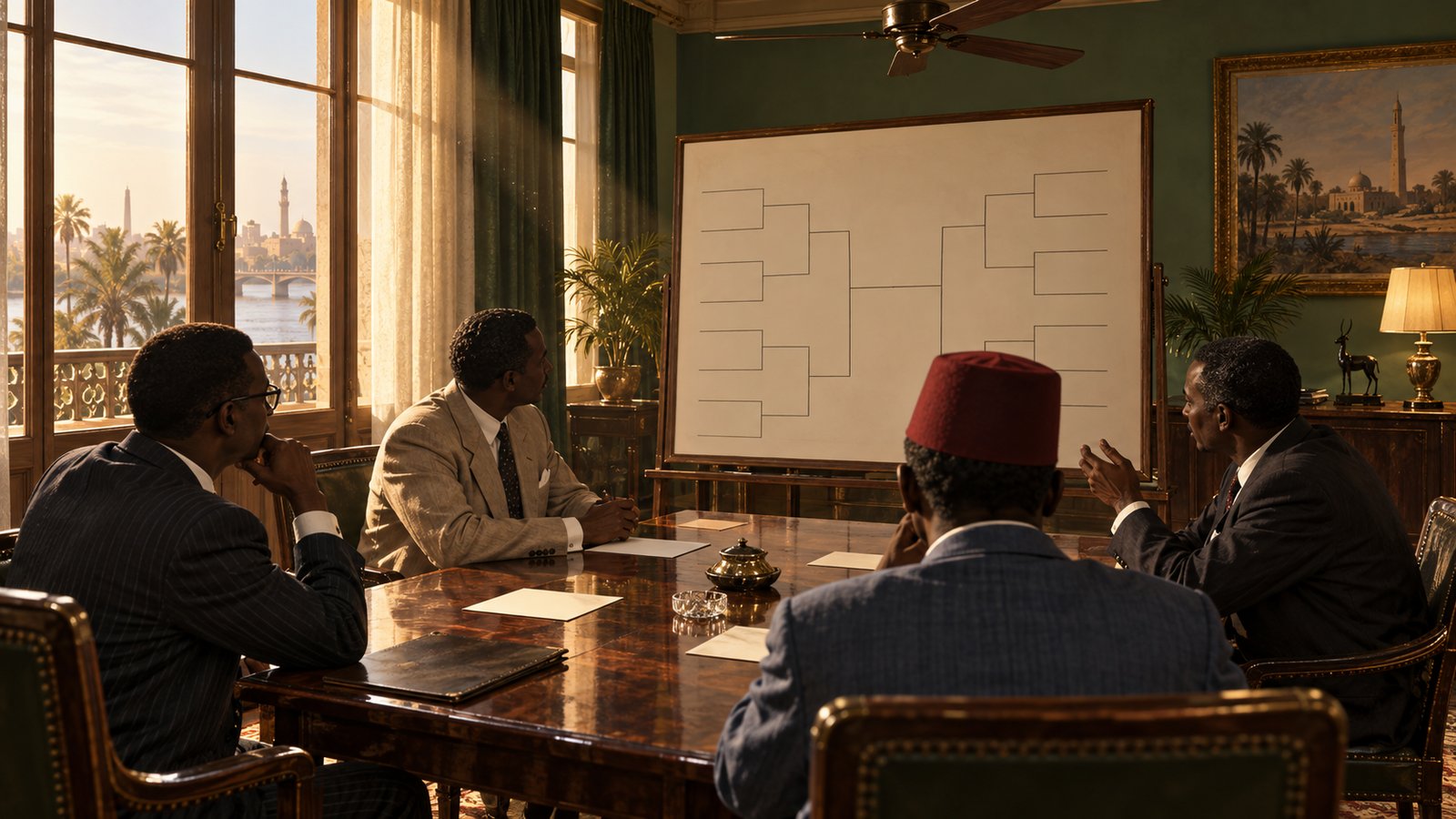
The bracket contained four names, but one semifinal would never kick off. Egypt, Sudan, Ethiopia and South Africa were the only members of the new Confederation of African Football when its first championship assembled in Khartoum in February 1957. There was no qualifying competition because there was nobody else to eliminate.
Then South Africa’s demand to send a team selected along apartheid lines collided with the new confederation’s terms. Its entry was removed. Ethiopia advanced without playing, leaving Egypt and host Sudan to contest the only semifinal. The first Africa Cup of Nations would produce a champion after just two matches, yet those two matches gave a young continental body something more important than scale: an event of its own.
Four Associations Met While Independence Was Still Rare
CAF’s creation and its first tournament were almost the same act. Representatives of Egypt, Ethiopia, Sudan and South Africa had discussed an African governing body around a FIFA congress in Lisbon. They gathered again at Khartoum’s Grand Hotel, where the confederation was founded on 8 February 1957. The opening match of its championship followed two days later.
The political map explains why the membership list was so short. Sudan had become independent on 1 January 1956. Tunisia and Morocco had also reached independence in 1956, but most of the continent remained under colonial rule. Calling the competition a cup of African “nations” therefore expressed an ambition larger than the number of teams available to fulfil it.
Its trophy honoured Abdel Aziz Abdallah Salem of Egypt, CAF’s first president. The host city supplied a single ground, Khartoum Municipal Stadium, for the entire schedule. No regional qualifying paths, seeded pots or television calendar had to be negotiated. Four member associations fitted directly into two semifinals, with the winners due to meet for the title.
That compact plan matters because it separates smallness from informality. Line-ups were recorded, referees came from fellow member nations, and a continental title was at stake. CAF did not wait until its map looked complete. It used the members it had to establish the championship that later generations could enter.
Apartheid Removed One Semifinal From the Bracket
South Africa’s place made the first draw a test of what membership meant. Its government’s racial policy prevented the association from sending a multiracial national team. CAF rejected that condition and disqualified South Africa. Ethiopia, the scheduled opponent, received a walkover into the final.
The decision changed the sporting problem immediately. Egyptian and Sudanese officials proposed replacing the broken knockout bracket with a three-team round robin. A detailed tournament reconstruction by the Rec.Sport.Soccer Statistics Foundation, drawing on the Sudanese newspaper El-Rai El-Amm, records that Ethiopia declined. Having been drawn against the disqualified entrant, it held to the bye the bracket now provided.
That left three teams but only two fixtures. It also established a boundary before CAF possessed wealth, broad membership or a long rulebook. South Africa was not allowed to make racial selection a condition of participation. The country remained outside the Africa Cup of Nations until the end of apartheid, returning to international competition decades later.
The walkover should not be confused with a quiet administrative footnote. It shaped who reached the first final, reduced expected gate income and placed the confederation’s political choice inside the tournament record. Before the cup had seen its first shot, the organisers had defined one kind of team they would not accept.
Khartoum’s Hosts Had One Route to Their Own Final
Egypt and Sudan met at the Municipal Stadium on 10 February in front of a reported 30,000 spectators. The match brought together neighbouring countries with a complicated political relationship, but its football can be followed through three precise moments. Raafat Ateya put Egypt ahead from the penalty spot in the 21st minute. Borai Ahmed Al-Bashir equalised for Sudan in the 58th. Fourteen minutes later, Mohamed Diab Al-Attar — known as El-Diba — restored Egypt’s lead.
The officials themselves illustrated the confederation’s tiny network. Gebeyehu Doube of Ethiopia refereed the semifinal in which Ethiopia was not playing. Sudan’s side was coached by József Háda, a former Hungary international goalkeeper. Egypt’s goalkeeper, Paraskos Trimeritis, was Greek, part of a wider Greek sporting presence in Alexandria, Addis Ababa and Khartoum described in contemporary histories of the competition.
For the home crowd, El-Diba’s 72nd-minute goal closed the only road Sudan had to the trophy. There was no second leg and no third-place match. Egypt won 2–1 and moved into a final against opponents who had reached the same stage without taking the field.
The asymmetry gave the final an unusual rhythm. Egypt had played a pressured match before a host crowd; Ethiopia had waited. The organisers allowed several days between fixtures, and a Sudanese referee, Mohammed Youssef, took charge of the decider. The tournament’s entire competitive history still occupied one score sheet when the teams emerged again in Khartoum.
El-Diba Scored Every Goal in the Decider
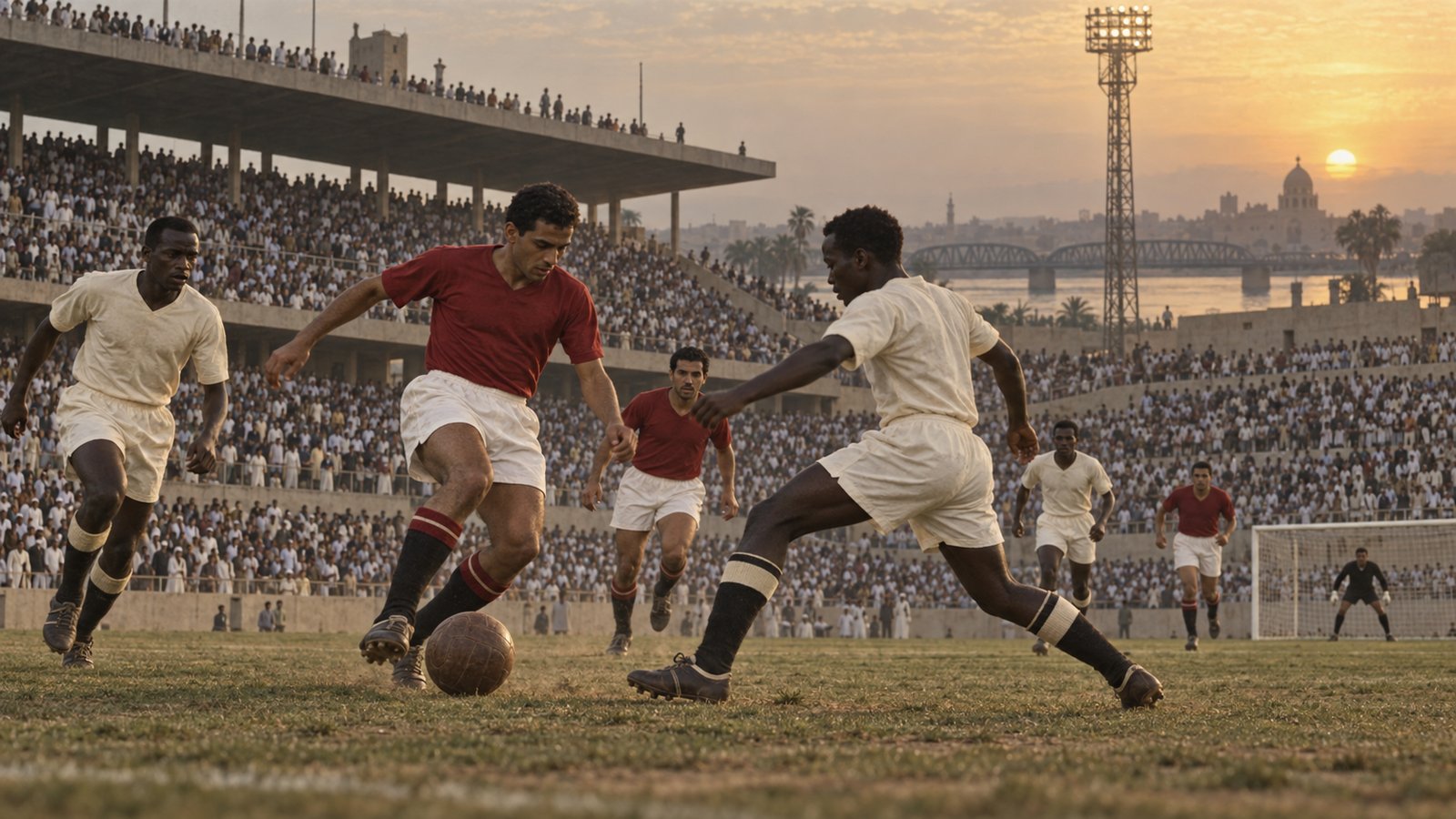
The final belonged to one forward and four separate timestamps. El-Diba scored in the second minute and again in the seventh, removing Ethiopia’s advantage of rest almost as soon as the match began. He added two more goals in the 68th and 89th minutes. Egypt won 4–0, and the same player who had decided the semifinal finished the tournament with five goals.
Five goals in two appearances made El-Diba the first Africa Cup of Nations top scorer. More strikingly, he scored every goal in the final. Egypt’s other tournament goal had come from Ateya’s penalty against Sudan, so two men accounted for the champions’ complete total of six.
The numbers make the competition look like a miniature: three participants, two matches, six days of waiting and playing, one venue. They also make individual contributions unusually visible. There is no long group stage to blur El-Diba’s role. Egypt needed a winner against the hosts and four goals against a rested finalist; he supplied all five.
A friendly between Sudan and Egypt followed after the tournament, reportedly arranged to offset financial losses caused by South Africa’s absence. Sudan lost 4–3. It did not change the cup record, but it reveals how much one missing semifinal mattered to an event dependent on a single stadium’s receipts.
Two Matches Were Enough to Create a Tradition
The inaugural tournament cannot be measured fairly against the modern Africa Cup of Nations. Its achievement was not competitive depth. It was continuity. A confederation founded days earlier completed a championship, named a winner and left behind a format that could expand as more countries became independent and their associations joined.
Ethiopia’s place in that beginning did not end with a walkover and a heavy defeat. The country appeared in each of the first seven editions and won the tournament at home in 1962. Egypt retained the title in 1959. Sudan, the first host, became champion in 1970. All three participants in Khartoum eventually lifted the cup.
The later scale gives the two-match origin its force. What began with one stadium and four founding associations grew into the continent’s principal national-team competition. The Ghost Goal’s account of Zambia’s 2012 victory in Libreville belongs to the same history, but its qualification rounds, global audience and crowded finals field would have been unimaginable inside the Grand Hotel meeting of 1957.
The first cup also joined football administration to a clear political consequence. South Africa’s exclusion damaged the schedule and the gate receipts, yet CAF did not repair the bracket by accepting an apartheid-selected side. Ethiopia kept its bye, Egypt beat the hosts, and El-Diba settled the final. The tournament was improvised because its world was unfinished. Completing it anyway was the durable result.
Sources
Rec.Sport.Soccer Statistics Foundation; BBC Sport; FIFA; l’Opinione Pubblica; Wikipedia.