
The 1925 Offside Change Did Not Just Create More Goals
The Rule Change That Moved the Whole Pitch
The 1925 offside law change looks, from a distance, like a minor edit to a sentence. Before it, an attacker generally needed three opponents between himself and the goal line when the ball was played. After it, two were enough. The difference sounds like one defender on paper. On grass, it changed where defenders stood, how forwards timed runs, and why managers started drawing shapes that looked less like inherited habit and more like deliberate machinery.
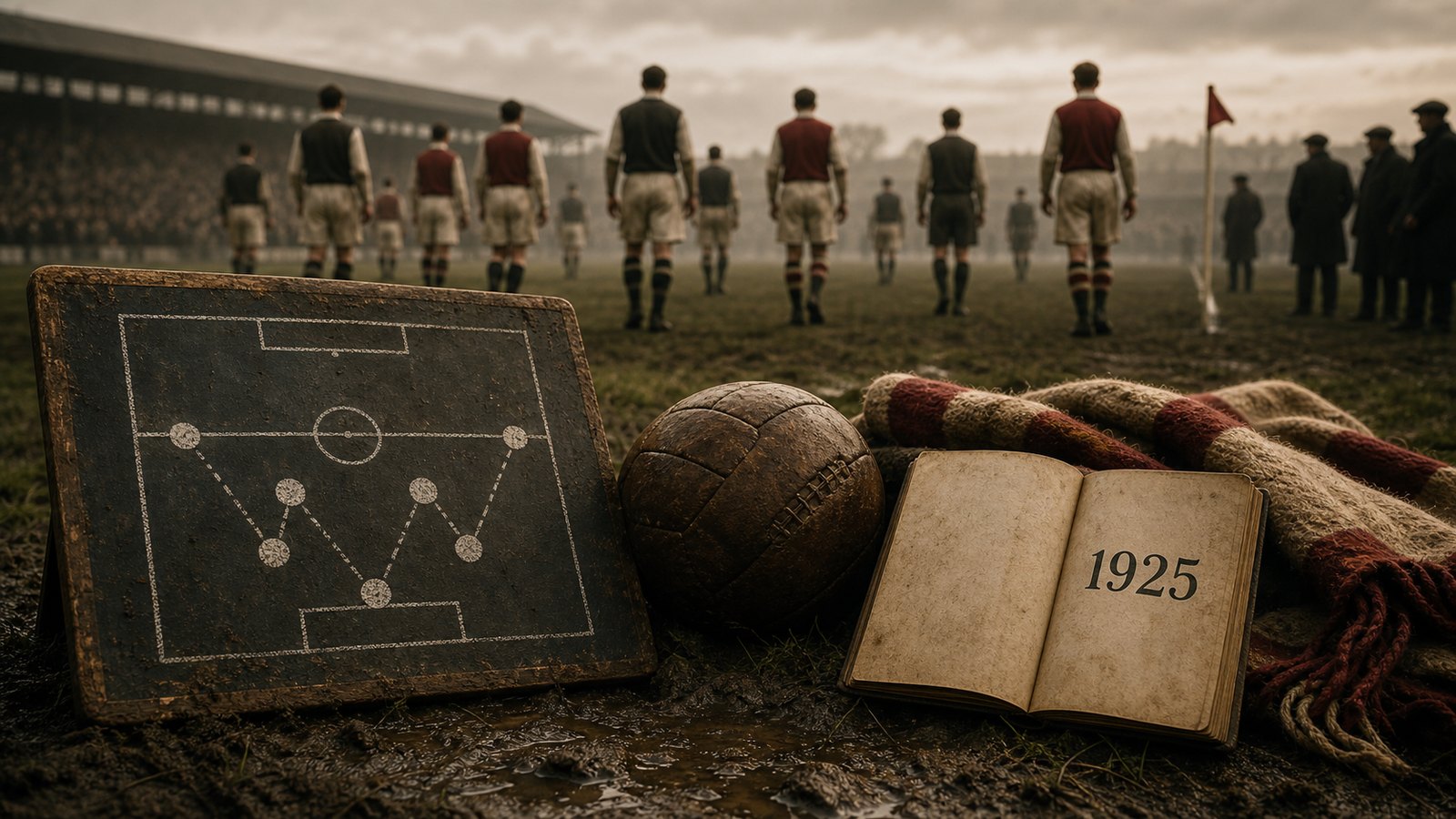
The Football Association did not rewrite the law because it wanted a tactical revolution. The stated aim was to bring goals back into a game that many administrators considered too cramped and too easy to kill with a disciplined line. Yet football rarely absorbs a rule change politely. Once attackers could live closer to goal, the old center-half could no longer wander as a broad midfield policeman without leaving the last line exposed. That pressure helped create the W-M: three defenders, two half-backs, two inside forwards, and three attackers arranged in a shape that made the pitch feel newly divided into compartments.
Why One Missing Defender Mattered
The old three-opponent requirement rewarded the back line that stepped together and squeezed forwards into a trap. The 1925 change did not abolish offside. It made the trap riskier. A forward who had once been clearly illegal could now stand level with the second-last opponent and threaten the space behind. That extra yard altered the psychology of defending. Center-halves had to think about the channel behind them, not only the man in front of them.
This is why the change mattered more than a simple scoring bump. It forced a redistribution of responsibility. Full-backs could no longer cover every emergency as a pair. The center-half, once associated with supplying and contesting midfield, began to drop into the defensive line. Half-backs narrowed their jobs. Inside forwards became connectors rather than just another layer of attackers. The alphabet shape later attached to Herbert Chapman’s Arsenal was not magic chalk. It was a practical answer to a law that had pulled the game lengthwise.
Chapman’s Arsenal Made the Answer Famous
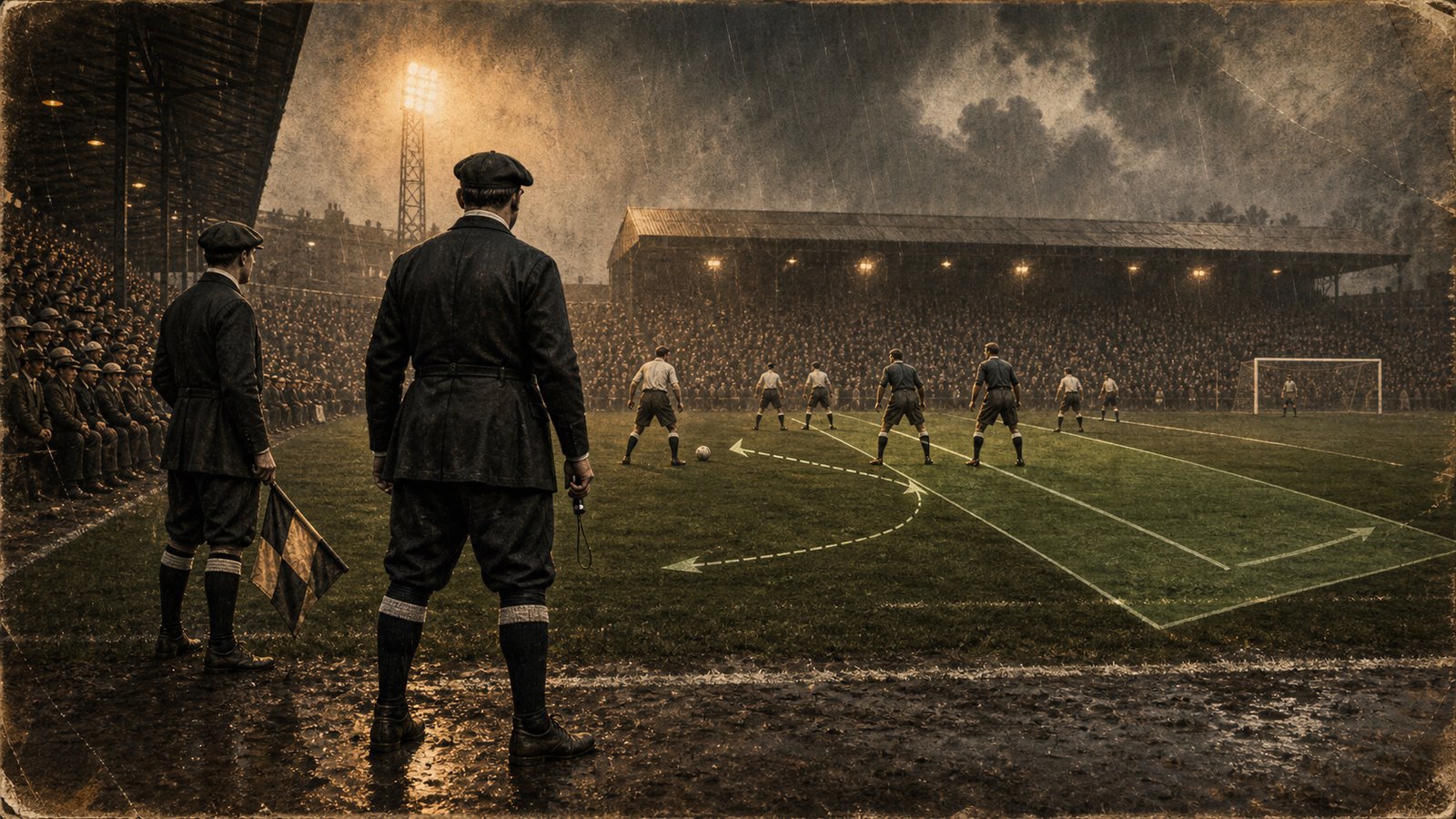
Herbert Chapman did not invent every idea that later gathered under the W-M label, but his Arsenal made the system famous because it combined shape with recruitment, coaching, and match-day discipline. The center-half could become a stopper. The inside forwards could pass, arrive, and press. The wingers could stretch the field while the center-forward threatened the now more generous offside line. Arsenal’s red shirts became a visual shorthand for the modern manager’s hand on the game.
The important point is not that one man saw everything before everyone else. It is that the new law created a competitive problem, and clubs with sharper organization solved it faster. Teams that still treated formation as a list of positions were suddenly facing opponents who treated it as a chain of cause and effect. If the center-forward pulled a stopper away, the inside forward could enter. If the full-back jumped, the winger had a channel. If the half-back hesitated, the whole W-M hinge opened.
Goals Rose, but Control Became the Prize
Contemporary accounts and later histories often note that goals increased after the change. That is true, but it can hide the deeper consequence. The law encouraged attacking play, then made defensive structure more valuable because the old structure had been weakened. Football did not simply become looser. It became a contest to restore control under new conditions.
The W-M was one restoration. It gave defenders a spare man where the law had created danger, while keeping enough players high to punish opponents who retreated too far. It also changed the type of footballer managers valued. A center-half needed timing and positional sense. Inside forwards needed the judgment to decide when to drop and when to break. The game was moving away from fixed labels and toward roles that only made sense in relation to each other.
The Tactical Revolution Was Also a Language Revolution
The 1925 change helped make football more discussable. Once shapes became arguments, newspapers, coaches, and supporters had a new vocabulary. A team could be brave or reckless depending on where its center-half stood. A winger could be isolated or liberated depending on whether the inside forward connected play. The white chalk lines on a board became a way of explaining why a match felt different, not just where eleven men began it.
That is the real inheritance of 1925. The W-M was eventually challenged, bent, and replaced by other systems, but the idea that a rule change could force a whole tactical ecosystem to adapt never went away. Every later debate about back fours, sweepers, pressing lines, and rest defense carries a trace of that moment. Football discovered that a small legal phrase could move the entire pitch.
Why the Story Still Feels Modern
Modern football lives inside rule adjustments: back-pass restrictions, substitutions, VAR protocols, added-time guidance, and interpretations of handball or offside. Each change begins as governance and becomes tactics. Coaches look for the edge between what the law permits and what opponents have not yet solved. The 1925 offside rewrite is one of the cleanest early examples because the causal line is so visible.
The change did not create modern football by itself. It did something more interesting. It exposed how quickly football can reorganize when the geometry of risk changes. A missing defender in the law became a new defender in the formation. A rule intended to produce more goals produced a new obsession with structure. The W-M was not a museum piece. It was football learning how to think in systems.
The Innovation Was Uneven Before It Was Obvious
Not every club copied the same answer at the same speed. Some sides still trusted the older habit of individual duels, while others experimented with deeper center-halves and more deliberate links between the half-back line and the inside forwards. That uneven adoption is part of the story. A tactical revolution rarely arrives as a memo. It appears first as confusion: one team suddenly has an extra passing lane, another keeps being caught square, and supporters argue whether the new shape is clever or cowardly.
The W-M also changed the rhythm of risk. A team could invite pressure, win the ball, and release wide players into space that the newer offside line made harder to police. It was not modern counter-pressing, but it was a recognizable ancestor of football’s later obsession with transition moments. The rule created more room for attackers; the best coaches then asked how to control the first pass after regaining possession. That question still sits at the heart of elite football.
The Human Detail Behind the Diagram
It is easy to draw the W-M as if chalk solved the problem by itself. The players had to live inside the diagram. A stopper dropping deeper needed the humility to abandon older prestige. Inside forwards needed the legs to connect midfield and attack. Wingers needed patience when the ball stayed inside and ruthlessness when the channel opened. The law may have changed overnight, but the body habits took longer. A defender’s first glance, a forward’s curved run, and a half-back’s angle of support were where the revolution became real.
Sources
- International Football Association Board, Laws of the Game discussions on offside amendments
- Jonathan Wilson, Inverting the Pyramid
- The Football Association historical summaries of the offside law
- Arsenal historical material on Herbert Chapman and tactical organization