

Wembley was half-asleep when the ball began to fall. Only about 20,000 people had filtered into the old stadium for England’s Wednesday-night friendly with Colombia on 6 September 1995. Jamie Redknapp’s contact was neither a shot nor a useful cross. It floated toward René Higuita, and even the commentary gantry seemed to expect the goalkeeper to collect it and return the evening to its goalless rhythm.
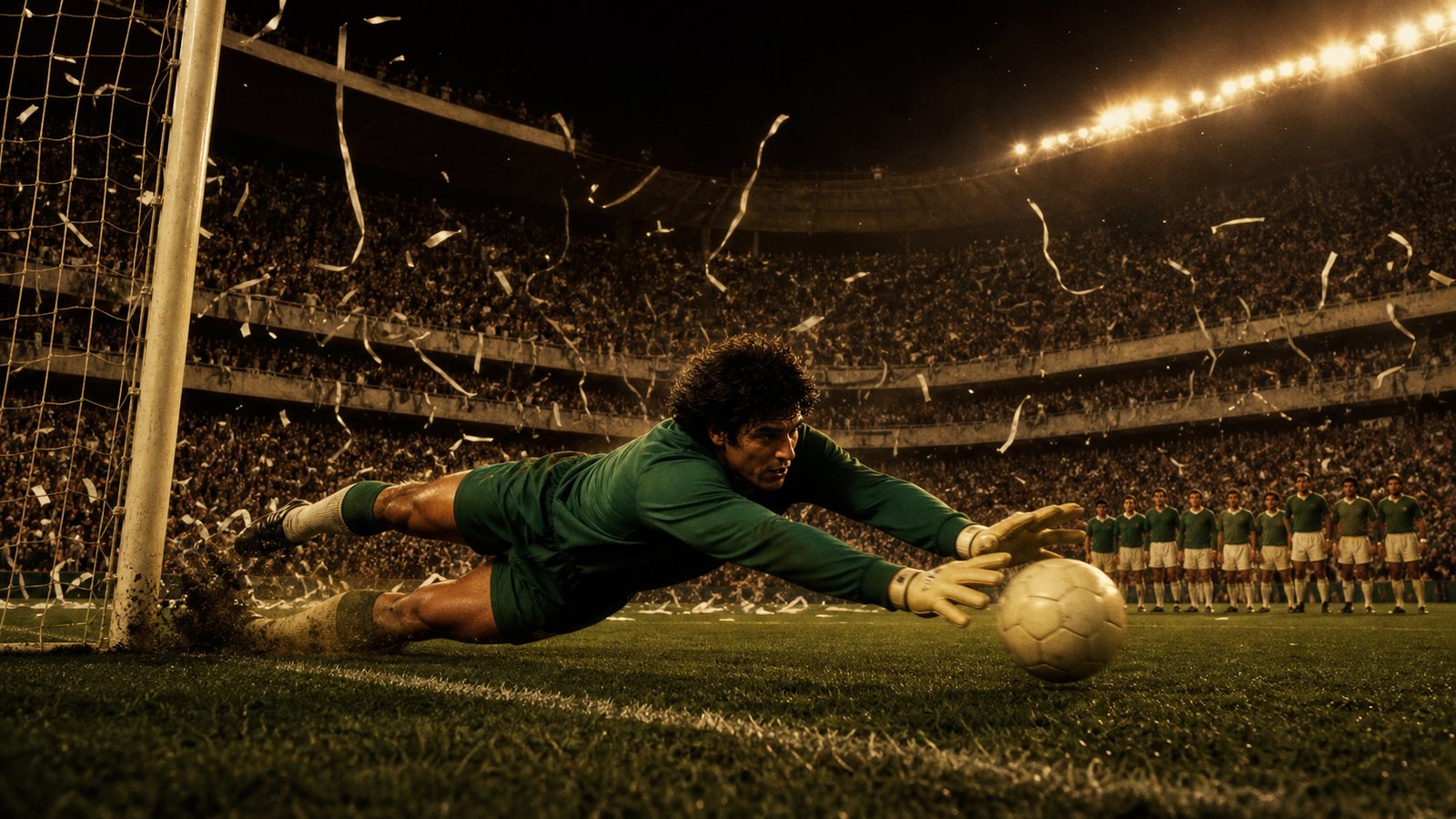
Instead, Higuita let the ball travel over him, threw his chest toward the turf and snapped both heels upward. For a fraction of a second, goalkeeping appeared upside down. His boots struck the ball away; his gloved hands broke the fall. England coach Bryan Robson laughed on the bench. Commentator Martin Tyler, seeing the assistant’s raised flag, initially wondered whether the whistle had gone. It had not. The game continued, but its ordinary logic never quite recovered.
The Ball That Arrived Too Kindly
The familiar clip can make the act look like a response to danger. It was almost the opposite. Redknapp’s delivery was tame enough for a routine catch, and the assistant referee’s flag may have offered Higuita a hint that the moment carried less competitive risk than it appeared to. The score remained 0–0. Nothing about the friendly required invention.
That is precisely what gave the choice its force. A conventional save would have vanished with the rest of the match. Higuita recognized a ball that matched a movement he had rehearsed and chose performance over efficiency. The stadium’s emptiness sharpened the effect: floodlight haze, scattered spectators and a drifting cross created a stage with room for one impossible silhouette.

The action was not spontaneous in the simple sense. According to Higuita’s later account, its seed appeared while he was filming a soda commercial with children in Colombia. A child bicycle-kicked a ball toward him, and the goalkeeper instinctively flung his legs behind his back to send it away. He then practiced the motion in training and warm-ups for roughly two years. Wembley supplied the right ball, not the first attempt.
Two Years Hidden Inside One Second
The scorpion kick worked because rehearsal had reduced a circus trick to a usable physical sequence. Higuita had to judge the ball’s slow drop, turn his back on it, commit his weight forward, synchronize both heels and place his hands before impact with the ground. Any one of those timings could have produced embarrassment. Together they produced an image clear enough to be understood without replay.
Its origin also suited the goalkeeper. Higuita had begun as an outfield player and moved into goal only when a teammate was injured. He carried the habits of a footballer into a position still widely defined by handling, angles and caution. On grainy Colombian footage he can be seen leaving his box to tackle, head the ball, exchange passes and dribble into areas where goalkeepers were expected to feel exposed.
This was not a decorative trait attached to an otherwise conventional career. With Atlético Nacional in the 1989 Copa Libertadores final, Higuita saved four penalties and scored one during the shootout victory over Olimpia. The triumph made Nacional the first Colombian club to win the competition. The same player who treated the penalty area as an elastic boundary could also decide a continental final through the traditional goalkeeper’s task of reading a kick.
The Cost Was Part of the Character
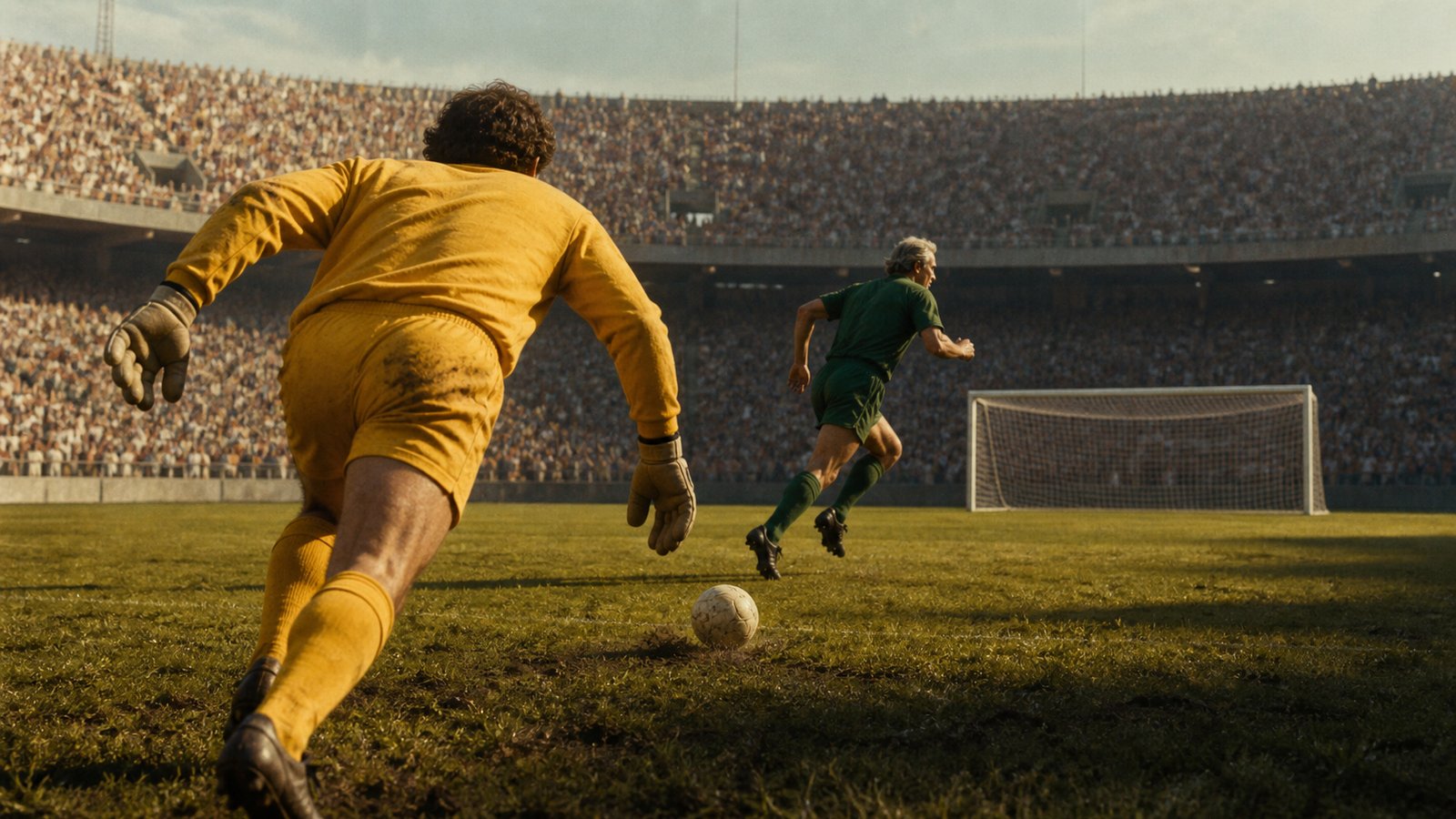
Higuita’s freedom carried an obvious bill. At the 1990 World Cup, Colombia reached the last 16 for the first time and met Cameroon. In extra time, with Roger Milla already having scored once, Higuita received the ball well outside his area. His touch escaped him. Milla stole possession, ran clear and supplied Cameroon’s decisive second goal.
That episode matters because Wembley cannot be understood as a safe stunt detached from consequence. Five years earlier, the same refusal to stay home had helped eliminate Colombia. Higuita later accepted responsibility in public, saying he would take criticism as he took praise. He did not retreat into the six-yard box afterward. The mistake remained visible, and so did the conviction behind it.
The contrast is sharper when set beside Cameroon’s wider 1990 World Cup breakthrough. Milla’s theft represented the veteran forward’s opportunism and Higuita’s exposure at once. One man saw an unguarded route; the other had made that route possible by insisting that a goalkeeper could participate in the field rather than merely protect its end.
A Goalkeeper Before the Vocabulary Caught Up
Modern football now has a comfortable phrase for much of what Higuita attempted: the sweeper-keeper. Teams ask goalkeepers to stand high, receive under pressure and create an extra passing option. Coaches measure decisions that once looked like eccentric intrusions into outfield territory. Higuita’s version was less controlled and far more theatrical, but its central question feels current: why should the penalty-area line define the limits of a goalkeeper’s technique?
The 1992 back-pass rule accelerated that question by preventing goalkeepers from simply picking up a deliberate kick from a teammate. Higuita later argued that the rule change and his famous scorpion both helped alter how the role was imagined. That is his interpretation rather than a clean line of causation. The sport was moving through many tactical and legal pressures. Yet his career offered a vivid demonstration before the new vocabulary became ordinary.
BBC Sport credits him with 43 career goals, including three for Colombia, mostly from penalties and free kicks. Those numbers locate the scorpion inside a long pattern rather than a one-night novelty. He crossed positional boundaries repeatedly: starting attacks, taking set pieces, leaving his box and accepting the danger created by each choice.
There is also a difference between expanding a role and merely ignoring it. Higuita still had to read the penalty, organize his body and protect the goal. His four saves in Nacional’s 1989 shootout were not rebellion against goalkeeping; they were its most concentrated form. The dribbles and set pieces enlarged that base. This is why the scorpion could be comic without feeling empty: the audience was watching a specialist manipulate a task he had already mastered in its severe, conventional version.
The Friendly Disappeared, the Gesture Stayed
Most scoreless friendlies decay into line-ups and record books. England against Colombia survived as a body shape. In 2002, Channel 4 placed the scorpion kick at number 94 in its list of 100 Greatest Sporting Moments. The ranking is less important than the category: a clearance in a low-attendance friendly had become a sporting event in its own right.
The broadcast confusion became part of the memory. Tyler recalled that nobody in real time expected a goalkeeper to choose such a movement, while the raised flag made the gantry wonder whether play had already stopped. Robson’s laughter supplied a second reaction: not outrage at needless risk, but disbelief that the move had landed cleanly. Those responses explain why the clip needs almost no setup. Spectators understand the normal answer before Higuita rejects it, then share the witnesses’ delayed realization that the strange answer actually worked.
Its durability comes from tension packed into one readable gesture. The move was comic and technically demanding, unnecessary and carefully prepared, reckless in appearance and controlled in execution. It also carried the rest of Higuita’s career inside it. Viewers who knew the Milla mistake could see defiance. Those who knew only the clip could still recognize a goalkeeper refusing the approved solution.
After landing, Higuita rose with the grin of someone whose private rehearsal had finally found its public second. No goal had been prevented that a catch could not have stopped. No tournament changed direction. But one routine ball exposed how much imagination the position had been leaving unused. Wembley went back to its goalless evening; goalkeeping kept the image.
Sources
BBC Sport; The Guardian; City A.M.