
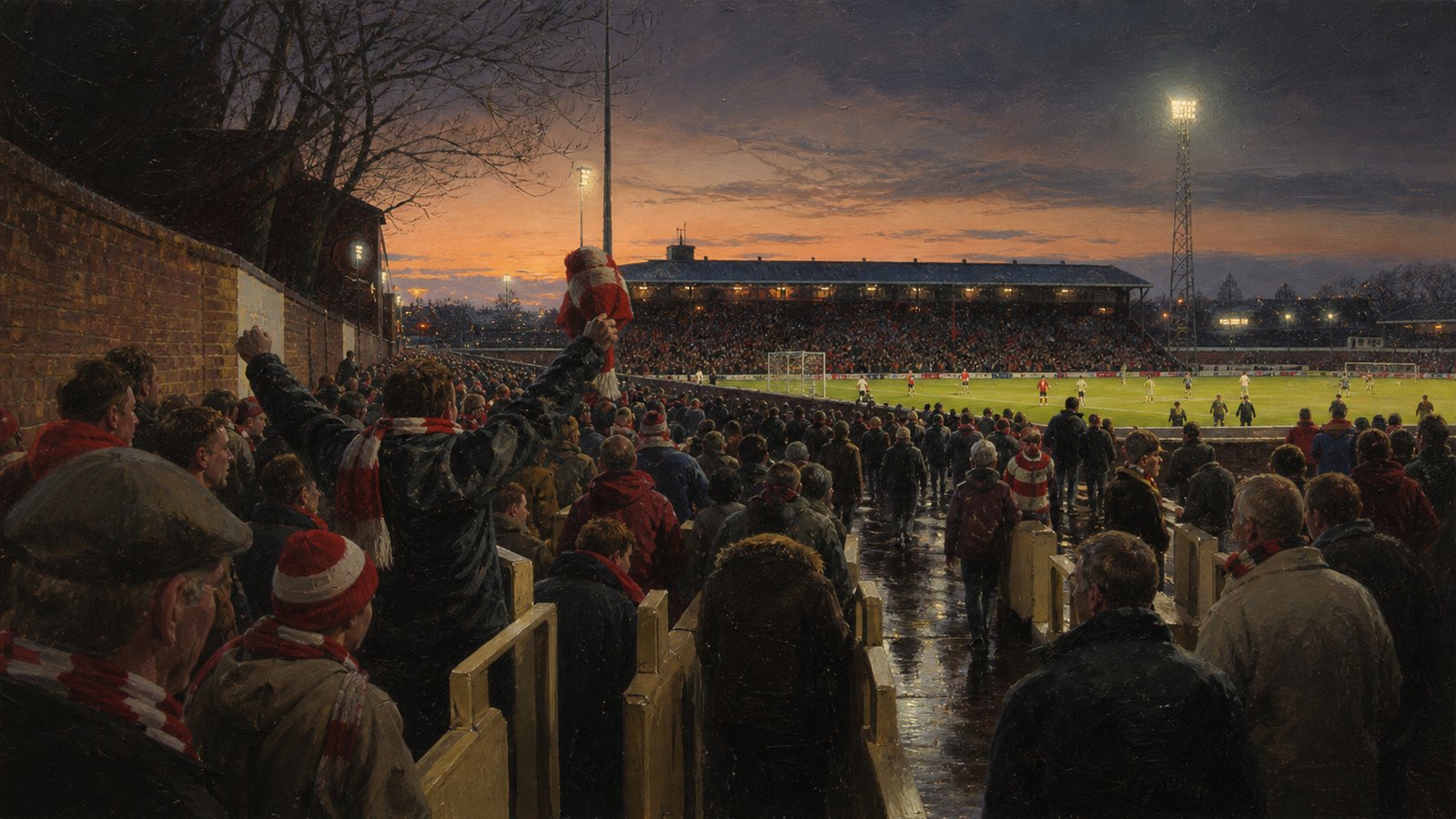
The football club had left, but the argument stayed behind. For seven years, Charlton Athletic’s supporters travelled away from SE7 for home matches while the old terraces of The Valley sat in the place where memory said Saturday ought to happen. The decisive contest was eventually played not on grass but across the streets and council wards of Greenwich.
In May 1990, sixty Charlton supporters stood as local-election candidates for a new, single-issue organisation called the Valley Party. They knew they were unlikely to win a council seat. Winning office was almost beside the point. Their campaign was designed to make one planning decision impossible to ignore.
The last afternoon became a protest
Charlton’s separation from The Valley began in the financial disorder of the 1980s. The club faced a High Court bankruptcy hearing in March 1984 and survived only when a rescue package was approved shortly before a Football League deadline. Survival did not settle the future of its ground. The new board could not retain the freehold from former chairman Michael Gliksten, while parts of the ageing stadium required work.
In September 1985, supporters were told that Charlton would move to Crystal Palace’s Selhurst Park. The announcement turned the home match against Stoke City on 21 September into something closer to a wake. Charlton won 2–0 and Robert Lee scored the final goal, but supporters invaded the pitch in protest at half-time and again after the match. A place built in a former chalk pit with supporters’ labour was being emptied without their consent.
The team could still succeed. Lennie Lawrence led Charlton into the First Division in 1986, the club’s first return to the top tier in 29 years. Yet promotion sharpened the contradiction. A top-flight club was staging its home fixtures at another club’s ground, several miles from its own community.
Selhurst Park supplied turnstiles, floodlights and a playable surface. It could not reproduce the habit of approaching Floyd Road, seeing familiar neighbours or occupying the same patch of terrace. Ground-sharing converted every nominal home game into a journey through somebody else’s geography.
A planning rejection changed the kind of campaign
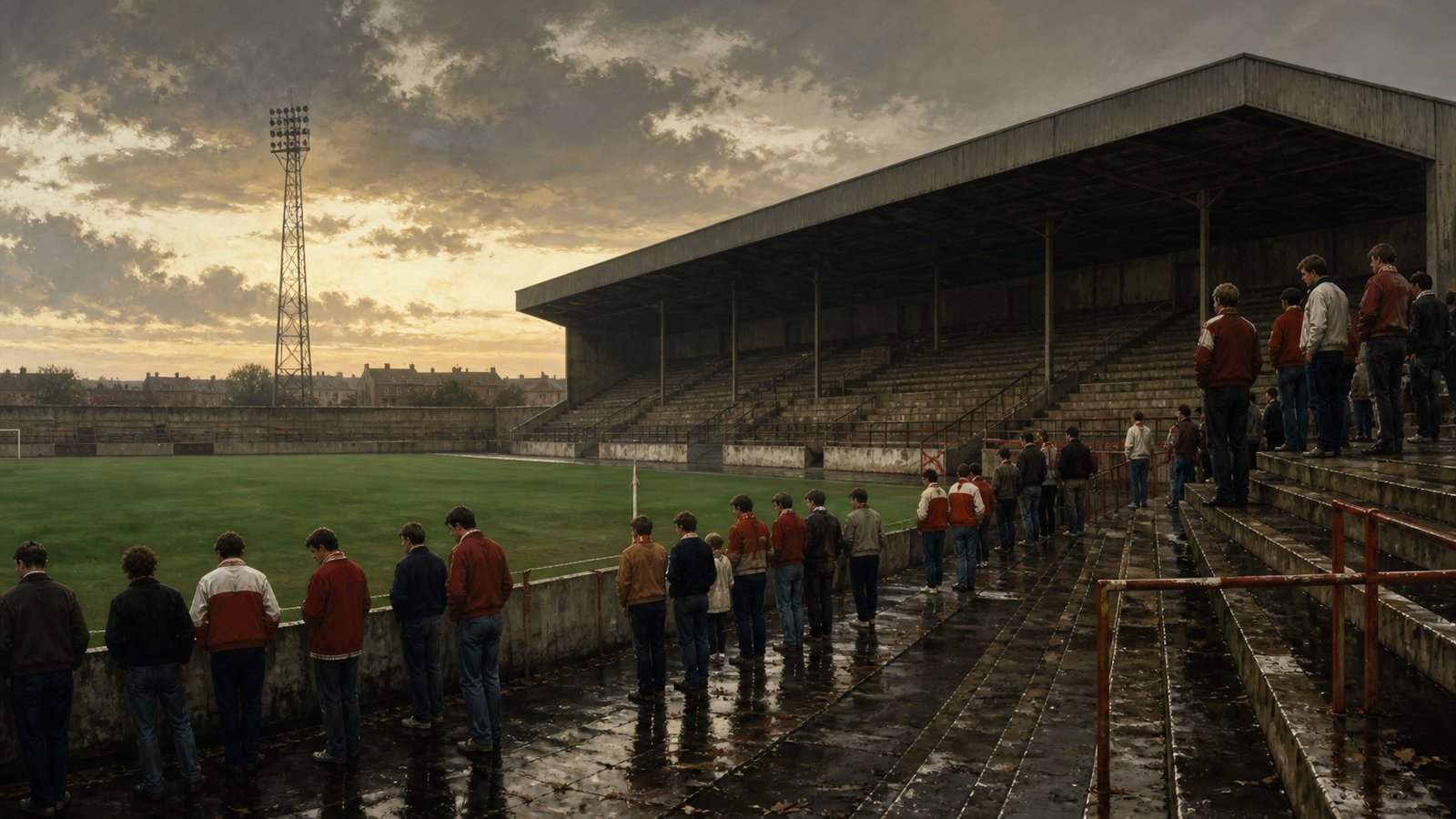
Supporters did not spend the exile merely waiting. Roger Alwen and Mike Norris secured the freehold of The Valley in 1988, creating a practical route back, but the stadium needed redevelopment. In 1990, Greenwich Council rejected the planning application. That decision moved the dispute from football administration into local politics.
The response was deliberately strange. The Valley Party had no broad programme for schools, refuse collection or taxation. It existed to force attention onto Charlton’s return. Its organisers planned to contest every one of Greenwich’s 36 wards and ultimately fielded sixty candidates. Three-quarters of Charlton supporters lived outside the borough, so the campaign could not rely on a concentrated block of resident season-ticket holders. It had to persuade ordinary voters that the ground mattered to the area.
This was also an era before social media could distribute a clip overnight. Rick Everitt, editor of the Voice of The Valley fanzine, used a weekly newspaper column to keep the issue visible. Sports editor Peter Cordwell gave the campaign space in the local Mercury. Richard Hunt of the advertising agency BMP DDB Needham helped produce a poster campaign strong enough to win recognition beyond football.
The election was therefore not a symbolic petition with candidate names attached. It required nomination papers, ward organisation, leaflets and bodies on streets. Meetings at the Meridian Sports and Social Club could be chaotic. Some supporters were effectively pressed into standing. The machinery of a real election had to be built by people whose shared qualification was that they wanted their club back home.
A robin, a bus and three leaflets for every address
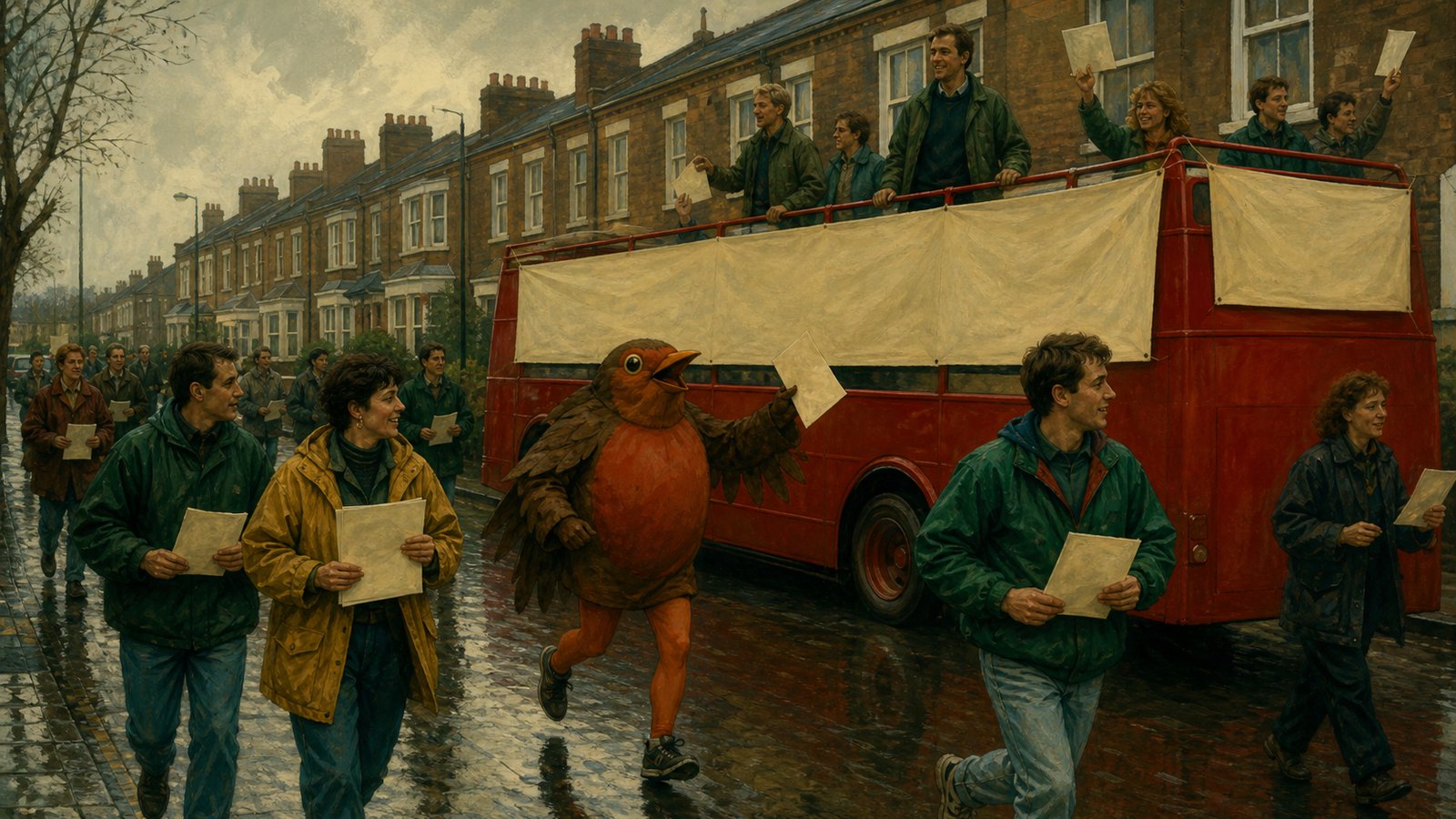
The campaign’s details explain why it cut through. Former Charlton forward Sailor Brown posed with a spade on the Valley pitch for the media launch. An open-topped bus crossed the borough carrying Vote Valley banners. A supporter dressed as a robin canvassed shoppers in Woolwich. Activists undertook the enormous job of delivering three different election leaflets to every address.
Those images made a technical planning case visible. A decaying football ground and a disputed application could sound remote from daily life. A bus, a mascot and a shovel turned it into a public argument about whether a community institution should be allowed to return.
The campaign was not politically comfortable. Greenwich was largely Labour-controlled, so Valley material often targeted Labour even though many Charlton activists normally supported the party. Conservatives had also opposed the stadium plan. The borough still contained a Social Democratic Party presence, including local MP Rosie Barnes. Football loyalty cut across the alignments that usually organised a council election.
In Sherard ward, the contest became a straight fight between Labour and Valley. Kevin Fox received 992 votes but did not unseat council leader Quentin Marsh. Elsewhere, the Valley vote divided margins even when it won no seat. The party’s purpose was being fulfilled in the count itself: candidates who might once have treated the stadium as one planning file now had to calculate its electoral weight.
Fourteen thousand eight hundred and thirty-eight votes made the issue measurable
On 3 May 1990, the Valley Party received 14,838 votes, 10.9 per cent of those cast. It won no council seats. Measured like a conventional political party, that sounds like defeat. Measured against its actual objective, it was a demonstration of organised pressure that could not be dismissed as noise from a few nostalgic supporters.
The total gave the return campaign a number. It showed that volunteers with modest funds could put the ground in front of tens of thousands of voters. The Institute of Practitioners in Advertising later described the poster-led effort as a small volunteer campaign with remarkable election results. The club had offered little understanding or support at the beginning; the supporters made their own leverage.
Local elections are usually remembered through seats gained and councils controlled. The Valley Party used a different scoreboard. Every ward contested widened the argument. Every vote established that rejecting the stadium had a public cost. Losing all sixty candidacies did not erase the message because office had never been the only prize.
The strategy also altered what supporter activism could look like. Fans were not asking a wealthy owner to purchase a star or remove a manager. They were learning planning language, buying poster space, canvassing strangers and exploiting the formal machinery of representative government. The object of devotion was a football ground, but the tools were civic.
The return took another thirty-one months
Planning permission was approved at Woolwich Town Hall on 2 April 1991. Approval did not instantly make the old ground fit for league football. Charlton spent part of the following period at West Ham United’s Upton Park while reconstruction continued. Supporters helped clear debris and prepare The Valley, extending a tradition that reached back to the ground’s beginnings in 1919.
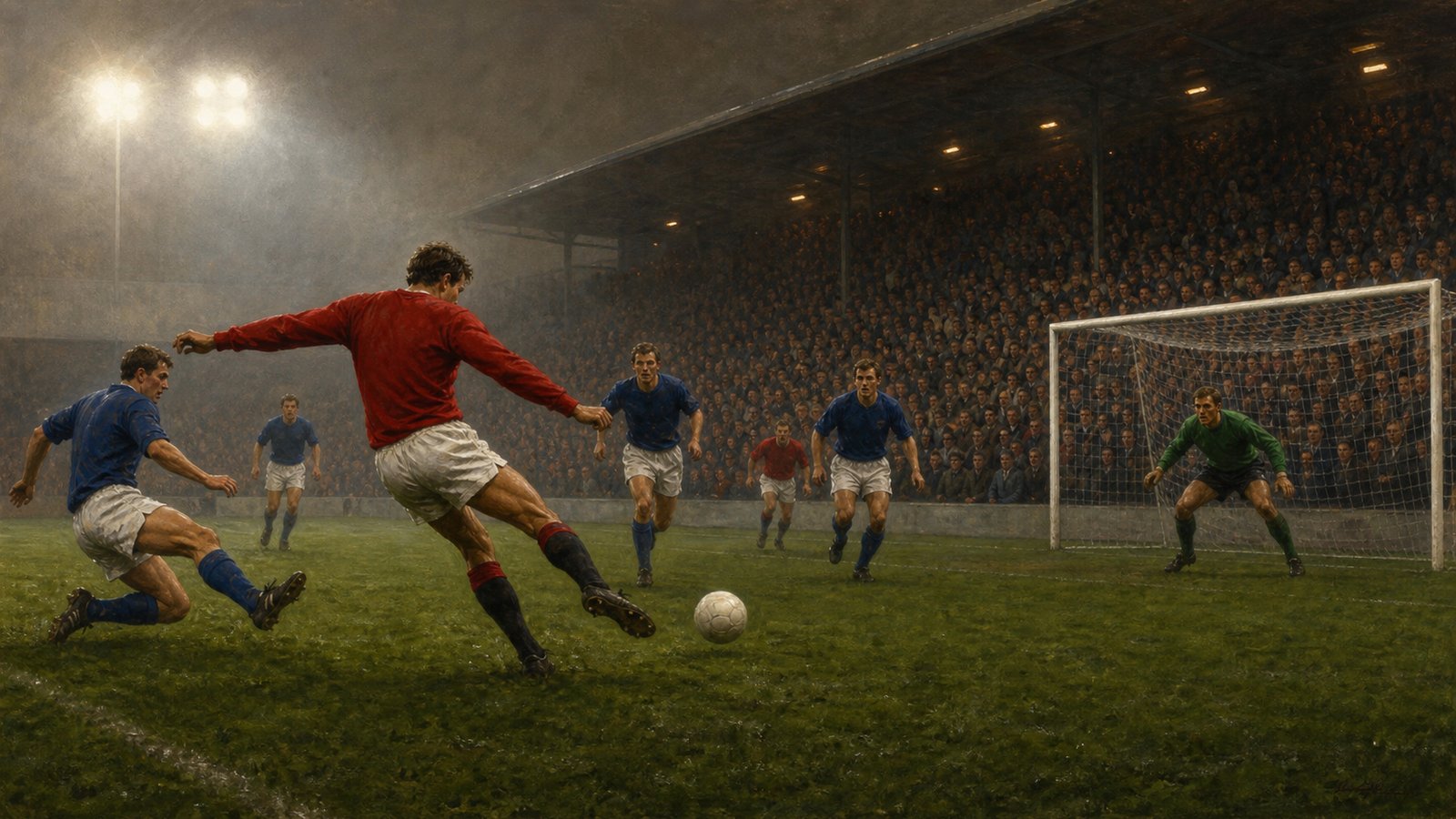
The homecoming finally arrived on 5 December 1992, seven years after the departure. The opponent was Portsmouth. The crowd was 8,337. In the seventh minute, Darren Pitcher laid the ball back to Colin Walsh, who drove the only goal of a 1–0 victory from the edge of the penalty area.
That score was modest beside Charlton’s extraordinary 7–6 comeback against Huddersfield, but spectacle was not required. The meaning lay in the ordinary components of a home match returning at once: the walk, the turnstiles, the view down the slope and a Charlton player scoring at the correct end of Charlton’s own city.
The Valley Party had dissolved after its election intervention, yet its campaign remained embedded in the reopened ground. The supporters had shown that a ballot could be used without expecting parliamentary power, and that losing every seat could still change the terms of a decision. Charlton returned because finance, ownership, planning approval and reconstruction finally aligned. The election campaign made sure the people controlling those pieces could no longer pretend the ground was merely property.
Sources
Charlton Athletic club history; Charlton Athletic Supporters’ Trust; BBC London; Institute of Practitioners in Advertising; London Football Scene.