
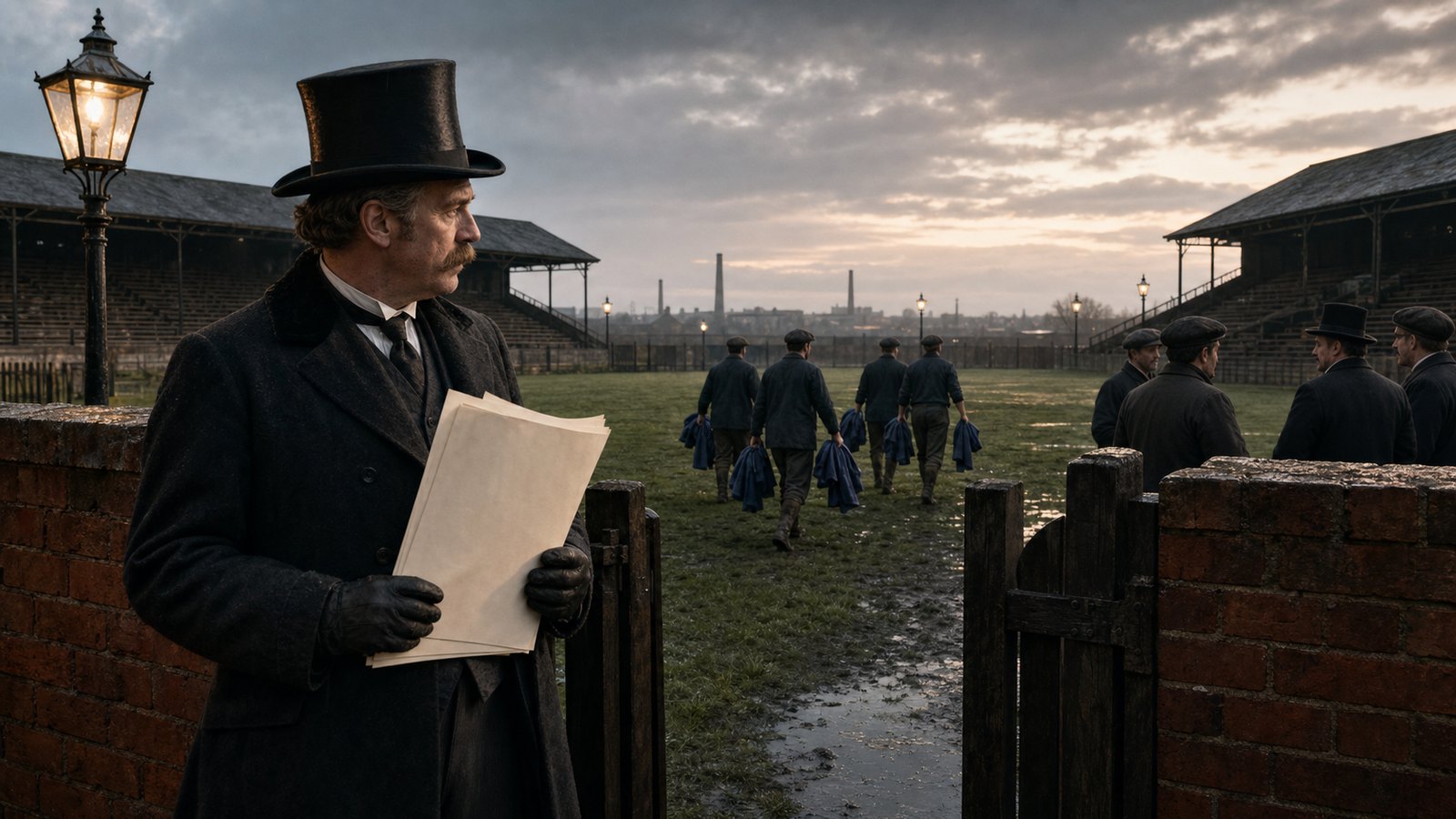
On 12 March 1892, John Houlding arrived at an Everton members’ meeting knowing that the room was against him. George Mahon, a leader of the opposing faction, offered him the chair. Houlding declined with a line that captured how far relations had deteriorated: he was there “on a trial,” he said, and a criminal did not take the chair. He left, followed by a small minority. Everton still existed, but the man closely associated with its home no longer controlled the club that played there.
The familiar summary is that Everton abandoned Anfield because the rent went up, leaving Houlding to create Liverpool. The figures matter, but they are only the visible edge of the dispute. Beneath them sat harder questions about who should own the ground, who could profit from matchday business, whether a growing club should remain a members’ institution, and how much leverage belonged to the person who controlled its most valuable physical asset.
The outcome separated identity from property. Everton’s majority kept the club, its Football League place and much of its football organization, then built a new home at Goodison Park. Houlding kept Anfield. An empty ground, however, could not play fixtures or draw a crowd. To make the property useful, he needed a new company, a new name and an entirely new team.
A Champion Club on Ground It Did Not Control
Everton had reached Anfield long before Liverpool FC existed. The club moved there in 1884 after using a field at Priory Road, where noisy matchday crowds had become unwelcome. Houlding, a brewer, businessman and local political figure, helped arrange the new site through another brewer and landowner, John Orrell. The move gave Everton space to grow as organized football acquired a national framework.
When the Football League began in 1888, Everton were one of its 12 founding clubs and Anfield was one of its original grounds. Three seasons later, Everton won the 1890–91 championship there. That success changed the scale of the argument. This was no longer a small local side negotiating informally over a field. It was a league champion attracting crowds, collecting gate money and needing a ground capable of further development.
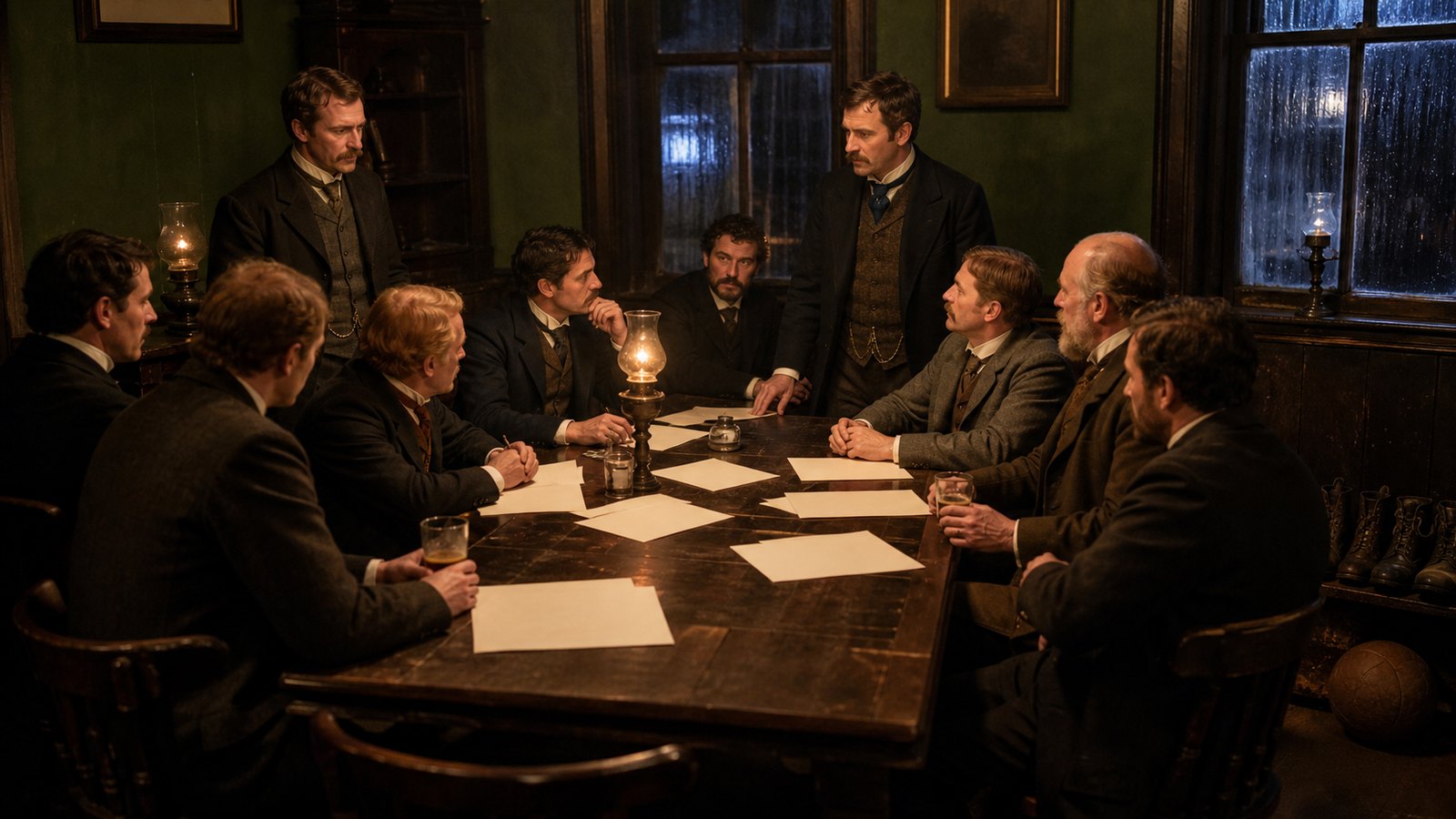
The club’s dependence was easy to see in the rent. Everton paid £100 in 1884. By 1889–90, the annual charge had reached £250. A rise of that size naturally became a rallying point for Houlding’s critics, yet the relationship was more entangled than a landlord sending a larger bill. Houlding had supported Everton financially, promoted its development and connected the club to premises he owned. The Sandon, his pub near Anfield, hosted meetings and served for years as a dressing room. Players had to move between it and the pitch through matchday crowds.
The Argument a Rent Figure Cannot Explain
Houlding wanted a durable property solution. His proposals included Everton buying Anfield and adjoining land, while he also supported putting the club on a corporate footing. From his perspective, ownership could secure a permanent home and reward the risk he had taken while Everton was still fragile. To his opponents, the suggested price and arrangement gave too much advantage to a president whose businesses already benefited from the club’s presence.
The disagreement therefore concerned incentives as much as cost. Houlding’s critics objected to the commercial relationship around the ground, including the sale of his ales. They wanted a long-term arrangement on terms the club could control. He would not accept the lower rent they offered. Each side could describe its position as protection: Houlding was protecting investment in the site; the Everton majority was protecting the club from dependence on one proprietor.
Everton Prepared an Exit Before Anfield Was Empty
Mahon’s faction did not merely threaten to leave. It secured Mere Green, on the north side of Stanley Park near Goodison Road. Contemporary descriptions made the site sound unpromising—a “howling desert”—but it offered the decisive thing Anfield no longer could: a future on terms the Everton majority had chosen.
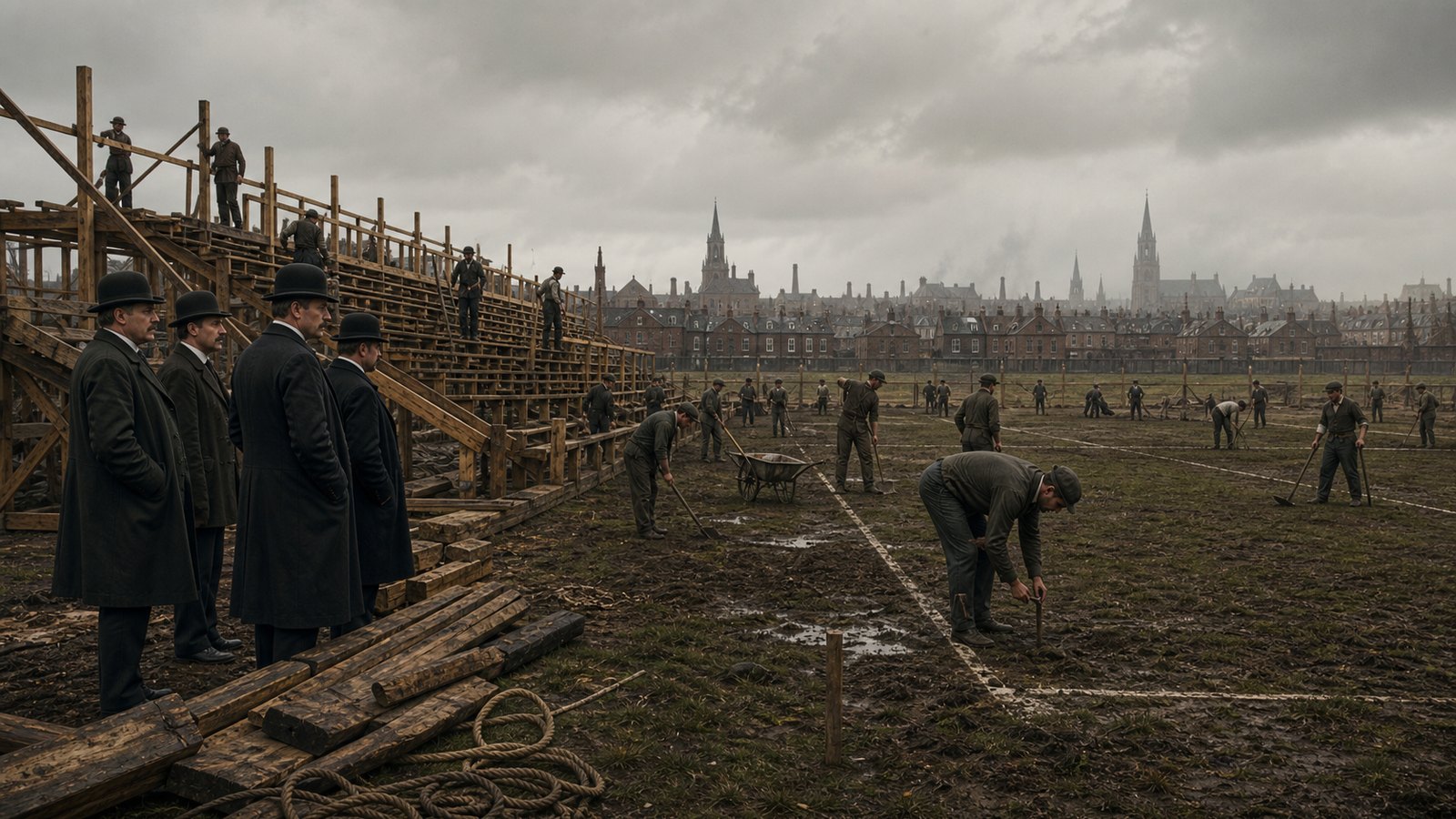
The official break came in March 1892. Everton’s members backed the move, while most of the club’s players and officials followed the majority. Work then transformed open land into Goodison Park. The new ground was inaugurated on 24 August before a reported crowd of 12,000, even though the opening ceremony included no football. Everton’s first match there was a friendly against Bolton, won 4–2. The first league fixture at Goodison ended 2–2 against Nottingham.
That sequence matters. Everton did not dissolve and reappear elsewhere. The organization moved, carrying its name and competitive continuity with it. If you are interested in how early football institutions grew around improvised grounds and changing rules, the story sits naturally beside the first Scotland–England international in 1872. In both cases, familiar modern structures emerged from practical decisions made by committees working without a settled template.
Houlding Had a Stadium and Needed a Club
Houlding first tried to preserve more of the old arrangement than Everton’s majority would allow. He had registered a company using an Everton name, but football authorities would not accept a second organization claiming the identity of an existing member. The name, like the league place, stayed with the club that moved to Goodison.
The alternative was bolder. Houlding and the allies who remained with him organized a new team for Anfield. William E. Barclay advocated naming it after the city rather than the Everton district. John McKenna helped recruit players. Liverpool Football Club and Athletic Grounds Ltd received formal recognition from the Board of Trade on 3 June 1892.

This inversion is the sharpest way to understand Liverpool’s beginning. Most football origin stories start with people who need somewhere to play. Here, a stadium owner had somewhere to play and needed people, fixtures and an identity. Houlding had retained the fixed asset but lost the sporting institution attached to it.
The new club was not simply Everton under another badge. Most of Everton’s playing and administrative organization had departed. Liverpool had to recruit a side and establish its own competitive path. Its emergence was nevertheless inseparable from Everton’s development: the same streets, meeting rooms, commercial networks and ground had incubated both. Even mundane football infrastructure could redirect history. John Brodie’s experiments with the goal net in 1891 show the same period turning practical problems into permanent features of the game.
One Split Created Two Different Kinds of Continuity
Everton and Houlding each preserved something essential. Everton preserved institutional continuity: the name, membership, league standing and core football operation. Houlding preserved physical continuity: Anfield and the local business network around it. Neither inheritance was sufficient alone. Everton had to finance and construct Goodison. Houlding had to form Liverpool and populate Anfield again.
The first league Merseyside derbies showed how quickly the separation produced a new relationship. In 1894–95, Everton won 3–0 at Goodison before a reported 44,000, then drew 2–2 at Anfield before 26,000. Within little more than two years, a boardroom and property conflict had become a mass public rivalry staged at two grounds.
Houlding’s later career added another layer to the story. He served as Lord Mayor of Liverpool from 1897 to 1898 and died in 1902. For years, his role was less prominent in popular memory than the managers and players who followed. Liverpool eventually installed a bronze tribute at Anfield, acknowledging that its history began with a figure whose most consequential football act came after he lost control of another club.
Reducing the episode to greed on one side or rebellion on the other misses its institutional force. Everton’s members made a bet that a club could leave its successful home without surrendering its identity. Houlding made the opposite bet that a major ground and a determined organization could attract a new identity. Both bets worked.
Anfield did not change clubs because of a transfer, merger or sporting result. The old tenant walked away, the landlord stayed, and Victorian football’s developing rules recognized the tenant’s name while leaving the stadium available. From that precise division—club without ground, ground without club—came Goodison Park, Liverpool FC and a rivalry that made the short distance across Stanley Park feel immeasurably larger.
Sources
Liverpool FC; Liverpool Echo; ToffeeWeb Everton History Archive.