
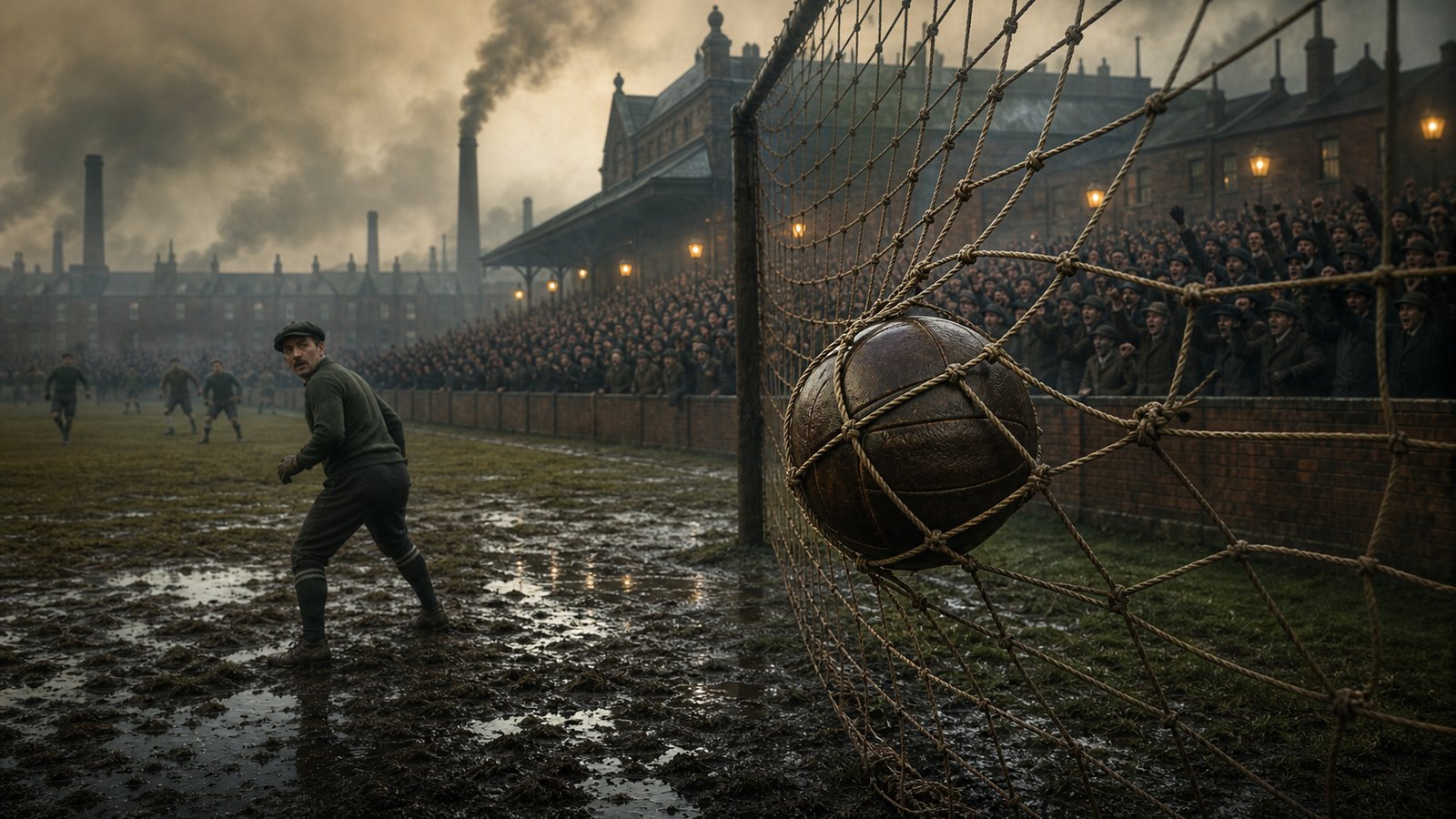
On 26 October 1889, a shot from an awkward angle created a problem that football’s laws could describe but its equipment could not settle. Everton’s Alex Latta struck toward goal against Accrington at Anfield. The crowd celebrated. The official decided that the ball had not passed between the posts. The match finished 2–2, and the argument escaped the ground with everyone else.
John Alexander Brodie is said to have been among the spectators. The story cannot be treated like a signed laboratory note; it comes through later histories and a contemporary account of the disputed decision. Yet it fits the problem his invention solved. A goal had two posts and a crossbar, but nothing behind them to keep the ball where a successful shot had sent it. Brodie, a Liverpool engineer, supplied that missing piece. Within two years, a hanging pocket of cord had moved from local trials to Football League grounds.
A goal could be correct and still leave no evidence
Football had spent decades making the frame of a goal more precise. Its width was fixed at eight yards in 1863. Clubs initially used tape or string to mark the upper limit, and a solid crossbar eight feet above the ground became compulsory in 1882. Those measurements defined the opening. They did not answer what happened after the ball crossed the line.
Without netting, a hard shot could flash between a post and the goalkeeper, travel into the crowd or roll behind the frame. An official watching from a poor angle had to reconstruct its path. Spectators close to the goal could make the view worse. The uncertainty did not require dishonesty. It came from speed, bodies and an object that refused to stay at the scene.
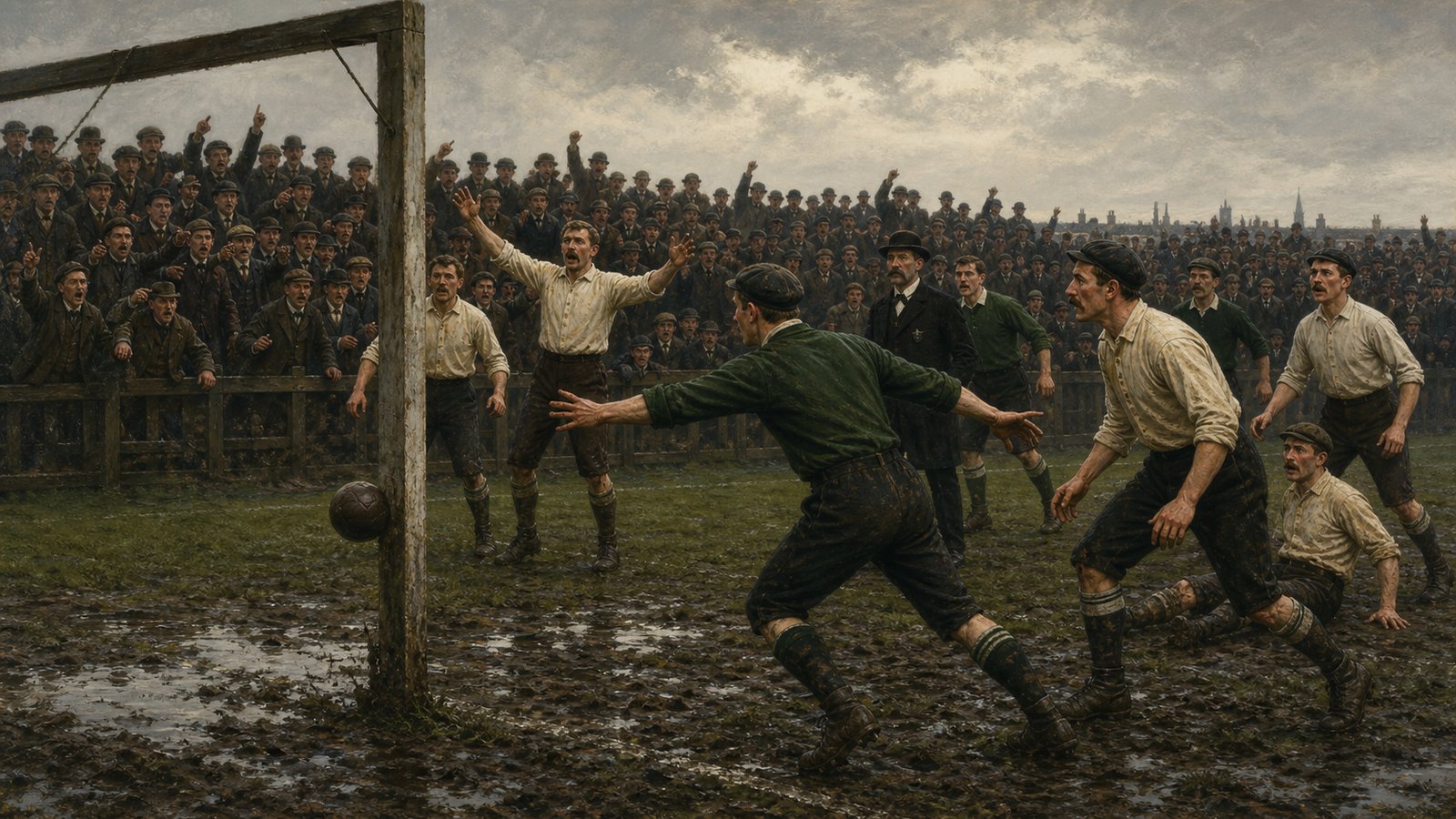
Everton’s own history supplied a particularly sharp example. Forward Hope Robertson later recalled a January 1891 match against Notts County. James Oswald appeared to score with a low shot near the post. Everton’s Dan Doyle collected the ball, carried it to the goal-kick line and restarted with such calm that the referee accepted his version of events. Oswald protested, but the moment had already been converted from a possible goal into a routine kick. A net would not make an official infallible. It would make that particular bluff much harder.
Brodie approached the argument as an engineer
Brodie was not a sporting dreamer who happened upon a piece of string. Born in Bridgnorth in 1858, he entered the Mersey Docks and Harbour Board’s engineering department as an apprentice in 1875. Scholarships took him into further training; his early career included design work in Manchester, harbour work near Bilbao and employment in Liverpool’s municipal engineering department. He was used to asking how a physical structure could make a desired result visible and repeatable.
The solution had to catch the ball without becoming a wall. Boards or canvas might have offered proof, but they would also have blocked sightlines and produced rebounds. Netting could form a deep pocket behind the frame, receive the shot and remain open enough for spectators to see through it. The Leicestershire Football Archive records that Brodie submitted a patent design on 28 November 1889 and that a revised version was approved in November 1890. Early versions even included bells intended to announce contact.
The bells did not become the enduring feature. The pocket did. Its value was evidential as much as practical: after a goal, the ball had somewhere to stop. The official could see the movement of the mesh, the goalkeeper could not disguise where the shot had gone, and the crowd received a physical punctuation mark. The familiar phrase “hit the back of the net” would eventually sound inevitable. In 1889, the back of the net did not yet exist.
Stanley Park turned a sketch into football equipment
An invention enters a sport through trials, not a slogan. Brodie’s nets were tested in local matches at Stanley Park in Liverpool. That was the necessary small stage: posts, cord, weather, balls arriving at different heights, and people discovering whether the arrangement helped or merely created new trouble.
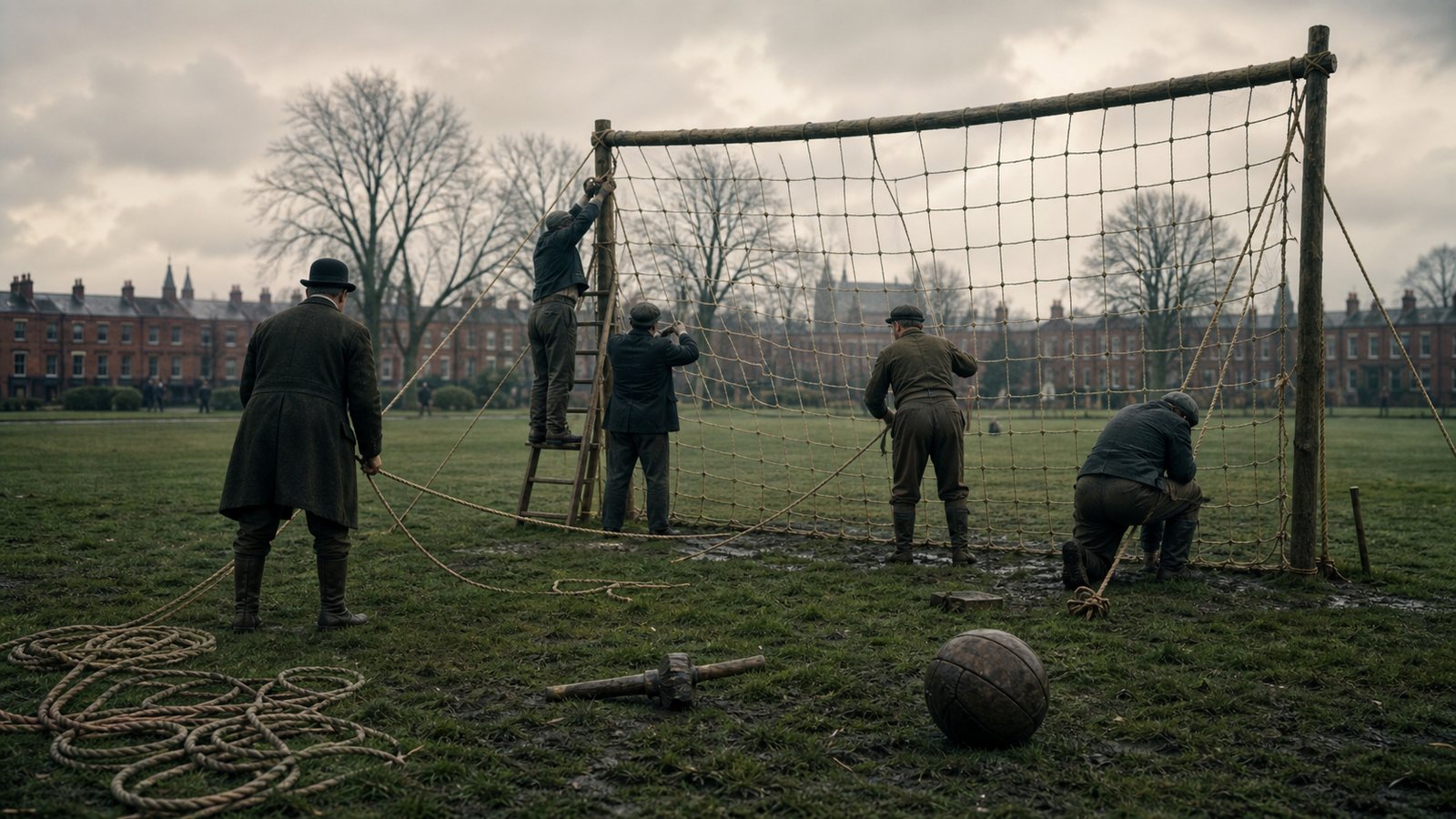
A larger examination came on 10 January 1891, when the nets were used for a North versus South representative match in Nottingham. Fred Geary and Edgar Chadwick scored in the trial. Both had Everton connections, which gave the experiment a neat local thread, but the important point was that the apparatus survived a prominent fixture. It could now be discussed as equipment rather than an engineer’s proposal.
Three weeks later Everton placed Brodie’s net behind the goal at Anfield for a friendly against Bolton Wanderers. A report in Athletic News called it a good invention and predicted that general use would prevent many unsatisfactory refereeing decisions. Everton approved the purchase of a set on 9 February. That sequence—local experiment, representative trial, club test, purchase—shows how quickly the object proved its case. It did not need to change how players struck the ball. It changed what everyone could know after they struck it.
The Football League made the pocket part of the ground
Adoption moved rapidly after the Anfield test. From 1 November 1891, goal nets were required in Football League matches. Brodie’s patent nets appeared in newspaper advertisements, and the device crossed the line between novelty and expectation. The 1892 FA Cup final at Kennington Oval, where West Bromwich Albion beat Aston Villa, is reported as the first final of the competition played with nets.
The speed matters because football governance often moves slowly when a change threatens tactics, money or tradition. This invention asked clubs to add hardware, but it did not redistribute authority between teams or rewrite the skill of the game. It made an existing law easier to administer. A goal was already defined by the ball passing between the posts and under the crossbar. The net made the ball’s journey easier to witness.
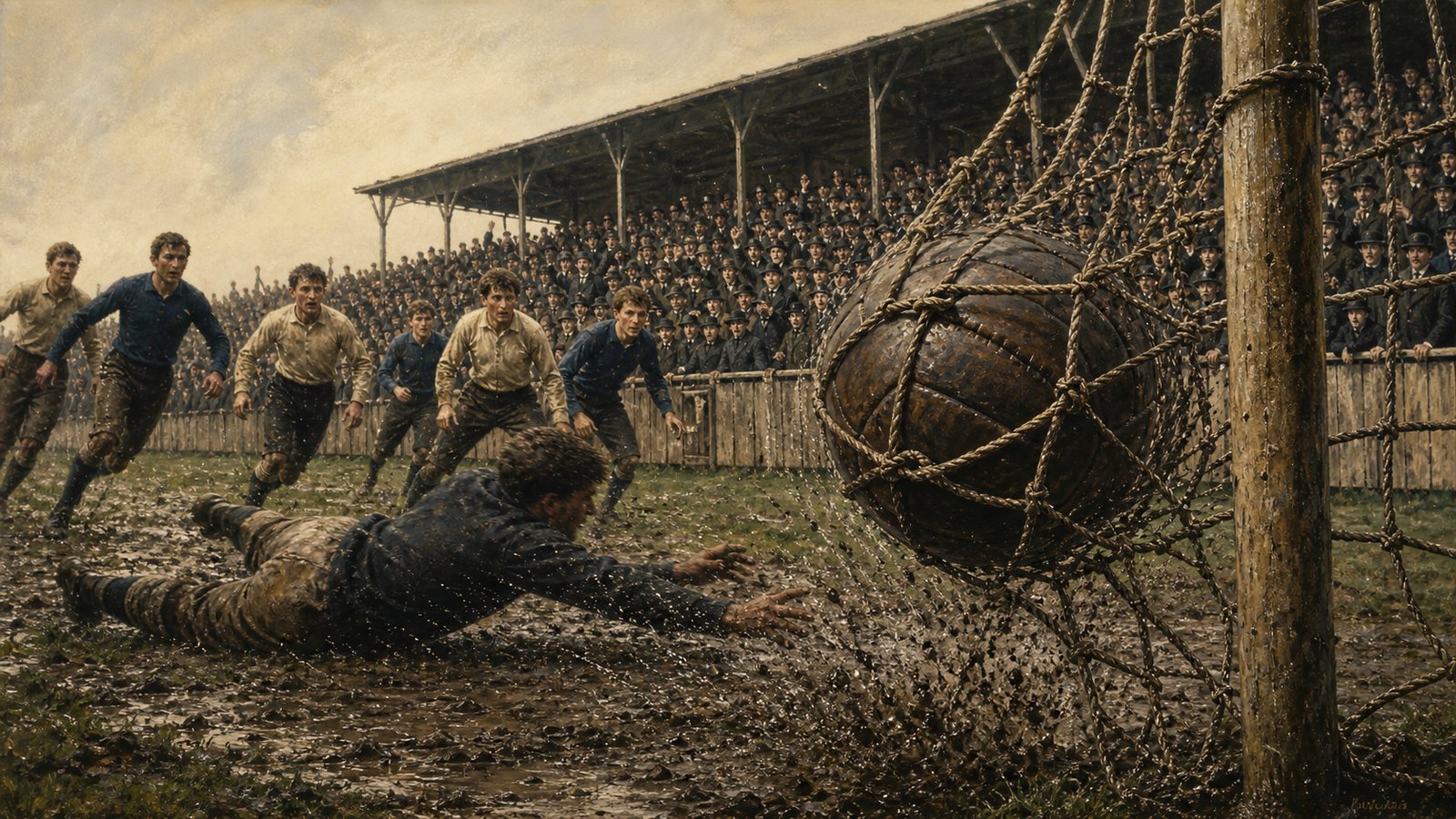
There were still decisions to make. A ball could hit the side netting, rebound from the frame or become tangled. Nets needed correct tension and placement so that they did not create their own confusion. None of that weakened Brodie’s central idea. Football had accepted that measurement alone was not enough; the goal required a receiving structure as well as a boundary.
The invention changed the sound and memory of scoring
The net’s first purpose was proof, but its cultural effect became larger. A goal acquired a visible shape: cord snaps backward, the ball drops, and the goalkeeper turns toward a place that confirms the outcome. Different materials and net depths later changed the movement, yet the basic image remained. A scorer could wheel away before retrieving the ball because the ground itself had caught it.
That altered the spectator’s instant of recognition. Before Brodie’s design, eyes had to follow the shot beyond the posts and wait for an official’s signal. With a net, the crowd could react to a shared physical event. The object did not eliminate controversy—football would find new lines to argue over—but it narrowed one old uncertainty. It also gave broadcasts and photographs a clear endpoint long before either medium became central to the sport.
Brodie’s wider career makes the modest scale of the net deceptive. He became Liverpool’s city engineer, worked on roads, drainage and the Mersey Tunnel, and served as president of the Institution of Civil Engineers in 1920–21. These were projects measured in miles, traffic and municipal budgets. Yet he reportedly called the goal net the invention of which he was most proud. It took less material than a tunnel, but it entered the weekly life of millions.
A simple object solved a moving problem
The genius of the net was not that it made the goal more complicated. It completed what the posts and crossbar had begun. The frame identified the legal opening. The net retained the result. Together they turned a fleeting trajectory into something an official and a terrace could read at once.
The disputed Latta shot remains an origin story rather than a perfectly documented moment of inspiration, and it should be told with that caution. The problem around it is beyond dispute. Contemporary football produced goals that vanished into open space and decisions that depended on obstructed angles. Brodie answered with a transparent pocket, tested it in public, and watched the game adopt it in 1891.
Every modern goalmouth now carries his idea, even when its shape, colour and material differ. The net does not score and it does not save. It waits. Then, for the fraction of a second when football most needs certainty, it moves.
Sources
Everton FC Heritage Society; Grace’s Guide to British Industrial History; Leicestershire Football Archive.