
Steaua Bucharest’s 1986 European Cup triumph can sound impossible when reduced to a headline. A Romanian club went to Seville, faced Barcelona in Spain, survived a goalless final, and won the shootout without conceding a single penalty. That last detail is so dramatic that it risks swallowing the whole story. Helmuth Duckadam saved four penalties, an achievement that still feels unreal. But the final was not only a goalkeeper’s fairy tale. It was the product of a club structure, a defensive plan, and a psychological contest that made Barcelona’s advantages feel heavier with every passing minute.
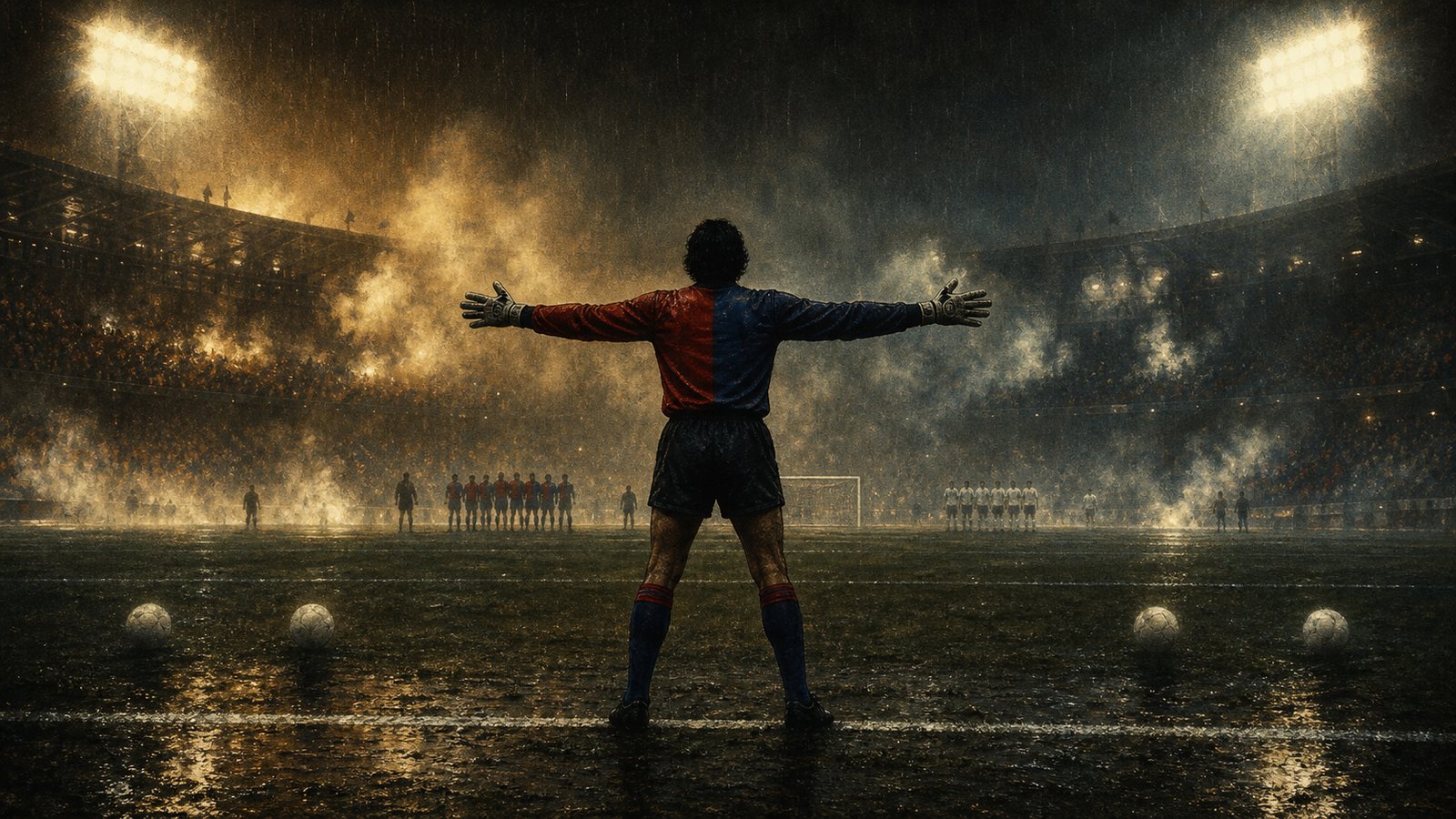
The 1980s European Cup was still a different tournament from the modern Champions League machine. It was a straight knockout competition, less forgiving and often stranger. Steaua reached the final from behind the Iron Curtain, backed by the machinery and privileges that came with being the army club in communist Romania. Barcelona arrived with a more familiar Western glamour and with the practical benefit of playing the final in Spain. Yet football finals do not distribute pressure evenly. Sometimes the team expected to make history becomes trapped by the expectation, while the supposed outsider finds clarity in making the match smaller.
The final was played inside Barcelona’s anxiety
Barcelona were not playing a neutral emotional match. The club had not won the European Cup, and the final in Seville offered a chance to turn domestic scale into continental validation. The setting added heat. A Spanish crowd, a Spanish giant, and an opponent many expected to be controllable: all of those elements made the match feel like a door Barcelona should open. When the door stayed shut, the weight of the handle changed.
Steaua understood that dynamic. They did not need to produce a romantic attacking display to trouble Barcelona. They needed to keep the score at zero long enough for doubt to become visible. Every blocked lane, every delay in Barcelona’s circulation, every attack that ended without a clean finish moved the final away from talent hierarchy and toward nerve. By extra time, the favorite was no longer only trying to score. Barcelona were trying to escape the embarrassment of not having scored already.
Steaua’s power was not accidental
It would be wrong to describe Steaua as a tiny provincial miracle. The club sat inside a specific Romanian sporting system, with resources, selection advantages, and institutional protection that mattered. They had strong domestic foundations and a team used to winning. That does not diminish the achievement. It makes it more historically precise. Steaua were outsiders in Western European imagination, not in their own football environment.
Victor Pițurcă, Marius Lăcătuș, Miodrag Belodedici, Adrian Bumbescu, and the rest of Emerich Jenei’s side were not tourists. They were organized, physically serious, and comfortable defending long stretches without turning the match into panic. The team’s discipline fitted the old European Cup perfectly. In a two-hour final where one mistake could decide everything, Steaua’s ability to keep returning to shape became an attacking weapon of its own. It forced Barcelona to keep proving superiority in a game that offered fewer and fewer places to prove it.
The match shrank until only details were left
Goalless finals often get remembered as empty, but this one was full of tension because the absence of goals changed what every action meant. A pass behind a winger, a heavy touch near the box, a defender choosing clearance over composure: each moment fed the sense that the match was becoming less like football’s usual flow and more like a test of who could tolerate the void. Steaua were better suited to that void than Barcelona wanted them to be.
That is one reason the shootout felt both sudden and inevitable. After 120 minutes without release, penalties did not arrive as a random tie-breaker. They arrived as the purest form of the pressure the match had been building. Barcelona’s players had carried expectation for two hours. Steaua’s players had carried resistance. The penalty spot asked which burden had become lighter.
Duckadam became a one-man wall
Helmuth Duckadam’s four saves against Barcelona are the central image because they compress the final into something almost mythological. Penalty shootouts usually turn on one save, sometimes two. Four consecutive stops by a goalkeeper against a club of Barcelona’s stature made the night feel detached from ordinary probability. Yet the saves were not magic. They were reading, reach, timing, and the brutal advantage a goalkeeper gains when the taker starts to believe the story is turning against him.
The first miss changes a shootout. The second changes the room. By the third, the goalkeeper is no longer merely reacting to shots; he is occupying the shooter’s mind before the run-up begins. Duckadam’s performance turned Barcelona’s penalties into public questions. Could anyone beat him? Could anyone strike cleanly enough to end the pattern? The longer the answer remained no, the more Steaua’s own takers could approach their kicks with the strange calm of a side watching the favorite unravel.
The result traveled beyond one club
Steaua’s victory mattered because it interrupted the assumed geography of European power. Clubs from Eastern Europe had produced great players and strong sides, but the European Cup was still a stage where Western wealth and prestige shaped expectation. A Romanian club lifting the trophy in 1986 made the continent look less orderly. It suggested that institutional strength, coaching discipline, and a hardened domestic culture could still beat glamour in the decisive match.
The win also complicated the politics of memory. Steaua’s achievement cannot be separated entirely from the state-era system around the club, but neither can it be reduced to that system. Players still had to survive Barcelona’s pressure. Duckadam still had to dive the right way and reach the ball. Jenei still had to build a side capable of holding its nerve. Football history is often uncomfortable because the machinery around a team and the human brilliance inside it are both real at the same time.
Barcelona learned the cruelty of delayed destiny
For Barcelona, the loss became part of a longer European wound. The club would not win its first European Cup until 1992 at Wembley. That later triumph changed the story, but it did not erase Seville. The 1986 final remained a reminder that status does not guarantee timing. A club can be large enough to expect a trophy and still meet a night that refuses to cooperate.
That cruelty is why the final still carries force. Barcelona did not lose to a cascade of spectacular goals. They lost to accumulation: no breakthrough, no release, no successful penalty. The emptiness became the event. Steaua made Barcelona’s attack feel progressively less like a solution and more like a problem Barcelona were being forced to watch in public.
The shootout was the symbol, not the whole machine
The cleanest version of the story is that Duckadam won the cup by saving four penalties. The fuller version is sharper. Steaua built a final in which those penalties became possible, then gave their goalkeeper the stage to turn resistance into legend. Without the defensive patience, there is no shootout. Without the institutional strength and hardened squad, there may be no final. Without Duckadam, the night probably becomes Barcelona’s escape. History needed all of those pieces to lock together.
That is why Steaua 1986 still feels like a Cold War football shock rather than a simple upset. It was not only East beating West, not only goalkeeper beating takers, not only outsider beating giant. It was a club from a different sporting universe dragging Barcelona into a narrow corridor and then closing every door from twelve yards. The trophy went to Bucharest because Steaua understood the final’s emotional shape before Barcelona could bend it back toward their own.
Sources
UEFA European Cup archive; RSSSF European Cup 1985-86 records; Romanian federation historical material; contemporary Spanish match reports; European football oral histories.