
Brazil 1982 is remembered with the glow usually reserved for winners. That is the first clue that the story is stranger than nostalgia admits. Telê Santana’s side did not lift the World Cup, did not even reach the semi-final, and still became shorthand for a style of football people mourn as if it had been taken from them. The yellow shirts, the midfield rotations, the long strides of Sócrates, the violent elegance of Zico’s passing, Falcão arriving from deeper spaces: all of it made the team feel like an argument that football should reward imagination.
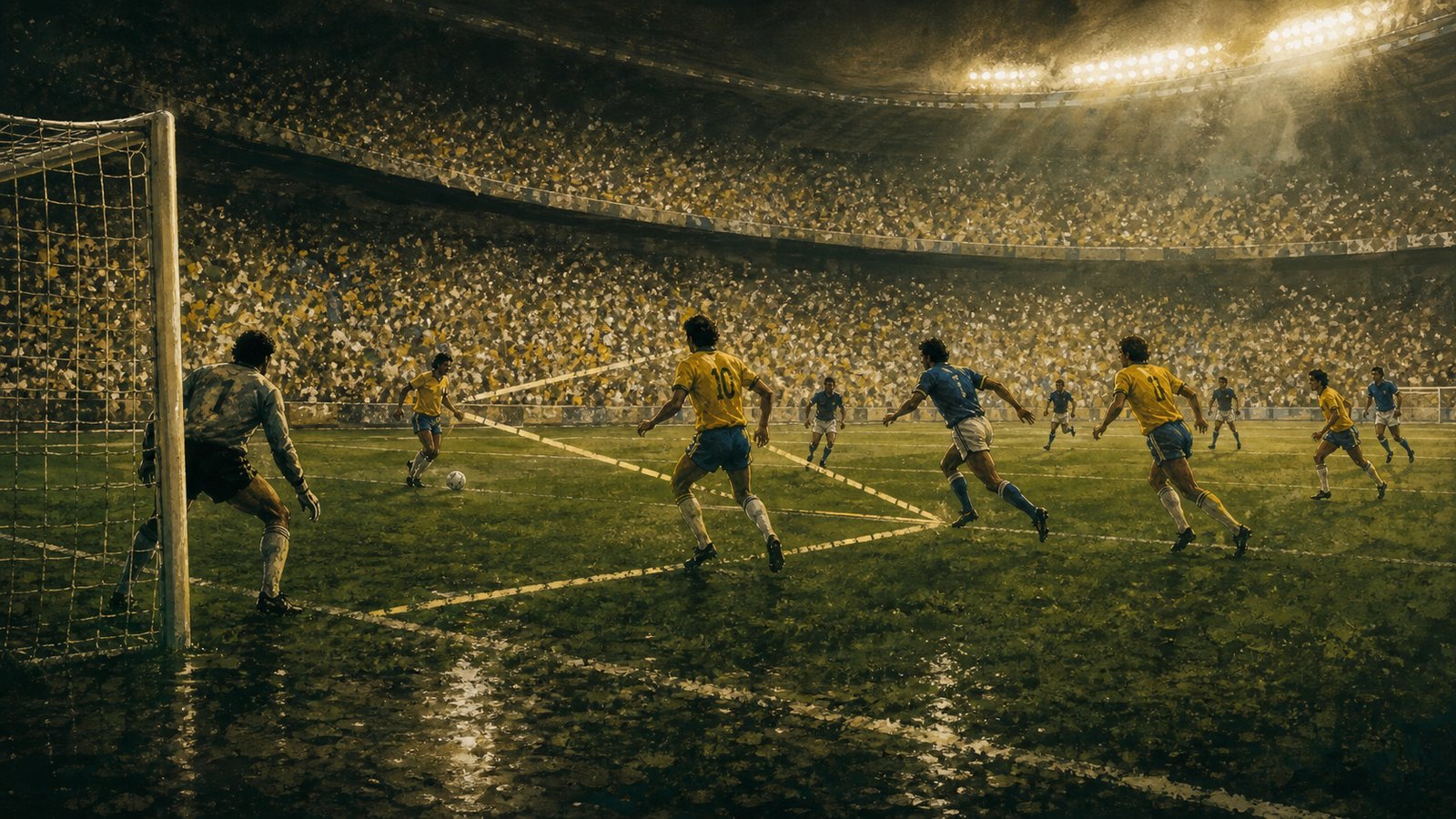
The problem is that football does not owe imagination a trophy. The 3-2 defeat to Italy at Sarrià in Barcelona was not a moral accident. It was a match where beauty met a risk register. Brazil could create rhythm, overload zones, and make opponents look one pass late. They could also leave themselves exposed when the move failed, when a central runner was not tracked, when the urge to keep playing forward became stronger than the need to reset the game. The tragedy is not that the team played beautifully and somehow lost. The tragedy is that the same habits that made them beautiful also made the defeat possible.
The romance began with midfield freedom
The side’s appeal came from the way midfielders seemed to share the pitch rather than occupy fixed offices. Sócrates could pause the game with a lifted head and then break it with one touch. Zico drifted between lines with the timing of a player who knew exactly when a defender had stopped looking over his shoulder. Falcão added late authority from midfield, carrying the sense that Brazil always had one more passer arriving into the picture. Toninho Cerezo brought running power and connection, giving the team its bloodstream.
That freedom was not just decorative. It created repeated uncertainty for opponents. If one midfielder dropped, another could advance. If a full-back moved, the ball could still travel through the inside channel. The pattern looked improvisational, but the best improvisation is built on shared expectation. Brazil’s players understood where the next option should appear. For long stretches of the tournament, the ball seemed to move before the defender had finished deciding what kind of danger he was facing.
Italy did not try to out-romance them
Italy’s answer was not to become more beautiful. Enzo Bearzot’s team found a way to make the match sharp, interruptible, and emotionally uncomfortable. Paolo Rossi entered the game carrying the story of a striker who had returned from suspension and had not yet exploded in the tournament. Against Brazil, he became the punishment for every loose connection. His hat-trick is often treated as pure finishing instinct, but it also showed how a player can turn small structural gifts into history.
The opening goal came early enough to disturb Brazil’s assumptions. That mattered. A team built to express itself can still respond calmly, and Brazil did equalize through Sócrates after a brilliant exchange. Yet every Italian lead changed the calculation. Brazil did not need to win the match; a draw would have taken them through because of the group format. But the team’s identity pulled toward solving the problem with the ball, not freezing the problem with caution. Italy made that identity expensive.
The draw that was enough never felt enough
This is the hinge of the game. At 2-2, after Falcão’s fierce left-footed equalizer, Brazil had reached the scoreline they required. The rational version of the match could have slowed. The full-backs could have been more selective. Midfielders could have kept one extra body behind the ball. Instead, Brazil continued to carry the emotional shape of a side that wanted to win the argument, not merely survive it. That is admirable in memory and dangerous in real time.
The distinction matters because people often reduce the defeat to naivety. That is too easy. Brazil were not children. They were elite footballers making choices inside a style that had rewarded them for weeks and, in many cases, for entire careers. When a team is that good at creating, restraint can feel like betrayal. Italy forced Brazil to decide whether beauty was a method or a vow. Brazil kept treating it as a vow, and the match tilted toward the side with the colder incentives.
Rossi punished the gaps between ideas
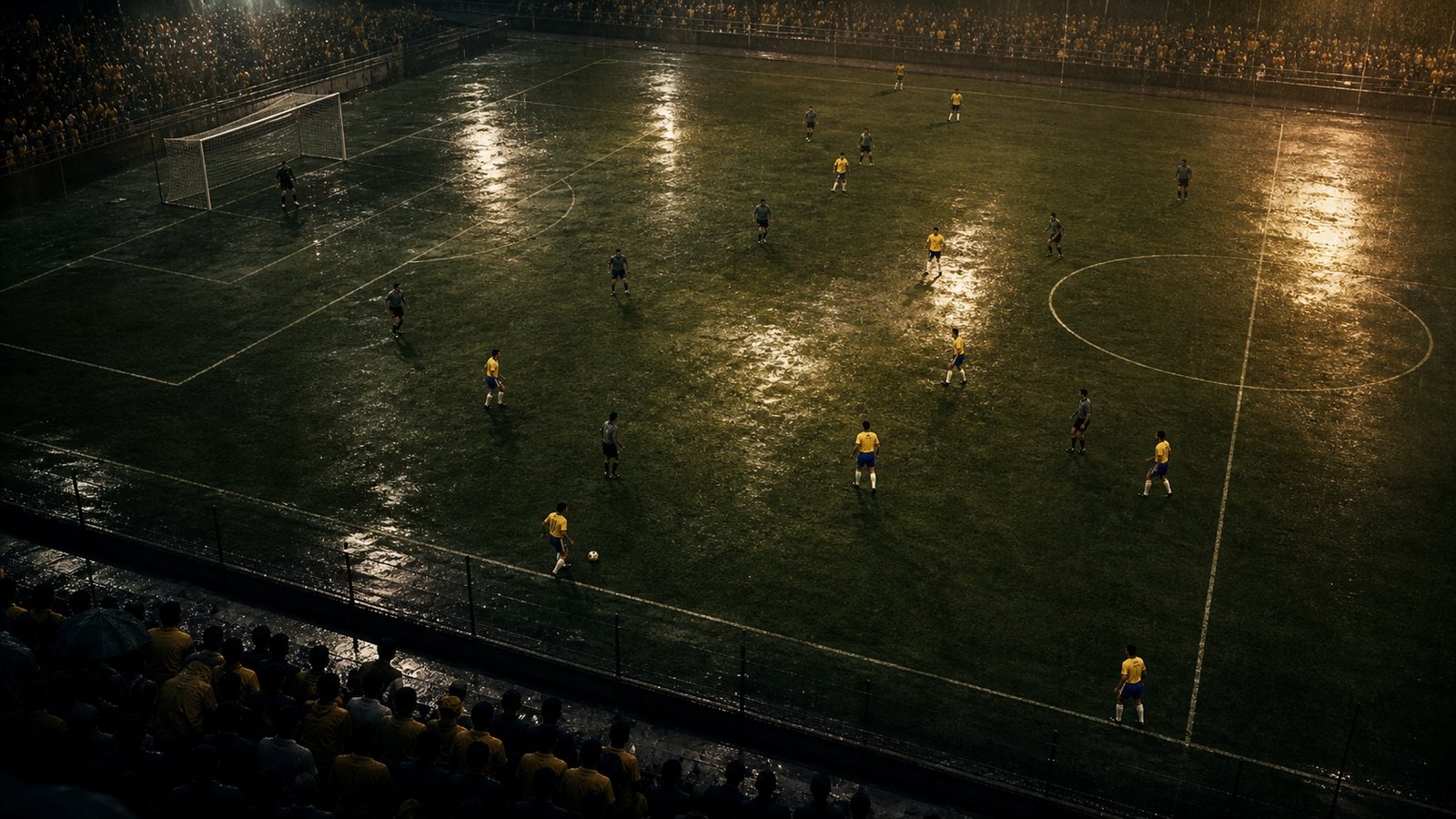
Rossi’s goals were not identical, but they shared a theme: Italy found moments where Brazil’s possession structure was no longer a defensive structure. A misplaced pass, a failure to account for the striker’s position, a corner not fully cleared, a crowded box in which attention splintered for half a second. Those do not sound like grand tactical revelations. They are exactly the details that decide World Cup games. The more beautifully a team attacks, the more painful it is when the defensive residue of that attack is not clean enough.
Brazil’s midfield artistry also created a psychological trap. Because the team could repair so many situations with the ball, danger sometimes looked temporary. Win it back, pass through, restore order. Italy made the temporary permanent. Rossi’s movement was not spectacular in the modern highlight sense. It was predatory, patient, and ruthless with time. He lived in the space between Brazil’s confidence and Brazil’s recovery runs.
The defeat became a myth because it felt unfair
Many football myths survive because the scoreline seems to have insulted the eye. Brazil looked like the team people wanted to keep watching. Italy looked like the team that understood what the competition actually demanded. That contrast made the result feel unfair to romantics, but it also made it historically useful. It showed that tournament football does not reward the side with the most memorable passages. It rewards the side that joins memorable passages to game-state control.
The match also exposed the danger of confusing aesthetic coherence with total control. Brazil were coherent when they had the ball. They were not always coherent in the seconds after losing it. Modern tactical language would talk about rest defense, counter-pressure, and protection around the ball. In 1982, the lesson was visible without the vocabulary. A team can be brilliant in possession and still leave the back door open wide enough for a striker like Rossi to walk through it three times.
The beauty survived because the lesson hurt
Brazil 1982 did not become beloved despite the loss; the loss helped preserve the love. A champion is absorbed into the record. A beautiful loser can become an argument people revisit forever. The team stands for a football dream in which midfield imagination, courage, and technique should be enough. The Italy match remains the counterargument: courage needs a lock on the door, and technique needs a plan for the five seconds after the pass goes wrong.
That does not make the side overrated. It makes them more interesting. Their football changed how people remembered a tournament they did not win. Their defeat helped future coaches think harder about the relationship between freedom and protection. And the players themselves remain vivid because their failure was not ordinary. It was a failure at the edge of a beautiful idea.
The fairest verdict is not that Brazil were foolish or that Italy were lucky. Italy solved the match they were actually playing. Brazil played toward the match they wanted the world to recognize. For ninety minutes at Sarrià, those two truths collided. The winner went on to become world champion. The loser became a warning that the most seductive football can still carry a tactical debt, and sooner or later, someone may arrive to collect it.
Sources
FIFA World Cup archive; RSSSF 1982 World Cup records; Jonathan Wilson tactical histories; contemporary tournament reports; Italian federation historical summaries.