
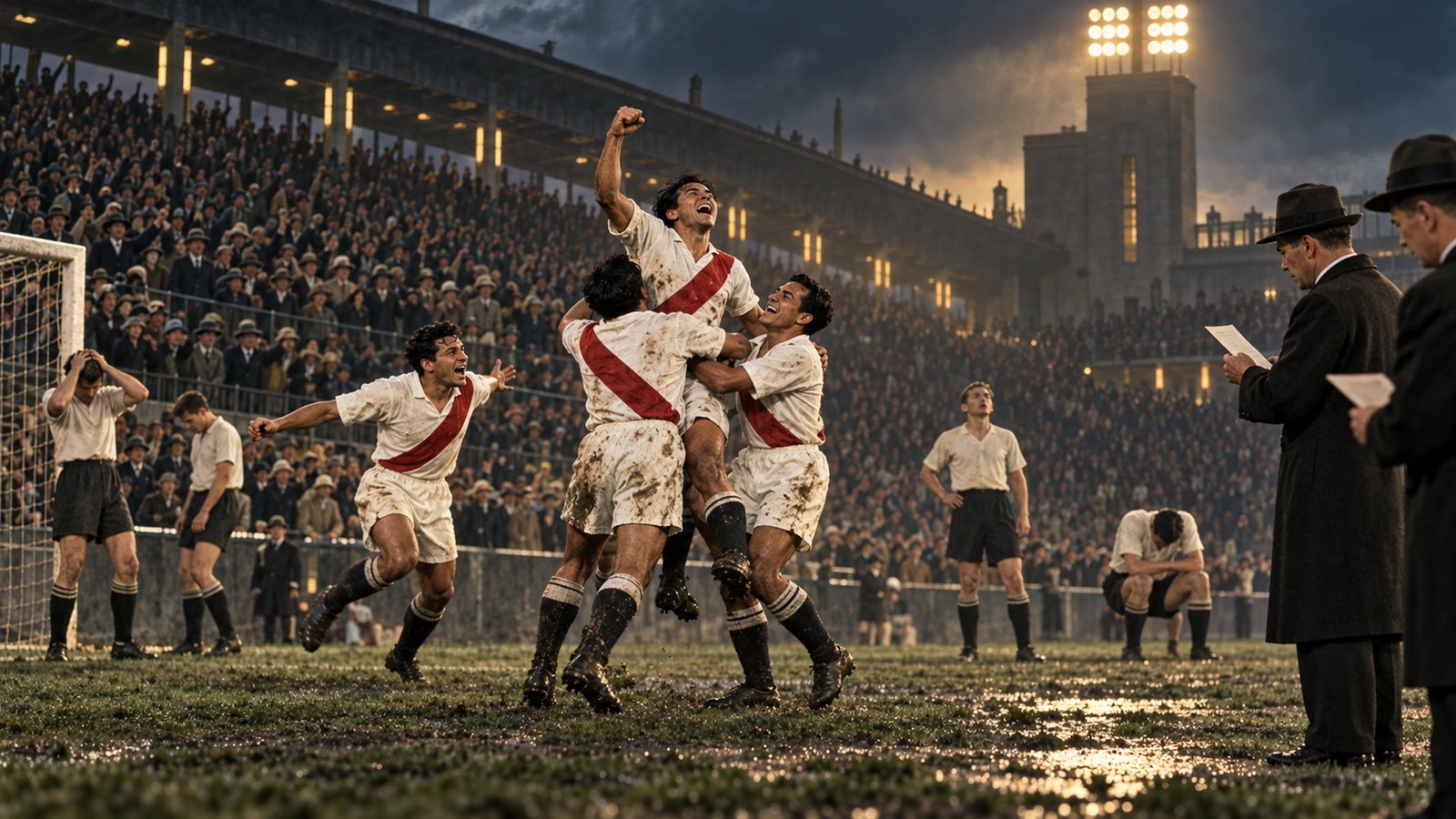
Peru left the Hertha-Platz in Berlin on 8 August 1936 believing it had completed one of the Olympic football tournament’s great recoveries. Austria had led 2–0. Peru equalised late, survived a chaotic extra period and won 4–2. Teodoro Fernández and Alejandro Villanueva had carried a dangerous attack from the opening round into the semi-finals.
The bracket did not keep the result. Austria protested, citing repeated incursions onto the field and violence against one of its players. FIFA’s Jury of Appeal ordered a replay behind closed doors. Peru’s representatives were not in the room when the case was decided. Rather than return for the rearranged match, the Peruvian delegation withdrew from the Games, and Austria advanced by walkover.
The story is often compressed into a claim that Adolf Hitler disliked a Latin American victory and personally demanded a reversal. That version is memorable and insufficiently supported. The documented dispute is already disturbing without it: a completed match was nullified through an appeal, one side’s defence was unheard, and the remedy required the winner to prove itself again away from the crowd. The scandal belongs to football governance before it belongs to legend.
A seven-goal opening made Peru impossible to ignore
Olympic football returned in Berlin after being omitted from the 1932 Games. Sixteen teams entered a straight knockout competition. Peru’s first opponent was Finland, and the match immediately established the South American side as more than a ceremonial visitor.
Peru won 7–3. Fernández scored five and Villanueva added two. The score gave the quarter-final a clear sporting frame: Austria faced a team whose forwards had already demonstrated speed, combination play and a willingness to keep attacking after gaining control.
Those names mattered in the next round. Fernández, known as Lolo, was the central scorer. Villanueva supplied movement and finishing around him. Their partnership gave Peru a route back when Austria opened a two-goal lead through Walter Werginz and Klement Steinmetz.
The first hour therefore produced a familiar knockout picture. Austria had converted its chances and could protect space. Peru had to chase against a side coached by Jimmy Hogan, whose influence on Central European football extended well beyond this amateur Olympic selection. Each minute made the earlier attacking display against Finland feel less relevant.
Four late goals changed the bracket on the field
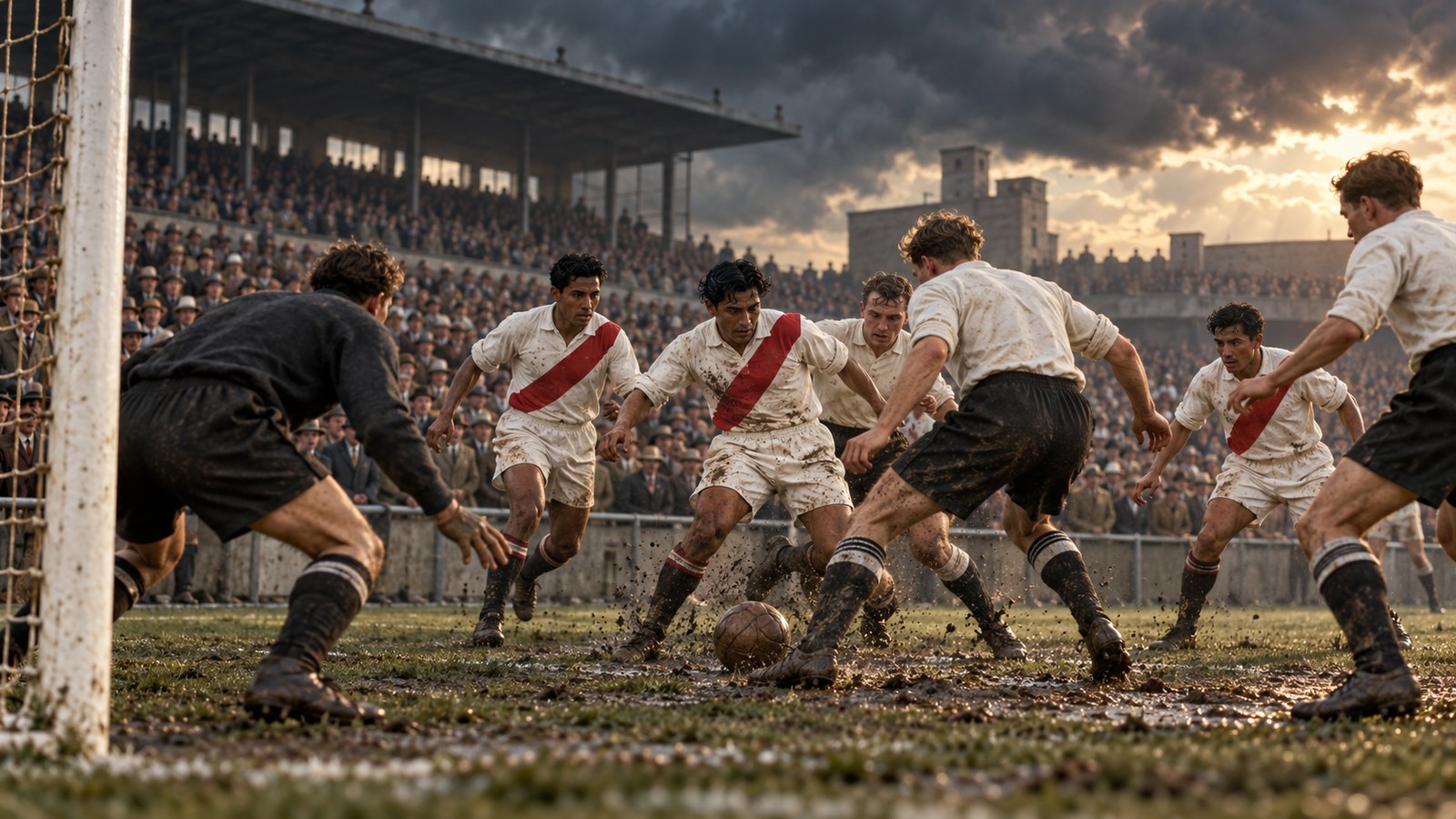
Peru’s first reply arrived in the 75th minute and was recorded by contemporary reports as an own goal. Villanueva equalised six minutes later. A match that had seemed settled entered extra time with the crowd close to the action and the atmosphere deteriorating.
Reports disagree on some details of the disorder, which is one reason the episode demands careful language. The statistical record says Peruvian supporters and officials repeatedly entered the field. It also records an allegation that one of them kicked Austrian player Anton Krenn. Tournament accounts describe several Peruvian efforts in extra time being disallowed.
What the scorebook preserves clearly is the finish. Fernández scored late in extra time, and Villanueva added another. Peru had moved from 0–2 to 4–2. The players completed the match, the referee recorded the result, and the Peruvian side left the ground with a place in the next round.
Crowd control was not a trivial issue. A pitch invasion can affect players, referees and the validity of competition. Austria had the right to protest an environment it considered unsafe. The decisive question was how football’s authorities examined that complaint and whether their response treated both teams fairly.
The appeal was heard without Peru’s defence
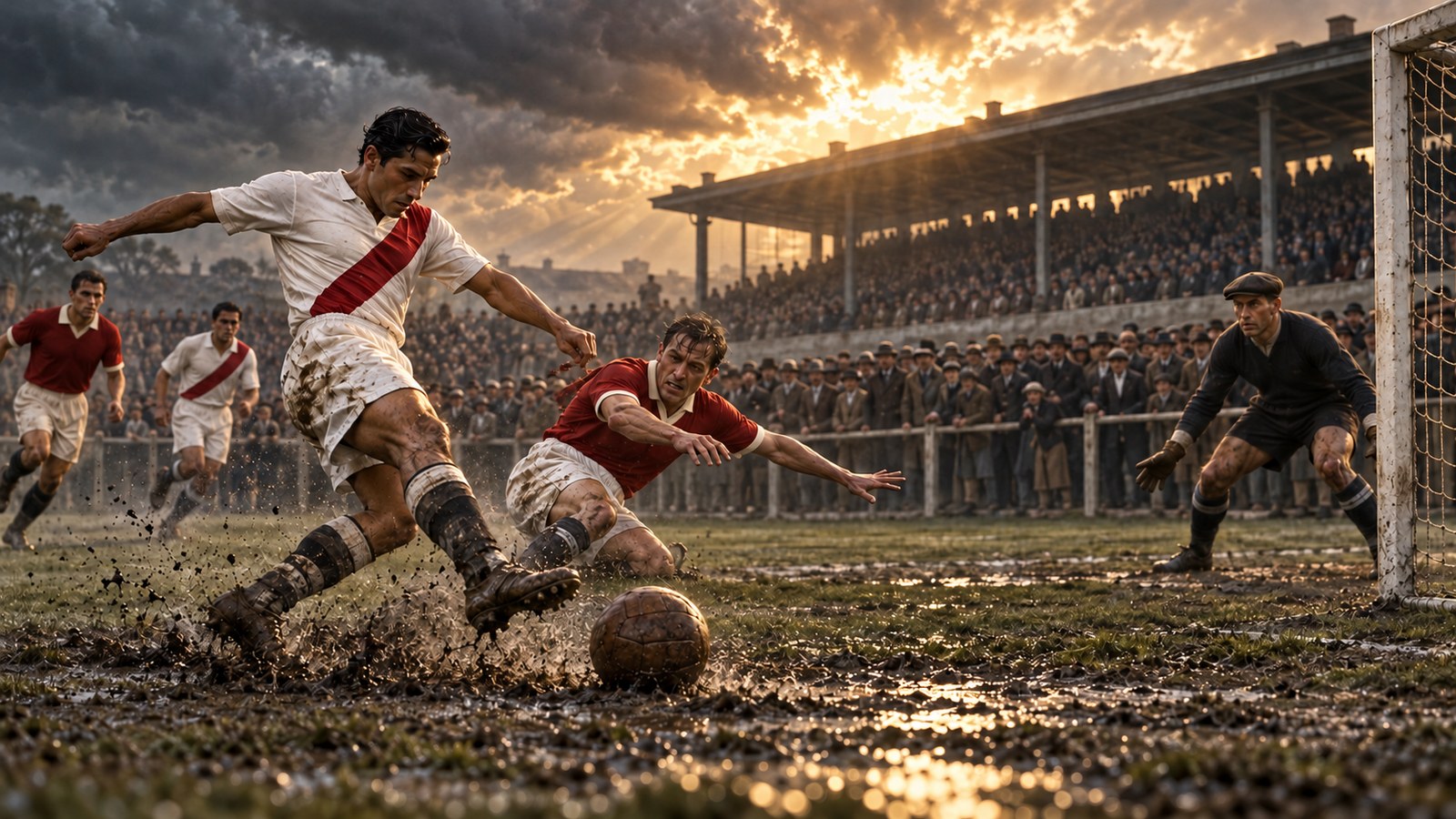
Austria’s case went to FIFA’s Jury of Appeal. The complaint cited spectators entering the playing area and the alleged assault on Krenn. Officials accepted enough of that case to cancel the result and order the quarter-final played again behind closed doors.
Peru was not represented at the hearing. Accounts state that its delegation tried to attend but was delayed by a German parade. Whether that delay was avoidable or deliberate is less important than the procedural fact: the body deciding the match heard the protest without hearing the winning side’s response.
A replay can look neutral because it does not simply award the protesting team a victory. Here it placed the entire burden on Peru. Its four goals disappeared from the bracket, while Austria received another opportunity. The closed doors addressed the stated crowd risk, but they could not restore the effort Peru had already expended or the advantage it had earned.
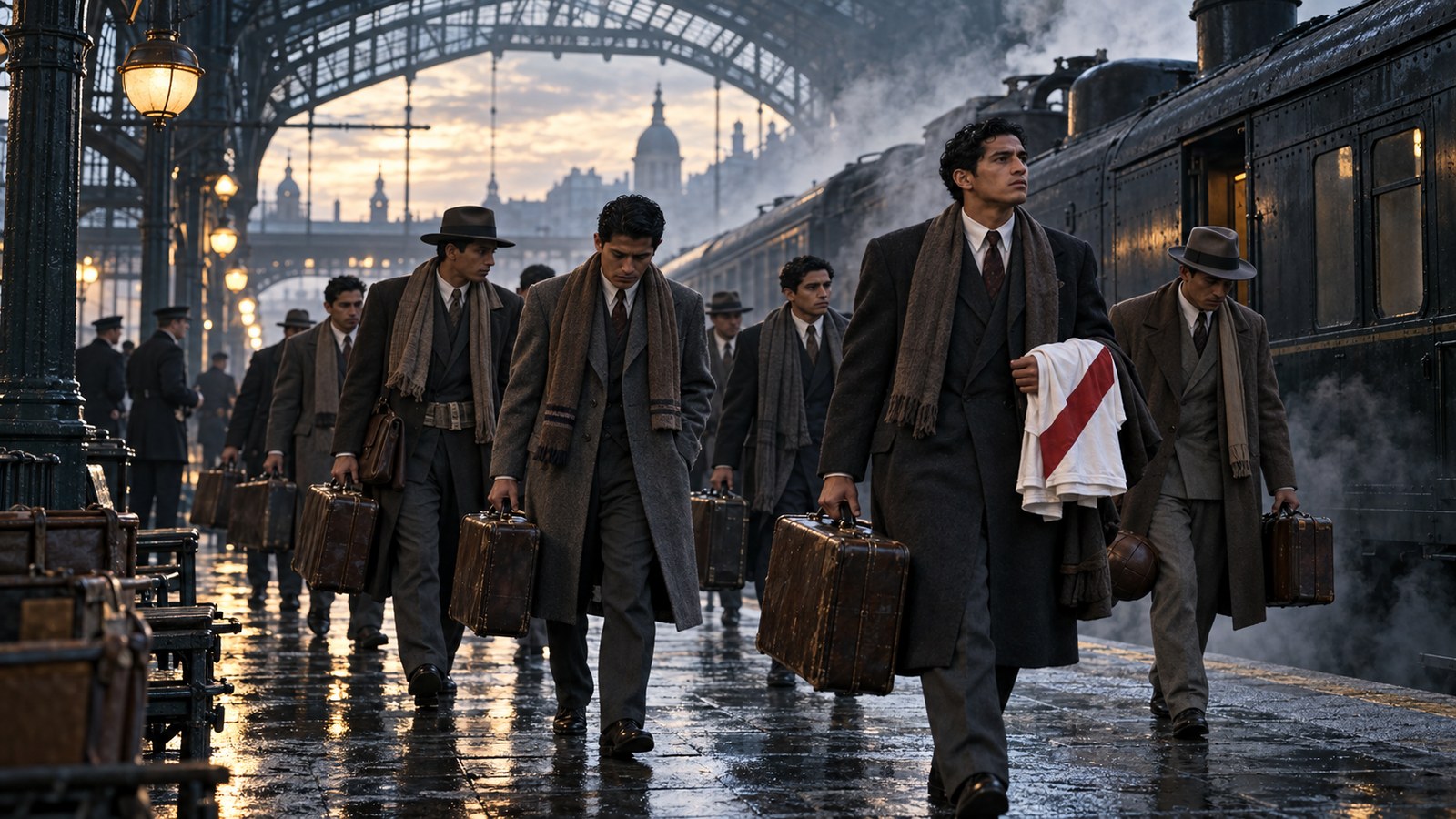
The replay was set for 10 August and then moved to 11 August. Peru refused to participate. Its whole Olympic delegation left Germany in protest, and Colombia’s delegation also departed. Other Latin American countries expressed solidarity. A football decision had escaped the boundaries of one match and become a public dispute over treatment, voice and authority.
The timing sharpened the imbalance. Austria could prepare for a second quarter-final knowing that its first defeat no longer controlled the bracket. Peru had to decide whether appearing would legitimise a hearing it believed had denied basic representation. Withdrawal sacrificed any remaining route to a medal, but it also prevented the replay from being presented as ordinary sporting consent.
Austria advanced, but the walkover did not settle legitimacy
With Peru absent, Austria received a walkover. It beat Poland 3–1 in the semi-final and then lost 2–1 after extra time to Italy in the gold-medal match. Officially, Austria remains the tournament’s silver medallist. Officially, the Peru quarter-final is a voided win followed by a forfeited replay.
Those entries answer who advanced. They do not erase what happened before the appeal. Peru scored seven against Finland and four against Austria. Its forwards had built a credible run, not stumbled into a disputed result through a single incident. That sporting record helps explain why the ruling caused such anger at home.
In Peru, demonstrations targeted Olympic and German symbols. The delegation’s withdrawal was framed as a defence of national dignity. Football had become a stage on which a European institution, operating inside Nazi Germany’s showcase Games, appeared to tell a South American winner that its result counted only provisionally.
The surrounding regime naturally shaped later memory. Berlin 1936 was constructed as propaganda, and racist hierarchy was central to Nazi rule. It is therefore understandable that retellings search for a direct order from Hitler. Yet repeating an unproven intervention weakens the strongest criticism. The appeal procedure, the unheard defence and the unequal cost of the replay are documented.
The match endures because the paperwork changed the winner
Football usually asks spectators to accept that the whistle fixes a result. Appeals can correct ineligible players, abandoned games or failures of security, but each intervention creates a second contest: evidence, procedure and institutional power decide what the field no longer can.
Peru–Austria is unusual because the field produced such a complete dramatic arc. A two-goal deficit became a two-goal extra-time victory. The administrative sequel then removed that arc from the tournament’s forward motion. No replay took place, so the competing claims were never tested in the remedy officials selected.
The episode belongs beside other moments when governance changed football’s geography and opportunity, such as India’s long path to withdrawing from the 1950 World Cup. In both cases, the simple folklore version obscures meetings, rules and institutional decisions that had practical consequences for players.
The careful conclusion is narrower than the famous legend and more useful. Peru won 4–2 on the field. Austria presented a serious complaint about invasions and alleged violence. An appeal body ordered a replay without Peru’s defence being heard. Peru rejected that remedy and left. The bracket could name Austria, but it could not make the process feel final.
Sources
- RSSSF, 1936 Olympic football tournament detailed match record
- Olympic football tournament historical record
- Contemporary-report summaries collected in tournament histories