
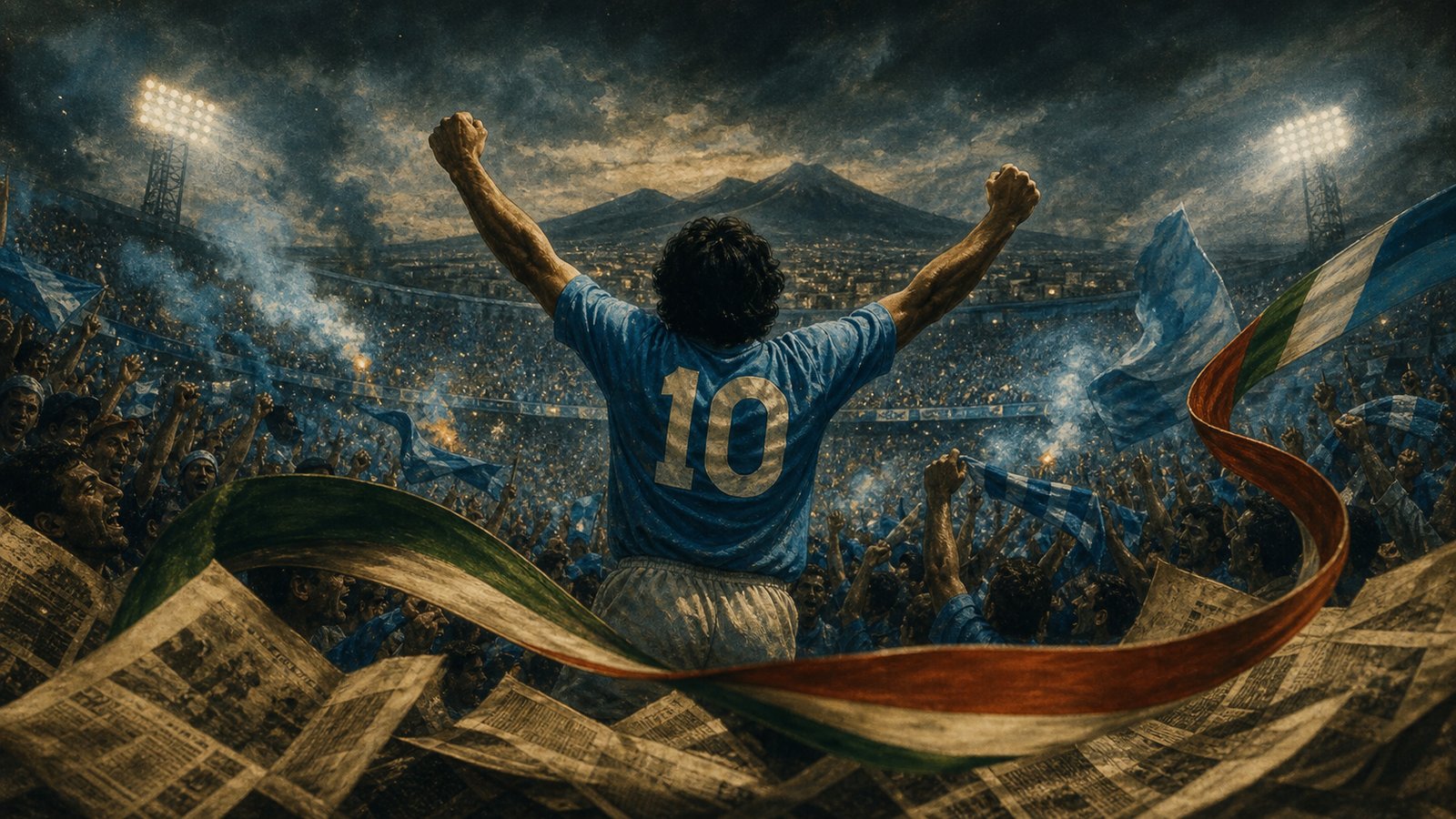
Napoli’s first Serie A title is often remembered as a single man carrying a city on his back. That is understandable. Diego Maradona was the brightest figure in the frame, the player whose balance, violence of acceleration, and nerve made everything around him feel possible. But the 1986-87 Scudetto was bigger than a superstar story. It was the moment a club from the south of Italy turned resentment, defensive discipline, careful recruitment, and civic hunger into a title-winning machine.
The old shorthand says Maradona won it alone. The better version is more interesting. Napoli had to become sturdy enough for genius to matter every week. In a league that still treated the northern industrial powers as football’s natural owners, the club built a side that could absorb pressure, win ugly, and make the San Paolo feel less like a stadium than a regional argument.
The South Was Not Supposed to Own the Table
Serie A in the mid-1980s was not a soft stage. Juventus had Michel Platini’s era close behind it, Milan and Inter still carried institutional weight, and the league’s foreign-player limits meant imported stars had to be chosen with ruthless care. Napoli, by contrast, carried the historical burden of a city often mocked by northern Italy. A league table was never only a table. For Naples, every away trip into the north could feel like a civic referendum.
Maradona arrived in 1984 from Barcelona for a world-record fee, and the presentation itself became part of the myth: tens of thousands inside the San Paolo just to see him introduced. But the first seasons were not instant coronations. Napoli rose in stages. The club had to learn how to protect leads, how to keep matches from becoming emotional avalanches, and how to turn a famous number 10 into the central pressure point of a balanced side rather than a weekly rescue act.
That context matters because 1986-87 was not a lightning strike. It was a climb. Manager Ottavio Bianchi gave Napoli a colder shape than the folklore sometimes remembers. The team could counter, yes, but it could also sit in a compact block, trust its goalkeeper and defenders, and make opponents chase the game in a stadium where the noise rarely felt neutral. Southern pride supplied heat; Bianchi’s structure supplied insulation.
Bianchi Built the Floor Under the Genius
The great trick was that Napoli did not ask Maradona to solve chaos all by himself. Bianchi’s side had Ciro Ferrara emerging as a serious defender, Salvatore Bagni adding bite and timing in midfield, Fernando De Napoli covering ground, and Bruno Giordano offering technique and penalty-box intelligence in attack. Andrea Carnevale, later in the cycle, became another important runner, but the title season already showed the pattern: Napoli’s famous man was surrounded by footballers who could keep the game close enough for his moments to decide it.
That is the difference between a celebrity team and a title team. A celebrity team waits for magic. A title team builds the conditions in which magic has repeated value. Napoli conceded fewer goals than its stereotype would suggest and often played with a seriousness that frustrated opponents who came expecting theater. Maradona could still turn a match with a pass, free kick, dribble, or piece of deception, but those interventions landed on a foundation.
The city’s role was real as well. The San Paolo was not just loud; it changed the emotional weather. Visiting teams entered a bowl of flags, smoke, whistles, and expectation. For Napoli players, that atmosphere could have become a burden. In 1986-87 it became fuel because the team had enough tactical order to stop the feeling from becoming panic.
The Title Race Was Won by Not Cracking
Napoli finished the league season ahead of Juventus and Inter, but the margin was not the story’s only tension. The real pressure was psychological. Every week dragged the club closer to something it had never done. In a city accustomed to football disappointment and national condescension, the fear of collapse could have been as strong as the desire to celebrate. Napoli had to keep playing matches, not history.
The decisive spring carried that double weight. Each point seemed to speak beyond football: about the south, about money, about respect, about whether a city dismissed as theatrical could also be ruthless. Maradona’s presence intensified everything. Opponents marked him as a tactical problem, media treated him as a moral weather system, and supporters looked at him as proof that the old order could be bent.
Yet the final run also showed the squad’s collective nerve. Napoli did not win the Scudetto by producing a weekly carnival of attacking football. It won by controlling enough fragments: second balls, restarts, foul management, narrow leads, and the emotional aftermath of difficult away matches. This was where Bianchi’s work mattered. It made the fairytale administratively competent.
A Double Made the Myth Practical
The Coppa Italia completed the season’s feeling of total takeover. Napoli did not merely nick a league title and disappear into celebration. It also won the domestic cup, underlining that the campaign was not a romantic accident. A double in Italian football, especially for a club outside the traditional northern axis, turned the achievement from a miracle into evidence.
That matters when assessing Maradona’s role. He was not reduced by acknowledging the team around him. If anything, the team’s structure makes his greatness clearer. He did not shine in a playground version of football where nobody else mattered. He carried creative responsibility inside a league that specialized in denying space, and he did it while the political and emotional meaning of every touch kept expanding.
The 1986 World Cup had already made him a global legend. The Napoli Scudetto made him something stranger and more local: a world star who became the chosen instrument of a city’s argument with Italy. Football history rarely separates sporting mechanism from social meaning this neatly. Napoli had both at once.
The Afterlife Changed What Clubs Thought Was Possible
Napoli’s title did not permanently destroy the old hierarchy, but it did puncture its inevitability. The club would win Serie A again in 1989-90, confirming that 1987 had not been a single-season hallucination. But the first Scudetto remains the more explosive memory because it opened the door. Once a club from Naples had stood above Juventus, Inter, Milan, and Roma, the map of Italian football felt less ordained.
There is also a warning inside the glory. The emotional concentration that made Napoli powerful was difficult to sustain. Maradona’s life in Naples grew more complicated, the club’s dependence on his aura remained dangerous, and later years brought decline as well as reverence. But that should not flatten the achievement. The 1986-87 side deserves to be remembered as a working football team, not only as a shrine.
The cleanest lesson is this: genius can break a ceiling, but only if a club builds the floor first. Napoli’s floor was made of Bianchi’s discipline, hard midfield labor, defenders who accepted long afternoons without glamour, and a stadium that made ordinary league fixtures feel historic. Maradona gave the story its immortal face. The team gave it enough legs to last from August to May. That balance is why the season still feels alive rather than decorative.
Sources
John Foot, Calcio; David Goldblatt, The Ball Is Round; Simon Kuper, Football Against the Enemy; Serie A historical tables; contemporary Napoli season records.