
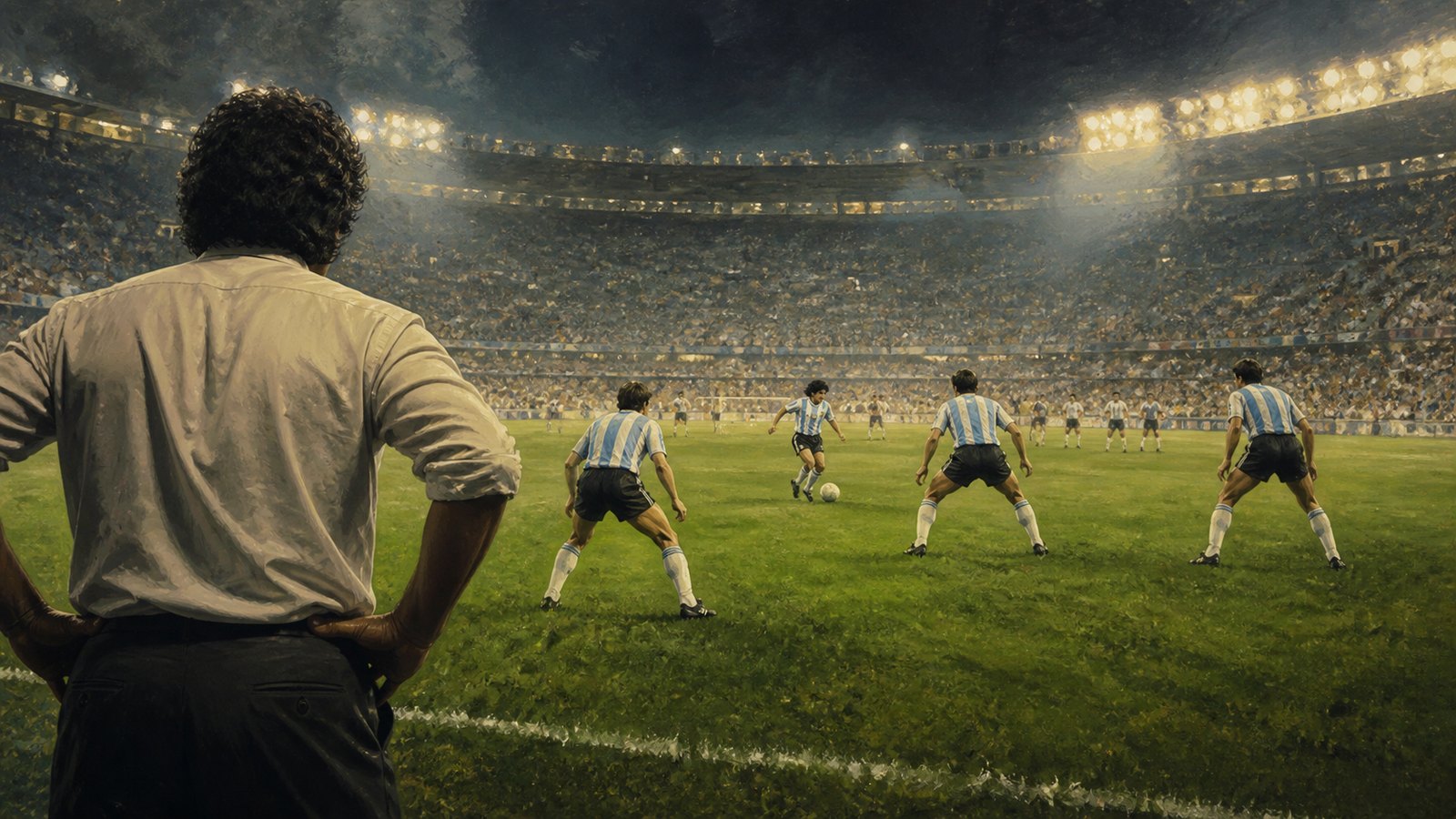
Before Argentina met England in the 1986 World Cup quarter-final, Carlos Bilardo removed a centre-forward. Pedro Pasculli had scored the winner against Uruguay in the previous round, yet the coach replaced him with midfielder Héctor Enrique. Argentina gained another runner and another passing angle around Diego Maradona, while Maradona gained the freedom to appear wherever England’s markers were not.
The famous goals that followed have often reduced the match, and then the whole tournament, to one extraordinary player. Bilardo’s achievement was to arrange everyone outside that centre. Three defenders protected a narrow core. Ricardo Giusti and Julio Olarticoechea supplied width. Enrique and Jorge Burruchaga could begin deeper and arrive beyond the ball. Jorge Valdano occupied defenders without trapping Maradona in a conventional partnership. Argentina’s shape did not restrain its genius. It paid the structural cost of releasing him.
Bilardo prepared for a player who was absent
Bilardo took the Argentina job in 1983 with the failure of Spain 1982 still close. In that tournament César Luis Menotti had used Maradona as a classic number ten behind two forwards. Opponents knew where creativity would begin, crowded him and fouled him. Argentina lost three of five matches, and Maradona’s campaign ended with a red card against Brazil.
The new coach treated Maradona as the fixed point even while the player was missing from the national side. Bilardo visited him in January 1983 as he recovered from hepatitis near Barcelona. According to Jonathan Wilson’s account for World Soccer, they jogged on the beach at Lloret de Mar and discussed the team’s future shape. Maradona would not play for Argentina again until May 1985, but Bilardo had already named him captain and described him as the only player guaranteed a World Cup place.
That long absence made the coach’s work unusually abstract. He had to design the supporting cast without repeatedly rehearsing beside its principal actor. Poor friendly results did not shake the plan. Argentina went five matches without a win in 1984, then travelled to Europe in September. Bilardo used that tour to reveal an uncommon back three and a midfield built to function without orthodox wingers or full-backs.
A European tour exposed the hidden geometry
The logic began with the opponents rather than a fashionable diagram. Bilardo reasoned that if elite teams no longer attacked with old-style wingers, two orthodox full-backs were an inefficient answer. A third central defender could provide cover while wide midfielders moved through longer lanes. In possession, the arrangement added bodies around midfield. Out of possession, it could fold into a five.
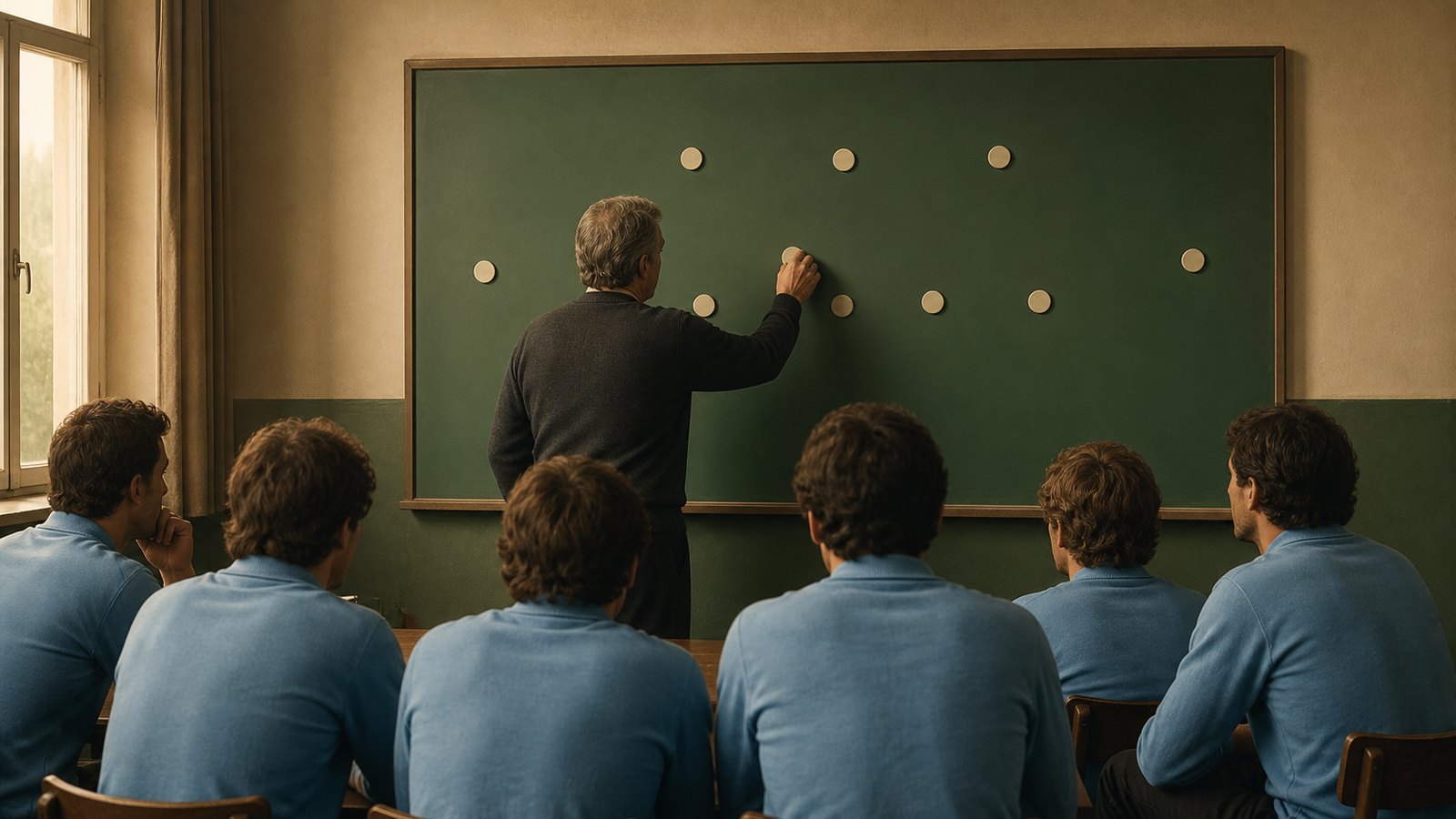
Argentina tested the idea with Ricardo Bochini in the creative role because Maradona was unavailable. The results on that European trip were emphatic: 2–0 victories over Switzerland and Belgium, followed by a 3–1 win against West Germany. Bilardo then hid the full version. He did not want a year and a half of public rehearsal to give World Cup opponents a manual for attacking it.
Mexico began with the plan still folded away
Argentina did not arrive as a serene favourite. FIFA’s retrospective interview with Bilardo records his memory that almost nobody came to the airport to see the squad off. The coach was known for superstition and tactical obsession, and confidence at home was thin. Yet the group stage gave his players time to establish control without showing every variation.
They beat South Korea 3–1, drew 1–1 with defending champions Italy and defeated Bulgaria 2–0 to finish first in Group A. A 1–0 victory over Uruguay followed in the round of 16, with Pasculli scoring. The forward had done his job. Bilardo’s next decision demonstrated that the tournament was not a reward system. Selection served the next match’s spaces, not the previous match’s hero.
England’s central defenders were comfortable confronting a pure striker. Bilardo expected an extra midfielder to be more disruptive. Enrique therefore entered the side, Pasculli left it, and Maradona played close enough to Valdano to threaten the last line but freely enough to escape it. José Batista screened ahead of José Luis Brown, Oscar Ruggeri and José Cuciuffo. Giusti and Olarticoechea worked the outside channels. Burruchaga and Enrique could connect the two halves of the formation.
The quarter-final showed what freedom required
Maradona’s second goal against England is remembered as an individual journey: the turn inside his own half, the acceleration through challenges, the finish beyond Peter Shilton. It was individual, but it did not occur in a tactical vacuum. Argentina’s occupation of midfield gave him places to receive before the decisive burst. Valdano’s movement occupied the defensive line. Runners around Maradona prevented every opponent from collapsing onto the same patch of grass.
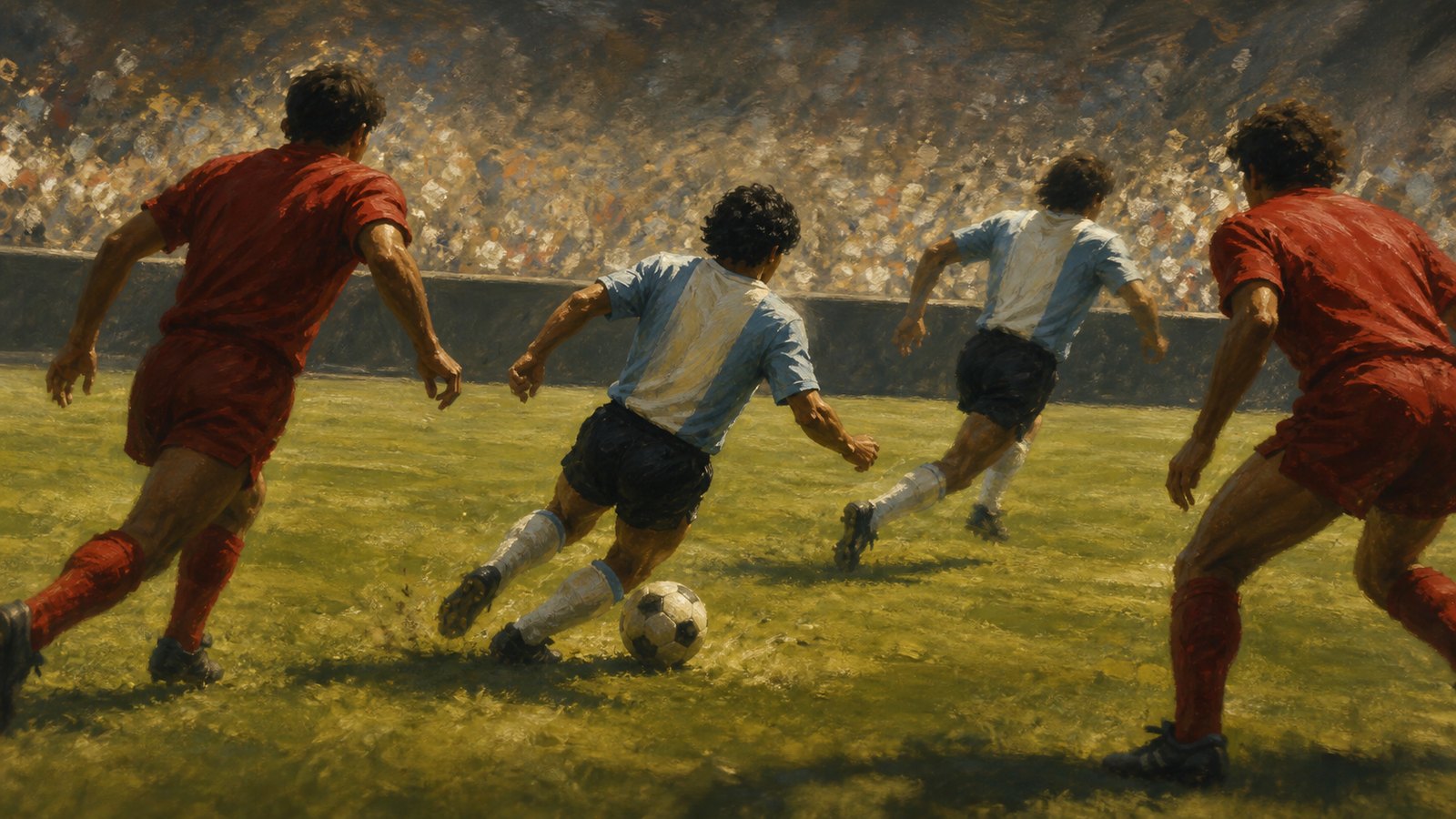
The shape also contained a weakness. Giusti and Olarticoechea were learning wide defensive roles rather than operating as conventional full-backs. England threatened those channels after introducing John Barnes and Chris Waddle. Barnes crossed for Gary Lineker to make the score 2–1 and nearly supplied another. Bilardo’s arrangement created an extra central presence, but it demanded enormous recovery work on the flanks.
Belgium chose a different response in the semi-final. Their own central congestion did little to exploit the spaces beside Argentina’s back three. Maradona scored twice in a 2–0 victory. The contrast clarified the bargain: force Argentina’s wide workers backward and the coverage could strain; pack the centre and Maradona could turn a crowded game into his stage.
The lesson belongs beside Argentina’s later tactical history. Four years after Mexico, Bilardo’s holders opened against Cameroon and discovered how quickly a World Cup plan can be disrupted; Cameroon finished with nine men and still beat them in Milan. In 1986, by contrast, Argentina’s adjustments remained one move ahead of each opponent until the final.
The final proved the runners were part of the weapon
At the Azteca on 29 June, West Germany assigned Lothar Matthäus close attention to Maradona. Argentina did not need its captain to score. Brown headed the opening goal, and Valdano finished a move for 2–0. The match then twisted. Karl-Heinz Rummenigge scored in the 74th minute, Rudi Völler equalised in the 81st, and a secure lead vanished in seven minutes.
The winning move revealed Bilardo’s design more completely than another dribble would have. Maradona found a moment away from Matthäus and played forward. Burruchaga, nominally one of the supporting midfielders, was already sprinting through the centre. His run had begun deep enough to escape the defenders’ first reference points. He reached the pass and finished in the 84th minute. Argentina won 3–2.
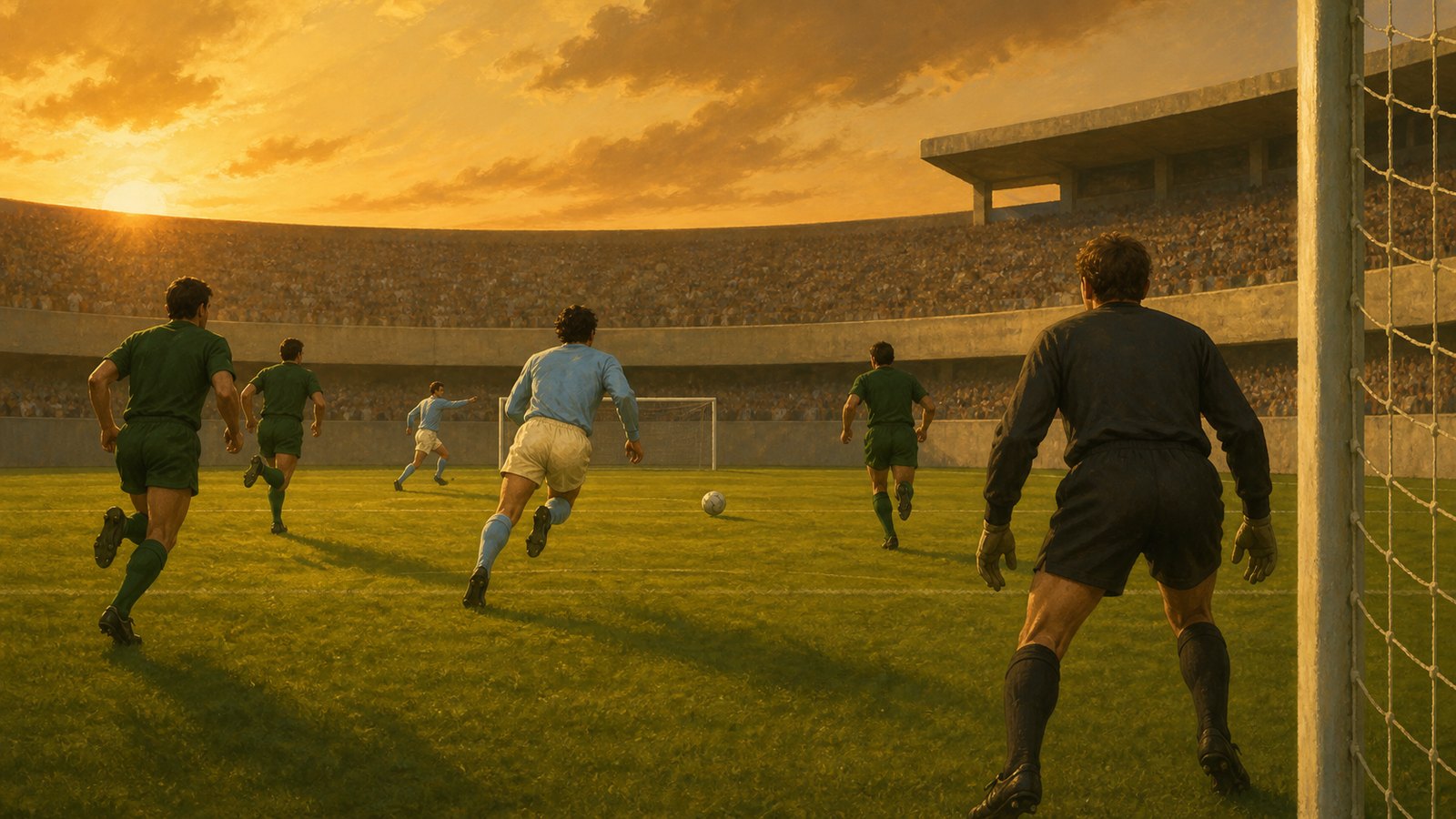
That sequence explains why describing the side as Maradona plus ten assistants is both understandable and incomplete. The team was built around him, but “around” meant specific labour. Brown, Ruggeri and Cuciuffo accepted the risk of defending large spaces. Batista guarded the central door. Giusti and Olarticoechea crossed the pitch vertically all afternoon. Enrique offered circulation and pursuit. Burruchaga had permission to become a forward at the decisive instant. Valdano stretched the last line so that Maradona could face the game rather than wait with his back to it.
The formation mattered less than its division of labour
Bilardo did not create the first back three in football history, and even Argentina’s precise notation can change depending on whether a snapshot is taken with or without the ball. The important innovation was not ownership of a string of numbers. It was the coherent exchange of responsibilities. Width came from players who also had to defend. Penalty-area support came from midfield runners. Creativity was concentrated in one player while movement around him stayed multiple and unpredictable.
The coach’s medical nickname, “The Doctor,” suited the precision of the project, though his methods were football rather than laboratory science. He had spent the cycle deciding which burdens Maradona should not carry. The captain was not asked to preserve a rigid midfield line or chase a full-back to the corner. His energy and attention could remain attached to receiving, turning, dribbling and releasing runners.
Mexico 1986 remains inseparable from Maradona because no scheme could reproduce his two goals against England or the authority of his tournament. The supporting plan did something less spectacular and just as necessary: it made those actions repeatable enough to survive seven matches. Bilardo’s Argentina gave its best player freedom not as a compliment, but as a financed tactical choice. Everyone else paid into it with distance, discipline and carefully timed movement. Burruchaga’s sprint in the final was the return.
Sources
World Soccer; FIFA; Wikipedia.