
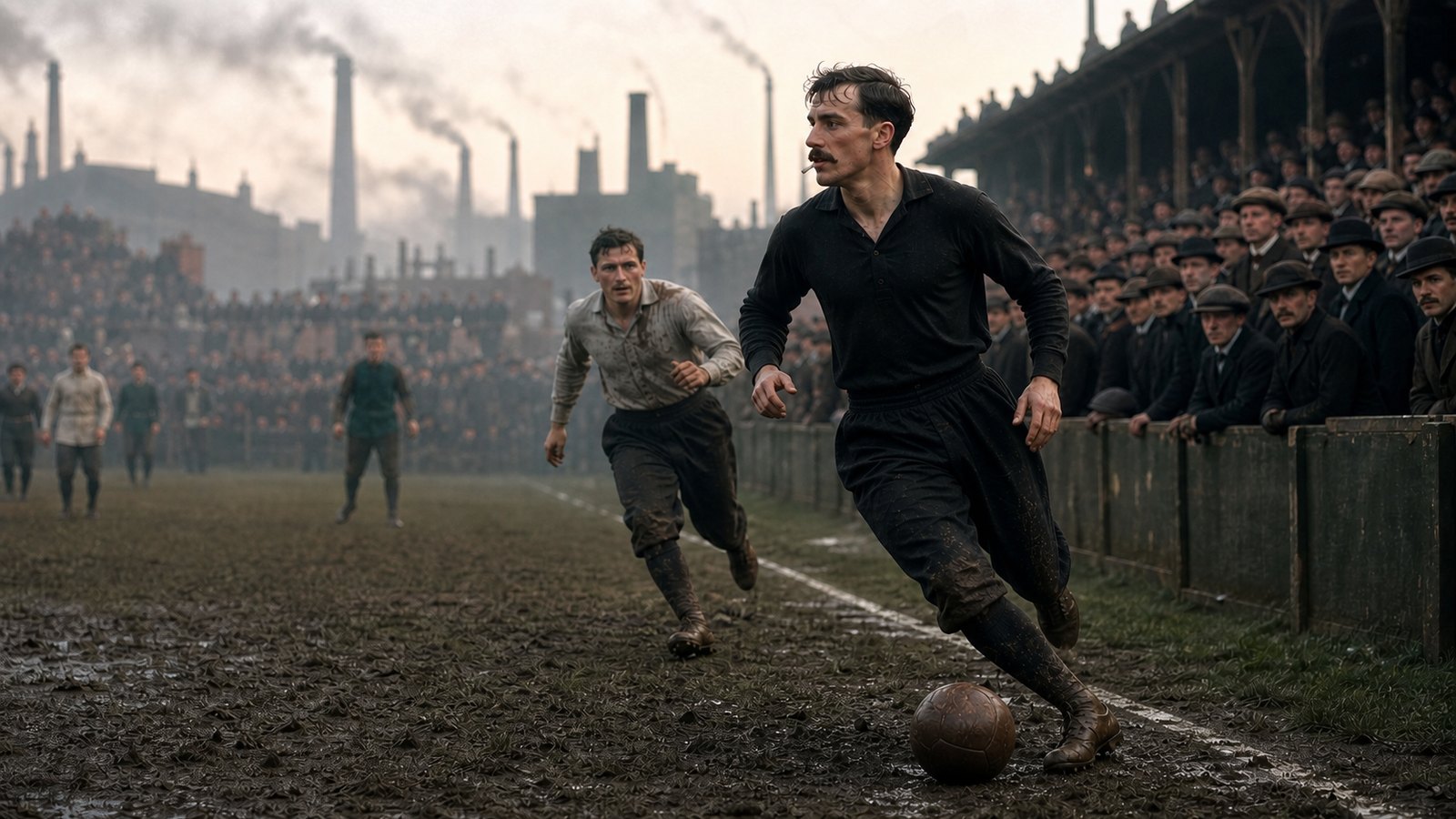
A wooden toothpick was a poor piece of sporting equipment. Billy Meredith kept one between his lips anyway. It sat beneath his moustache while he waited on the right wing in loose trousers, looking almost idle until the ball reached him. Then the still figure changed pace, carried the ball at a defender and delivered the precise crosses that made him one of British football’s first nationally recognised stars.
The toothpick is remembered because Meredith’s career crossed so many versions of the game. He was born before the Football League existed. He worked underground as a boy, travelled to Manchester while still employed at a colliery, captained City to their first major trophy, survived an eighteen-month suspension, helped players organise against the authorities and then returned to FA Cup football at 49. He played long enough to appear at both Hyde Road and Maine Road.
His story is often reduced to longevity or eccentricity. Its stronger thread is independence. Meredith learned football in a mining community where the shift and the match belonged to the same day. Fame did not persuade him that a celebrated player should remain obedient. The winger who resisted defenders also kept testing where a professional footballer’s authority began.
The Coal Shift and the Touchline Shared the Same Weekend
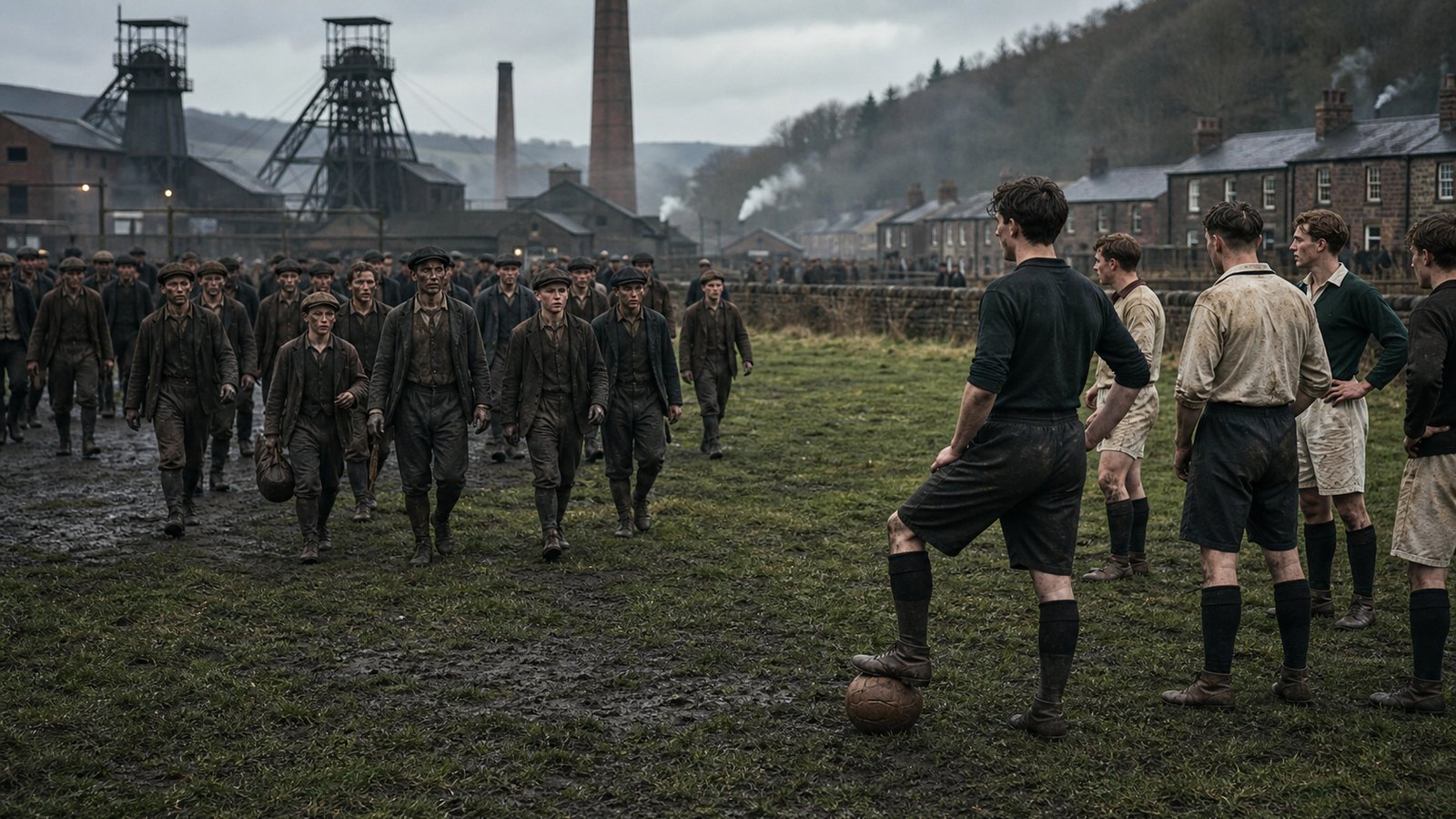
Meredith left school at twelve and worked at Black Park Colliery near Chirk as a pony driver and hutcher. Football grew around the same industrial community. Chirk had already built a formidable side, and Meredith was part of its 1894 Welsh Cup-winning team. His older brother Sam also became a professional and represented Wales.
A schoolmaster, Thomas E. Thomas, gave the boys another route into the game. He taught them to keep the ball on the ground and became the first executive president of the Welsh Football Association. Meredith absorbed a style based on close control rather than simply chasing distance. After spells with local sides and Northwich Victoria, he joined Manchester City late in 1894.
The move did not instantly separate work from sport. Meredith continued underground during the week until 1896, when City insisted that he leave the colliery and concentrate on football. That overlap matters: the famous winger did not emerge from a specialist academy or a protected sporting life. His early routine still depended on a mine, a train and enough physical reserve to play after labour.
A Winger Became the Face of Manchester City’s First Trophy
Meredith’s consistency was extraordinary for a wide player. During his first five years with City, he missed only seven matches. The club won the Second Division in 1899 and again in 1903. Historical totals differ, but his role does not: he created from the flank and finished often enough to become the club’s central attraction.
His defining City moment arrived in the 1904 FA Cup final against Bolton Wanderers. Meredith scored the only goal and, as captain, lifted the first major trophy in the club’s history. The achievement made him the first Welshman to captain an FA Cup-winning side. Cigarette cards carried his image, crowds came specifically to watch him, and “Welsh Wizard” became a marketable identity before football possessed the modern machinery of celebrity.
His appearance was part of the appeal. The loose trousers and Edwardian moustache made him recognisable, while the toothpick suggested ease. Defenders received a different impression. Contemporary descriptions emphasised his quick change from apparent stillness, his balance, and the accuracy of crosses delivered after drawing an opponent toward him. The public image looked casual because the hard part happened in the instant after the ball arrived.
An Accusation Sent a Star Across Manchester
The first City spell ended in scandal. An Aston Villa player accused Meredith of offering him £10 to throw a match. The Football Association found Meredith guilty and suspended him for eighteen months. He denied the allegation for the rest of his life. The case also exposed City’s breaches of payment rules and forced the sale of key players.
Meredith disputed the bribery case, but the punishment altered the balance between player and club. Manchester United signed him in 1906 while the ban still ran, as City’s punished side was broken up and key players were sold. He then helped United win First Division titles in 1908 and 1911 and the FA Cup in 1909. A disciplinary collapse at one club became the route to trophies with its neighbour.
The transfer also placed him among players prepared to challenge football’s employment rules. Meredith had already seen how quickly a club could celebrate a player, punish him and control his next move. Decades later, George Eastham would attack a different form of player control through the courts; his retain-and-transfer case belonged to the longer struggle over who owned a footballer’s working life.
Outcasts FC Made a Union Dispute Visible
Meredith’s concern extended beyond his own contract. Deaths and injuries among players had shown how fragile professional life could be. In 1907 he helped establish the Players’ Union, an ancestor of today’s Professional Footballers’ Association. Its members sought better wages and recognition that playing football was skilled employment rather than a favour granted by clubs.
The confrontation sharpened in 1909 when the Football Association demanded that players leave the union. Manchester United’s players refused. The FA suspended them, and the group trained under the name “Outcasts FC.” The name converted an administrative conflict into a public scene: leading professionals, including a famous international winger, practising outside the recognised structure because they would not surrender collective membership.
United eventually reached a settlement, and the union survived. Meredith’s presence did not solve every dispute over pay or registration, but it supplied something valuable—a star willing to make the argument in his own name. He could have treated fame as insulation from the weaker bargaining position of ordinary professionals. Instead, he used the attention around him to insist that skill on Saturday did not erase vulnerability during the rest of the week.

At 49, the Oldest City Player Reached One More Semi-Final
Meredith’s first United appearance came after the suspension; his last years made the chronology seem improbable. He was still playing in his fiftieth year. After the First World War he returned to Manchester City, fifteen years after the scandal had ended his first spell.
The return was more than a ceremonial afternoon. He scored against Brighton in the 1924 FA Cup and reached the semi-final against Newcastle United. Meredith was 49 years and 245 days old, one of the oldest outfield players ever to appear in the competition. The defeat ended City’s cup run and Meredith’s playing career with the club.
The setting completed a remarkable arc. His first City season had included journeys from the colliery. His last major match took place before a crowd larger than many industrial towns. Between them came two Manchester clubs, two league championships with United, two FA Cups across the clubs, 48 official Wales caps and a union confrontation that outlived his own career.
Meredith died in Manchester in 1958, the same year as the Munich air disaster. By then the Players’ Union had become an established part of professional football. Country, rival clubs and organised players all retained a claim on his story, but none could contain it alone.

The toothpick survives in descriptions because it made the contradiction visible. Meredith looked relaxed while stretching what a football career could contain. He moved from mine work to mass celebrity without accepting that fame should make him quiet. His longevity was not merely the preservation of an athlete’s body. It carried a working footballer’s argument from the game’s early professional years into the age of huge crowds and organised player power.
Sources
National Football Museum; Manchester City; Dictionary of Welsh Biography.