
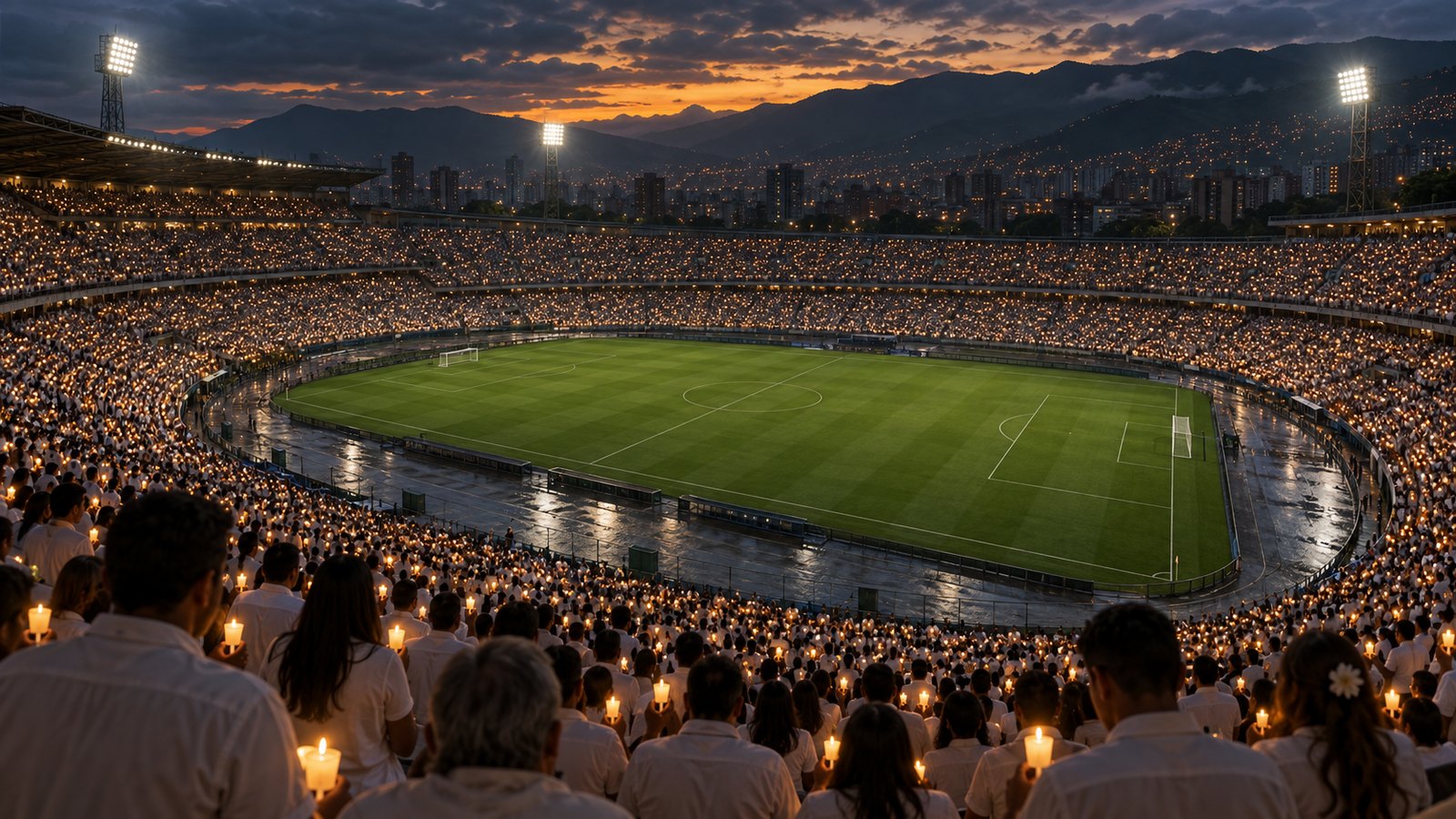
The clock still mattered. At 6:45 on the evening of 30 November 2016, Estadio Atanasio Girardot in Medellín was supposed to stage the first leg of the Copa Sudamericana final. Atlético Nacional would have faced Chapecoense, the Brazilian club completing the largest continental run in its history.
There was no team sheet and no match. Two nights earlier, the aircraft carrying Chapecoense’s party toward Medellín had crashed. Yet tens of thousands of people came to the stadium at the appointed hour. Atlético Nacional had asked them to wear white and bring candles.
Keeping the date and changing its purpose gave the crowd a difficult task. A football fixture normally directs every sound toward a result. This gathering had to use the same floodlights, stands and shared clock to acknowledge an absence. The stadium became a place where supporters could answer a catastrophe together, without pretending that football could repair it.
The final already had two cities and two clocks
The competition had arranged a conventional continental conclusion. Atlético Nacional and Chapecoense were to play over two legs, beginning in Medellín on 30 November and ending in Curitiba on 7 December. The first kickoff was listed for 18:45 local time at the Atanasio Girardot.
Chapecoense’s own Arena Condá was not due to host the return. CONMEBOL required at least 40,000 places for the final, so Estádio Couto Pereira in Curitiba had been selected. Even before the first ball, the tie depended on supporters travelling and two stadiums temporarily carrying identities larger than their ordinary matchdays.
The sporting rules offered a complete route to a winner. Away goals would not settle a level aggregate. Extra time and penalties were available if two matches left the teams tied. That careful sequence became irrelevant when LaMia Flight 2933 crashed on 28 November as it approached the Medellín area.
Seventy-one people died, including 19 of the 22 Chapecoense players aboard. Six survived. CONMEBOL suspended its activities early the next morning. A final designed to resolve uncertainty through 180 minutes could no longer begin.
Atlético Nacional preserved the appointment
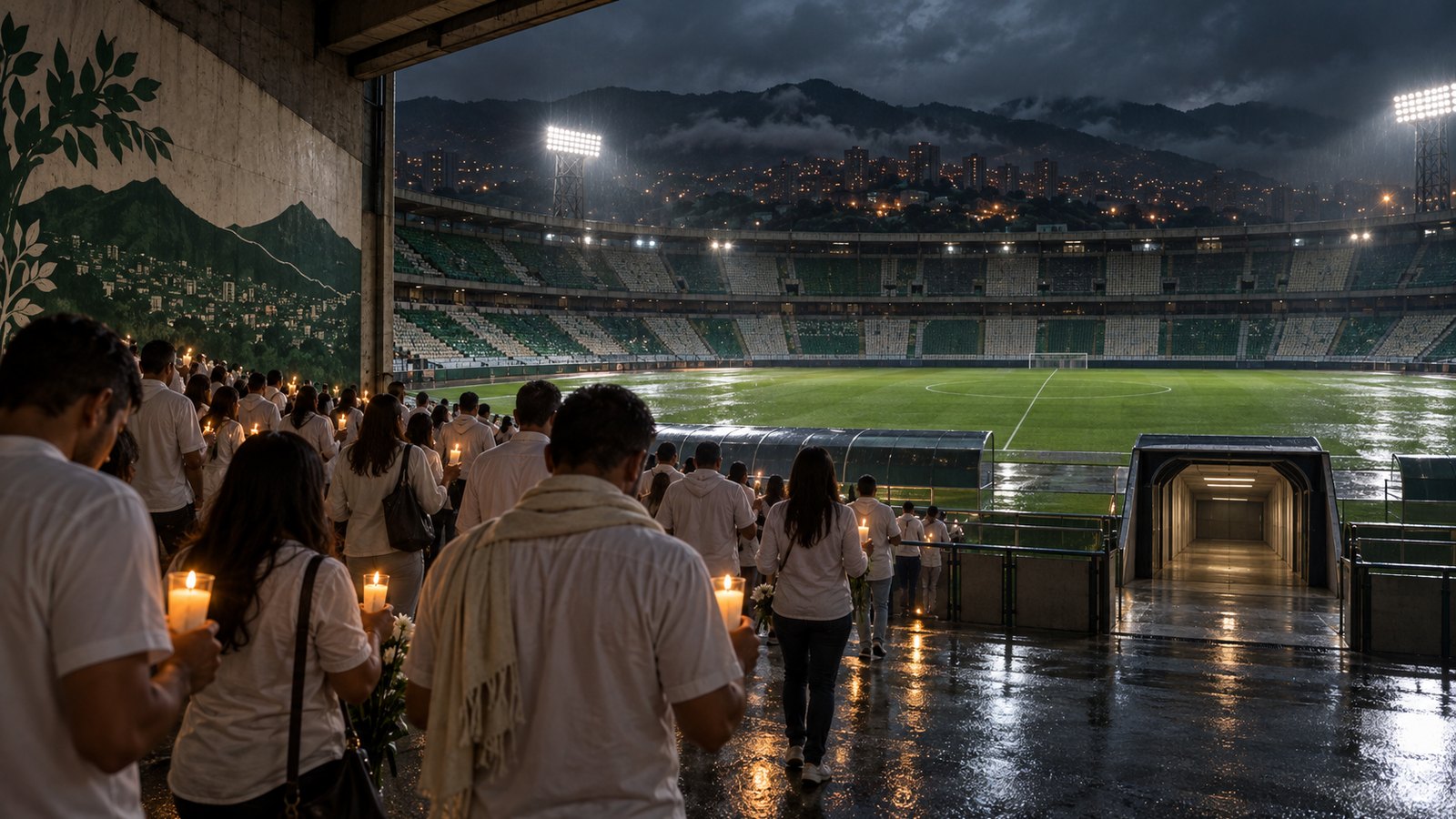
Atlético Nacional made two connected choices. The club asked CONMEBOL to award the trophy to Chapecoense, removing itself from the normal contest for the title. It also invited supporters to attend the Atanasio Girardot when the first leg should have started.
The invitation was precise enough to shape the scene. People were asked to dress in white and carry candles. Those instructions replaced the visual grammar of a home final. Club colours, opposition and advantage receded; a repeated pale colour allowed individuals across a huge bowl to read as one assembly.
The scheduled hour did practical work too. Supporters did not need a new date detached from the event they had expected. Tickets, travel plans and anticipation had already pointed toward Wednesday evening. By retaining 6:45, the club let the cancelled match supply the memorial’s meeting point.
Tens of thousands gathered. The number matters because this was not a small ceremony placed beside a stadium. The crowd occupied the scale prepared for a continental final. Floodlights illuminated a pitch that would remain unused, while candlelight made the spectators rather than the players the visible action.
Supporter intervention often tries to stop ordinary football so that a club’s danger cannot be ignored. The Ghost Goal’s account of Leyton Orient fans halting their own match follows that form. Medellín presented its inverse: the fixture was already impossible, and supporters came because gathering was the only part of match night still available to them.
White shirts and candles rewrote the home crowd
A home crowd normally divides the stadium into loyalties. The host expects its own noise to press the visiting team, and every ritual—from scarves to songs—marks possession of the ground. Atlético Nacional’s invitation asked its supporters to surrender that advantage before they entered.
White clothing did not erase who they were. It made their identity legible through restraint. They were Atlético Nacional supporters using Atlético Nacional’s stadium, but the evening was directed toward people from another club and country. The choice carried more weight because Nacional had been Chapecoense’s scheduled opponent, not a neutral organiser.
Candles changed the tempo. A final crowd is built for sudden movement: entrances, tackles, shots and goals. A flame asks for stillness and care. In a large stand, each small light remains fragile, yet thousands together alter the entire view. The effect suited an event in which no single speech or gesture could carry the scale of the loss.
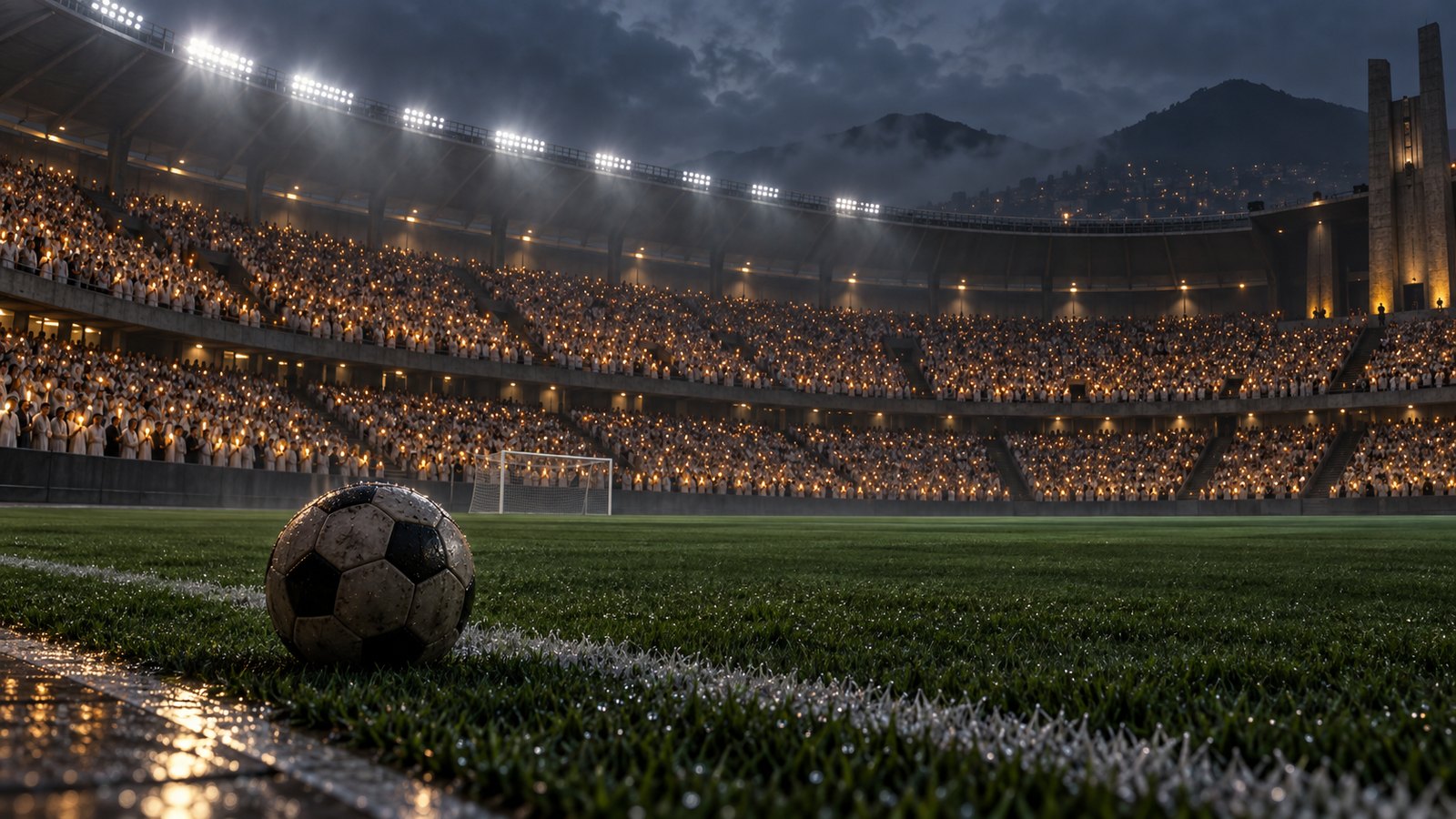
There was also discipline in coming without demanding replacement entertainment. The pitch, scoreboard and kickoff time were present, but their usual product was absent. The supporters accepted that emptiness instead of filling it with a ceremonial game. What happened in the stands gained meaning from the unused grass below.
Chapecó answered from its own ground
The gathering was not confined to Colombia. Supporters also assembled at Arena Condá in Chapecó on the night the first leg had been scheduled. Contemporary reporting described club colours, flags and flowers at the Brazilian ground. At one point, people recited the Lord’s Prayer together.
The two vigils were not mirror images. Medellín was the destination Chapecoense’s party had been trying to reach; Chapecó was home. One stadium held the unrealised welcome of an opponent, while the other held the families, neighbours and supporters whose ordinary football community had been torn open.
Still, the match calendar joined them. The same fixture that had promised competition now supplied a shared hour across borders. That connection made the response more than a sequence of disconnected tributes. The supporters in each city occupied their football ground because those grounds had been assigned roles in the final.
Other parts of the game began offering practical support. Brazilian first-division clubs proposed lending players without charge and asked that Chapecoense be protected from relegation for three years. UEFA arranged a minute’s silence before that week’s Champions League and Europa League matches. Those measures addressed different needs, from rebuilding a squad to widening remembrance.
None was equivalent to the stadium gatherings. Loans, regulations and institutional ceremonies travel through organisations. The vigils depended on thousands of personal decisions to leave home, wear a chosen colour and stand with strangers at a time that no longer promised a match.
The trophy followed the gesture rather than a score
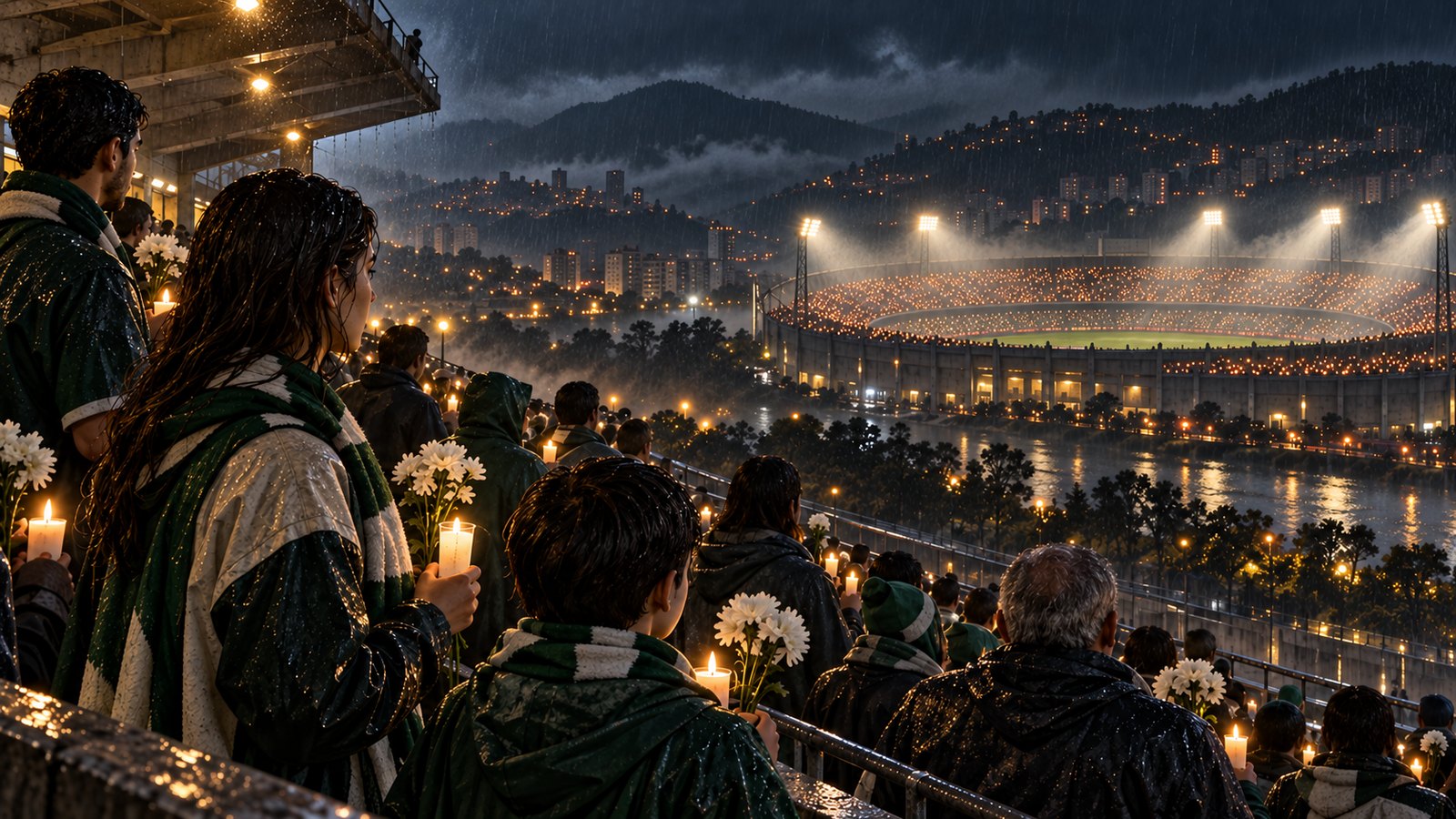
On 5 December, CONMEBOL declared Chapecoense the 2016 Copa Sudamericana champion. It was the club’s first continental title. The decision followed Atlético Nacional’s request rather than a result produced on the field.
Nacional received CONMEBOL’s Centenario Fair Play award and $1 million. The governing body praised the Colombian club’s solidarity, consideration and respect. An award could formally recognise the choice, but the choice had already become visible at the Atanasio Girardot: the scheduled home side had treated its opponent’s loss as the central fact of the night.
The trophy did not convert grief into victory. Nor did the vigil provide a neat ending. Chapecoense’s acting president Ivan Tozzo spoke of rebuilding with help from the wider football community. The three surviving players named in contemporary accounts—Alan Ruschel, Jakson Follmann and Neto—carried futures that could not be reduced to a symbol.
What the crowd accomplished was narrower and more honest. It preserved an appointment after the event itself had vanished. At 6:45, the stadium could have gone dark and left the cancelled fixture as an empty line in a record. Instead, tens of thousands arrived and made the absence public.
Football crowds are often described by the pressure they create, the colours they defend or the noise they direct at an opponent. This crowd was memorable for yielding all three. White replaced the expected home palette, candles slowed the stands, and the opponent became the reason to gather. The match never began, but its hour was kept.
Sources
BBC News; The Guardian and Press Association; CONMEBOL records summarized in the 2016 Copa Sudamericana finals event record.