
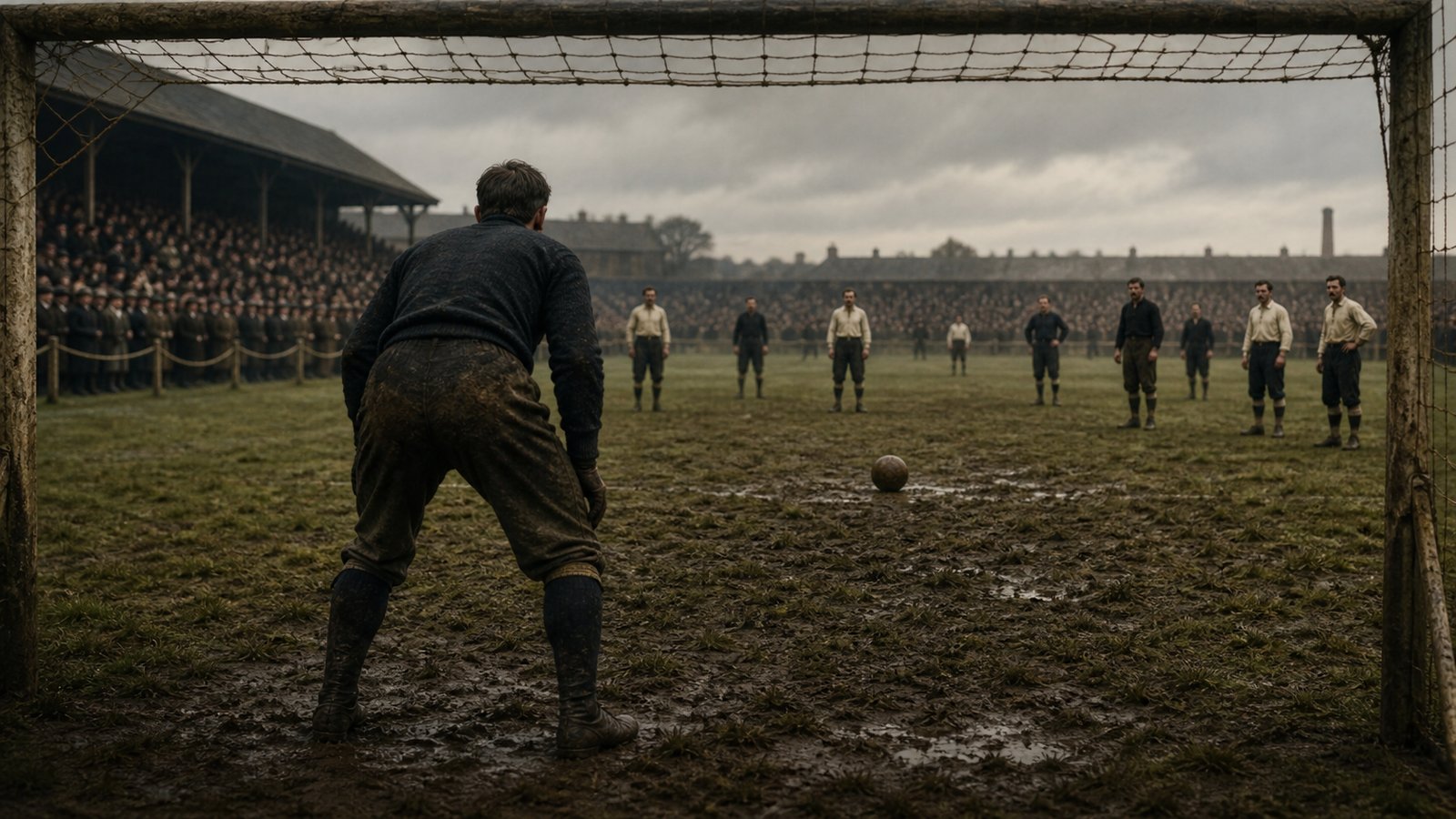
On 2 June 1891, football’s rule-makers met at the Alexandra Hotel in Glasgow and considered a punishment that many players had treated as an insult. The proposal assumed that someone might deliberately stop a goal by tripping, holding or handling the ball. Victorian football liked to describe itself in the language of honour. William McCrum’s idea began from the less comfortable evidence of what happened near a goal.
The delegates did not create the modern penalty spot. They drew an invisible line twelve yards from the goal and allowed the kick to be taken from any point along it. The goalkeeper could advance as much as six yards. Everyone else had to stand at least six yards behind the ball. Strange as those conditions look now, the meeting had accepted a lasting principle: a foul that destroyed a likely goal needed a consequence unlike an ordinary free-kick.
A goalkeeper at the bottom of the table
McCrum was born in 1865 near Milford in County Armagh, into a family whose fortune came from linen. He studied at Trinity College Dublin and played in goal for Milford FC. EPIC, the Irish Emigration Museum, places him in the first Irish Football League season of 1890–91, when Milford competed against seven Belfast clubs. It was a punishing education in the space directly in front of goal.
BBC’s account records Milford finishing bottom after conceding more than sixty goals in fourteen matches. The exact misery matters because McCrum was not theorising from a committee room alone. A goalkeeper repeatedly watched attackers reach the dangerous final yards, defenders intervene, and the existing law struggle to distinguish a routine infringement from the deliberate removal of a scoring chance.
In 1890, through the Irish Football Association, he proposed a single shot from twelve yards when a defender deliberately prevented a probable goal. The proposal was mocked as the “Irishman’s motion” and, in some retellings, the “death penalty.” The objection was partly practical, but it was also moral theatre. Critics argued that writing such a sanction into the laws presumed a gentleman footballer was capable of calculated cheating.
The foul football could barely punish
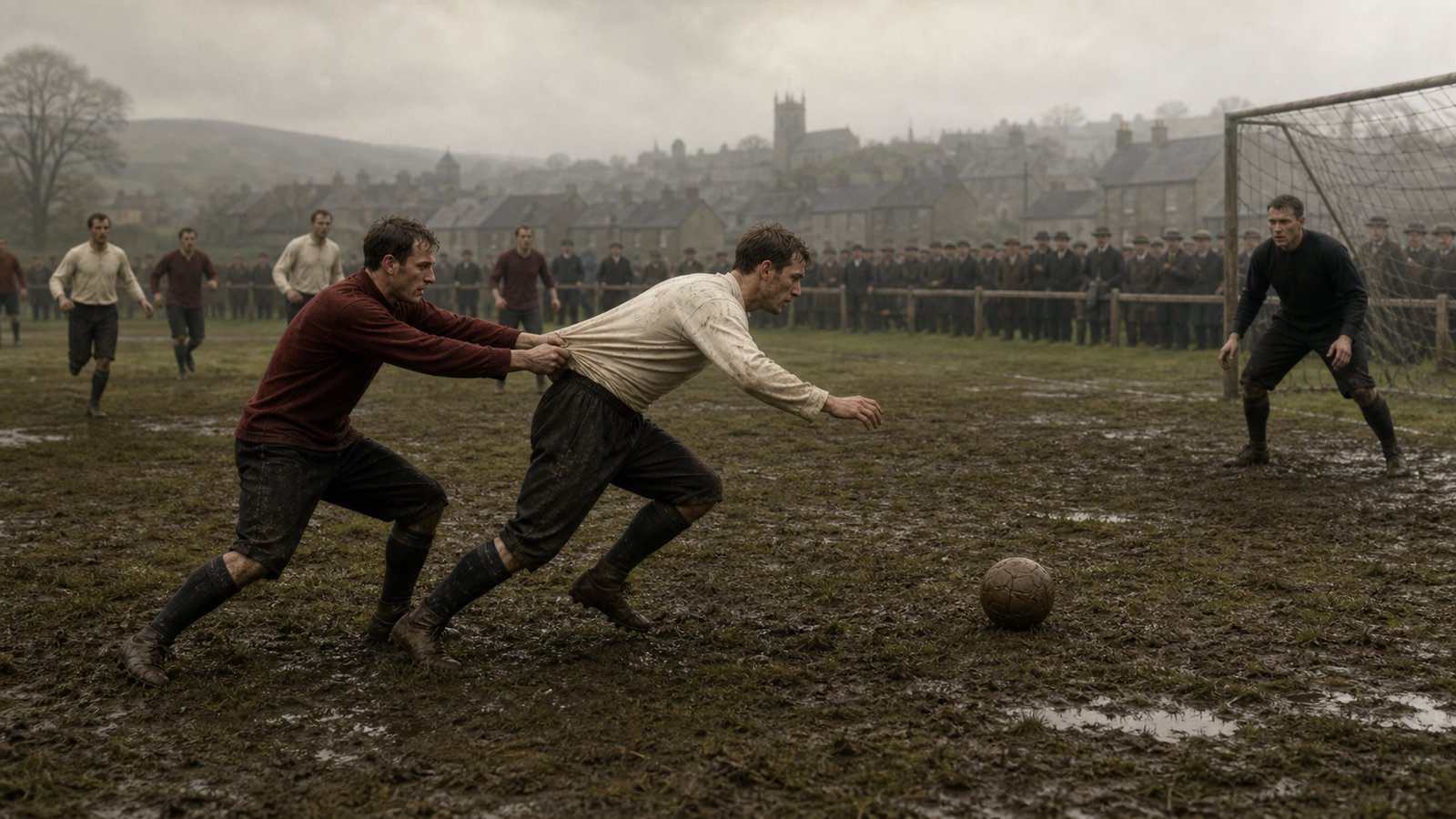
The old response near goal was a free-kick. That could produce almost no remedy when defenders packed the goalmouth. BBC recounts the episode that made the weakness vivid: during an 1891 FA Cup tie, a Notts County defender handled the ball on the line to deny Stoke City. At the resulting free-kick, Notts County’s players stood shoulder to shoulder in front of goal. Stoke could not score and eventually lost.
The incident did not invent McCrum’s proposal; he had already raised it. Its importance was demonstration. A defender could exchange a likely goal for a restart that the defending side was well equipped to smother. The law acknowledged an offence without restoring any meaningful share of the opportunity that had been taken away.
That gap explains why the penalty was more than a dramatic new set piece. It attached the punishment to the location and intention of the offence. The 1891 minutes named intentional tripping, holding and deliberate handling within twelve yards of a team’s own goal-line. The kick could produce a goal directly. Football had begun to price a cynical intervention differently from a foul elsewhere on the field.
Glasgow rewrote the proposal
The surviving International Football Association Board minutes make the adoption unusually tangible. The meeting began at 6 p.m. with delegates from England, Wales, Ireland and Scotland. The press was not admitted. W. Reid of Ireland proposed the new law and C. Crump of England seconded it. After “considerable discussion,” the delegates amended the conditions rather than discarding the idea.
The original wording required the kicker and goalkeeper to be separated from the other players, who would stand behind the ball and at least six yards away. The meeting tightened that geometry. All other players had to stand at least six yards behind the ball, while the goalkeeper was specifically allowed to advance no more than six yards from the goal-line. The kick itself could be taken from any point twelve yards out.
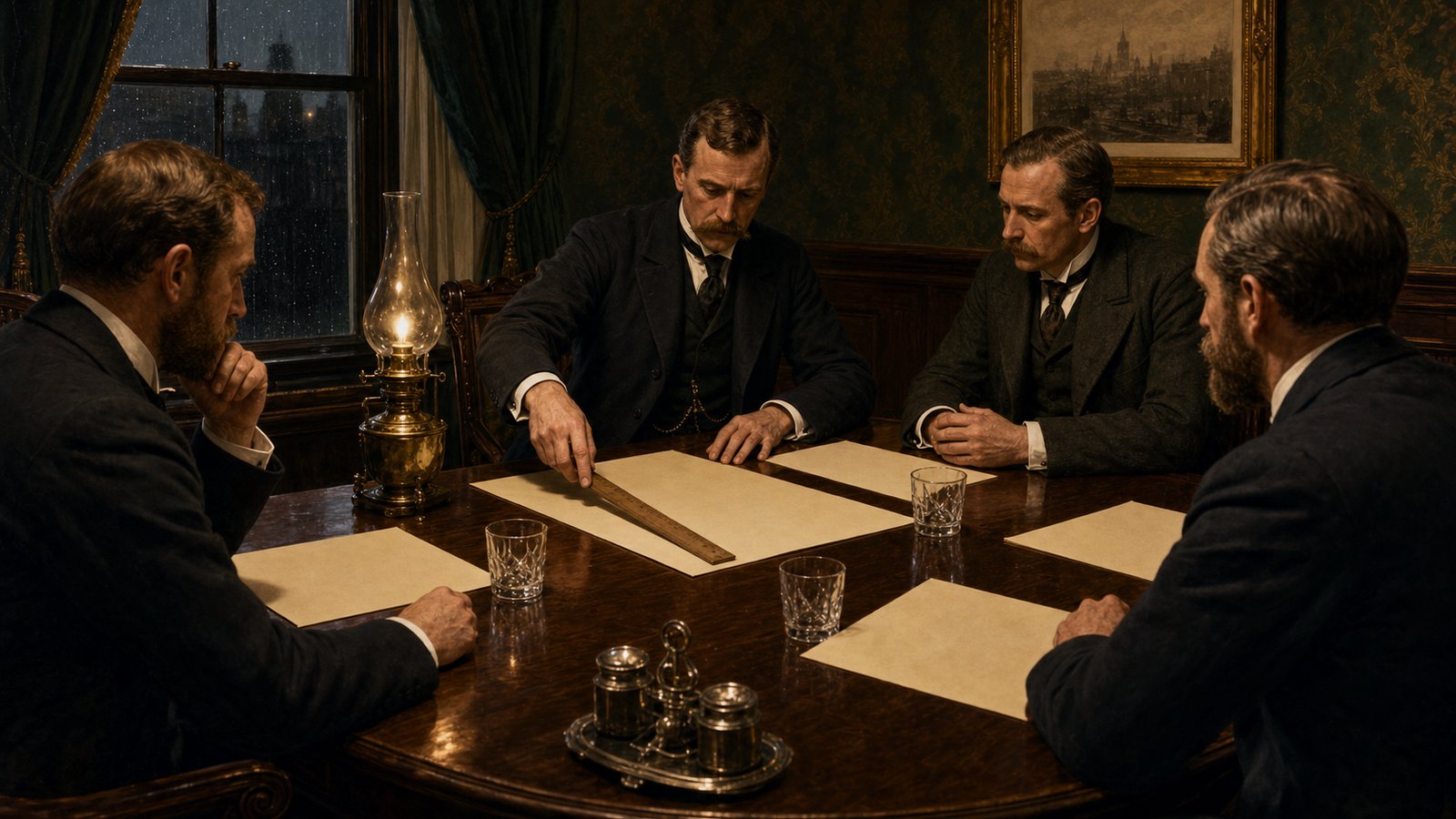
The same meeting also abolished the old umpires and defined duties for linesmen under the referee. That context is revealing. The penalty did not arrive as an isolated piece of spectacle. It belonged to a broader effort to give one referee clearer authority and make disputed moments governable as football spread beyond small circles of familiar opponents.
McCrum was not named in the published wording, and his role faded from much of football’s everyday memory. Yet the route of the proposal remained clear: an Armagh goalkeeper’s idea passed through the Irish association, was argued over by the four national bodies, and emerged as a common law.
The first penalty was a moving target
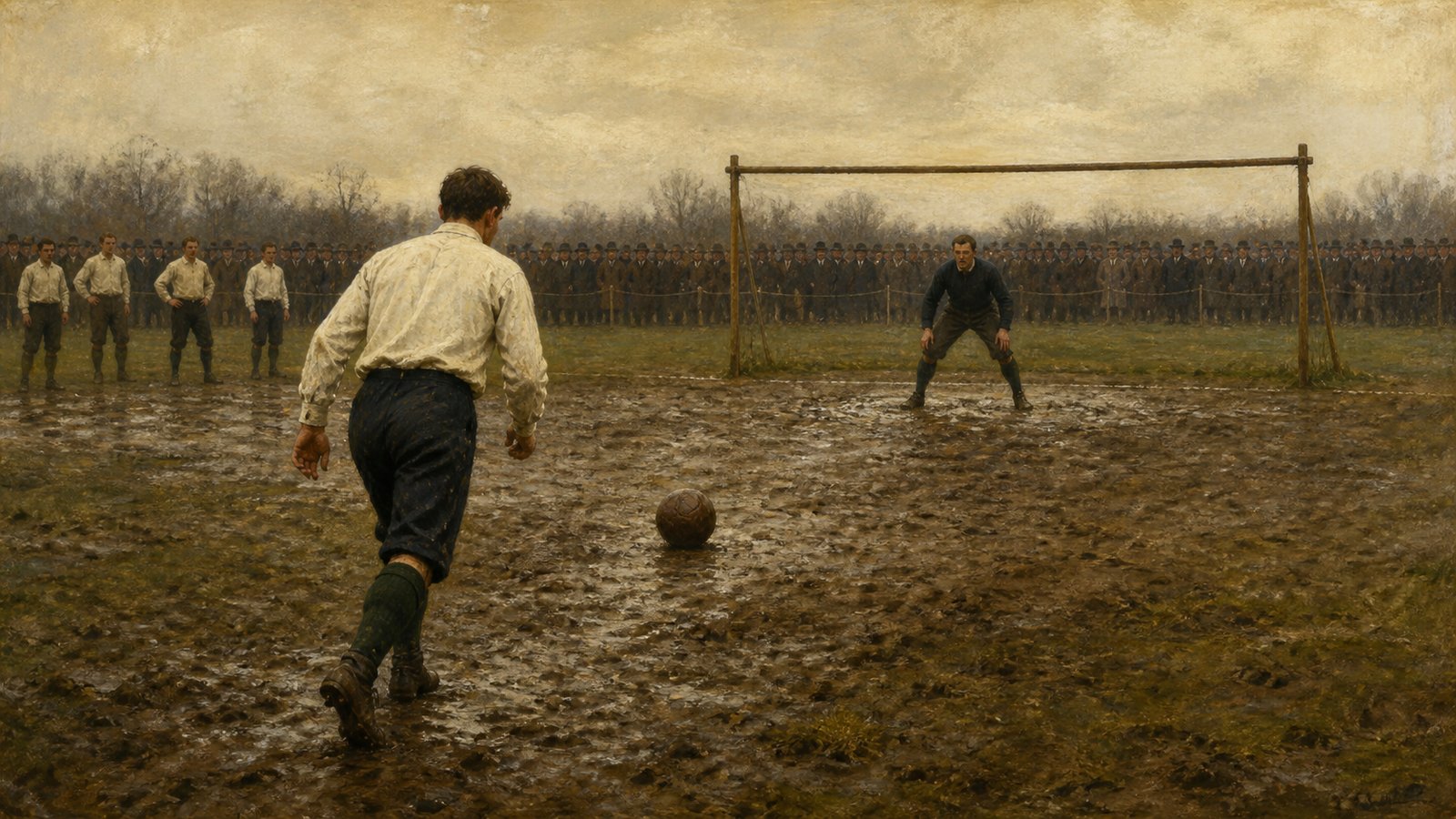
A modern viewer would recognize the tension but not the stage. There was no painted penalty area and no fixed spot. BBC’s history notes that the ball could be placed anywhere along the twelve-yard line. A clever taker could choose the angle; a goalkeeper was not anchored to the goal-line. The remaining players waited behind the ball, not outside a rectangular box.
The award also depended on an appeal in the 1891 wording. It covered deliberate conduct within twelve yards, but the visual grammar now familiar from television—referee pointing to a spot, goalkeeper on the line, players around an arc—had not yet been assembled. The first law established the bargain before later revisions standardized the scene.
Its geometry created choices that the fixed spot later removed. Because the ball could sit anywhere on the twelve-yard line, the taker could shift left or right rather than accept a central approach. Because the goalkeeper could advance six yards, the apparent twelve-yard contest might shrink sharply before contact. The other players, held six yards behind the ball, were positioned for whatever followed. These were not decorative details. They show delegates trying to create an advantage severe enough to answer the foul while still allowing the defending side a contest.
EPIC records that resistance did not vanish after adoption. Corinthian objections were rooted in the belief that the law offended sportsmanship by anticipating foul play. Reports of players missing deliberately or leaving the goal unattended in protest show how radical the sanction felt. The penalty made a public judgment about intention, and it offered the offended side an unusually clear advantage.
What twelve yards changed
McCrum’s proposal solved a narrow problem with a rule that exposed a larger truth. Football could not rely on ideals of gentlemanly conduct once competitive rewards made tactical fouling useful. The laws needed to anticipate behaviour that participants preferred not to admit. A punishment severe enough to deter the foul was also severe enough to provoke arguments about judgment, intention and fairness.
The modern penalty has accumulated its own complications, from goalkeeper movement to encroachment and video review. Those later debates should not obscure the original mechanism. Before 1891, a defender could erase a near-certain goal and face a restart with little attacking value. After Glasgow, the defending side had to confront a direct shot capable of scoring.
McCrum died in 1932, long before penalty shootouts became tournament theatre. His contribution survived because it was not tied to one match or one era’s tactics. Whenever a referee separates a grave foul near goal from an ordinary infringement, football repeats the decision made in that Glasgow hotel: twelve yards can represent the chance that foul play removed.
Sources
International Football Association Board, Minutes of the 1891 Annual General Meeting
England Football Online, International Football Association Board Meeting 1891
BBC Bitesize, Who Invented the Penalty Kick and When Was It Created?
EPIC The Irish Emigration Museum, William McCrum: The Irish Inventor of the Penalty Kick
Wikipedia, William McCrum (biographical cross-check only)