
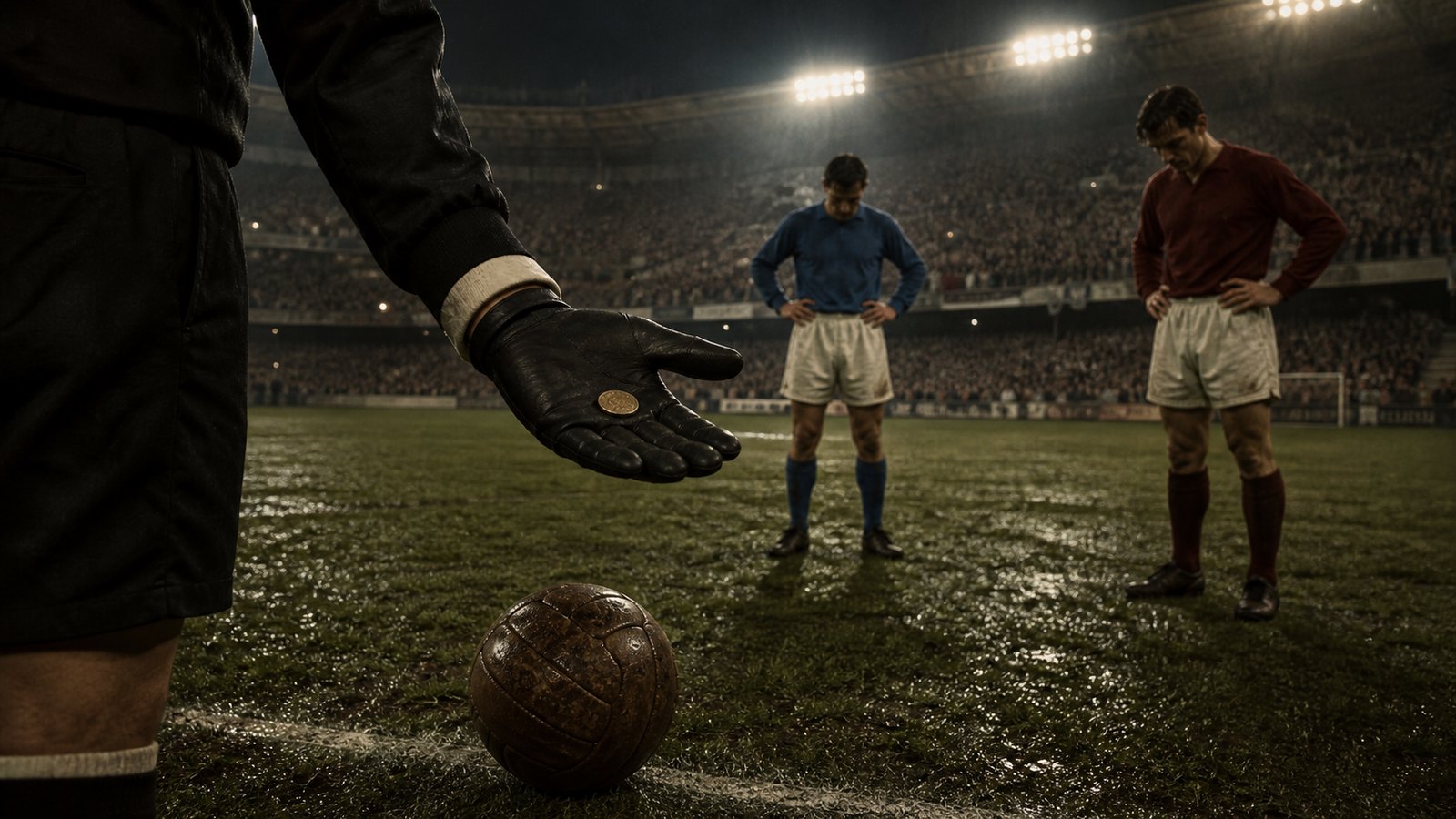
At Naples’ Stadio San Paolo on 5 June 1968, Italy and the Soviet Union played for 120 minutes and produced no goal. Then football ran out of match. Captain Giacinto Facchetti made the correct call on a referee’s coin, and Italy advanced to the European Championship final.
The scene feels almost impossible now because the stakes were enormous and the procedure was so small. There was no penalty shootout waiting behind extra time. A place in the continental final moved on the fall of metal rather than another touch of the ball. Yet the toss was not a piece of folklore improvised after a stalemate. It was the competition’s accepted way to separate teams when the game could not.
Italy’s luck in Naples is usually remembered as a curious footnote. Follow the tournament for another five days, however, and the footnote becomes the organising idea of the whole event. EURO 1968 exposed a game whose grand competitions had grown faster than its methods for ending them. The semi-final required a coin. The final required a second match. Italy became champion only after football used both remedies in the same week.
Thirty-one entrants, four places in Italy
The 1968 competition was the first to carry the name UEFA European Championship, replacing the European Nations’ Cup. Its qualifying structure had also changed. Thirty-one countries entered, eight seeded groups produced eight group winners, and those winners met in two-legged quarter-finals. Only England, Italy, the Soviet Union and Yugoslavia reached the final tournament.
That made the event in Italy remarkably compact. There were two semi-finals on 5 June, a third-place match on 8 June, and what was supposed to be one final that same day. Every game carried a large fraction of the tournament’s meaning. There was no long group phase at the host venue and little room for recovery. One unresolved semi-final could force the rulebook into view immediately.
Italy arrived as host but had still needed to qualify. They topped a group containing Romania, Switzerland and Cyprus, then recovered from a 3–2 quarter-final defeat in Sofia by beating Bulgaria 2–0 in Naples. The Soviet Union had won five of six group matches before reversing a 2–0 quarter-final loss in Budapest with a 3–0 victory over Hungary in Moscow. These were not teams drifting into a ceremonial home tournament. Both had already survived a long route and a two-leg scare.
Two hours without a separating goal
The Naples semi-final paired Italy’s Dino Zoff, Tarcisio Burgnich, Facchetti, Gianni Rivera and Sandro Mazzola with a Soviet side including Albert Shesternev, Anatoliy Banishevsky and Anatoliy Byshovets. West German referee Kurt Tschenscher took charge in front of a reported crowd of 69,000 at the San Paolo.
Neither side scored in regulation time. Neither scored in extra time. The record looks bare—Italy 0, Soviet Union 0 after extra time—but the emptiness is exactly what created the crisis. A tournament built around elimination had reached the end of the allotted football without producing an eliminated team.
Modern viewers instinctively wait for the teams to gather at the centre circle, for the goalkeepers to study run-ups, and for five takers to be nominated. That ritual did not exist here. Penalty shootouts were not part of this European Championship’s resolution procedure. The next competitive act belonged to the captains and the referee, but it was not a football action at all.
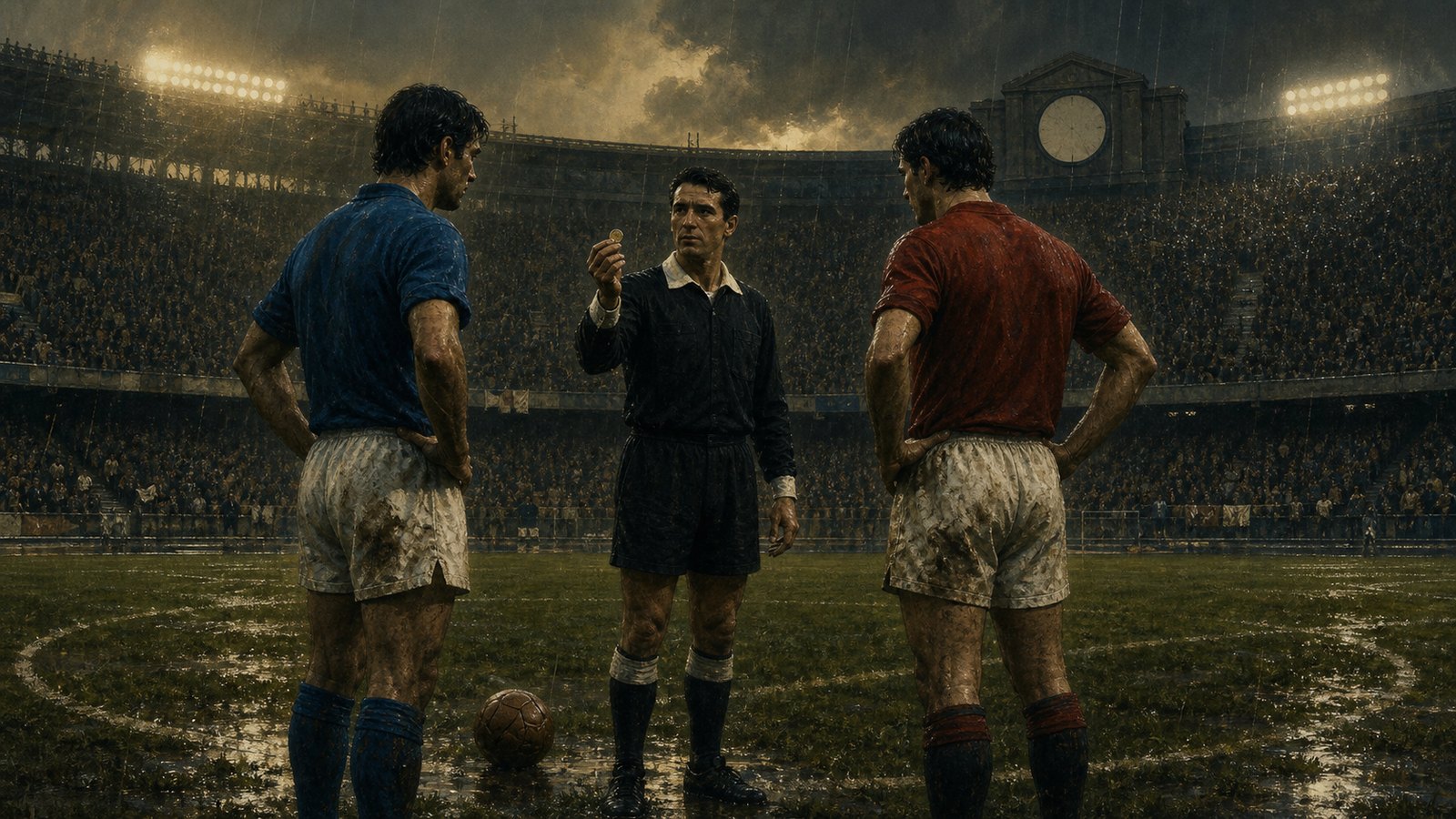
Facchetti, Italy’s captain and Inter left-back, made the successful call. UEFA’s history describes him as making the right choice after the goalless draw, sending the host nation into the final. The Soviet Union’s entire qualifying campaign—six group matches, two quarter-final legs and 120 minutes in Naples—ended without a losing goal in the semi-final.
The rule waiting beyond extra time
A coin toss is brutally clear. It has no tactical interpretation, no argument about technique and no opportunity for a goalkeeper to intervene. That clarity explains why administrators could use it; its indifference explains why football eventually moved away from it. The procedure guarantees an answer while refusing to pretend that the answer measures sporting superiority.
EURO 1968 made that tension visible at the highest level. UEFA records the Italy–Soviet Union semi-final as the only competitive European international decided by a coin toss. The uniqueness matters. Football did not build a tradition around this solution. It passed through the moment, preserved the result, and later embraced a method that at least asked players to perform a recognisable football skill under pressure.
The difference is more than theatre. A penalty shootout gives coaches choices, takers responsibility and goalkeepers a role. Chance remains—the post, a slip, a guessed direction—but chance works through an action from the sport. A tossed coin removes even that narrow connection. In Naples, Facchetti could carry the responsibility of calling, but he could not influence how the coin landed.
The contrast also sharpens the story of Ken Aston’s yellow and red cards. Football in the late 1960s was solving several rule and communication problems at once. Cards gave disciplinary decisions a visible language. A new tie-break method would give deadlocked knockout matches a playable ending. Both changes addressed moments when the old procedures no longer matched the scale and speed of the international game.
Luck opened a route that Italy still had to finish
Winning the toss did not hand Italy the trophy. It placed them in the final against Yugoslavia, who had beaten world champions England 1–0 in Florence through Dragan Džajić’s 86th-minute goal. Three days after Naples, Italy confronted another match that the existing format could not settle.
Džajić scored for Yugoslavia in the 39th minute at Rome’s Stadio Olimpico. Angelo Domenghini equalised with ten minutes left. Extra time ended at 1–1. This time the rules produced a replay rather than a coin toss. The finalists returned to the Olimpico on 10 June, two days after the first final.
Italy changed personnel for the replay, bringing Luigi Riva and Sandro Mazzola into the side. Riva scored in the 11th minute and Pietro Anastasi in the 32nd. The 2–0 victory gave Italy their first European title. UEFA still notes that this is the only European Championship or World Cup final decided by a replay.
That sequence prevents an easy verdict on Italy’s championship. They benefited from pure chance in the semi-final, but the final demanded 210 minutes across two games before they won it. The same tournament was both arbitrary and exhausting. Facchetti’s call opened the door; Zoff, Riva, Anastasi and their teammates still had to pass through it.
It also explains why the toss cannot be reduced to a joke about lucky hosts. The Soviet Union had every reason to feel the cruelty of the procedure, yet Italy’s later work was real. Tournament design can shape who gets the chance to perform without making the performance imaginary. In 1968, the boundary between access and achievement was unusually easy to see.
A five-day argument for better endings
The final tournament used three stadiums and involved only four teams, but it generated two resolution methods that major football has since abandoned at this level. Naples supplied the coin-toss semi-final. Rome supplied a drawn final and a replay. Together they form a snapshot of rules under strain.
Penalty shootouts would soon offer a different bargain: still imperfect, still painful, but conducted through kicks and saves rather than a captain’s guess or an entire second fixture. The sport kept chance but made players carry it. It kept finality but compressed the answer into the same event.
Facchetti’s coin remains compelling because it marks the instant before that bargain became familiar. Sixty-nine thousand people had watched two elite teams cancel each other out for two hours. The tournament needed one finalist. Its rulebook answered with an object small enough to disappear in a referee’s hand.
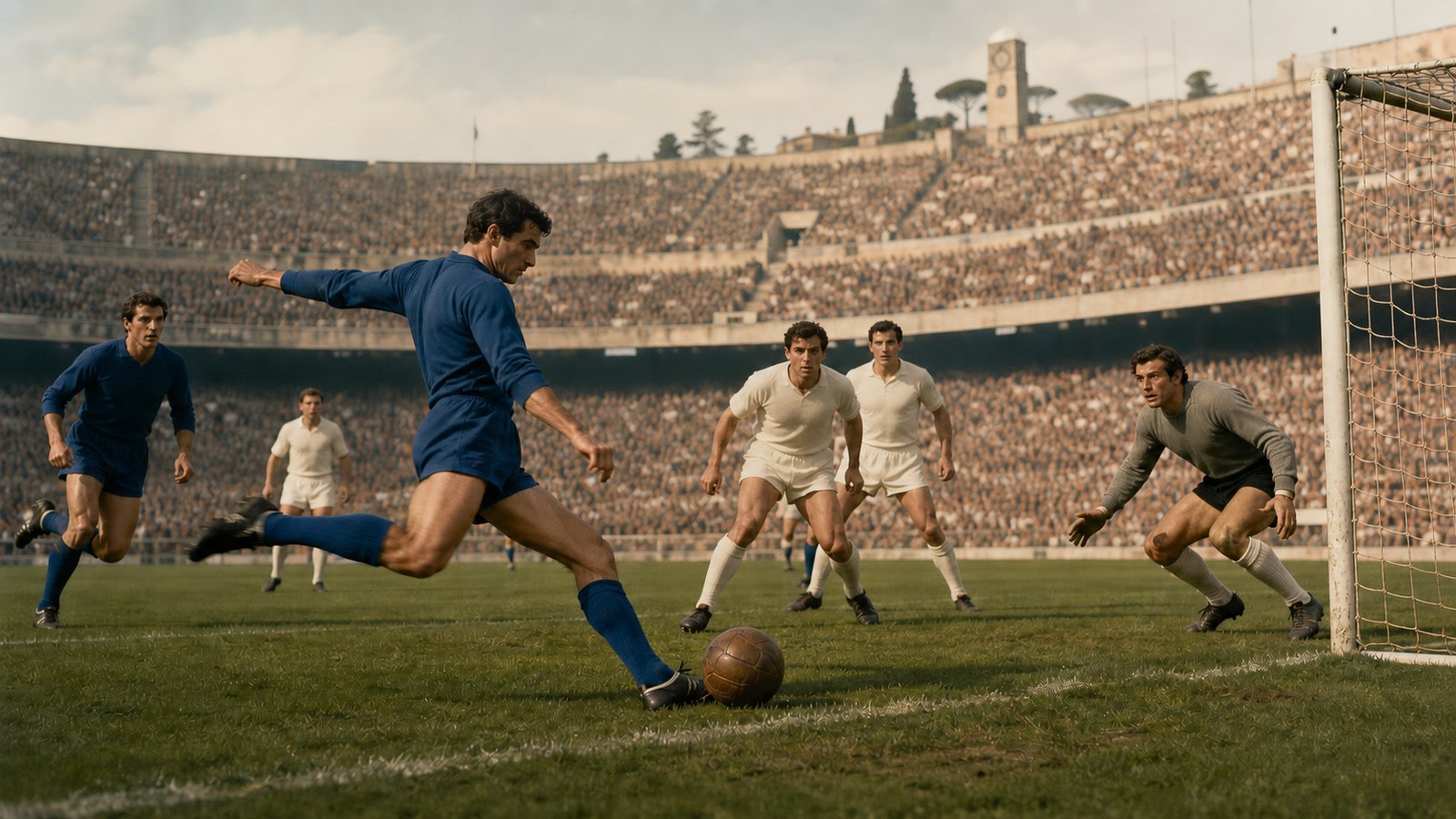
The trophy photographs show Italy as European champion, and correctly so. The route behind them is stranger: qualification, a two-leg quarter-final recovery, a scoreless semi-final, a correct call, a drawn final and a replay. EURO 1968 crowned a team while quietly demonstrating that the competition needed a better way to reach its endings.
Sources
- UEFA, “EURO 1968: All you need to know”
- UEFA EURO 1968 season history
- Rec.Sport.Soccer Statistics Foundation, European Championship 1968
- BBC Sport, “Euro 1968: Alan Mullery’s moment of madness”