
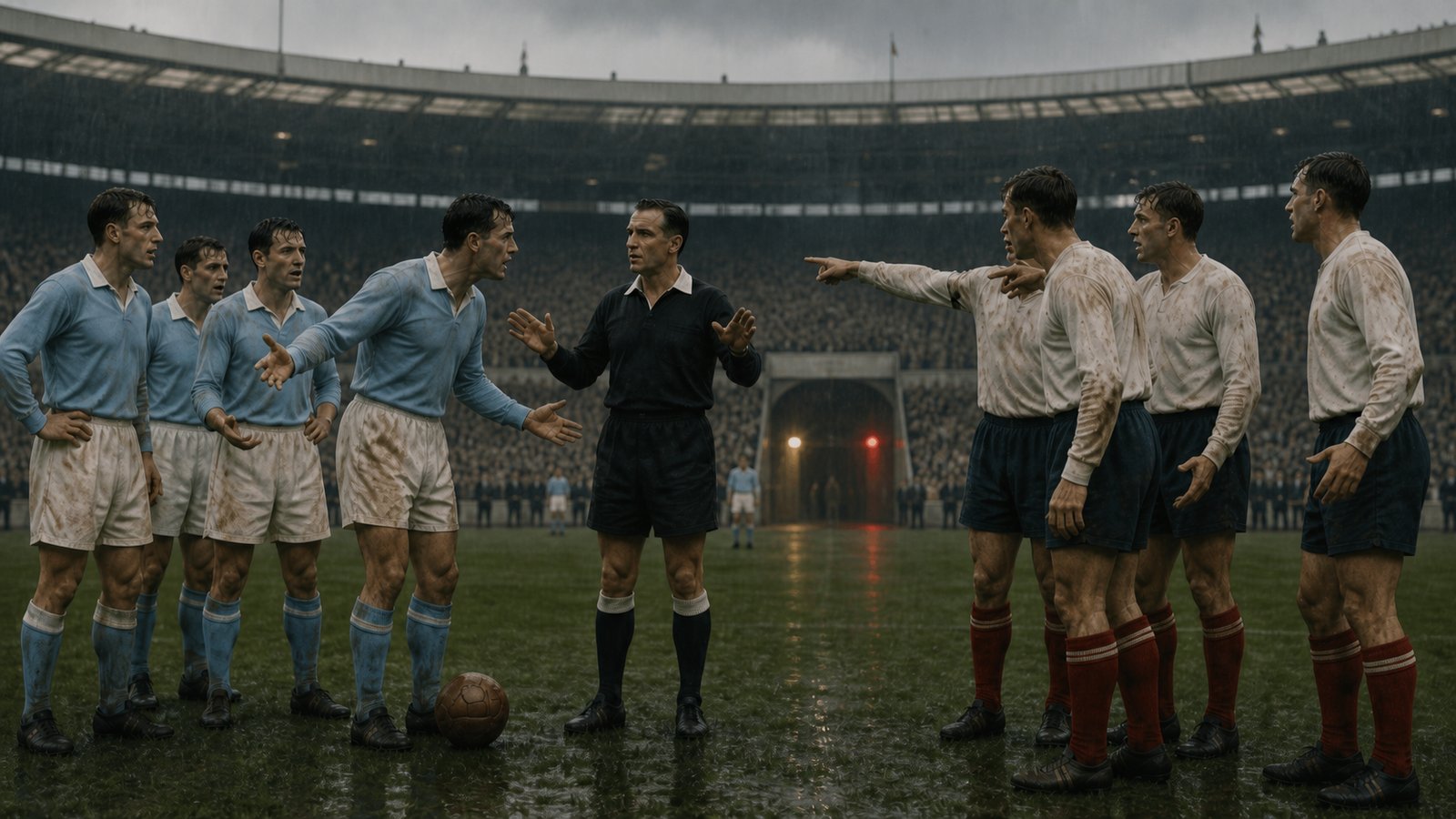
Wembley held 90,584 people for England’s 1966 World Cup quarter-final against Argentina, yet one of the afternoon’s most important decisions could not be understood. West German referee Rudolf Kreitlein sent Argentina captain Antonio Rattín from the field. Kreitlein spoke no Spanish; Rattín spoke no German. The dismissal stretched into several minutes of argument while players, spectators and commentators tried to read a judgment that had no visible sign.
Ken Aston watched the confusion with unusually relevant experience. Four years earlier he had refereed the violent Chile–Italy match now remembered as the Battle of Santiago. By 1966 he chaired FIFA’s Referees’ Committee and was responsible for the tournament’s officials. His answer came away from the pitch, in London traffic: use two colours that could cross a language barrier. Yellow would communicate a caution. Red would communicate a sending-off.
One dismissal exposed an invisible part of refereeing
England beat Argentina 1–0, but the quarter-final produced more uncertainty than the score records. Kreitlein’s decision to remove Rattín was real; the communication around it was improvised. A referee could speak, point and write in a notebook, yet there was no universal display telling the stadium whether a player had received an official warning or had been expelled.
The confusion extended beyond Rattín. Reports after the match said England’s Bobby and Jack Charlton had been cautioned, a fact that was not clear to everyone during play. The problem was larger than translation between one German official and one Spanish-speaking captain. International football placed teams, officials and crowds from different countries inside the same emotional space, then relied on gestures whose meaning was not always shared.
Aston saw that enforcement and explanation were separate jobs. The Laws gave the referee authority, but authority lost some of its force when nobody could instantly recognise what had been decided. A useful signal had to work from the touchline, the opposite end of the ground and the press seats without requiring a conversation.
The distinction also protected the sequence of a match. Spoken explanation invites another exchange: a player asks what the referee means, the official repeats himself, teammates arrive, and uncertainty becomes a crowd. A visible card closes one part of that exchange. Everyone may still dispute the judgment, but nobody needs to debate whether a formal caution or dismissal has occurred. Aston’s proposal addressed the moment before argument about fairness, when the participants first need a common account of the decision itself.
Santiago had already shown Aston the cost of lost control
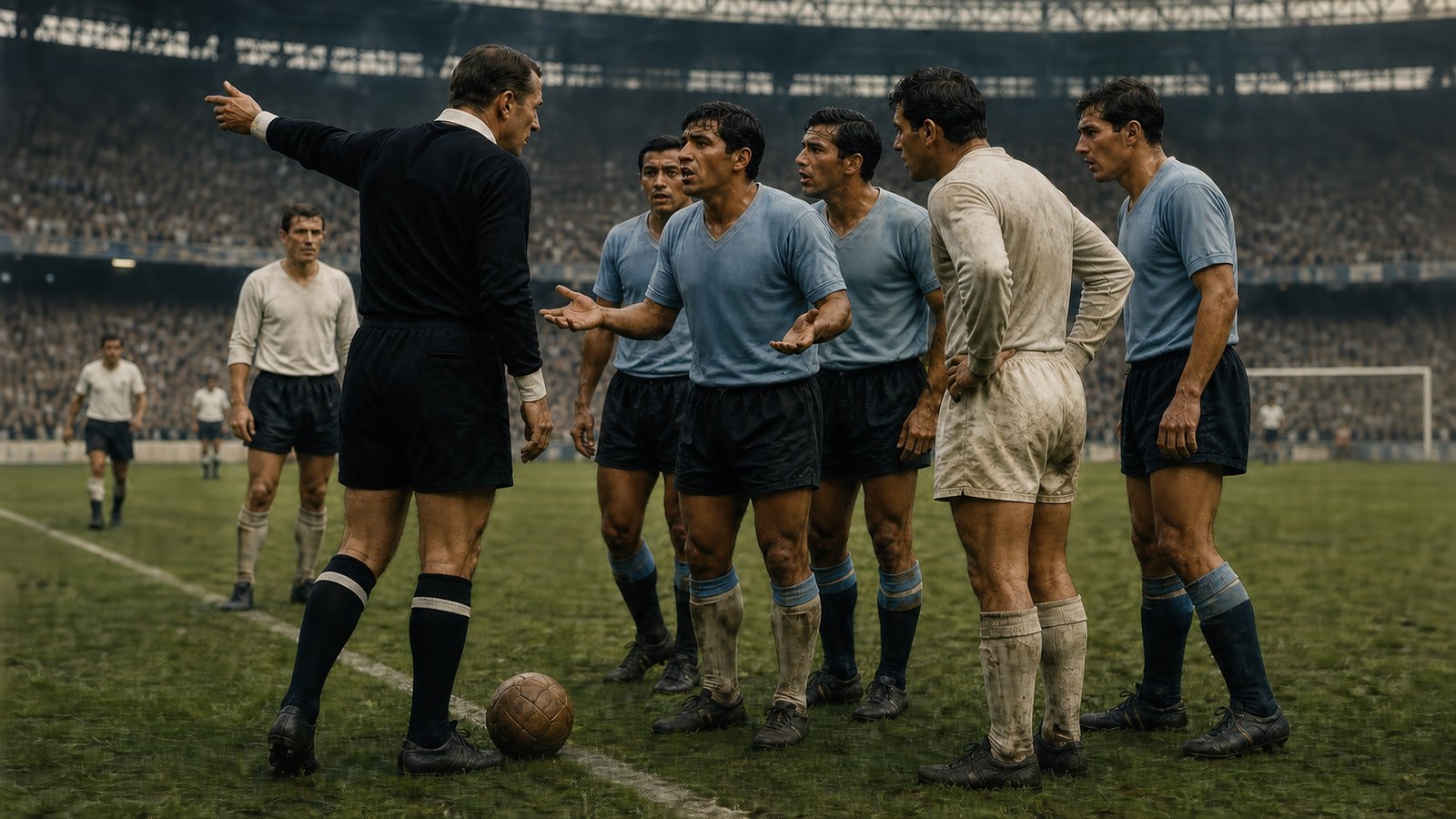
Aston was not approaching this as a designer looking for an abstract problem. In 1962 he had handled Chile against Italy, a match FIFA’s account describes through a left hook, a broken nose, two expulsions and repeated police intervention. The contest became a case study in how quickly hostility could outrun an official’s available tools.
His path to that field had begun far from a World Cup committee room. Kenneth George Aston was born in Colchester on 1 September 1915 and moved to Redbridge while young. In 1935 he joined the staff at Newbury Park School, ran its football team and qualified as a referee. During the Second World War he served with the Royal Artillery. In 1953 he became the school’s headteacher.
Teaching and officiating demanded a similar skill: a rule mattered only when the people subject to it knew where the boundary stood. Aston progressed into major football and refereed the 1960 Intercontinental Cup meeting in which Real Madrid beat Peñarol 5–1. Two years later Santiago tested the limits of spoken warnings and physical presence. He could punish offences, but the wider spectacle still needed a cleaner vocabulary.
A traffic signal supplied a language without words
FIFA’s history places the breakthrough during a drive through London after the 1966 confusion. Aston saw a traffic light change from yellow to red. The sequence offered a ready-made hierarchy. Yellow meant danger and a warning to stop if safe; red meant stop. Neither colour required a player to understand the referee’s language, and both could be recognised at distance.
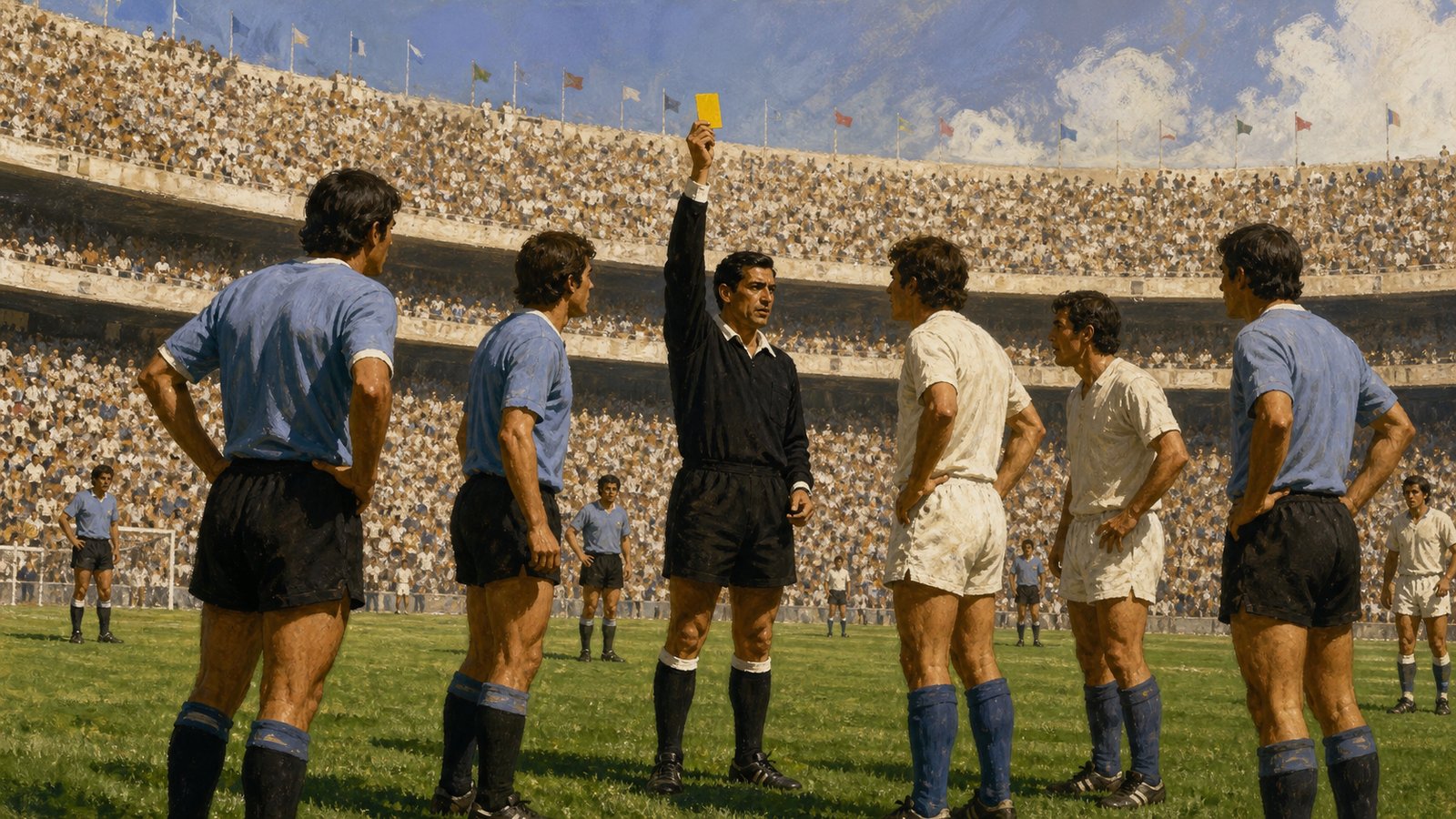
The strength of the idea lay in compression. A caution involves law, judgment and consequence, but the public signal could be reduced to one rectangle held above the referee’s head. A dismissal is even more consequential, yet red could make it unmistakable. The cards were not a new offence or a new punishment. They were an interface between the decision and everyone who needed to comprehend it.
This also changed the experience of watching. A supporter no longer had to infer whether a stern conversation counted as a caution. Teammates and coaches could see a player’s disciplinary position. Journalists could identify the sanction immediately. The same act communicated to the player standing a metre away and to a crowd spread across a vast ground.

Mexico 1970 made the colours part of the World Cup
The proposal took four years to reach football’s largest stage. Yellow and red cards were introduced at the 1970 World Cup in Mexico. Aston, who had responsibility for World Cup referees in 1966, 1970 and 1974, had converted a tournament problem into a tournament standard.
The change fitted a longer pattern in his work. The Ilford Recorder credits Aston with becoming the first referee to wear a black uniform with white trim in 1946 and with proposing bright linesmen’s flags in 1947. Flags in home-team colours could fade into the visual background; bright colours made the assistant’s message easier to detect. The cards followed the same practical logic. Officials should not merely make correct decisions. Their equipment should help those decisions travel.
Those earlier changes make the cards look less like a lucky flash and more like the continuation of a working method. The black-and-white uniform separated the referee visually from the teams. Bright flags separated an assistant’s signal from shirts, terraces and advertising around the touchline. Yellow and red then separated two disciplinary outcomes from the noise of an international match. In each case, contrast carried information. Aston kept asking what a person at distance could actually see, not only what the official intended to convey.
That logic survives in the current Laws of the Game. The International Football Association Board states that the yellow card communicates a caution and the red card communicates a sending-off. The wording is revealing: the card communicates. It does not create the referee’s decision. It renders the decision visible and portable across competitions, languages and generations.
A schoolmaster’s solution became football’s shared grammar
Football often remembers innovators through formations, transfer fees or trophies. Aston’s achievement occupied a smaller physical space. A referee could carry both parts of it in a shirt pocket. Its effect, however, reached every level of the game because it answered a recurring human problem: how to make authority legible when voices fail.
The 1966 quarter-final supplied the urgent example. Rattín and Kreitlein could not settle the meaning through speech, and the delay made the whole stadium part of their confusion. Aston joined that scene to memories of Santiago and to decades spent teaching, refereeing and refining officials’ equipment. The traffic light did not hand him a complete disciplinary code. It revealed the simplest way to display one that already existed.
Modern spectators can miss how radical that clarity was because the gesture now feels inevitable. A raised yellow card changes the atmosphere before the referee lowers his arm. A red card can silence one section and ignite another without a word being audible. Two colours created a shared grammar for warning and removal—and a London journey gave football the symbols it had lacked at Wembley.
Sources
- FIFA World Football Museum — “1966 World Cup: Gripping tales and inspirational traffic lights”
- Ilford Recorder — “Local hero Ken Aston a ‘giant in the football world’”
- International Football Association Board — Laws of the Game, Fouls and Misconduct