
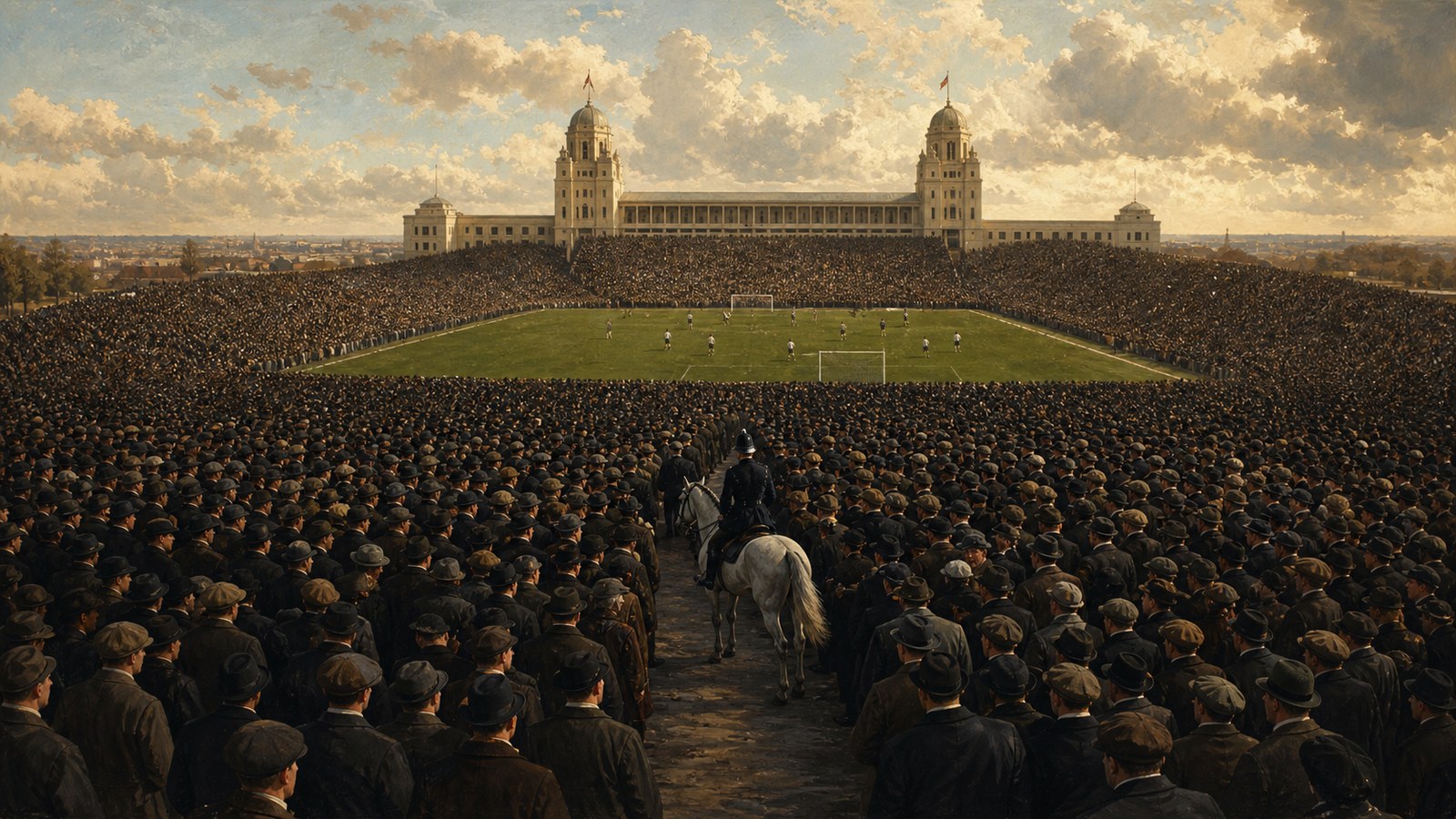
PC George Scorey had reported for duty at six in the morning on 28 April 1923 and spent most of the day expecting nothing stranger than ordinary Saturday traffic. He stopped at Rochester Row police station for tea. Instead, an inspector sent him and his grey horse Billy towards Wembley, where a football crowd had swallowed the new stadium’s approaches and was beginning to cover its pitch.
The assignment placed one mounted policeman inside an event far larger than any horse could control. Bolton Wanderers and West Ham United were due to contest the FA Cup final, but the real attraction was the building itself: the first football match at the Empire Stadium, completed only five days earlier. Its immense concrete bowl promised a modern home for English football. Before the opening whistle, the crowd exposed how little anyone yet understood about operating it.
A Finished Stadium With No Rehearsal
Wembley had been designed as the centrepiece of the British Empire Exhibition rather than as a permanent football monument. The original plan anticipated demolition after the exhibition. The Football Association, searching for a better final venue after using Stamford Bridge, obtained a 21-year agreement and accelerated the building schedule.
Construction began in 1922 and took 300 days. The last brick was laid on 23 April 1923, leaving five days before the final; the wider British Empire Exhibition was due to open in 1924. Labourers had tested the structure by marching around it, while sandbags stood in for spectators. The ingredients were formidable: roughly 25,000 tonnes of concrete, 1,400 tonnes of structural steel and half a million rivets. What had not been tested was the movement of an excited, largely unticketed mass through unfamiliar turnstiles, roads and gates.
That gap mattered because this was not simply another cup final transferred to a larger ground. Newspapers had advertised an architectural event. The twin towers and white exterior offered people a first glimpse of a place intended to embody national scale. Bolton had lost two previous finals; West Ham had never reached one and were still a Second Division club. Yet thousands travelled without tickets because being present at Wembley’s opening seemed to be an occasion in itself.
At 2:20 the Green Began to Disappear
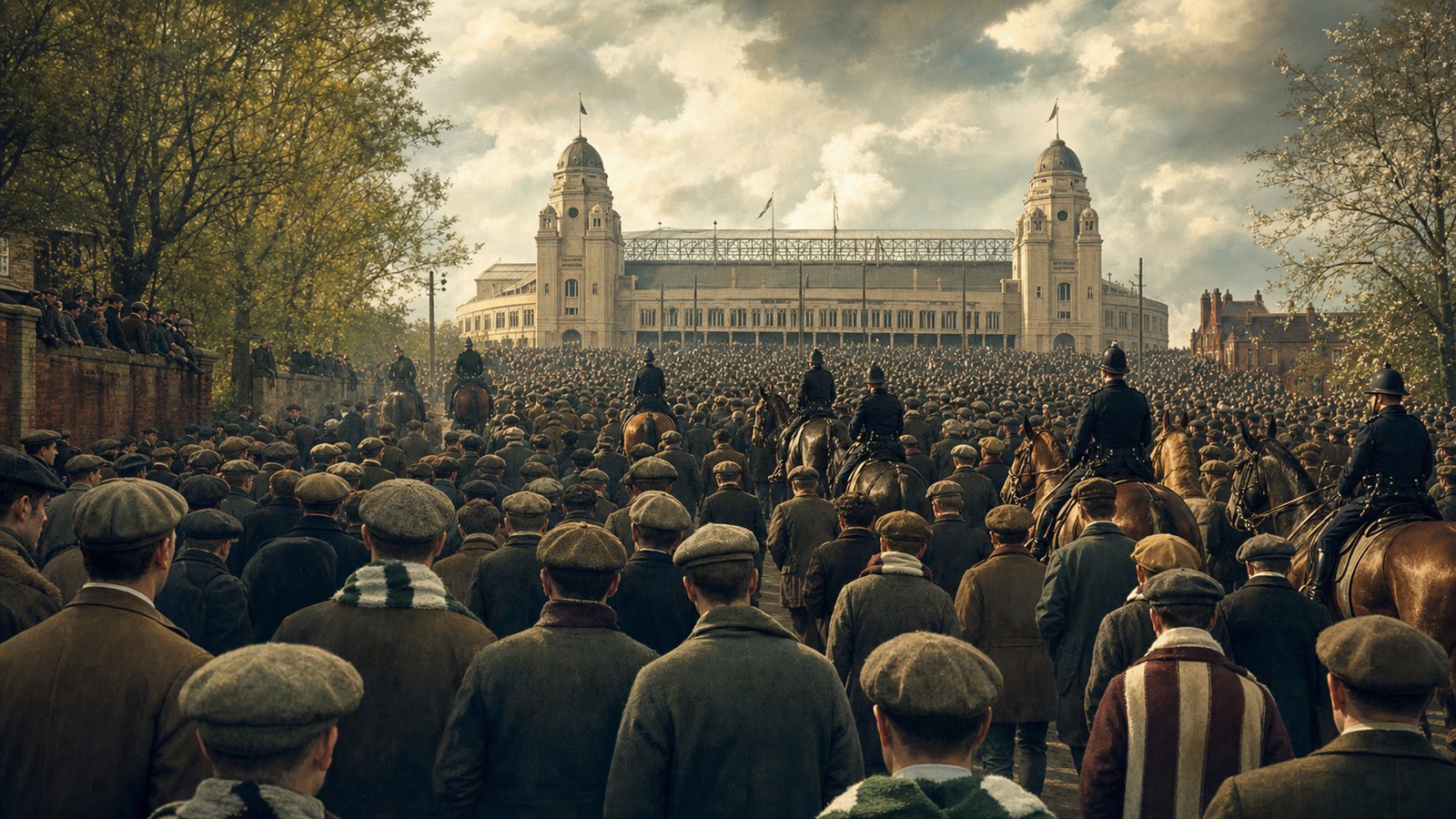
The early flow looked manageable. A contemporary Manchester Guardian reporter entered at 1:35 and reached the press gallery without difficulty, although the outer terrace was already dense. Ten minutes later, he believed there was no room left. Below him lay what he described as an oval of green surrounded by a solid slope of faces.
The gates were closed at about two o’clock, but closing them did not disperse the people outside. At roughly 2:20, the crowd near the western goal bulged forward and settled on the touchline. The opposite end followed. By 2:35, the broad approach road was black with people, buses and cars. Men climbed iron supports, used planks against low sections of wall and poured through gates broken under pressure. Ticket holders and unticketed arrivals were compressed together.
The official attendance eventually recorded was 126,047, close to the stadium’s intended capacity. Estimates of the total number inside ran as high as 300,000. The uncertainty is part of the story: once barriers failed, no turnstile count could describe the crowd that occupied terraces, running track and field. Hundreds were injured, many in the pressure outside, while ambulance workers struggled to move stretchers through packed bodies.
Billy Was Visible, Not Solitary
Mounted police entered because they could move through a crowd more effectively than officers on foot. Scorey and Billy became the lasting image, but they were one pair among several. The horse also was not white. Billy was grey, and the dark uniform of his rider made him appear brilliantly pale in black-and-white photographs.
Scorey later described asking people to step back little by little. This was persuasion conducted at the height of a mounted officer rather than a charge. Other officers, players and spectators participated in opening a strip of grass. The task was not to remove everyone who had crossed the boundary; that had become impossible. It was to compress the human wall far enough for a football match to exist inside it.
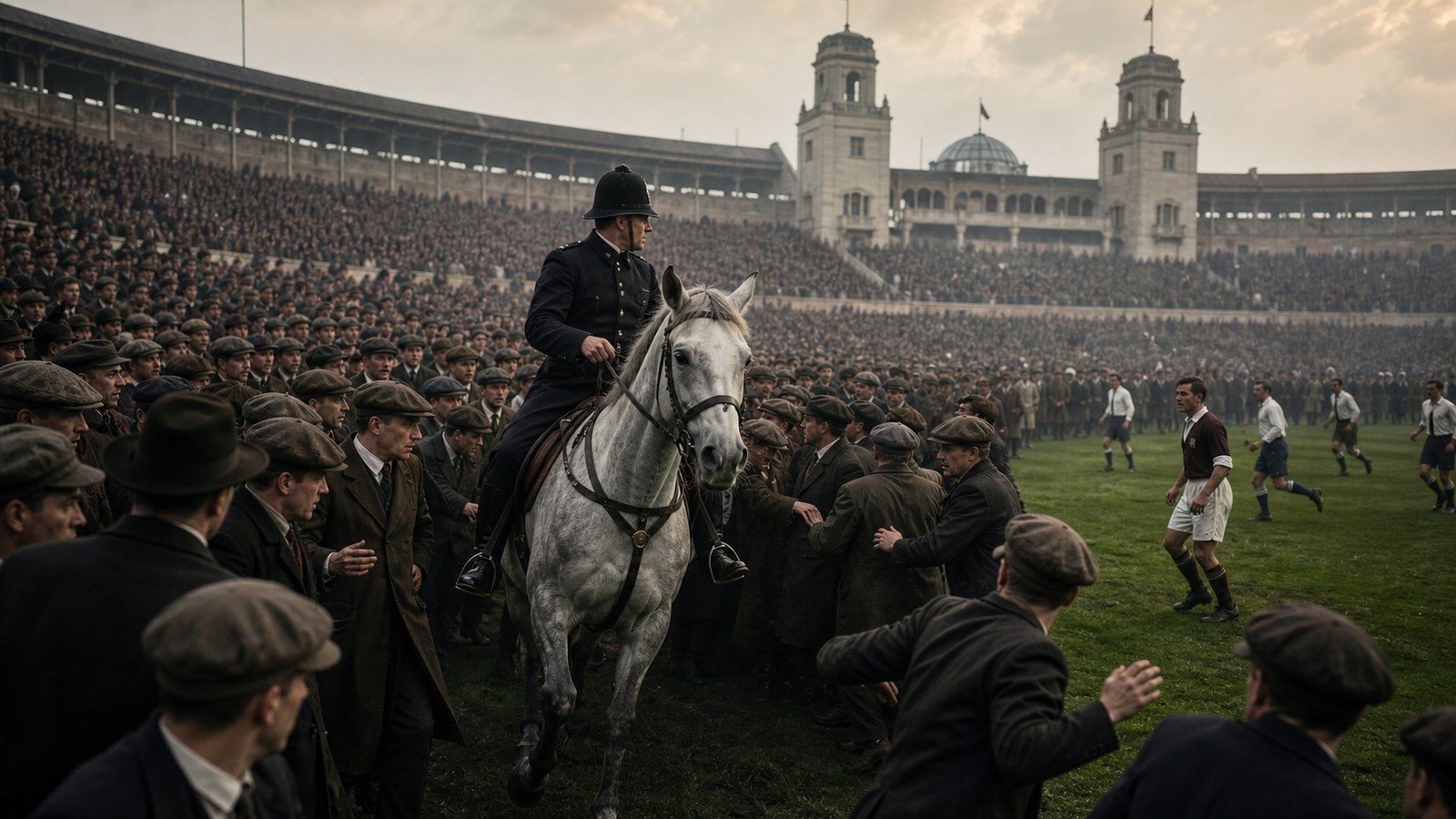
The famous aerial view simplified a collective operation into one luminous animal. That simplification gave the event a name people could retain: the White Horse Final. It also preserved an accidental contrast at the centre of the picture. Around Billy, dark-clothed spectators formed a nearly continuous surface. The pitch looked less like protected sporting space than a narrow clearing negotiated from the crowd.
The Match Used People as Its Boundary
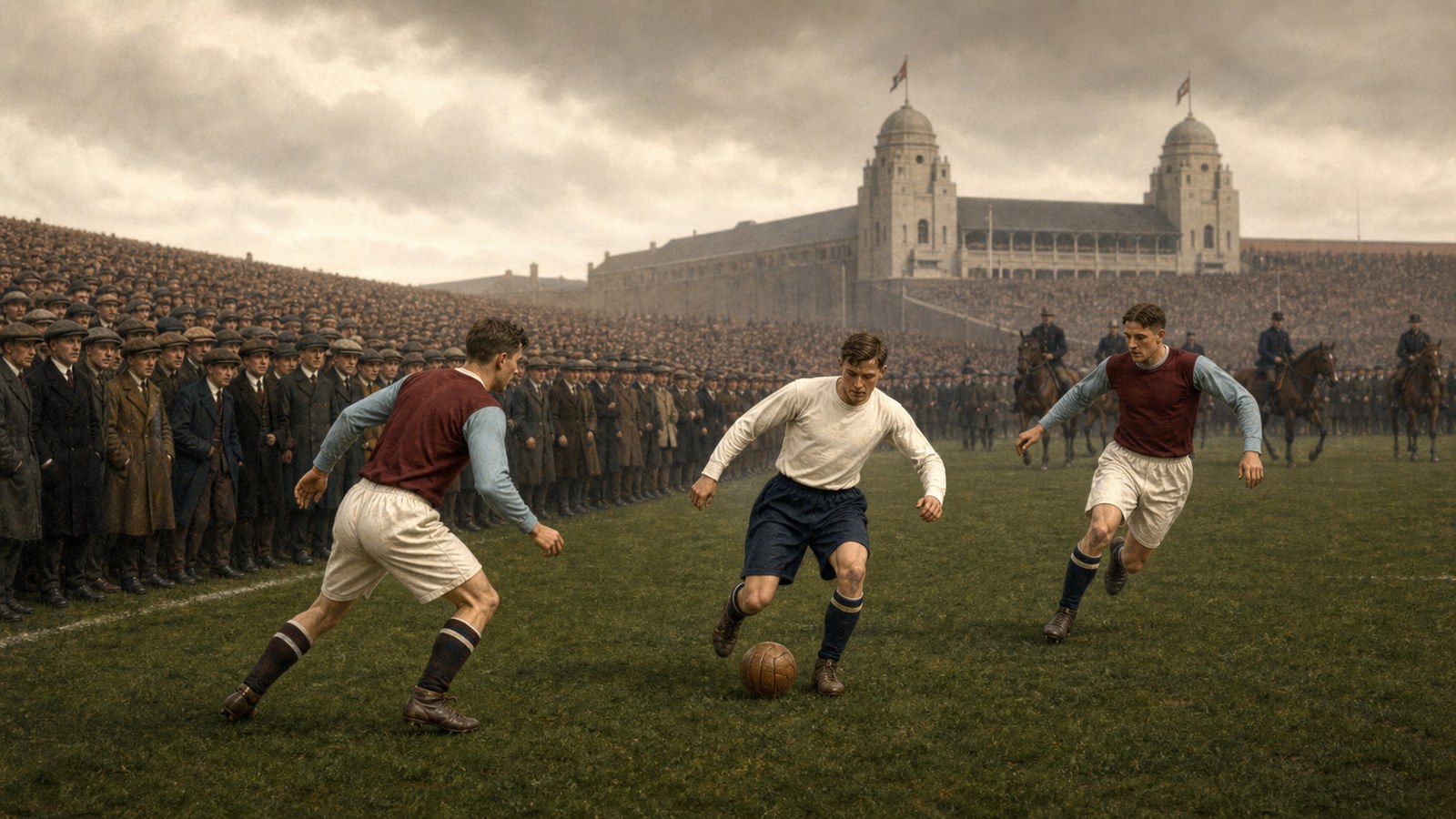
King George V arrived while the recovery was still under way. The teams eventually emerged and the final began about 45 minutes late. There was no normal buffer between players and spectators. People stood immediately beyond the touchlines and behind the goals, becoming a living boundary that moved when the ball or a player approached.
Bolton scored after two minutes. David Jack’s shot beat Ted Hufton, and the roar was reportedly so powerful that spectators were knocked from their feet. West Ham argued that a man returning from the field had interfered, but the goal stood. In the second half Jack Smith struck the second; the ball hit a spectator pressed close behind the goal before returning to the field, feeding another dispute about whether it had crossed the line. Bolton won 2–0.
The football therefore carried physical traces of the emergency. Space beyond the line, normally empty by rule and custom, was occupied. A shot could rebound from a spectator. A celebration could become another crowd movement. The final was completed not because order had been restored to modern standards, but because players, police and spectators accepted a temporary and precarious version of order.
A Crowd Changed the Next Final
The authorities could not treat completion as proof that the arrangements had worked. Overcrowding was discussed in the House of Commons. For future finals, admission became an all-ticket operation, converting hope of entry into a controlled allocation before supporters reached Wembley. The 1924 final drew a much smaller, regulated crowd.
The response marked an important change in how major football occasions were understood. A very large stadium did not make crowd management automatic. Capacity was not merely the number of bodies a concrete bowl could physically contain. It depended on tickets, transport, approach roads, perimeter control, trained staff and protected circulation routes. Wembley’s structure had passed its engineering tests; its first crowd supplied the missing operational test.
That lesson outlasted the original building. When the replacement Wembley opened, a bridge beside it was named the White Horse Bridge. The name honoured Billy and Scorey, but it also carried the memory of supporters occupying every available metre on the stadium’s first afternoon.
Why One Horse Still Carries the Day
The White Horse Final survives because its central image makes an uncountable crowd legible. Figures such as 126,047 or 300,000 describe scale without giving the eye a place to rest. Billy provides that place: one pale animal, one upright officer and thousands of dark hats and coats extending in every direction.
Yet the image becomes more revealing when its limits are remembered. No single policeman rescued the final, and the crowd was not a passive background. Supporters moved backwards by inches, passed instructions, tolerated a match played against their toes and helped create the narrow lane in which it could proceed. The day belongs to the history of supporter culture as much as stadium design: desire to witness a new football home exceeded every plan made for receiving it.
Wembley opened as a confident monument and immediately discovered that football crowds were part of its architecture. Concrete, steel and rivets provided the bowl. Tickets, routes, boundaries and cooperation would have to make it usable. Billy’s pale figure remains at the centre because he shows the exact moment a building became a football ground—not when it was completed, but when people negotiated enough space for the ball to move.
Sources
BBC Sport; The Guardian; National Football Museum; Wembley Stadium; Encyclopaedia Britannica.