
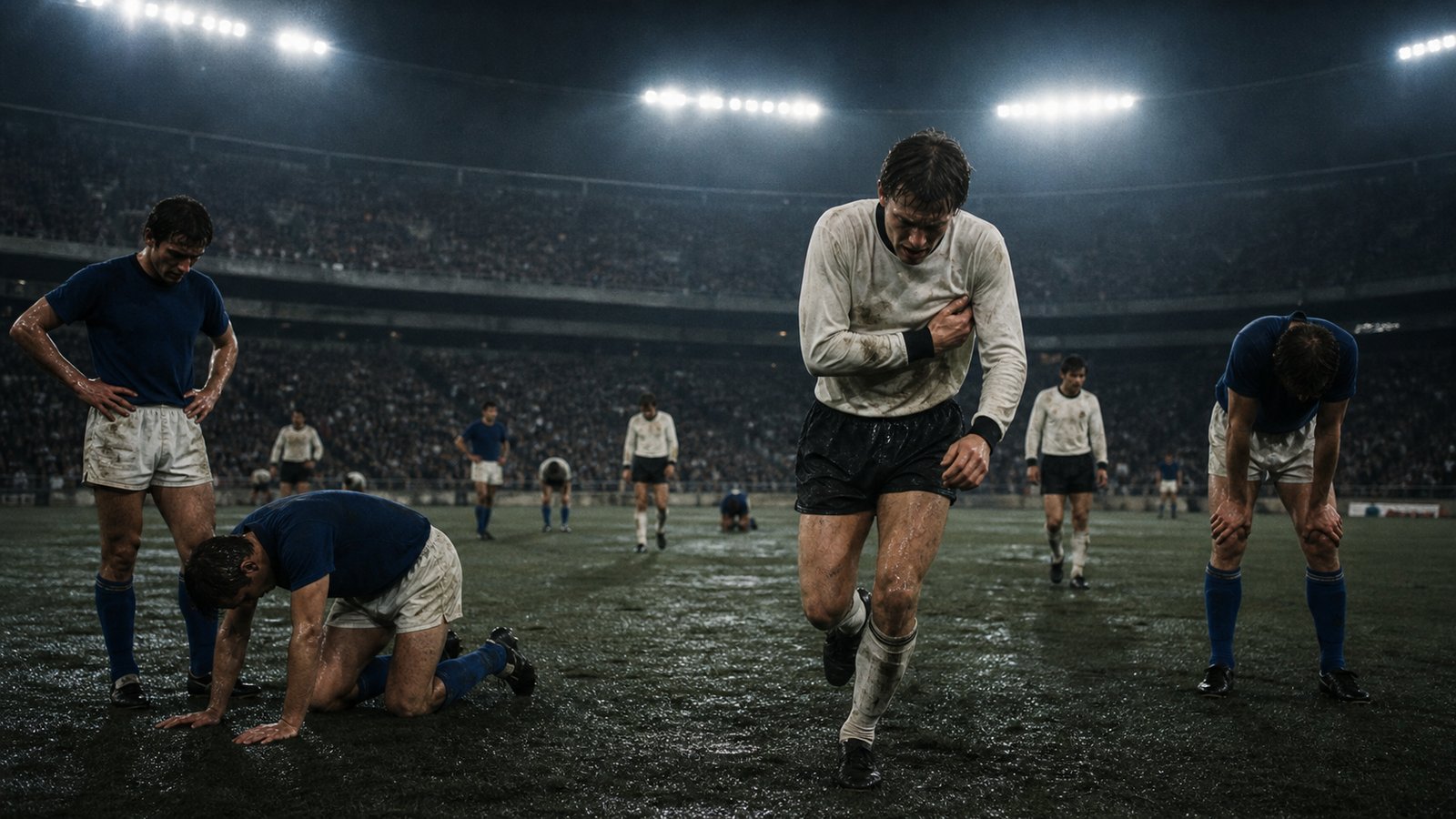
At 10:17 on a warm Wednesday night in Mexico City, Franz Beckenbauer was still running with his right arm strapped against his chest. West Germany had used both substitutes. Italy had spent nearly the entire match protecting a lead scored in the eighth minute. Then Karl-Heinz Schnellinger, a defender playing his club football in Milan, arrived at the far post and equalised in the second minute of stoppage time.
The semi-final should have been ending. Instead, it was about to become unrecognisable. The next 30 minutes produced five goals, four changes of score and a kind of collective exhaustion that stripped both teams down to instinct. What made Italy’s 4–3 victory memorable was not merely the number of goals. It was the way a controlled match broke apart, then kept asking injured and depleted players for one more decision.
Eighth-minute control, eighty minutes of restraint
Italy reached the Azteca Stadium on 17 June 1970 with a reputation for caution, but the opening goal was sharp and direct. Roberto Boninsegna exchanged passes with Luigi Riva near the German penalty area and drove a left-footed shot beyond Sepp Maier. FIFA’s match record places it in the eighth minute. The scoreboard gave Italy exactly the match they were equipped to manage: a narrow advantage, room to defend, and the possibility of choosing when to accelerate.
Ferruccio Valcareggi’s team had already shown two faces in Mexico. Italy scored once across three group matches, yet beat the host nation 4–1 in the quarter-final. Against West Germany, Giacinto Facchetti and his defenders narrowed the central spaces, while Gianni Rivera began on the bench under Valcareggi’s staffetta, or relay, arrangement.
West Germany carried a different rhythm into the semi-final. Helmut Schön’s side had recovered from two goals down to beat England 3–2 after extra time. Gerd Müller was the tournament’s leading scorer, yet Italy repeatedly forced attacks toward crowded areas. For most of the next 80 minutes, Enrico Albertosi looked likely to preserve the lead.
The equaliser came from the least expected runner
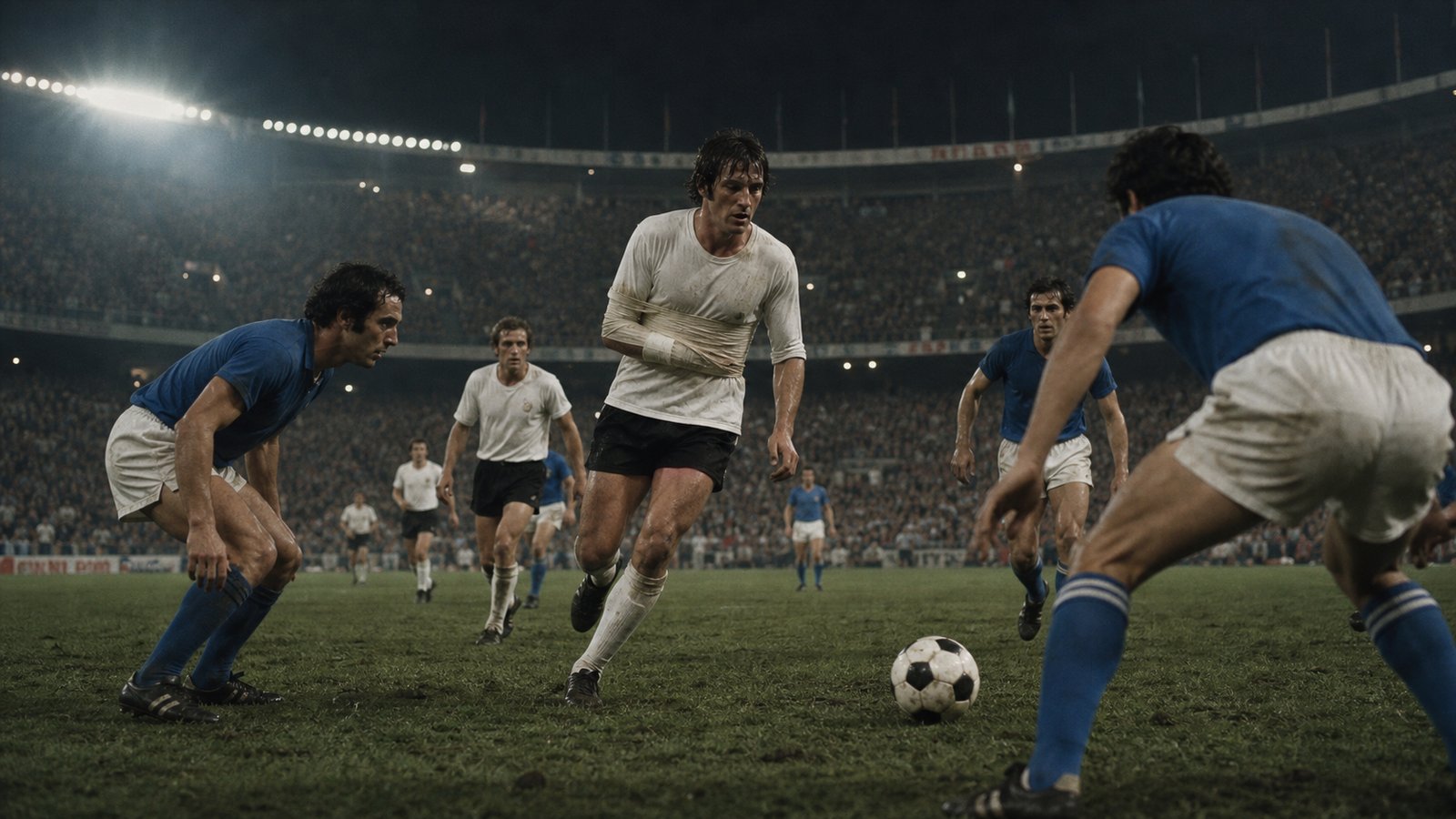
The German pressure gathered without producing a clean finish. Albertosi saved, defenders blocked, and appeals accumulated. The match also narrowed Schön’s options. West Germany had already sent on Jürgen Grabowski and Hannes Löhr, using the two substitutions then permitted. When Beckenbauer damaged his shoulder after a challenge, there was no replacement available. Medical staff bound his right arm to his torso, leaving him to continue in a sling-like harness.
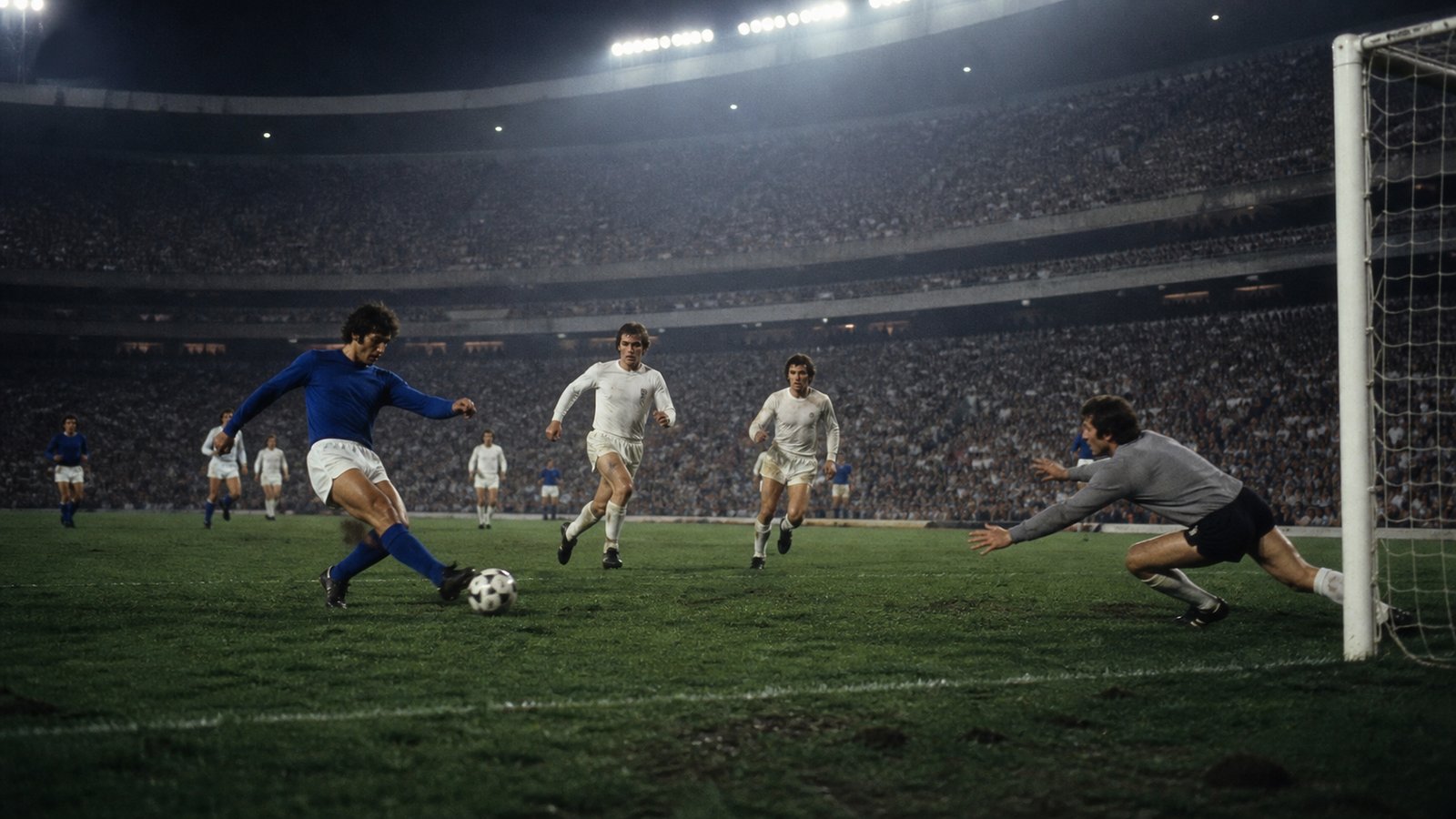
That image has become one of the match’s emblems, but the equaliser belonged to another unlikely figure. Schnellinger was a left-back, not a penalty-box striker. He also played for AC Milan alongside several Italians on the field. In stoppage time, Grabowski delivered from the right and Schnellinger reached the far side of the six-yard area. His contact sent the ball beyond Albertosi for his only goal in 47 West Germany appearances.
German commentator Ernst Huberty reacted with “Ausgerechnet Schnellinger!”—“of all people, Schnellinger.” Italy had survived the obvious threats, only for a defender familiar to Italian club supporters to erase Boninsegna’s lead. At 1–1, the semi-final crossed into a half-hour played by bodies beyond the normal limit.
Extra time abandoned the shape of the first ninety
Four minutes into extra time, Müller put West Germany ahead. The sequence came from Italian uncertainty close to goal, and the striker reacted first. For the first time that night, Italy had to chase. The response came quickly: defender Tarcisio Burgnich scored in the 98th minute, another improbable name in an increasingly improbable match.
Riva then restored Italy’s lead before the extra-time interval. He received the ball with space to move across the retreating defence and finished low with his left foot. In roughly eleven minutes, the score had moved from 1–0 to 1–1, 1–2, 2–2 and 3–2. The strategic patience of the opening period had vanished. Players were following second balls, loose marks and whichever channel briefly opened before fatigue closed it.
This was not carefree attacking in the usual sense. It was damaged structure. Beckenbauer could not use one arm normally. Both sides had already played knockout extra time during the tournament—Italy’s match was its first, Germany’s its second in four days—and the altitude of Mexico City added to the physical demand. Each goal forced the team that had just conceded to spend what remained of its energy immediately.
Müller equalised, Rivera answered in the same minute
The decisive exchange arrived after the restart. In the 110th minute, Müller met a corner and headed the ball down toward goal. Rivera, stationed near the post, could not keep it out. The score was 3–3. The German striker had his second goal of the night and his tenth of the tournament. Momentum appeared to have swung once more.
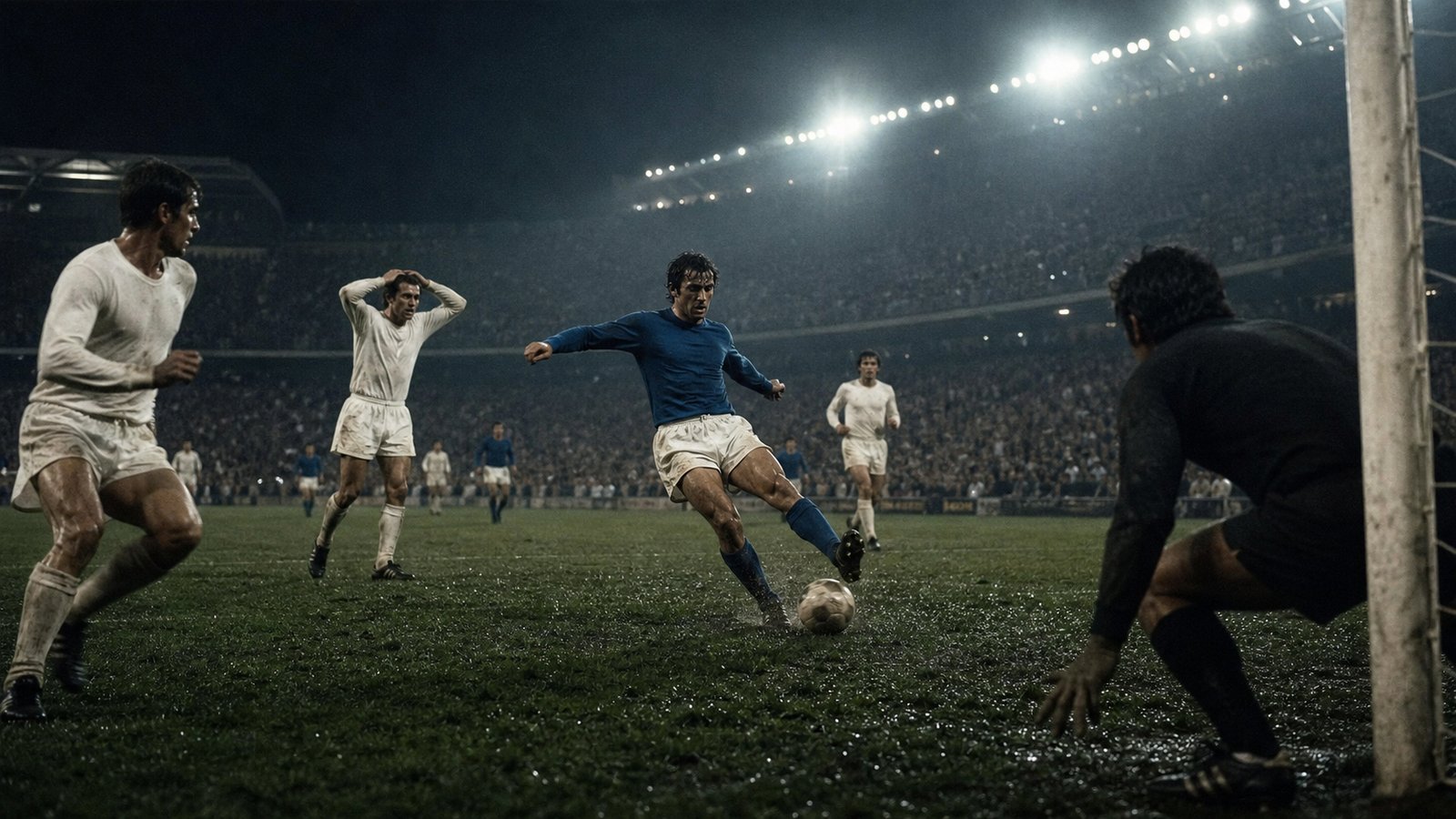
Italy restarted instead of pausing inside the shock. Boninsegna drove down the left and pulled the ball back into the penalty area. Rivera arrived centrally and directed a right-footed finish into the corner away from Maier. FIFA records both Müller’s equaliser and Rivera’s winner in the 110th minute. The apparent contradiction captures the speed of the passage: one attack seemed to reset the match, and the next settled it.
Rivera’s role added another layer. Valcareggi’s relay system divided time between him and Mazzola because the coach was reluctant to field both playmakers together. Rivera entered after half-time and was on the line for Germany’s third goal before scoring Italy’s fourth. Within moments he moved from a visible defensive failure to the calmest attacking action of the night.
Why seven goals did not create an equal final
Italy still had ten minutes to survive, and West Germany still had enough conviction to attack, but there was no fifth change of score. The final whistle sent Italy to face Brazil three days later. That schedule is essential to the story. The semi-final supplied drama while extracting a price. Italy and West Germany had played 120 minutes; Brazil had beaten Uruguay in regulation time in the other semi-final one day earlier.
The final remained level at 1–1 until the 65th minute, then Brazil pulled away to win 4–1. It would be too simple to explain that defeat only through fatigue. Brazil were the tournament’s outstanding side and produced their own tactical and technical answers. Still, the contrast matters: Italy arrived after an emotional and physical match that had demanded repeated recoveries, while Brazil reached the same stage without extra time.
The semi-final’s wildness came from the competition around it: limited substitutions, altitude and a compact schedule. Its ending affected how Italy could approach the next match. For another example of tournament rules reshaping behaviour, the 1982 Gijón controversy shows how scheduling later became part of World Cup reform.
A plaque, a phrase and a memory built from disorder
The Azteca later installed a plaque describing the contest as “The Game of the Century.” The label is grand, but the numbers underneath it remain unusually concrete: Italy led for more than 80 minutes, the equaliser came in stoppage time, and five goals followed in extra time. Three defenders—Schnellinger, Burgnich and Facchetti’s pressured back line—were central to a match remembered for attacking drama.
Its endurance also comes from distinct human images. Boninsegna scoring before the crowd had settled. Schnellinger materialising at the far post. Beckenbauer running with an immobilised arm because the bench was empty. Rivera failing on the goal line, then arriving at the opposite end to finish the winner. These are not interchangeable moments from a generic classic. Each only makes sense because of the match state immediately before it.
Most great games acquire a clean explanation after the fact: tactical superiority, a star performance, one decisive mistake. Italy–West Germany resists that tidiness. Italy’s defensive plan worked until seconds from the whistle. Germany’s comeback worked until the next Italian attack. Extra time rewarded strikers, defenders and a substitute playmaker in turn. The match lasted because neither side could keep control once it had finally seized it.
Sources
FIFA Match Centre; Rec.Sport.Soccer Statistics Foundation 1970 World Cup match record; FIFA World Cup tournament archive; contemporary match records compiled in the Italy–West Germany 1970 historical overview.