
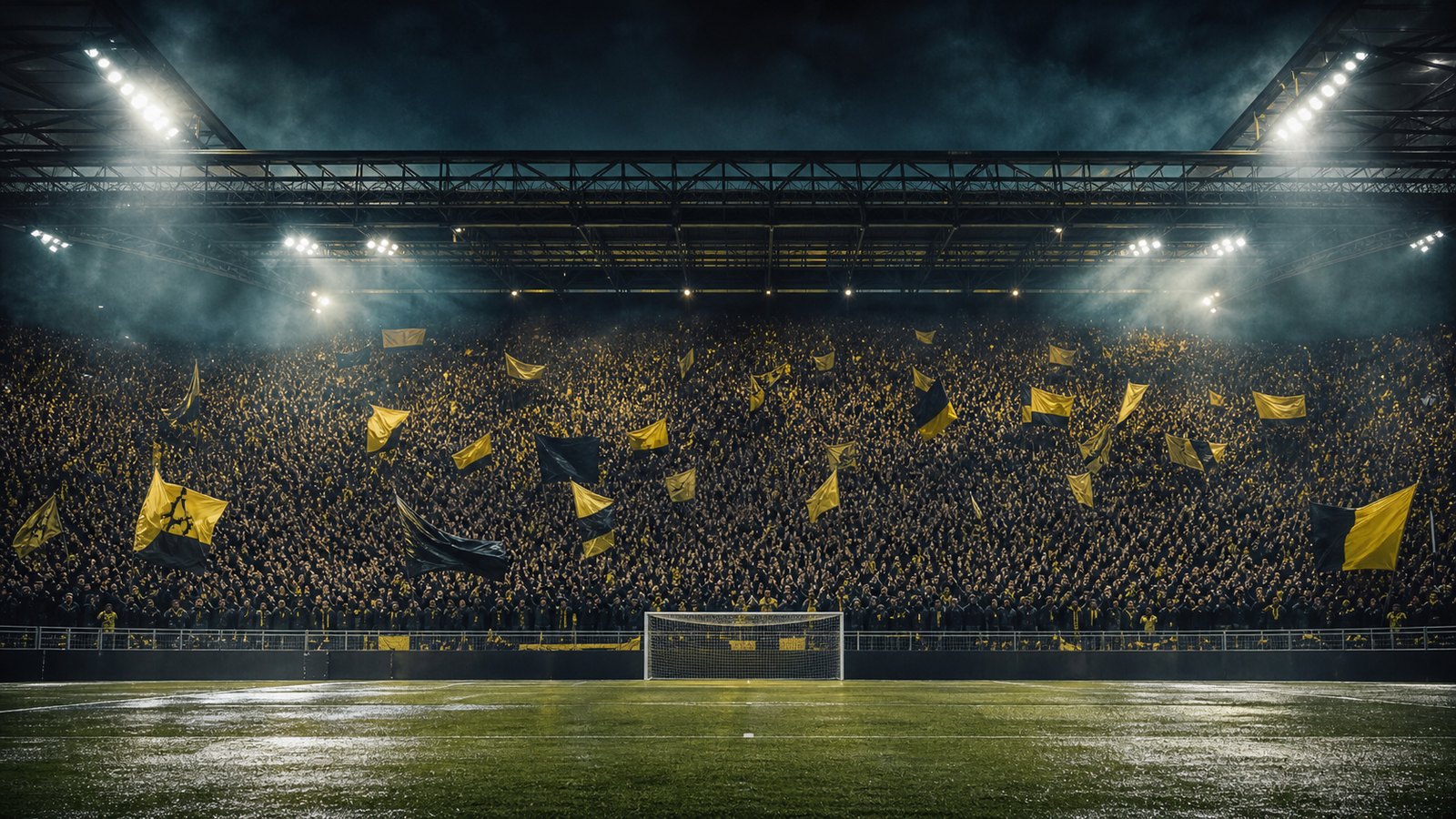
The first thing the Südtribüne changes is scale. A football pitch remains 105 metres long and 68 metres wide, but behind one goal in Dortmund almost 24,454 standing spectators rise in a single bank of black and yellow. From the opposite end, individual bodies lose their edges. Flags cut across the mass, arms move together and sound seems to come from the architecture itself.
This is the image now called the Yellow Wall. It can look like inherited folklore, as though Borussia Dortmund simply found it waiting beside the pitch. The real story is more physical. A World Cup deadline created the stadium in 1974. Successive expansions lifted the south terrace to its present height. Financial risk nearly overwhelmed the club that built it. Only then could generations of supporters turn concrete, barriers, steps and repetition into one of football’s most recognizable rituals.
A replacement World Cup host gave Dortmund its opening
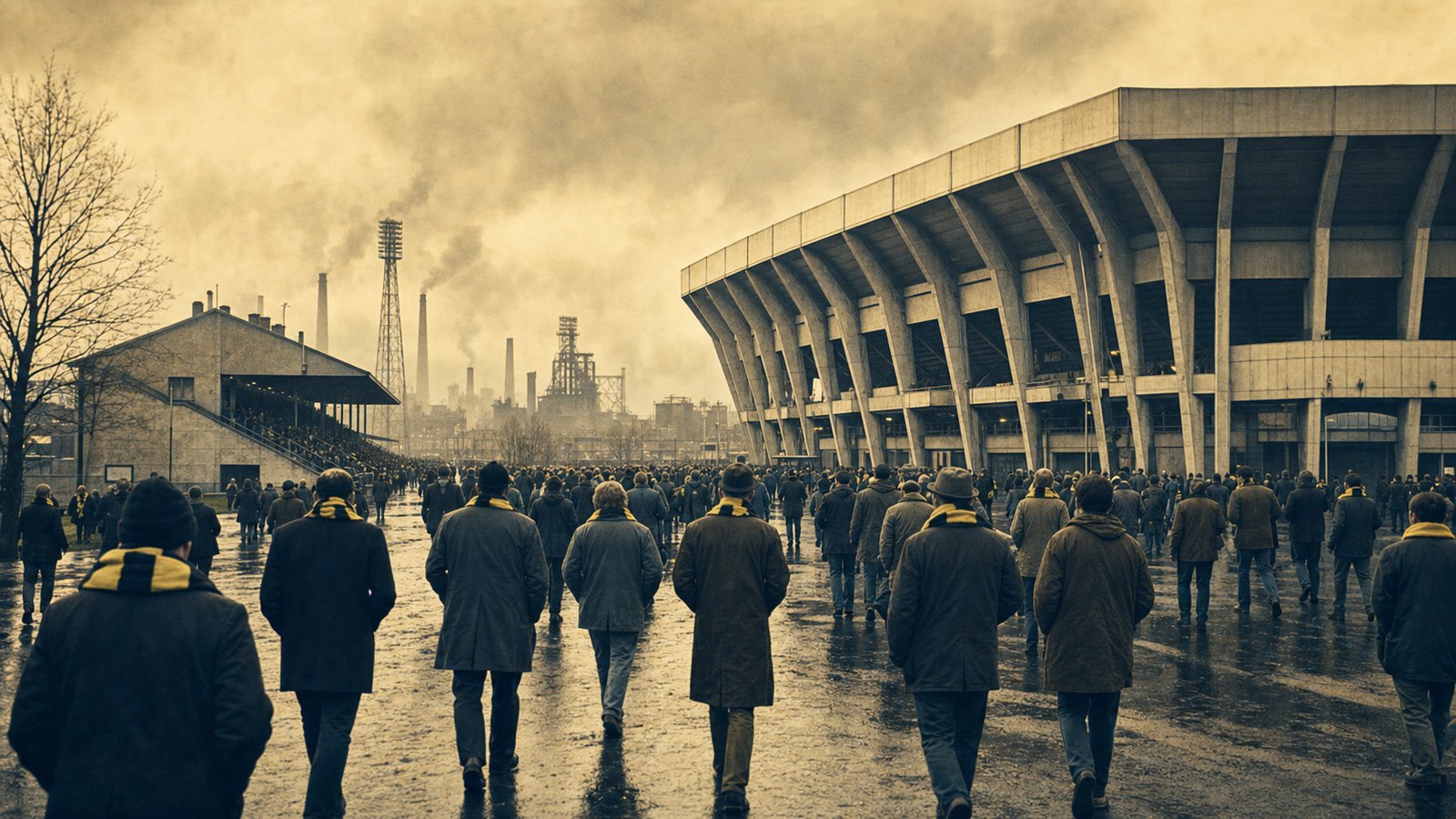
At the start of the 1970s, Dortmund did not resemble a city preparing to build a global football landmark. Borussia had fallen into the second tier, carried debt and played at the ageing Stadion Rote Erde. The city was wrestling with the steel crisis and could not casually fund a grand new arena. The opportunity arrived indirectly when Cologne withdrew from the host-city plan for the 1974 World Cup. Dortmund took the available place and gained access to the support needed for a tournament stadium.
The construction was deliberately practical. WDR records three years of work, a cost of 32.7 million Deutsche Marks and extensive use of prefabricated components. The Westfalenstadion stood beside the Rote Erde rather than erasing it. Borussia gives the original capacity as 53,000, including 37,000 standing places; WDR rounds the total to 54,000. Either figure describes an arena made for a large standing crowd.
It opened on 2 April 1974 with the right opponent for Dortmund: Schalke 04. A friendly between the Ruhr rivals introduced a ground whose closeness immediately mattered. Spectators were nearer the action than in the broad multi-use bowls common to the era. The new stadium did not yet contain the modern Yellow Wall, but it supplied the essential conditions—steep collective sightlines, standing room and a south end supporters could make their own.
The south end grew by stacking one decision on another
The Südtribüne’s current size was not part of the opening blueprint. As Borussia’s audience and ambitions expanded, the stadium changed in stages. Capacity dropped when safety changes converted standing areas, then rose through construction in the 1990s and early 2000s. New upper tiers appeared along the sides. Corners were filled. The south stand was expanded into the vast single bank that now defines the ground from almost every camera position.
Borussia lists the present domestic capacity at 81,365, the largest football stadium in Germany. Within it, the Südtribüne accommodates 24,454 people in its standing configuration and is described by the club as Europe’s largest standing terrace. That number is not simply a statistic about volume. It means one end can contain a crowd similar to the entire attendance at many professional grounds without breaking the group into multiple decks.
European nights reveal that the figure depends on rules as well as concrete. UEFA competition requires a seated configuration, so the terrace is converted and total capacity falls. The stadium therefore has two operating lives: an enormous standing bank domestically and a divided seated area internationally. The famous 24,454 belongs specifically to the domestic form.
A single tier allows emotion to travel without a ceiling
The Yellow Wall’s effect begins with geometry. In a stand split by executive boxes, walkways or stacked levels, songs must cross interruptions. Dortmund’s south bank gives a chant a long continuous surface. Supporters near the front can turn toward those behind them. Flags remain visible across broad sections. A response can climb upward without disappearing beneath an overhang and return toward the pitch as one enlarged sound.
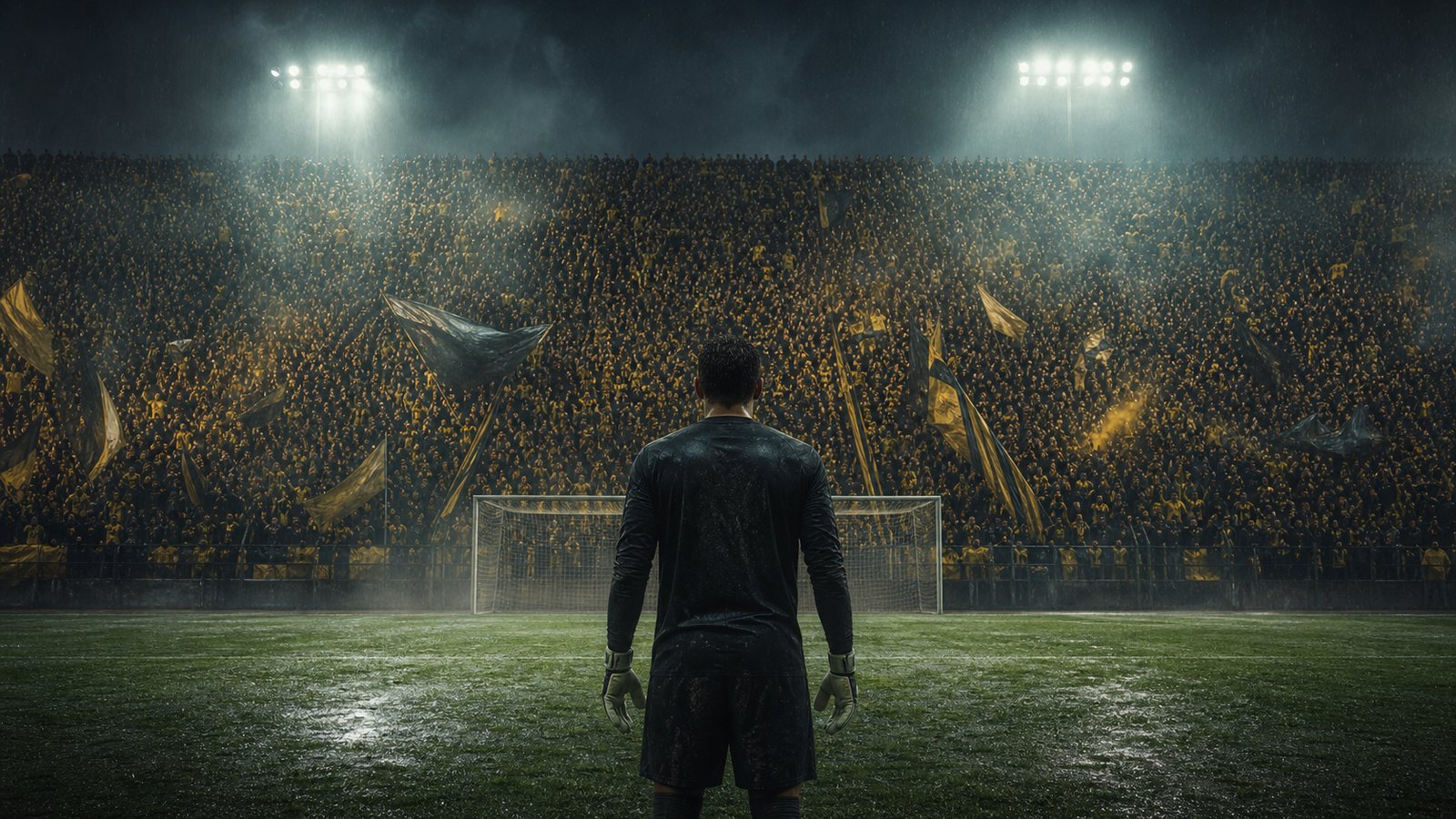
The pitch itself is a standard 105 by 68 metres. What feels unusual is the ratio between that familiar rectangle and the human bank behind one goal. A visiting goalkeeper looking south sees a steep field of colour above the net. Former Dortmund goalkeeper Roman Weidenfeller captured both sides of the sensation: with the stand behind him it felt fantastic; as an enemy, he said, it could crush you.
That description is testimony, not a measurable law of results. Crowds do not complete passes or mark runners. Yet architecture shapes perception. It gives a late corner a backdrop larger than the action, makes silence conspicuous and makes noise feel like the expected state.
The ritual depends on thousands of separate choices
No architect can specify atmosphere on a drawing. The Südtribüne becomes the Yellow Wall because supporters repeatedly perform the work required to animate it. They arrive wearing common colours, carry flags, begin songs, answer cues and accept that standing in the south includes a responsibility to the whole end. The wall is assembled again for every home fixture and dissolves when the crowd leaves.
The Revierderby against Schalke gives that ritual its most local charge. Matches against Bayern and European knockout nights add different forms of pressure, but the derby connects the stand to Ruhr identity and the opponent from the opening game in 1974. Sporting News notes how the Yellow Wall becomes especially prominent on those occasions. The club’s own account calls the Südtribüne the stadium’s heart and emphasizes the black-and-yellow flags and chants that make each visit distinct.
Its social claim is equally important. Borussia describes the terrace as a place where origin and status recede behind attachment to the club. Reality in any crowd is more complicated than a motto, but standing space does alter the social choreography. People do not occupy isolated upholstered islands. They negotiate room, sightlines, beer, movement and song with strangers at close range. Belonging is expressed physically before it is printed on a membership card.
The expansion also carried a dangerous bill
The finished stadium can make its own history look inevitable. It was not. Borussia’s official account acknowledges that expansion nearly broke the club financially and dates the resolution of that burden to the end of May 2006. The same construction that multiplied capacity and commercial value also increased exposure when the club’s finances deteriorated. The Yellow Wall became an emblem during a period when the institution behind it had to secure its future.
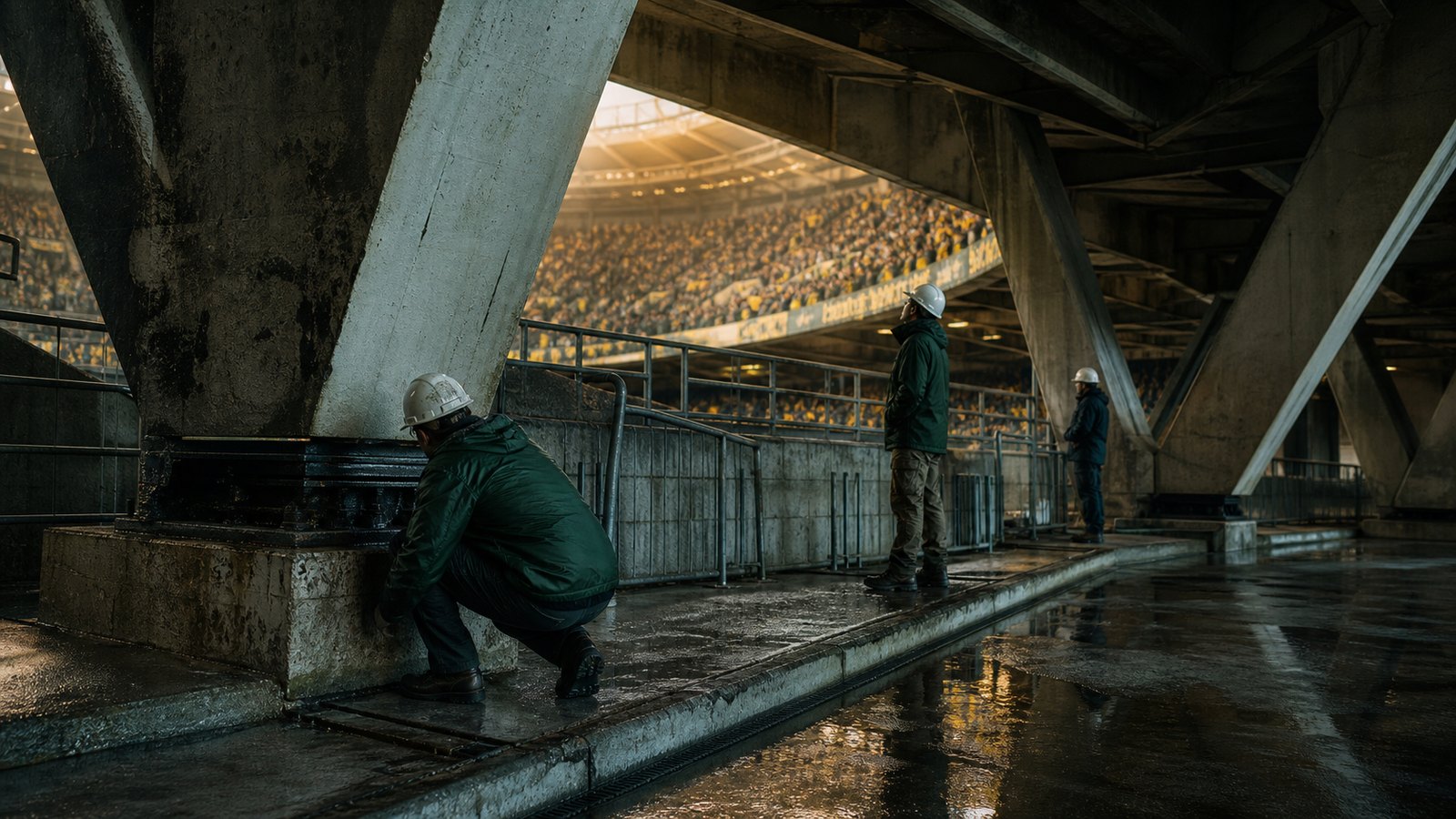
Maintenance never ended with that rescue. Borussia says it invested €10 million in stadium work during 2012 alone. The pitch and drainage were renewed, while structural supports and concrete on the south and north stands required attention. Those details interrupt the romantic picture usefully. A terrace holding more than 24,000 moving people is not sustained by emotion. It depends on inspections, engineering, crowd management and money spent on surfaces most supporters will never notice.
The naming history contains another compromise. Westfalenstadion became Signal Iduna Park through a naming-rights agreement in 2005, but many supporters still use the old name. Commercial income, institutional survival and inherited language occupy the same address. The ground can be both a sponsored asset and a place fans describe as their temple without either description fully cancelling the other.
The wall is rebuilt every time the turnstiles open
Dortmund’s south terrace is often copied as an image: yellow shirts, giant choreography, a camera held wide enough to show the stand swallowing the frame. Its harder lesson concerns continuity. The stadium began with a replacement World Cup bid, grew in stages, survived financial danger and still requires expensive care. Supporters inherit the concrete, not a guaranteed atmosphere.
What makes the Südtribüne powerful is the meeting of fixed and temporary things. Concrete fixes the angle. Barriers organize density. Domestic rules permit the standing capacity. Then 24,454 people decide whether to sing, lift a flag, respond to a lead or keep the noise alive after a concession. The official number counts bodies. The Yellow Wall describes what those bodies can choose to become together.
Dortmund did not build an atmosphere in 1974 and preserve it under glass. The city built a practical stadium, Borussia enlarged it at considerable risk, and supporters made one end feel larger than its dimensions. The terrace remains famous because they begin again whenever the turnstiles open.