
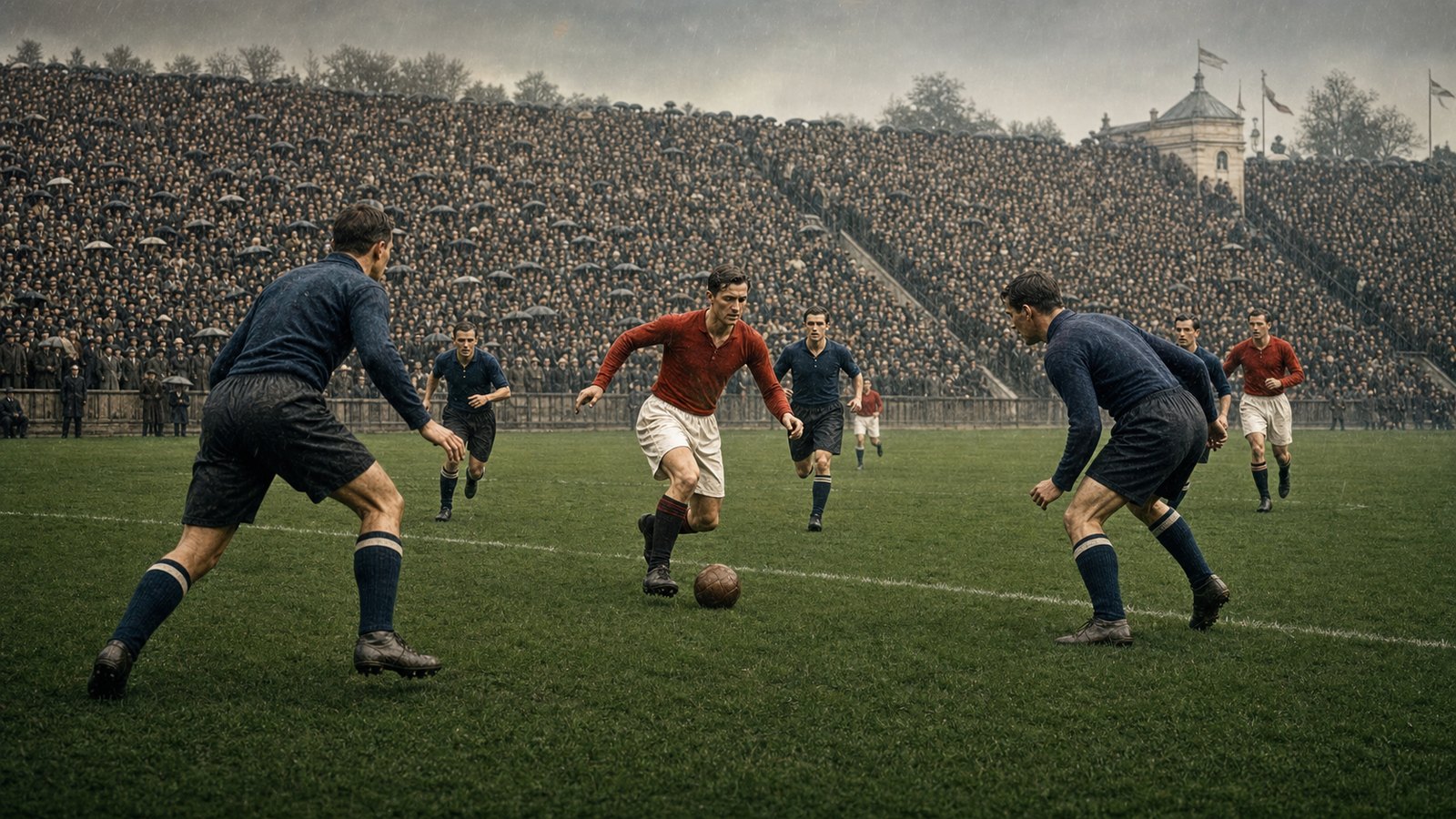
On 16 May 1931, Scotland walked into Vienna carrying more than an unbeaten record against continental Europe. The visitors represented an old hierarchy of football knowledge. British teams had exported the passing game, judged the pupils and generally kept the authority to themselves. Ninety minutes later, Austria had won 5–0 at the Hohe Warte. Karl Zischek scored twice; Matthias Sindelar, Anton Schall and Adolf Vogel supplied the other goals. The score was emphatic, but the deeper shock was positional. Scotland had been beaten by familiar passing principles arranged into unfamiliar angles.
This was the public arrival of Hugo Meisl’s Wunderteam. Its centre-forward did not behave like the fixed spearhead the number on his shirt suggested. Sindelar moved away from the places defenders expected him to occupy, joined combinations and reopened the centre for runners arriving from elsewhere. The effect was not one player abandoning his job. It was five forwards continually rewriting where each job began.
The Hohe Warte became a classroom with 45,000 witnesses
The Hohe Warte was built for scale. Its broad natural banks could hold crowds far larger than most continental grounds of the period, and the Scotland match drew a recorded 45,000 people into that bowl in Vienna. They came to see whether Austria’s recent improvement could survive contact with a British side. Scotland arrived without players from Rangers and Celtic, but the visitors still carried the prestige of the game’s exporting nation.
Austria refused the expected script. Rather than treating the match as a physical examination, the home side made it an argument about timing. Short passes invited Scottish players forward. A receiver would release the ball before pressure settled, then move to create the next option. Zischek’s two goals from the right, alongside finishes by Sindelar, Schall and Vogel, showed that the attack did not depend on one repeated route. The five scorers’ positions stretched across the front line because the movement had already stretched Scotland’s references.
The 5–0 result also mattered beyond one afternoon. The Unofficial Football World Championships record treats it as the first time its lineal title left the British Isles after 59 years of matches. That label was retrospective, but it captures the contemporary feeling: a border around football authority had been crossed.
Meisl built a language rather than drawing a trick
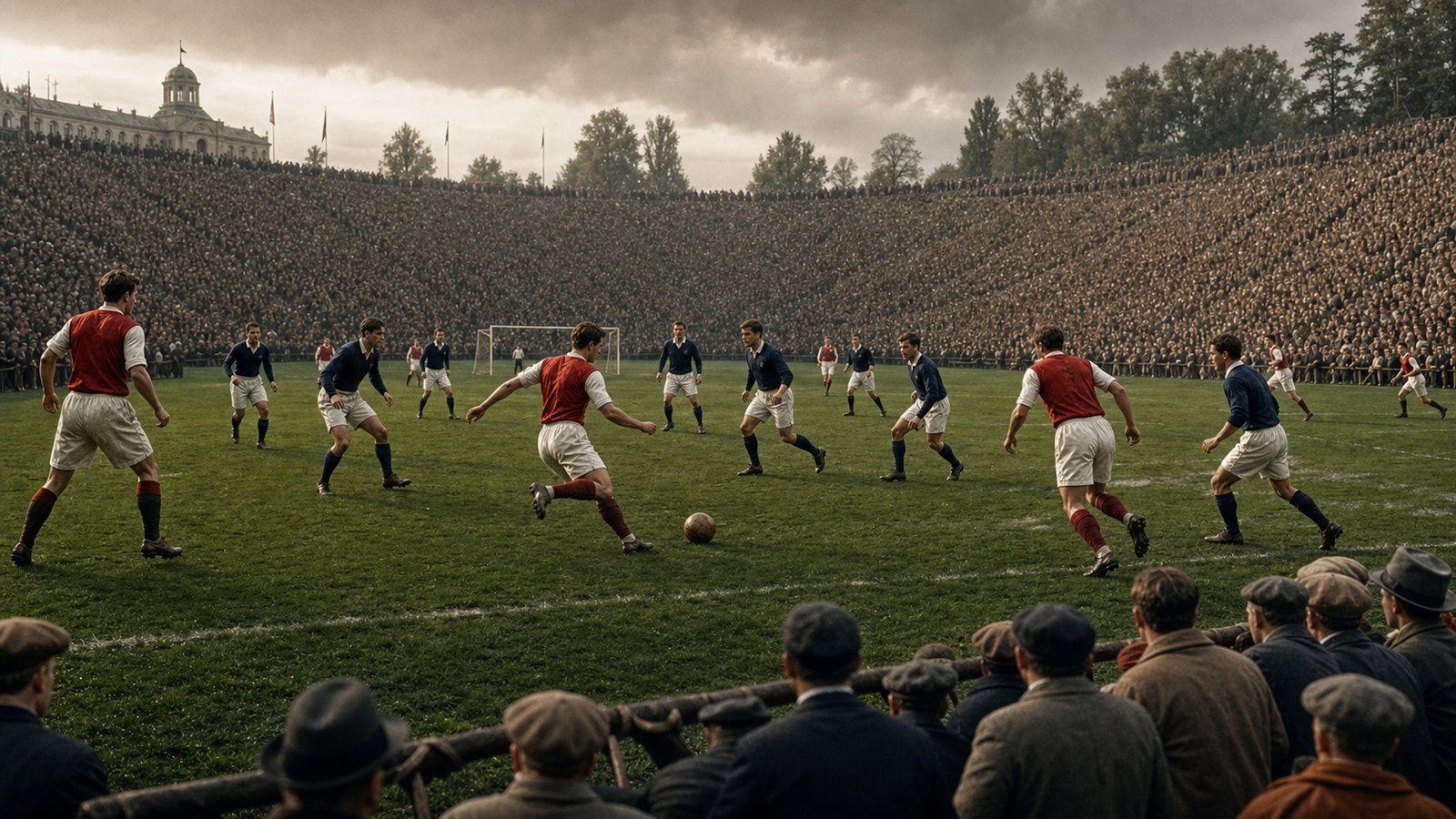
Hugo Meisl’s contribution cannot be reduced to moving Sindelar on a tactics board. He was an administrator, selector and coach who had spent years connecting Austrian football to ideas travelling across Europe. His collaboration with the English coach Jimmy Hogan gave Vienna a strong version of the Scottish passing tradition: control through short combinations, support angles and technique under pressure.
The important adaptation was cultural as well as tactical. Vienna’s clubs had developed players comfortable receiving in crowded spaces. Austria Vienna, Rapid and other city sides supplied footballers who understood that a pass was also an instruction to move. Josef Smistik at centre-half could step into circulation rather than simply destroy attacks. Walter Nausch and the wing-halves widened or narrowed the platform behind the forwards. Ahead of them, Schall, Zischek and the other attackers could exchange distances without waiting for a formal positional switch.
Meisl therefore had something more useful than a surprise formation. He had a shared grammar. When Sindelar dropped toward the ball, teammates did not stare at the empty centre-forward space. One entered it, another moved outside, and the passer gained a third option. The pattern could survive different opponents because it depended on recognition rather than choreography alone.
Sindelar’s absence from the penalty area created the attack
Sindelar’s slight frame helped produce his nickname, Der Papierene, the Paper Man. It also encouraged a misleading picture of fragility. His game was based on avoiding the collision defenders wanted, not on avoiding responsibility. As a nominal centre-forward, he could receive with his back to goal, turn between lines or drift laterally to combine. A centre-half then faced a choice with no clean answer.
If the defender followed, the central lane opened behind him. If he held position, Sindelar could face forward and choose a runner. If a half-back stepped up instead, Austria gained a free player deeper in midfield. These dilemmas are recognizable to a modern audience, but in the early 1930s they disturbed marking conventions built around direct positional opponents.
The method was especially potent because Sindelar was not merely a decoy. He scored in the Scotland victory and could finish combinations he had helped begin. His 43 official appearances and 26 goals for Austria show that movement away from goal did not remove his threat near it. The centre-forward vanished only long enough to make the decisive space visible.
The scorelines traced an idea gaining confidence
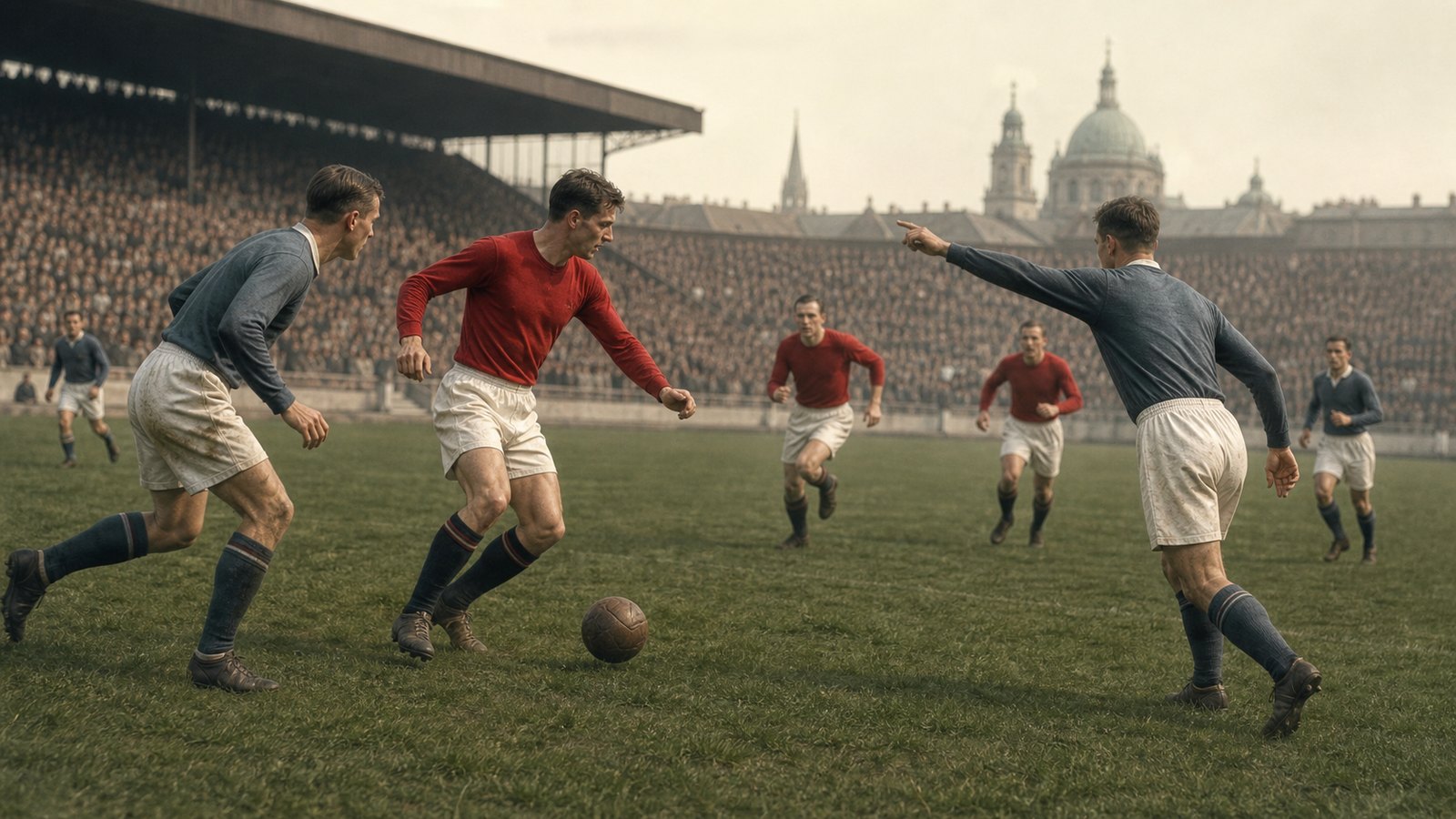
Scotland was the breakthrough, not an isolated performance. Eight days later Austria beat Germany 6–0 in Berlin. In September the return meeting in Vienna ended 5–0. Switzerland were beaten 6–0, and Hungary lost 8–2 in Vienna in April 1932. Those results made the nickname Wunderteam feel less like newspaper excitement and more like a description of a sustained peak.
The sequence was not perfect. England beat Austria 4–3 at Stamford Bridge in December 1932. Yet even that defeat strengthened the side’s reputation because Austria competed in England with the same passing conviction rather than retreating into damage limitation. ORF’s historical account describes the England loss as a high point of the era precisely because matching the sport’s old centre of power mattered nearly as much as the result.
Austria also won the 1931–32 Central European International Cup, a long-form competition involving the region’s leading national teams. That trophy gave the period a competitive achievement beyond celebrated friendlies. It confirmed that the approach could accumulate results over a campaign, not merely dazzle a visiting audience on a favourable afternoon.
Italy narrowed the spaces and the weather narrowed them again
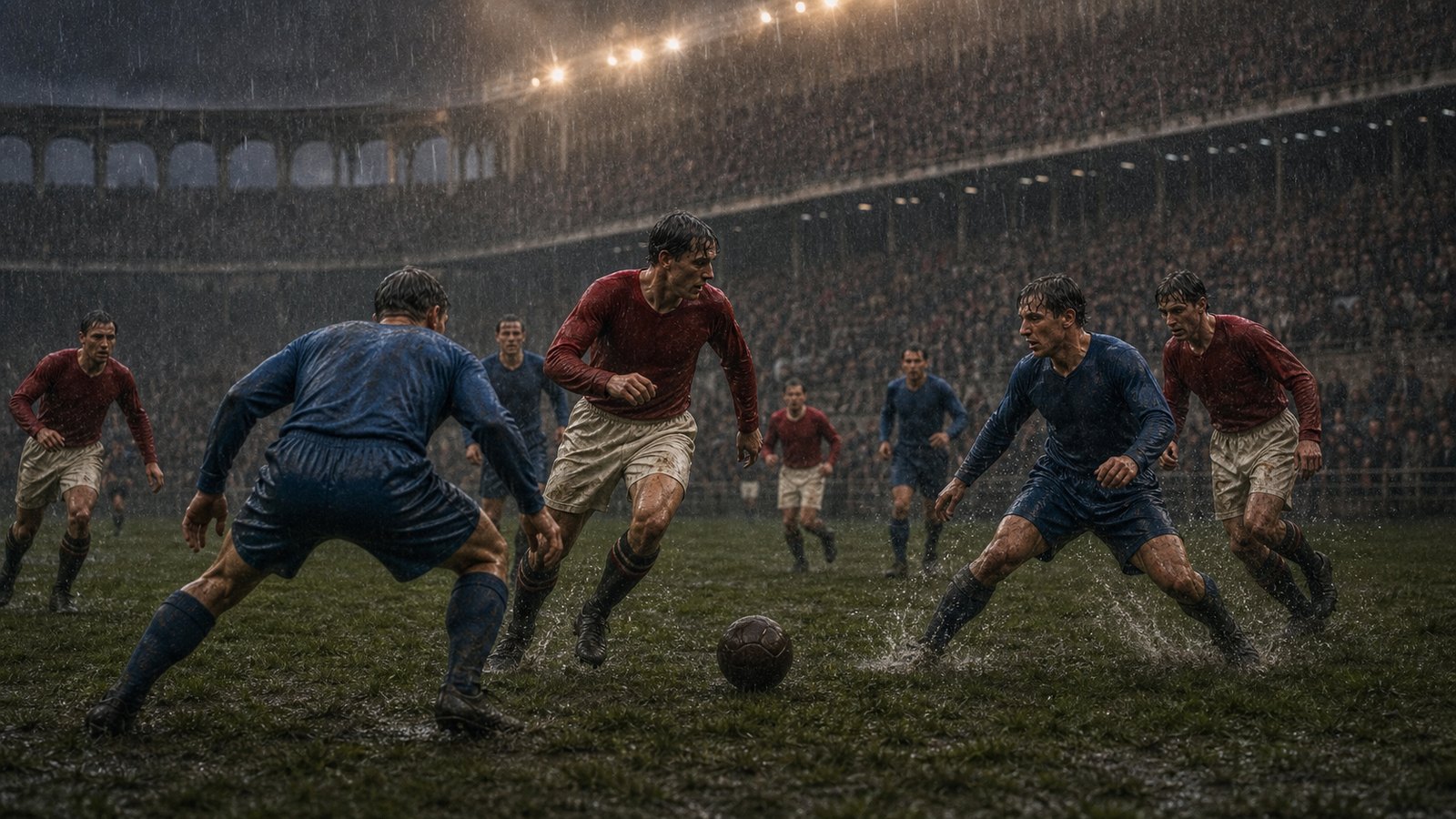
By the 1934 World Cup, Austria arrived in Italy as one of the favourites. The route immediately demanded strain. France were beaten 3–2 after extra time in Turin. Hungary then fell 2–1 in a quarter-final between teams that knew the same Central European football conversation. Austria had reached the semi-final, but the fluidity seen at the Hohe Warte now had to survive a host nation, a heavy pitch and an opponent comfortable compressing the match.
Italy won 1–0 in Milan. Enrique Guaita scored the only goal in a crowded goalmouth, and Austria could not restore the passing rhythm that had made the team famous. The result has attracted lasting debate about the conditions and refereeing, but no disputed detail is needed to understand the tactical limit. A style built on clean support and quick combinations loses oxygen when the ball slows and useful space shrinks.
Germany then won the third-place match 3–2, leaving Austria fourth. The tournament did not erase the preceding run, but it changed its ending. The Wunderteam became remembered as a side whose influence exceeded its World Cup finish: admired, studied and left without the single trophy that would have simplified its place in history.
Vienna’s disappearing forward left a visible inheritance
The temptation is to draw a straight line from Sindelar to every later false nine. Football history is rarely that tidy. Rules, formations and defensive responsibilities changed, and similar solutions appeared in different places for different reasons. What Austria demonstrated was more fundamental: the position named on a team sheet did not have to describe the player’s location after kickoff.
That insight travelled because it solved a recurring problem. A fixed marker is comfortable when the opponent remains fixed. Movement makes the defender negotiate territory with teammates, and every negotiation takes time. Hungary’s great side of the 1950s would later use Nándor Hidegkuti’s withdrawals to devastating effect. Modern teams use forwards who drop, rotate or empty the centre for runners. The details differ, but the dilemma at the heart of the move remains familiar.
The Wunderteam’s strongest legacy is therefore not the claim that Austria invented one modern role. It is the evidence left by a particular team in a particular city. Meisl joined a passing tradition to Vienna’s technical culture. Sindelar gave that language a mobile centre. Around him, teammates treated vacant space as an invitation rather than a mistake. Scotland came to the Hohe Warte expecting to recognize the football. Austria changed the picture by moving the person who was supposed to stand in its middle.