
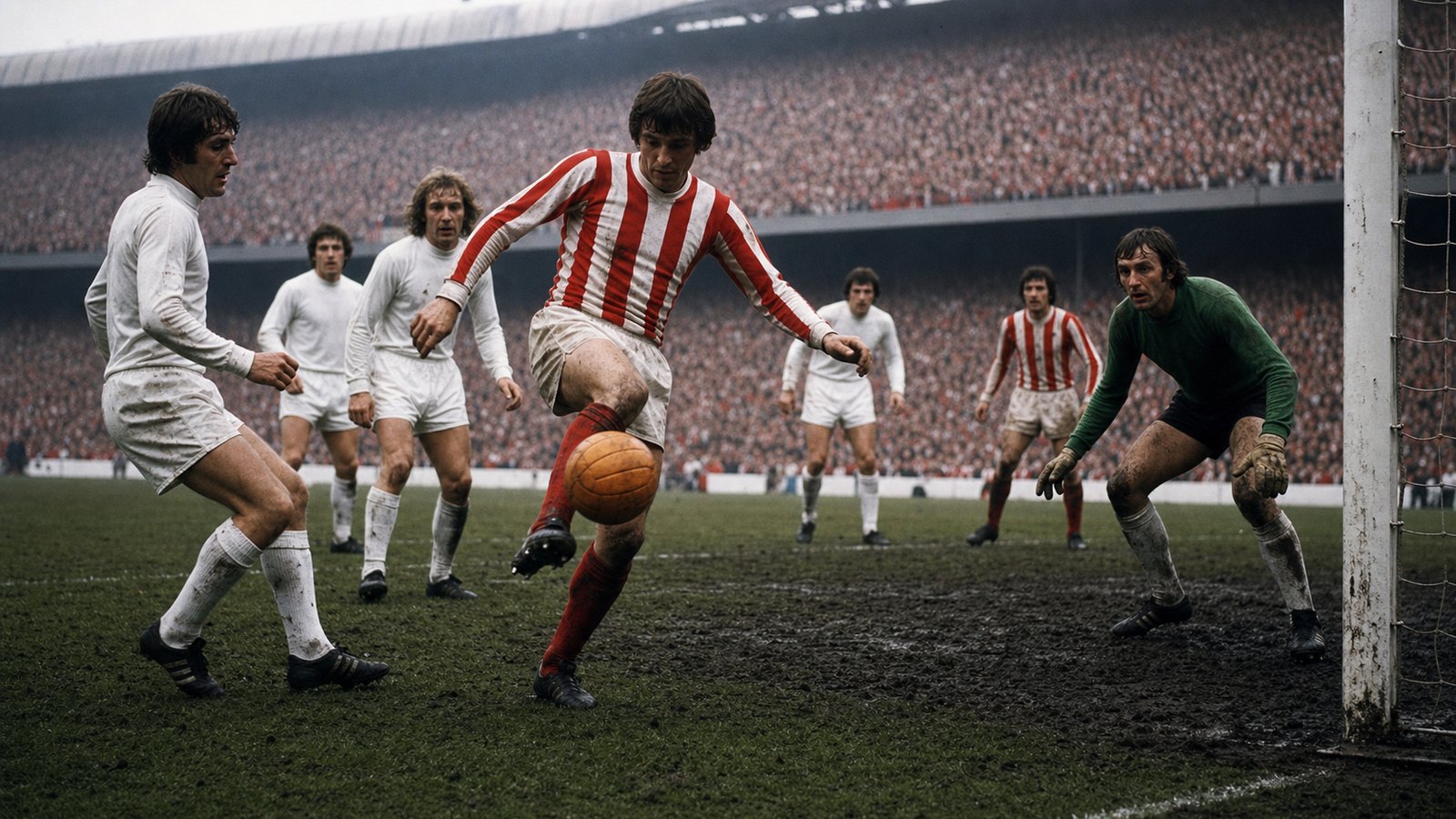
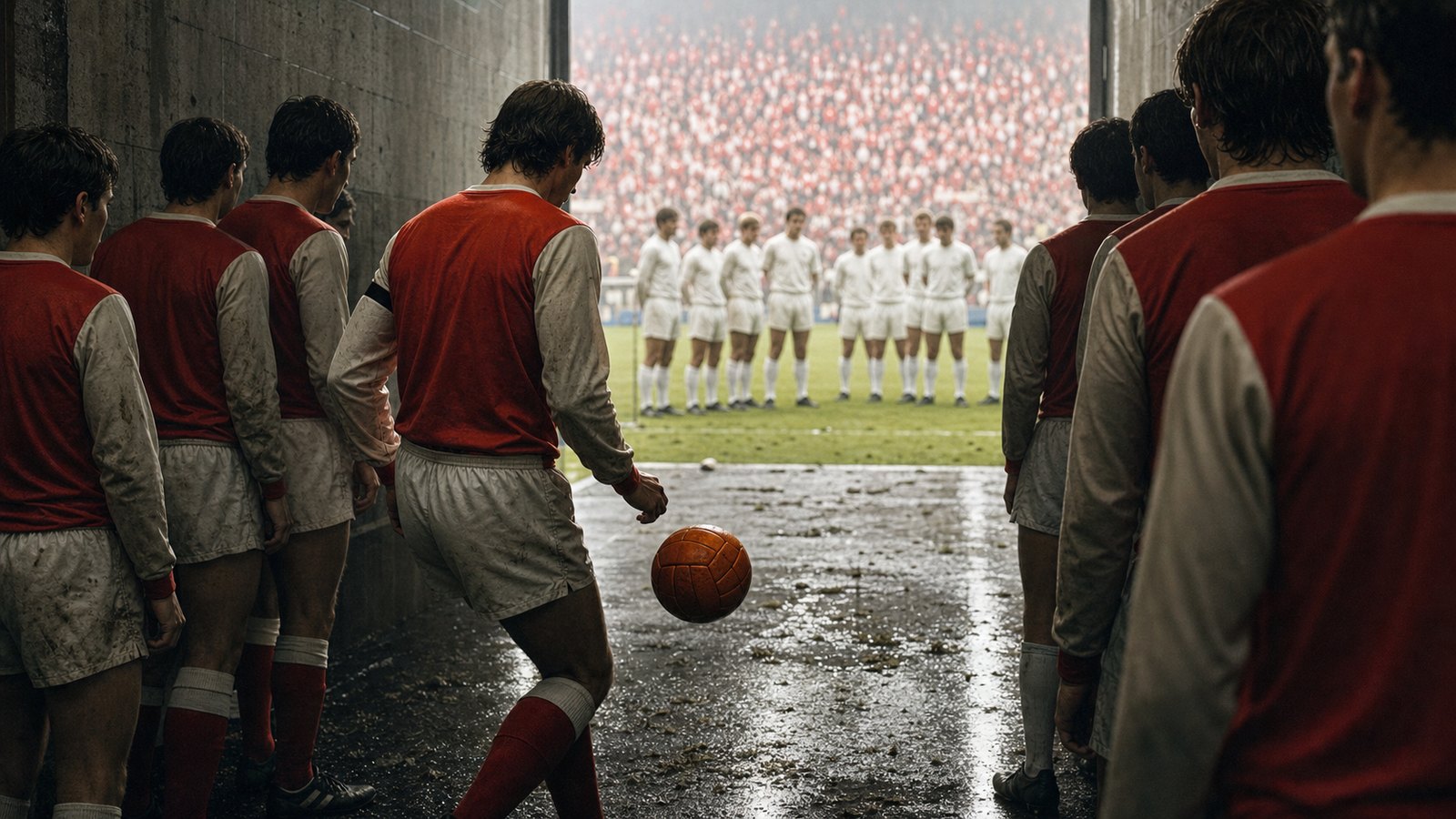
Bobby Kerr stood in the Wembley tunnel chewing gum and bouncing the ball. He would later remember that both movements betrayed the same thing: tension. Sunderland were a Second Division side about to meet the FA Cup holders, a Leeds United team hardened by title races and European nights. The easiest version of the story says the underdog simply wanted it more. The details reveal something sharper. Sunderland made fear usable.
They won 1–0 on 5 May 1973, but the score alone hides the shape of the afternoon. Bob Stokoe’s team needed an early statement, one clean finish, a goalkeeper’s impossible recovery and ninety minutes of collective refusal. Their victory became one of English football’s enduring upsets because it was romantic. It survived because the romance was built from decisions.
A team that arrived carrying the wrong kind of table
Leeds came to Wembley as holders and were appearing in their third FA Cup final in four seasons. Don Revie’s side contained Billy Bremner, Johnny Giles, Norman Hunter, Peter Lorimer and Allan Clarke. The historical match archive describes ten Leeds starters as internationals. Sunderland’s status could hardly have been more different. They played one division below and Stokoe had taken charge during the season with the club third from bottom.
The cup run altered the emotional weather around the team. Sunderland survived a 2–2 draw at Manchester City, won the replay 3–1, then eliminated Luton Town and Arsenal. Each round gave the squad evidence that a difficult match could be moved onto its own terms. Wembley was not a continuation of league status. It was a single argument, played once.
Even the equipment told an underdog story. Derek Young remembered players being offered money to wear unfamiliar new boots. Some feared the stiff pairs would hurt them, so older boots were blacked out and painted with the required logo. Rain soon washed the disguise away. It is a tiny, physical detail: a side about to contest football’s grand domestic occasion choosing broken-in comfort over presentation.
The opening challenge was part of the message
Sunderland could not allow Leeds to make the afternoon feel routine. Richie Pitt’s early challenge on Clarke was therefore more than contact. Pitt later explained that Sunderland wanted to show they would neither be intimidated nor permit Leeds to settle. It set the emotional boundary of the final: every ball would be contested, every extra touch would carry a cost.
This was not a claim that Sunderland controlled possession or created chance after chance. Leeds had openings. Lorimer later admitted that his side sometimes tried to beat another man, take another touch or make another pass when an earlier finish was available. Sunderland’s pressure worked partly by making good players hesitate. The favourite began searching for the perfect action while the underdog kept the match rough-edged and immediate.
The contrast appeared in the line-ups. Sunderland relied on Jimmy Montgomery behind Dick Malone, Ron Guthrie, Micky Horswill, Dave Watson and Pitt, with Kerr captaining midfield and Ian Porterfield joining Billy Hughes, Vic Halom and Dennis Tueart farther forward. These were not anonymous workers, but they did not carry Leeds’ international reputation. Their advantage was clarity. The longer the score stayed level, the more the burden moved toward the team expected to win.
Porterfield took the chance Leeds kept decorating
The decisive attack arrived in the 32nd minute. Hughes delivered a corner, the ball remained alive in a crowded penalty area, and Porterfield adjusted to the drop. He later described bringing it down on his left thigh before striking right-footed from roughly twelve yards. There was no second touch to improve the picture. He hit through the moment before Leeds could close it.
Porterfield remembered tears coming to his eyes. The goal did not merely put Sunderland ahead; it changed every subsequent decision. Leeds now had to chase against a team whose defensive intensity had already been validated. Sunderland no longer needed the match to remain uncertain. They needed to protect a concrete lead, one duel and one clearance at a time.
It also gave the crowd a role. Dick Malone recalled looking around Wembley and feeling as if nearly the whole ground had turned red and white. A hundred thousand people were officially recorded inside the stadium. Once Sunderland scored, the sound no longer represented hope alone. It made every Leeds attack feel like an attempt to reverse an event that had already begun writing its own mythology.
Montgomery’s first save created a harder second save
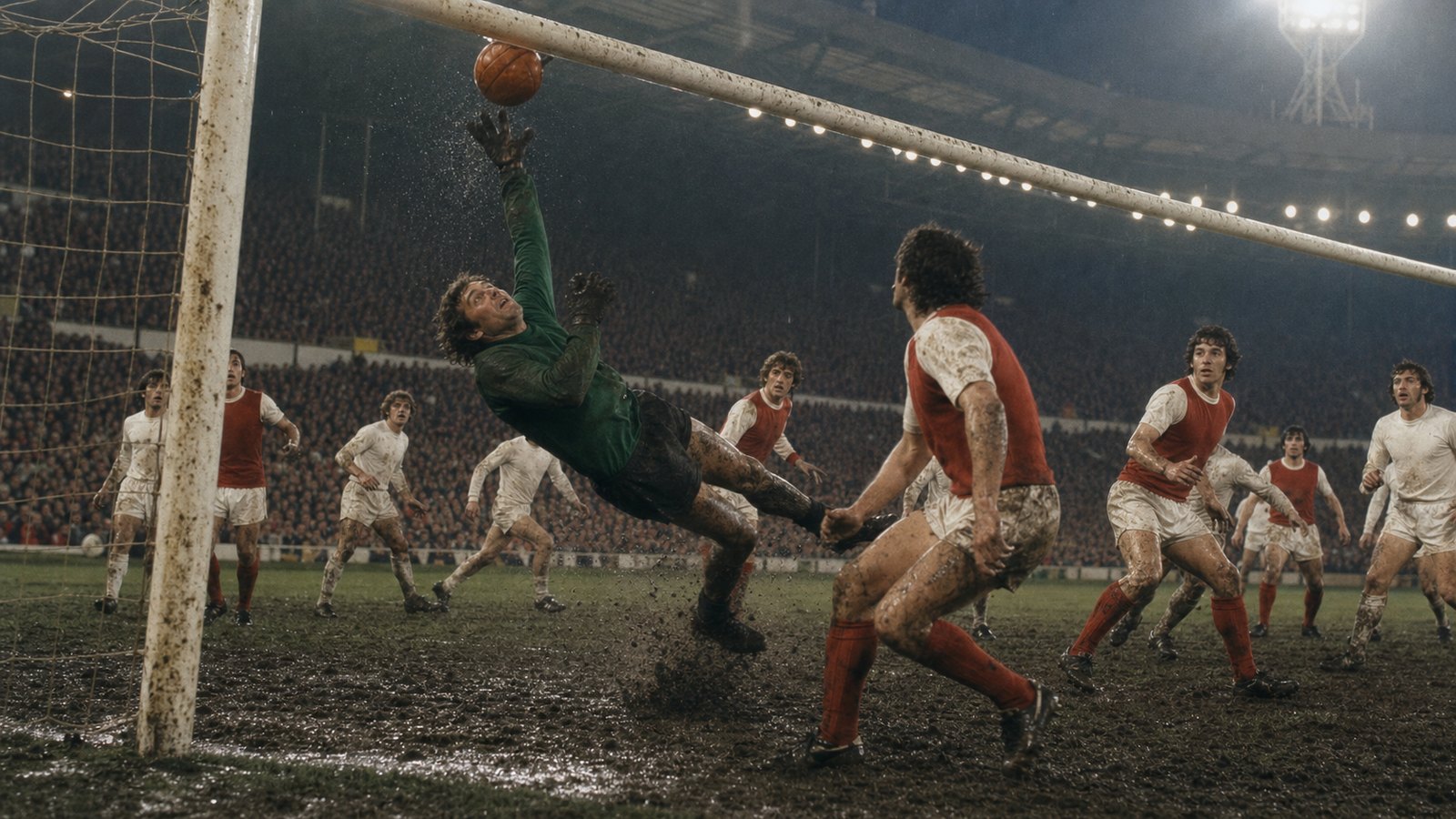
The famous sequence came after Leeds drove the ball across the Sunderland goalmouth. Trevor Cherry met it at close range and Montgomery reacted to keep out the header. That stop did not end the danger. The rebound fell to Lorimer, one of the hardest shooters in English football, with the goal exposed and the goalkeeper still recovering from his first movement.
Lorimer struck. Montgomery somehow changed direction and reached the follow-up, diverting it onto the underside of the crossbar. The ball stayed out. The brilliance was not simply athletic. Goalkeeping technique usually depends on balance and preparation; this action demanded a second response from a body already committed to the first. Sunderland’s entire afternoon was compressed into those seconds: recover before the favourite can exploit what appears to be an open door.
The save dominates memory because it looks like the moment fate chose a side. Yet it mattered only because defenders remained alert, because Sunderland had a lead to preserve and because the preceding hour had kept Leeds uncomfortable. A miracle can decide a final, but a team has to build the conditions in which one miracle is enough.
The final whistle turned Stokoe into part of the picture
Leeds continued to press. Sunderland continued to close spaces, clear danger and absorb the next wave. They even came close to a second goal when Halom forced David Harvey into a late save. That chance matters because it stops the story becoming ninety minutes of passive survival. Sunderland defended, but they also retained enough threat to make Leeds guard the other direction.
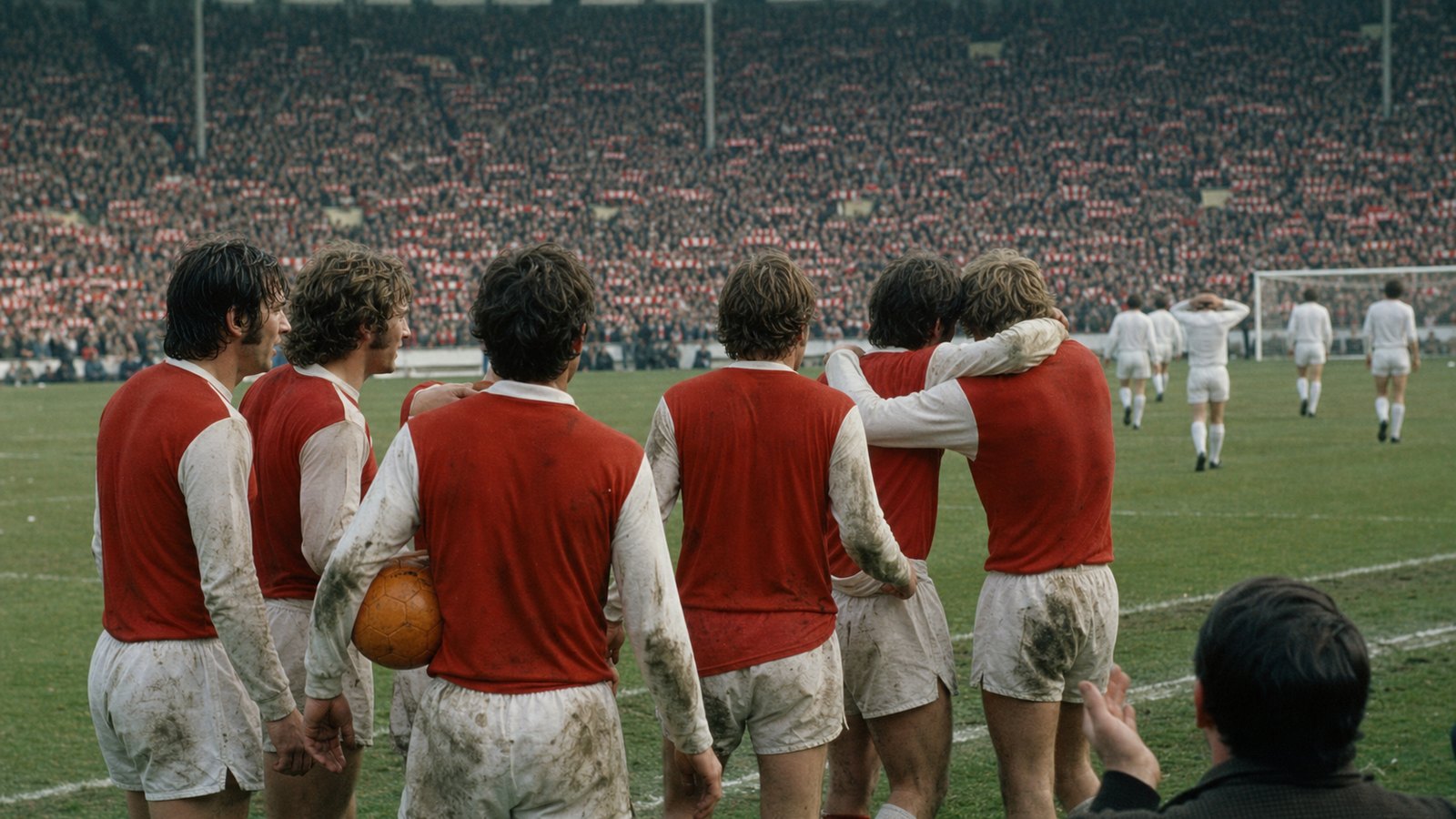
At the final whistle, Montgomery turned toward the Sunderland supporters behind his goal and applauded. He later said that when he half-turned, Stokoe was already only about ten yards away. The manager, in overcoat and hat, crossed the Wembley turf and embraced his goalkeeper. It became the release after an afternoon spent controlling panic: the authority figure abandoning composure because composure was no longer required.
Sunderland became the first Second Division winners of the FA Cup since West Bromwich Albion in 1931. The orange match ball—recorded as the last used in an FA Cup final—added another distinctive object to the memory. Yet the result did not need curiosities to endure. A team that had recently been near the bottom of the second tier had beaten the holders by reducing an enormous mismatch to a sequence of manageable tasks.
Why 1973 still feels larger than one upset
The victory is often used as proof that the FA Cup once possessed a magic modern football has lost. Nostalgia gets close, but it can also flatten the players. Sunderland did not win because the competition sprinkled romance on them. They won because Pitt established a boundary, Porterfield finished without delay, Montgomery recovered when recovery looked impossible, and everyone around them kept the game inside Sunderland’s preferred emotional temperature.
That is why the final remains useful beyond Wearside. Underdogs cannot erase differences in quality, money or experience. They can decide which differences are permitted to dominate a particular match. Sunderland forced Leeds to operate inside tension rather than status. The famous save preserved the score, but the deeper achievement was making one goal and one extraordinary intervention sufficient.
When the photographs are revisited, the final can look inevitable: Porterfield poised to strike, Montgomery reaching upward, Stokoe running. It was anything but. The power of 1973 lies in the work between those frames—the challenges, clearances, wet boots and resisted impulses that allowed an improbable image to become a permanent one.
Sources
- The National — interview with Jimmy Montgomery on the 50th anniversary
- The Northern Echo — player oral history of the 1973 final
- FA Cup Finals — 1973 match archive and line-ups
- Wikipedia — 1973 FA Cup final reference record