
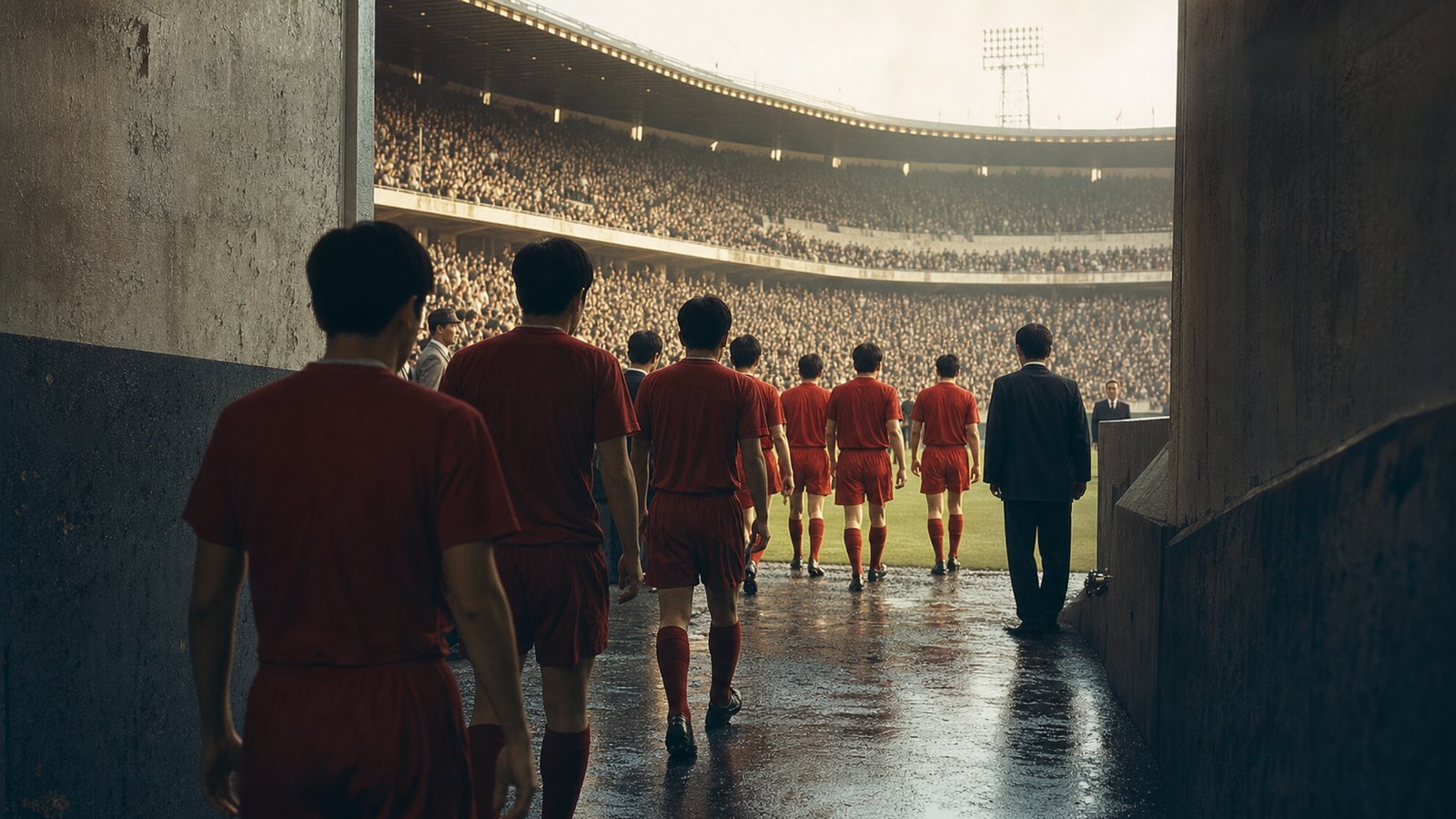
For a few minutes in Liverpool, the most unlikely team at the 1966 World Cup seemed ready to tear the tournament open. North Korea were three goals ahead of Portugal after 25 minutes. The score was startling, but it was not an isolated bolt from nowhere. Four days earlier, the same side had eliminated Italy in Middlesbrough. Before that, they had rescued their tournament with an 88th-minute equaliser against Chile.
The familiar version of the story is a list of shocks: Italy humbled, Portugal frightened, Eusébio unleashed. The more revealing story is about how a team arrived with almost no status, learned to make a small English corner feel like home, and turned compact football into emotional momentum. North Korea did not simply produce one upset. Across four matches, they built a relationship with a place, a crowd and a style of play that made the impossible feel briefly repeatable.
The tournament began with a hard lesson at Ayresome Park
North Korea reached England through an unusual route. South Africa had been disqualified and South Korea withdrew; the remaining Asian and Oceanian qualification path came down to a play-off against Australia. North Korea won the two matches 6–1 and 3–1 in Phnom Penh, a 9–2 aggregate victory that placed them in a World Cup group with the Soviet Union, Chile and Italy. They were making their tournament debut, while Italy arrived as one of the established powers.
The opening match on 12 July did nothing to soften the scale of the task. At Ayresome Park, the Soviet Union won 3–0 in front of 23,006 spectators. Eduard Malofeyev scored twice and Anatoliy Banishevskiy once. The decisive burst came in the first half, with goals in the 31st and 33rd minutes. North Korea had discovered how quickly an organised opponent could punish a moment of separation.
Yet the defeat also gave the team a usable boundary. They could not win by stretching the field into a collection of individual contests. Their best chance lay in keeping the side connected, competing for second balls and turning recovery into direct forward movement. Seven players would start consistently across the run. In a short tournament, familiarity was not a romantic detail; it was a competitive resource.

An equaliser in the 88th minute changed the emotional weather
Three days after the Soviet defeat, North Korea returned to Ayresome Park to face Chile. Rubén Marcos put Chile ahead from the penalty spot in the 26th minute. For most of the evening, the scoreboard threatened to reduce North Korea’s first World Cup to a lesson in survival. Then Pak Seung-zin scored in the 88th minute. The 1–1 draw was modest in the table and enormous in effect.
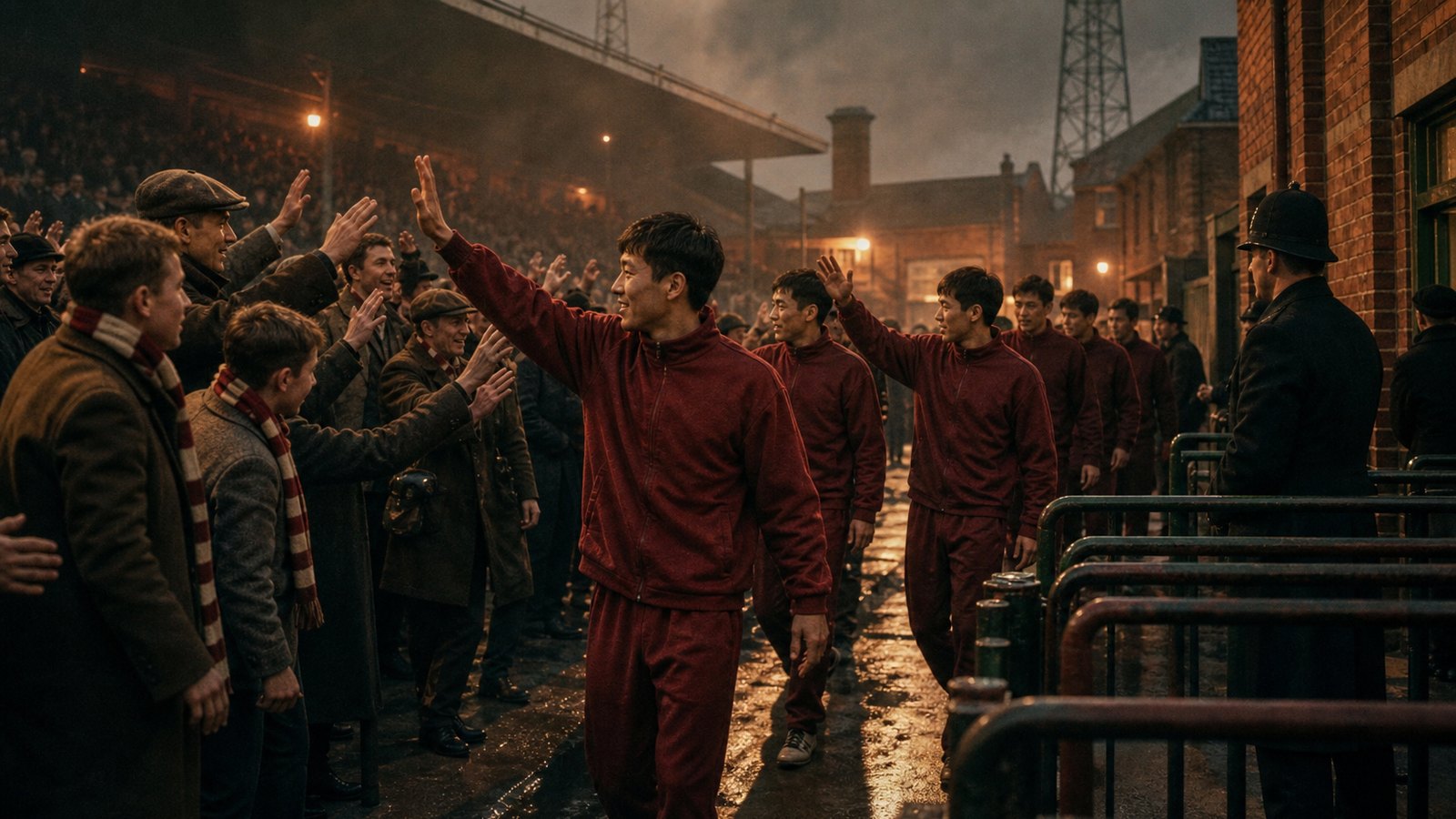
That late goal kept qualification possible. It also gave the home crowd a reason to attach itself to the visitors. Middlesbrough was an industrial football town watching a team that carried none of the tournament’s usual glamour. The connection did not require a shared language. It grew from visible effort, from the refusal to let the match die, and from the pleasure of seeing an outsider force its way back into the story.
The crowd for the Chile match was 13,792, smaller than for the opener, but the relationship was becoming more specific. North Korea were no longer merely an unfamiliar name in Group 4. They were the side playing all three group matches at Ayresome Park, returning to the same streets and the same stands. Tournament geography gave them something close to a temporary home ground.
Italy discovered that reputation could not create space
The decisive group match came on 19 July. Italy needed the result; North Korea needed to turn hope into a place in the quarter-finals. The tactical problem for Italy was uncomfortable. Their reputation demanded control, but North Korea’s compactness denied easy routes through the centre. The underdogs did not need to dominate possession. They needed the match to remain narrow enough that one interception, one loose ball or one direct attack could matter.
Italy also suffered a major disruption when captain Giacomo Bulgarelli was injured. Substitutions were not yet permitted at the World Cup, so Italy had to continue with ten effective players. North Korea still had to exploit the opportunity, and they did so just before half-time. In the 42nd minute, Pak Doo-ik drove the ball beyond goalkeeper Enrico Albertosi for the only goal.
The remaining minutes became a test of collective nerve. Italy fielded names such as Giacinto Facchetti, Sandro Mazzola and Gianni Rivera, but status could not manufacture a clean opening. North Korea protected the centre, chased the next action and made every Italian attack feel shorter than the pressure behind it. When the match ended 1–0, the 17,829 spectators had witnessed the elimination of a double world champion.
North Korea finished second in the group with three points under the era’s two-points-for-a-win system: one victory, one draw and one defeat. They had scored only twice in three matches and conceded four, yet that was enough to advance ahead of Italy and Chile. More significantly, they became the first Asian team to progress beyond the first round of a men’s World Cup.
At Goodison Park, the fairy tale became a tactical warning
The quarter-final against Portugal on 23 July moved the story from Middlesbrough to Goodison Park in Liverpool. Many of the English supporters who had adopted North Korea followed. What happened next explains why the run has survived as more than a single upset.
Pak Seung-zin scored in the first minute. Li Dong-woon made it 2–0 in the 22nd, and Yang Seung-kook added a third in the 25th. North Korea were not protecting a lucky lead; they were attacking the space opened by Portugal’s surprise. Their directness carried the emotional force of the Italy result into a new stadium. For a brief stretch, the quarter-final looked less like a miracle than a repeatable method.
But a three-goal lead also changed the geometry. Portugal had to attack continuously, and North Korea now had more ground to defend against a side with elite one-against-one quality. Eusébio scored in the 27th minute, then converted a penalty in the 43rd. He scored again in the 56th and from another penalty in the 59th. In 32 minutes, he had turned 0–3 into 4–3. José Augusto completed a 5–3 victory in the 80th minute.
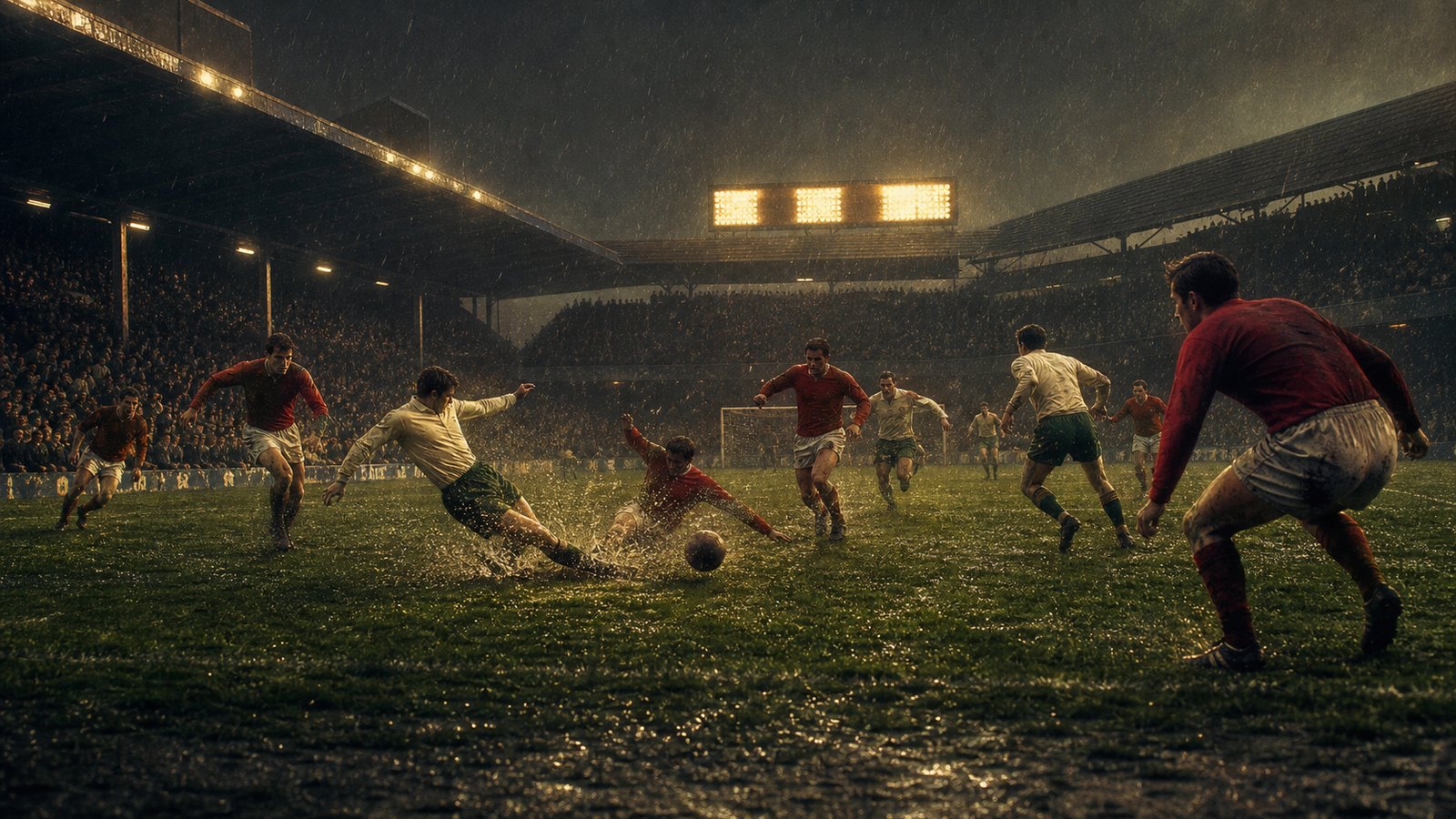
The collapse should not be simplified into naivety. North Korea had reached the last eight by taking risks at the correct moments, and those same instincts produced three goals against Portugal. Retreating completely after the third might have surrendered the qualities that created the lead. The match instead exposed the brutal edge of knockout football: a method can be good enough to terrify a favourite without being strong enough to survive every adjustment.
Why Middlesbrough remained part of the achievement
North Korea left the tournament with one win, one draw and two defeats, five goals scored and nine conceded. Those numbers do not look like the record of a side that changed a World Cup. Context gives them weight. The team had entered through a remote qualifying play-off, lost its opening match by three goals, then recovered to remove Italy and lead Portugal 3–0 in a quarter-final.
The local bond mattered because World Cups are not played in neutral emotional space. A crowd can reward an underdog’s pressure, magnify an opponent’s anxiety and make each clearance feel like evidence that the impossible is holding. Middlesbrough’s supporters did not score the goals, but their adoption of the team gave the run a human setting. The story belongs to Ayresome Park as much as it belongs to the results.
It also complicates the way underdog football is remembered. North Korea were not only a defensive curiosity. Pak Seung-zin scored twice in the tournament, including the first-minute goal against Portugal. Li Dong-woon and Yang Seung-kook also scored in the quarter-final. Pak Doo-ik’s goal against Italy supplied the iconic moment, but the run required several players to act decisively across different match states.
The final image is therefore not simply Italy’s embarrassment or Eusébio’s rescue. It is a small travelling team becoming temporarily local, using cohesion to survive one setback, and carrying belief from an 88th-minute equaliser all the way to a three-goal quarter-final lead. North Korea’s 1966 run lasted only eleven days. Its emotional map still runs from Middlesbrough to Liverpool.
Sources
- FIFA, North Korea’s 1966 World Cup story
- FIFA Match Centre, North Korea–Italy, 19 July 1966
- FIFA Match Centre, Portugal–North Korea, 23 July 1966
- RSSSF, World Cup 1966 finals
- Oceania Football Confederation, 1966 qualifiers
- The Guardian, North Korea at the World Cup