
Real Sociedad’s league titles in 1981 and 1982 are sometimes remembered as a beautiful interruption: a Basque club briefly breaking the grip of Spain’s giants before the familiar order returned. That is too soft. Those titles were not a charming exception. They were the result of a local football machine that made continuity, defensive trust, and Atotxa pressure feel bigger than money.
The club did not simply have a good season. It won La Liga twice in a row, in a country where Real Madrid and Barcelona were supposed to pull the center of gravity back toward themselves. The achievement was not only sporting. It was structural: a club rooted in local identity used a stable squad and a defined environment to create an edge that outsiders found hard to copy.
Atotxa made the margins feel personal.
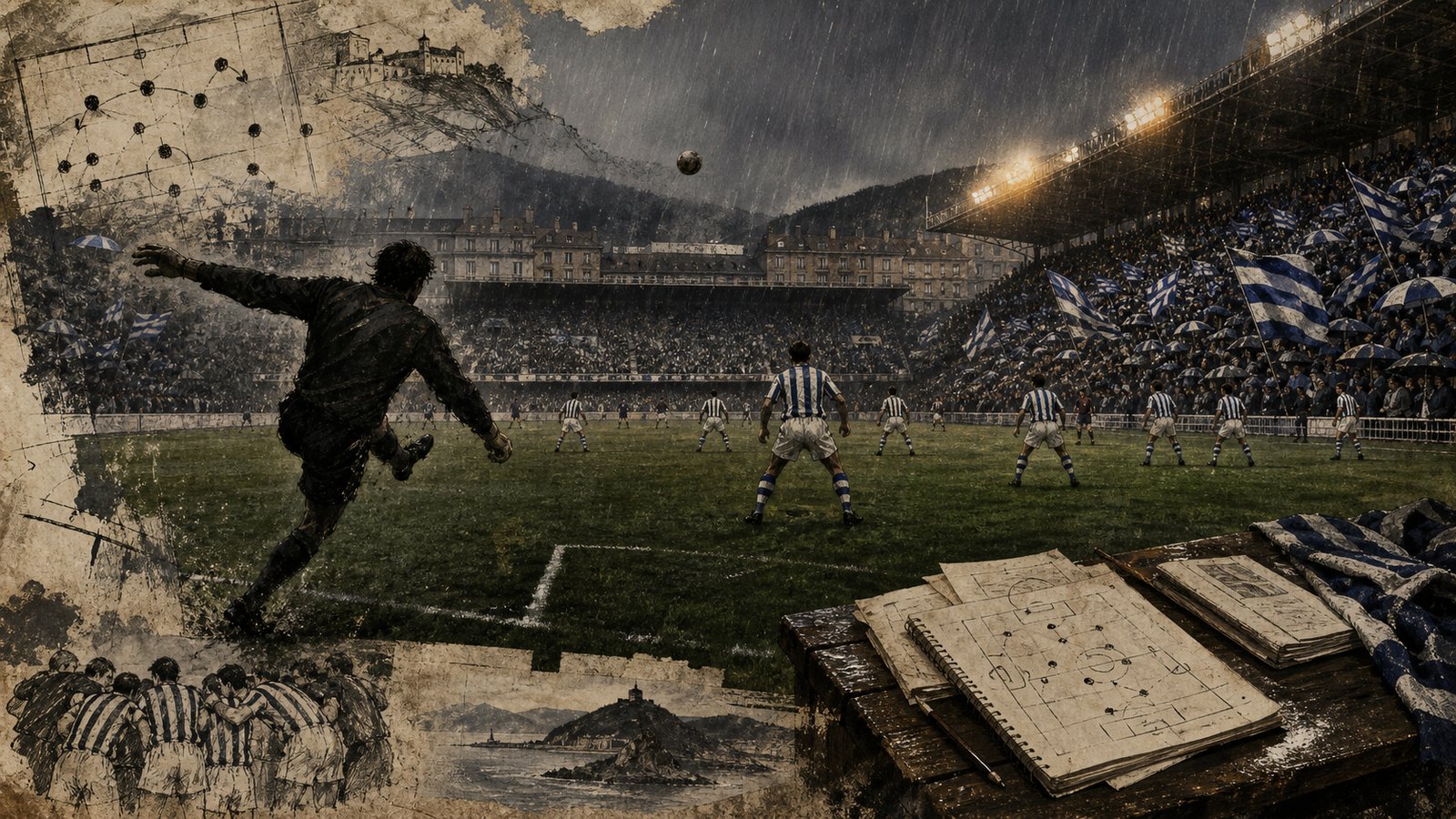
Old Atotxa was not a neutral stage. Its narrow, intimate feel made matches claustrophobic in the best football sense. The crowd sat close enough for every duel to sound important. Rain, tight spaces, and local expectation could turn a routine league match into something with a cup-tie pulse. For a team built on shared habits, that mattered.
Real Sociedad’s strength was not one superstar floating above the rest. It was the feeling that the side knew itself completely. The back line trusted the goalkeeper. Midfielders understood when to protect and when to arrive. Attacks did not have to be constant to be dangerous, because the team was comfortable letting opponents discover how little space was available.
That is why the back-to-back titles should not be treated as a freak statistical run. Winning one league can be explained away by form, fortune, or a rival’s bad year. Retaining it is different. Retention asks whether the first success had a mechanism strong enough to survive attention. Real Sociedad had one.
The local policy was a football decision, not only an identity statement.
Real Sociedad’s reliance on local and Basque-rooted talent is often discussed emotionally, and understandably so. But it also had a practical football effect. Players who came through similar environments did not need every habit translated. They had common assumptions about tempo, bravery, and responsibility. In a league filled with technically gifted opponents, that shared base helped the team defend and attack as a unit.
The danger of identity stories is that they can become misty. The football was concrete. A settled core reduces waste. Training references carry from week to week. Mistakes are interpreted inside an existing culture rather than as random individual failures. When a club has fewer resources than the giants, that kind of coherence becomes a form of capital.
The titles also arrived before the modern explosion of global squad building. That does not make them easier. It makes the context different. Real Sociedad had to beat teams that still had enormous prestige, deep domestic pull, and strong institutional advantages. Their answer was not to imitate those giants. It was to make a smaller ecosystem perform at a higher percentage.
Two titles changed the meaning of the first.
The 1980-81 title is dramatic because it came at the end of a tense race. The 1981-82 title is important because it prevented the story from becoming a single romantic snapshot. Back-to-back championships changed the question from “how did they do that?” to “what exactly had they built?”
They had built a team comfortable with pressure because pressure was part of the home environment. They had built a squad with enough internal trust to survive difficult away matches. They had built a rhythm in which clean sheets, narrow wins, and controlled emotional temperature all counted as attacking acts, because each one moved the title race toward opponents who needed to chase.
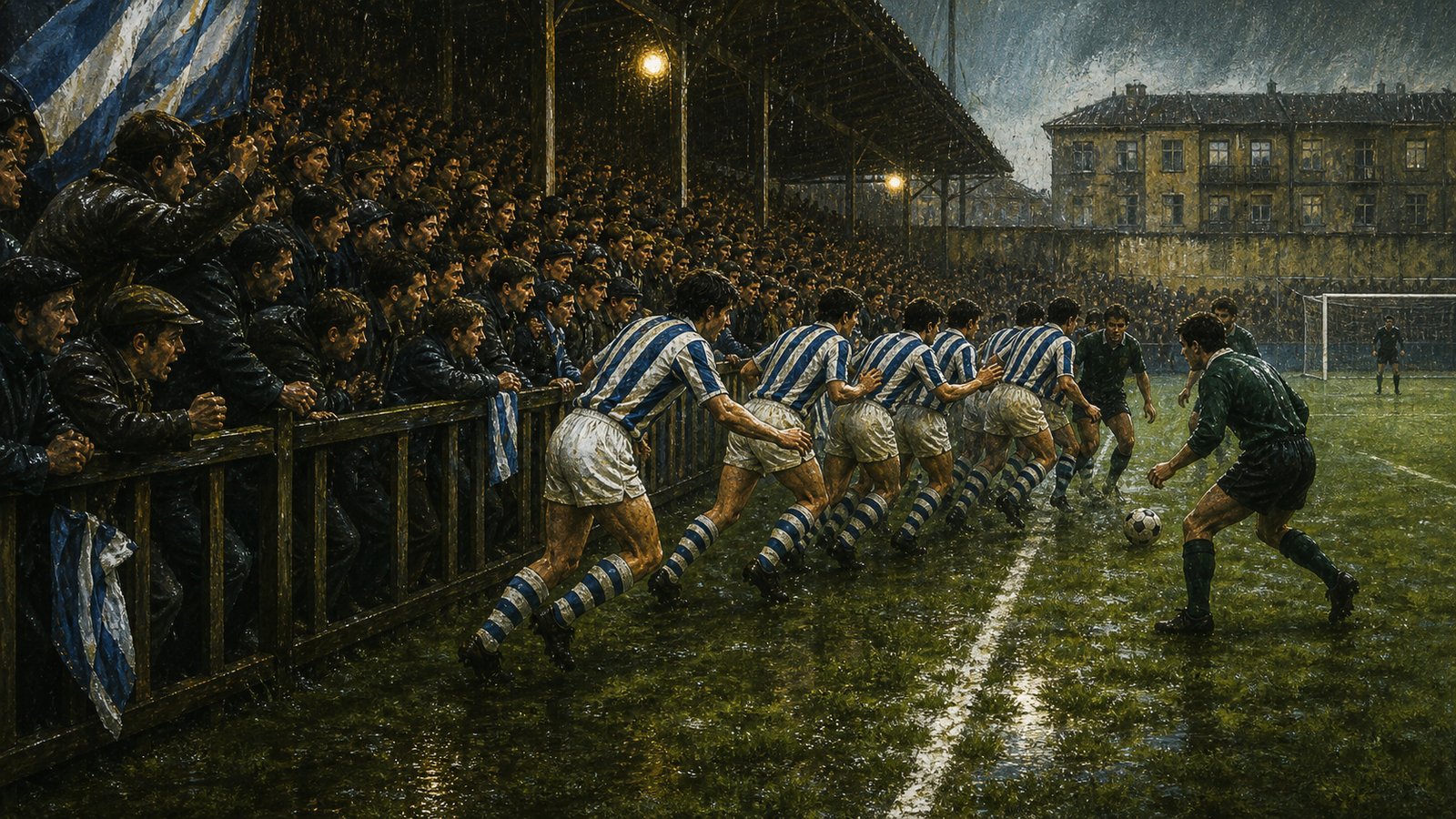
The giants were not absent. They were made to look inefficient.
It is easy, decades later, to flatten the story by saying Spain’s giants were in a transitional period. Every title winner benefits from context, but context does not kick the ball away in the final minutes. Context does not organize a back four. Context does not repeat title-winning habits across two campaigns. Real Sociedad still had to make the giants’ advantages feel less decisive.
The lesson is not that local identity automatically wins. Most identity projects fail if the football is vague. Real Sociedad’s triumph was that identity had a tactical and developmental expression. The club’s sense of itself showed up in who played, how they trusted each other, and how Atotxa turned games into tests of patience.
The story still matters because modern football keeps moving the opposite way.
Modern elite football is built on movement: players moving between countries earlier, managers moving between projects faster, money moving through squads with less patience. Real Sociedad’s 1981 and 1982 titles offer a counter-image. They show what can happen when continuity is not an accident but a strategy.
That does not mean the old model can simply be restored. The economics have changed. But the principle remains useful. Clubs outside the richest tier still ask how they can turn local knowledge, development, and home advantage into something opponents cannot buy by Friday. Real Sociedad answered that question with two league trophies.
The individual landmarks make the collective point clearer. Luis Arconada gave the side an elite goalkeeper and a symbol of reliability, while outfield leaders around him made the defensive block feel less like retreat and more like control. The title race did not ask Sociedad to win every match by spectacle. It asked them to keep returning to the same habits after injuries, bad pitches, away pressure, and the psychological drag of being chased by larger institutions.
Back-to-back success also changed how opponents approached them. In the second season, the club was no longer the charming challenger. It was the champion with a target on its back. That difference matters. Retaining the league meant solving matches after the surprise had gone, after scouting reports had thickened, and after every visit to Atotxa carried the added motivation of knocking the local machine off its rhythm.
For modern clubs, the story is not a command to copy a nationality policy. It is a warning that culture without football detail is not enough, and football detail without culture can become fragile. Real Sociedad’s peak joined the two. The result was not a slogan. It was two league tables with the same local club at the top.
The timing also matters. These titles arrived in an era before the Champions League economy made repeated domestic disruption almost impossible for clubs outside the wealthiest brands. That does not make Sociedad lucky; it makes their window historically revealing. They found a moment when preparation, home identity, and a settled squad could still press directly against institutional power. The achievement now reads like a preserved photograph of a different football economy, but the competitive logic remains alive.
Look at the emotional sequence of a visiting match in San Sebastián. The opponent starts with the bigger name, the bigger assumption, maybe the cleaner technical reputation. Then the pitch tightens. The crowd hears every contact. Arconada’s calm reduces the value of hopeful shots. Midfield pressure turns possession into a negotiation rather than a comfort. By the final half-hour, the bigger club is no longer playing an abstract title race. It is trying to escape Atotxa with its rhythm intact.
Sources
La Liga historical records; Real Sociedad club history; RSSSF Spain championship records; contemporary Spanish football reports; histories of Basque football and Atotxa.