
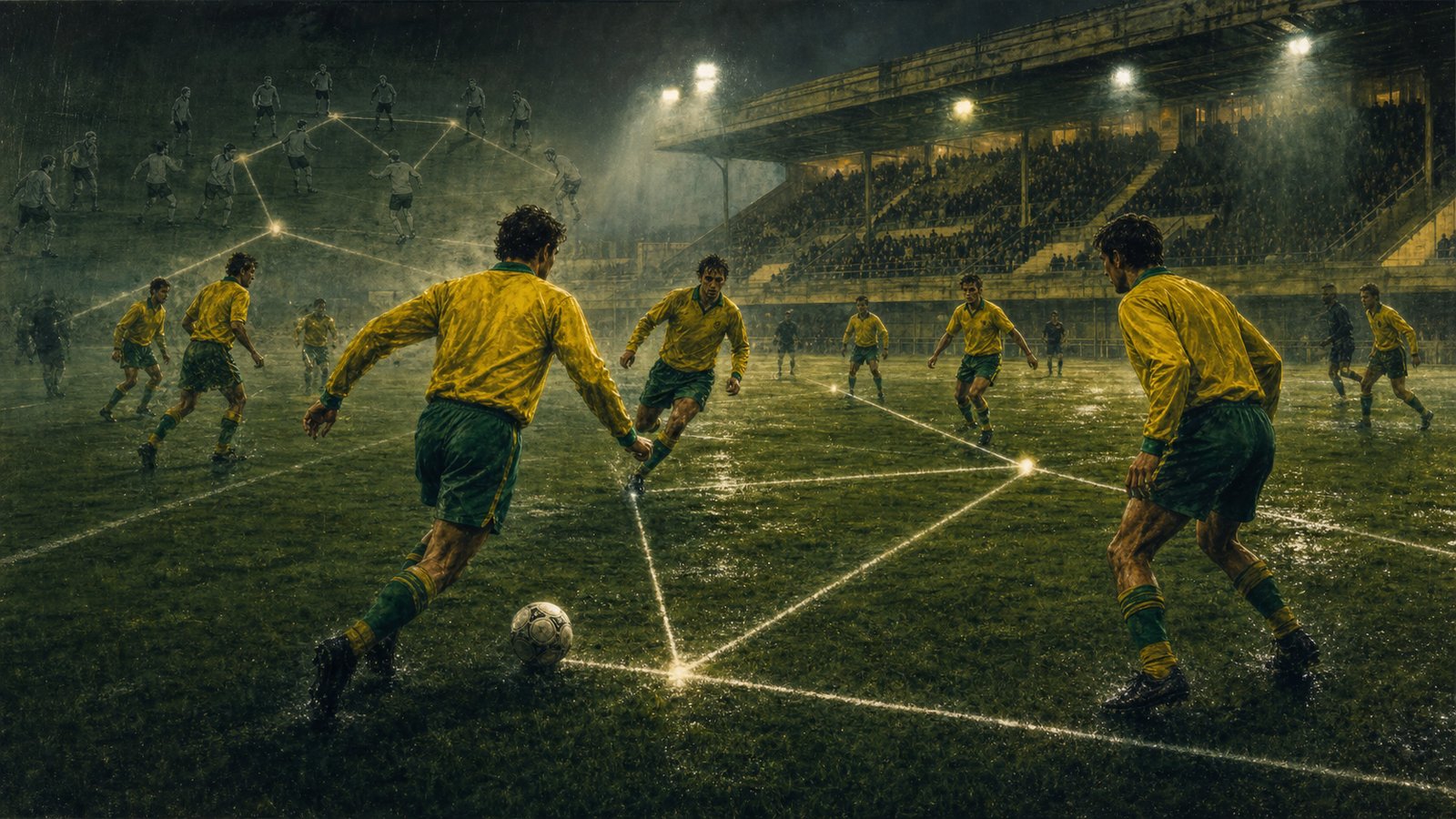
Nantes in 1994-95 were not just a pleasant French champion with a pretty nickname. They were proof that an aesthetic can become an operating system. The phrase jeu à la nantaise can sound decorative from a distance: quick passing, movement, academy habits, yellow shirts moving in triangles. In that season, it was not decoration. It was how a club turned collective rhythm into a league title.
The side finished the French league season with a reputation for elegance, but elegance is only useful if it survives contact. Nantes survived because their style was not a luxury added after the defensive work. It was the defensive work, the attacking work, and the squad-building work all speaking the same language. Players moved early because they had been trained to expect the next pass. They trusted the pattern because the pattern had been repeated long before the cameras arrived.
The beauty came from repetition.
One-touch football can look spontaneous when it works. That is part of its charm. But the spontaneity is usually manufactured by hours of boring preparation: body angles, support distances, third-man runs, and the courage to release the ball before the receiver looks obviously free. Nantes made those details feel natural.
The 1994-95 team belonged to a club culture that valued development and collective intelligence. The ball was not treated as a toy for individual expression alone. It was a message moving through the team. Each quick pass asked the next player to be brave enough to continue the sentence. When enough players shared that grammar, opponents were forced to chase shadows rather than names.
That mattered in a league where physical duels and cautious structures could slow matches into fragments. Nantes did not need to overpower everyone. They needed to make the first and second pass after pressure cleaner than the opponent expected. Once the ball moved through the first line, the pitch opened.
The unbeaten run gave the idea a hard edge.
The most useful way to understand Nantes is to separate prettiness from resilience. A stylish team that collapses after three bad tackles becomes a cult memory. A stylish team that keeps winning turns into a problem for the league. Nantes were the second kind. Their long unbeaten stretch in the 1994-95 campaign gave the method credibility because it showed that the idea could carry pressure.
That run did not mean every match was a parade. It meant the team had answers on ordinary days. When the first combinations did not cut through, the same spacing still helped them recover loose balls. When opponents sat deeper, the circulation tested concentration. When matches tightened, the shared habits reduced panic. The game could become less beautiful without becoming unfamiliar.
This is the part many style stories miss. A tactical identity is not only what a team does when it is comfortable. It is what remains when comfort disappears. Nantes had enough internal structure for the style to survive the weather of a full season.
Academy habits became first-team advantages.
Nantes’ title also shows why development is more than producing saleable individuals. A club can develop relationships, not just players. If young footballers are taught similar movements, similar cues, and similar values before they reach the first team, the senior side can play faster without becoming reckless. The pass can be made earlier because the receiver has been raised inside the same expectations.
That does not remove individual quality. It channels it. The best Nantes players still needed technique, timing, and nerve. But the system made their choices easier to recognize. Instead of every attack beginning as a private calculation, many attacks began from a shared map.

The title was also a market lesson.
French football in the mid-1990s was not insulated from money or movement, but Nantes’ achievement showed a different way to create value. When a club cannot simply buy the finished version of every role, it can make the roles clearer. It can build a team where the whole improves the price of the parts.
That is why the season still resonates with clubs trying to punch above their financial weight. Recruitment is important, but recruitment without a playing language can become a collection. Nantes had a language. A new player entering that environment could understand what the shirt demanded: move, offer, combine, recover, repeat.
The risk, of course, is that success attracts buyers. A beautiful team often becomes most vulnerable immediately after proving its beauty works. But that should not reduce the achievement. If anything, it sharpens it. The 1994-95 title captured a moment when development, coaching, and shared belief were synchronized before the market could pull the picture apart.
Why the machine is remembered as music.
Nantes are remembered fondly because their football gave supporters something beyond results. But the romance should not hide the engineering. The rhythm existed because the distances were right. The one-touch moves worked because players trusted spaces before they fully appeared. The title arrived because a club culture had made those choices repeatable.
That is the real legacy of the 1994-95 side. It did not simply play attractively and then happen to win. It won because the attractive thing had been made durable. The music was the machine.
The names attached to the team matter because they show the range of the idea. Claude Makélélé, Christian Karembeu, Japhet N’Doram, Reynald Pedros, and Patrice Loko were different kinds of footballers, yet the season is not remembered as five separate highlight reels. It is remembered as a collective language strong enough to make those differences useful. That is the point of a real club style: it does not erase individuality, but it prevents individuality from becoming noise.
The European afterlife also gives the title weight. Nantes did not become a permanent superpower, and several players eventually moved into bigger markets, but the season left a template that French football kept discussing. Development was not only a moral preference or a budget necessity. Done well, it could be a competitive weapon against clubs that looked more imposing on paper. In a modern game obsessed with recruitment departments, the Nantes lesson remains awkwardly simple: relationships can be recruited too, but they are usually built earlier than the transfer window.
The story also has a physical detail that matters: this was not abstract chalkboard football played by mannequins. It was acceleration on grass, first touches under pressure, forwards starting runs before defenders had adjusted their hips, and midfielders brave enough to receive with an opponent arriving. The beauty depended on risk. A one-touch game becomes sterile if nobody threatens depth, and reckless if nobody protects the loss. Nantes made the two halves of the equation feel joined.
That balance is why the season still feels like a tactical reference rather than a nostalgic postcard. Many teams say they want to play quickly. Fewer build the conditions that make quick play responsible. Nantes had enough shared education to make speed look calm. That is the difference between a team that merely likes possession and a team that can use possession to win a league.
Sources
Ligue 1 historical records; FC Nantes club history; RSSSF France championship records; contemporary French football reports; histories of the jeu à la nantaise.