
Tottenham Hotspur’s 1960-61 Double is often wrapped in glow: white shirts, packed English terraces, a great domestic side playing with style before the modern age hardened into television money and European superclubs. The romance is real, but it can make the football too soft. Spurs did not win the league and FA Cup because they were charming. They won because Bill Nicholson turned tempo, passing, spacing, and dressing-room authority into a machine that English opponents could admire and still fail to stop.
The numbers remain blunt. Tottenham won the First Division in 1960-61, then beat Leicester City 2-0 at Wembley to complete the first English league-and-FA-Cup Double of the twentieth century. They opened the league season with a long winning run, finished with 66 points under the two-points-for-a-win system, and scored 115 league goals. Those figures do not describe a cautious champion edging through narrow margins. They describe a side that could attack repeatedly, recover quickly, and make pressure feel like routine. The Double was not only a trophy cabinet event; it was an operating model.
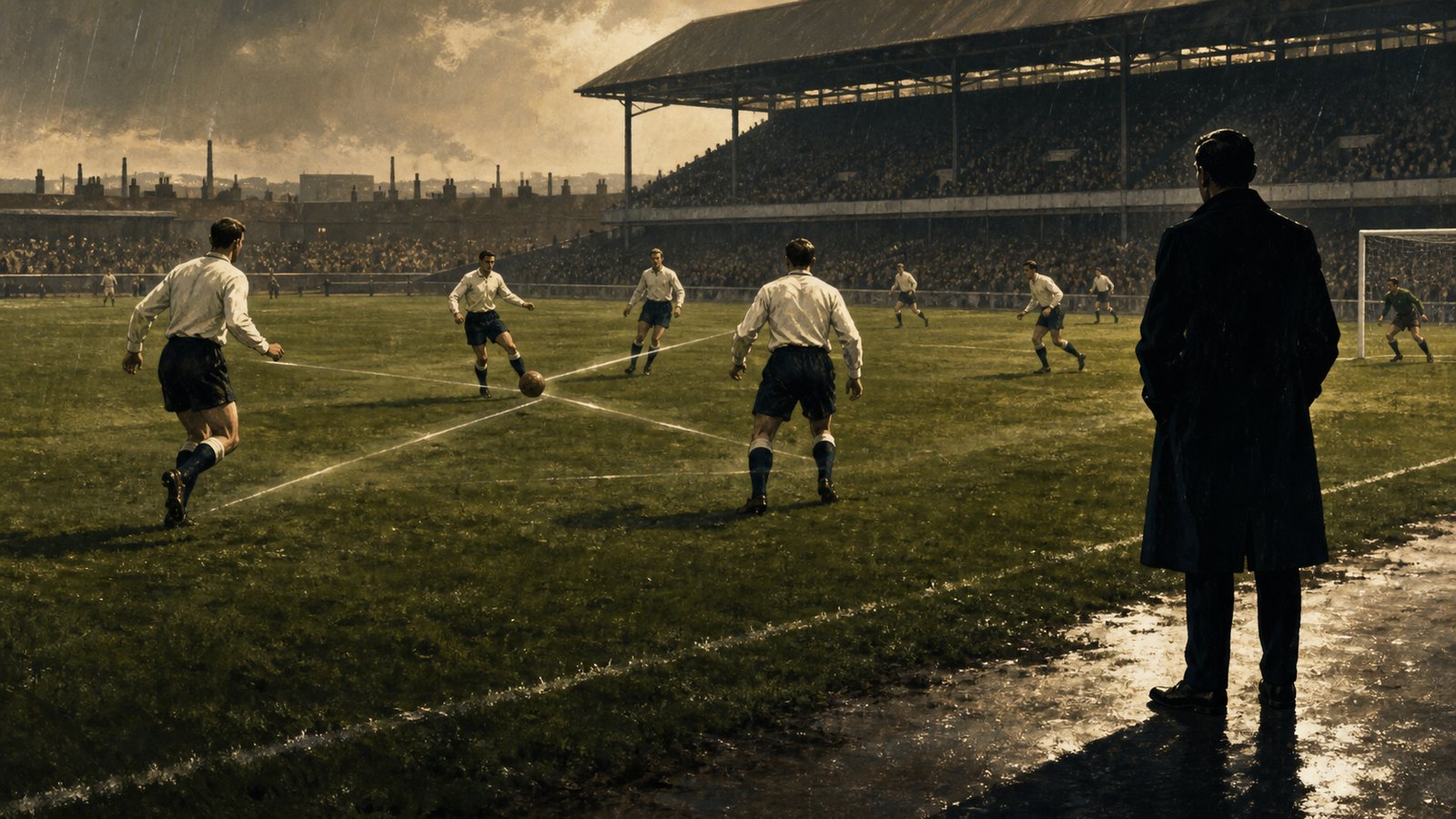
Nicholson Inherited a Club and Built a Tempo
Bill Nicholson was not an outsider arriving with a slogan. He had been part of Tottenham as a player and understood the club’s push-and-run tradition from the inside. That mattered because 1960-61 was not a sudden import of a foreign theory. It was a sharpening of an existing idea: pass early, move again, trust the next angle, and make the ball travel before defenders could settle. In an English game still comfortable with directness, muscular duels, and set-piece territory, Spurs made speed of thought look like physical superiority.
The phrase push-and-run sounds simple, almost quaint, but simplicity can be brutal when a team repeats it faster than the opponent can organize. One player released the ball and immediately became available. A teammate received not as an isolated dribbler but as the next connection. The ball did not need to be held for long enough to invite contact. That rhythm made Spurs difficult to press in the language of the time, because tackling one player did not solve the next pass. The system lived in habits more than diagrams.
The Stars Were Famous, but the Balance Was the Point
Danny Blanchflower gave Tottenham intelligence and authority from midfield. Dave Mackay supplied drive, steel, and emotional force. John White drifted into spaces that opponents did not always know how to mark. Bobby Smith offered a central presence, while Cliff Jones brought speed and width. It is tempting to list the names and let reputation do the work. The better question is how those qualities fitted together. Tottenham had craft without becoming fragile, aggression without becoming crude, and scoring power without losing their passing identity.
Blanchflower’s role is especially important because he represented control rather than mere decoration. The captain could slow a move, speed it, or switch its angle, and his passing gave Nicholson’s side a brain on the pitch. Mackay made that intelligence harder to bully. White’s movement made it harder to assign fixed defensive jobs. Smith and Jones turned territorial advantage into goals. This was not a team of identical technicians. It was a set of differences organized around one tempo, which is why the football could feel fluid without becoming loose.
The Fast Start Was a Weapon, Not a Footnote
Spurs’ famous start to the league season did more than build a points cushion. It changed the emotional terms of the campaign. Every opponent knew they were facing the side everyone else was chasing. Every Tottenham match became a test of whether the machine would finally slow down. That kind of pressure can break a team, especially one expected to play attractive football rather than merely grind. Instead, the early run became proof inside the dressing room. The players had evidence that their rhythm worked against real resistance.
In a two-points-for-a-win league, sustained aggression carried risk. Draws could keep rivals alive. Bad away days could shrink a lead quickly. Tottenham’s answer was not to protect the season by becoming smaller. They kept scoring. The 115 league goals were not a decorative statistic; they were the scoreboard expression of an approach that trusted chance creation as a form of defense. If a match became open, Spurs believed their patterns would produce the better chances more often than not.
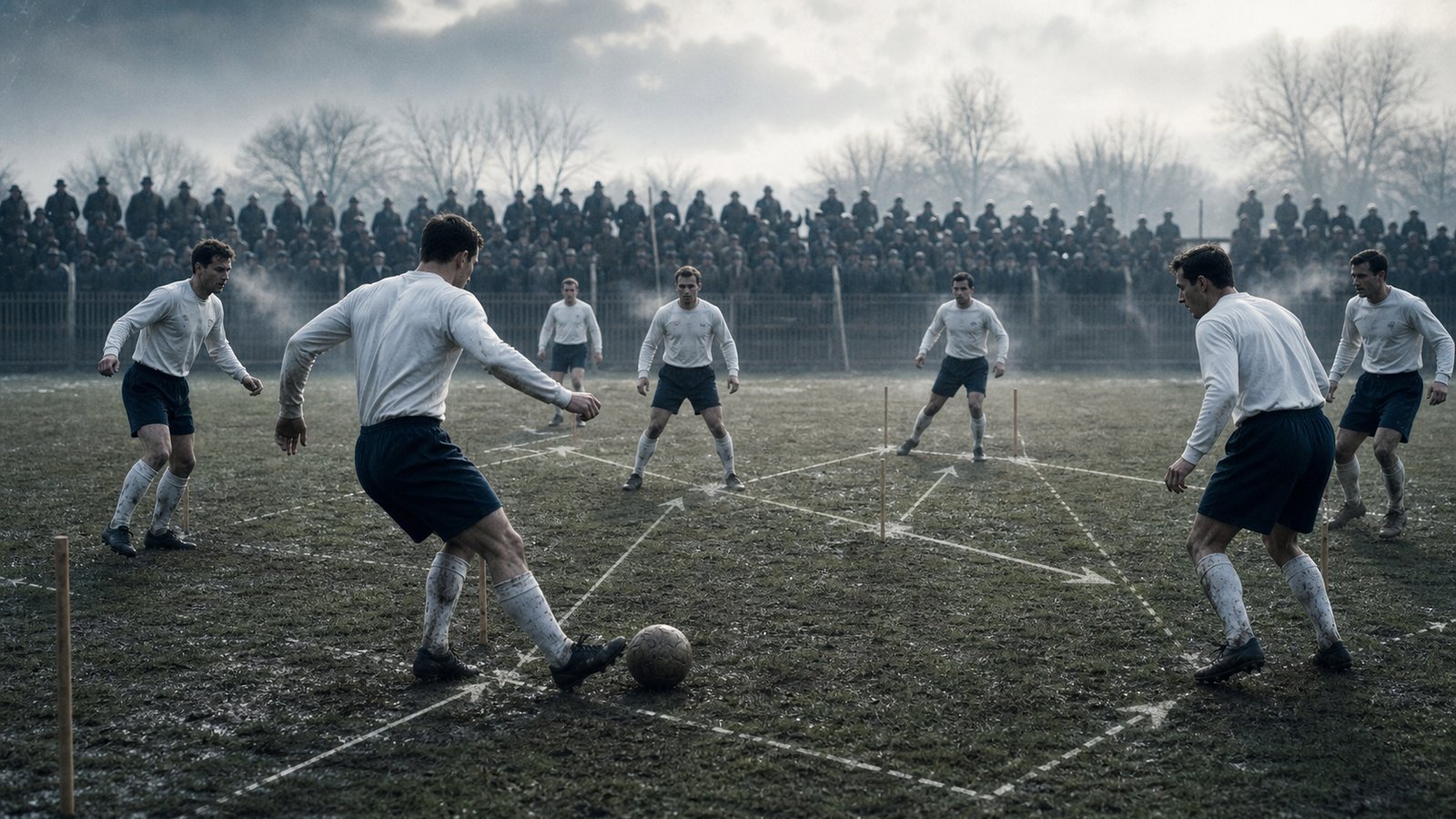
Wembley Proved the Double Was Not Just Momentum
The FA Cup final against Leicester City could have become the awkward final exam. Cup finals often punish favorites because the weaker side can compress the match into nerves, fouls, and isolated incidents. Leicester also had their own disruption when Len Chalmers was injured, a reminder that the final belonged to its era before substitutions could smooth every accident. Tottenham still had to turn status into goals. Bobby Smith scored, Terry Dyson added another, and the 2-0 result gave the season its clean historical shape.
That Wembley win matters because league dominance alone can be explained as rhythm over months. The Cup required Tottenham to carry their identity into a single day when every touch was heavier. They did not need to produce the most beautiful football of the season. They needed to show that the habits built across the campaign could survive the ceremonial pressure of Wembley. In that sense the final did not create the legend; it authenticated it.
Why the 1961 Double Still Feels Like a System
The later game would become richer, faster, more global, and more tactically explicit. Yet Tottenham’s Double still belongs in any history of football systems because it shows how style becomes durable only when it is operational. Push-and-run was not just a phrase for pleasing attacks. It demanded recruitment, training, collective trust, and authority. Nicholson had to make talented players accept a shared rhythm. The players had to make that rhythm aggressive enough to win ugly minutes as well as pretty ones.
That is the part nostalgia often misses. Spurs were not floating above the old English game. They were competing inside it, against physical defenders, heavy pitches, hard travel, and the psychological grind of being hunted. Their achievement was to make fluency practical. The Double is remembered because it was beautiful, but it lasted because beauty had structure underneath it.
The Legacy Was a Standard, Not a Museum Piece
Tottenham supporters have returned to 1961 for decades because it offers a complete image of what the club can be: ambitious, stylish, brave, and successful at the same time. But the wider football lesson is not confined to Spurs. The team proved that an attacking identity does not have to be an indulgence. If the passing network is disciplined, if the midfield has authority, if width and finishing are connected to the same idea, then style can become a competitive edge rather than a public-relations slogan.
That is why the Double should not be filed away as sepia romance. It was an argument about how to win. Tottenham did not simply collect two trophies in a gentler era. They showed that speed of pass, speed of movement, and clarity of role could overwhelm opponents before modern tactical language had settled on the words to describe it. The machine looked graceful, which may be why people sometimes forget it was a machine at all.
Sources
Tottenham Hotspur club history; The Football Association cup archive; English Football League historical tables; Norman Giller, Bill Nicholson: Football’s Perfectionist; David Goldblatt, The Ball Is Round.