
Before Manchester United became a modern symbol of European nights, the club had to decide that Europe was worth the risk. The Busby Babes were not simply a beautiful team interrupted by tragedy. They were the first proof that United could build an identity around youth, continental ambition and the stubborn belief that a club from England should measure itself beyond England.
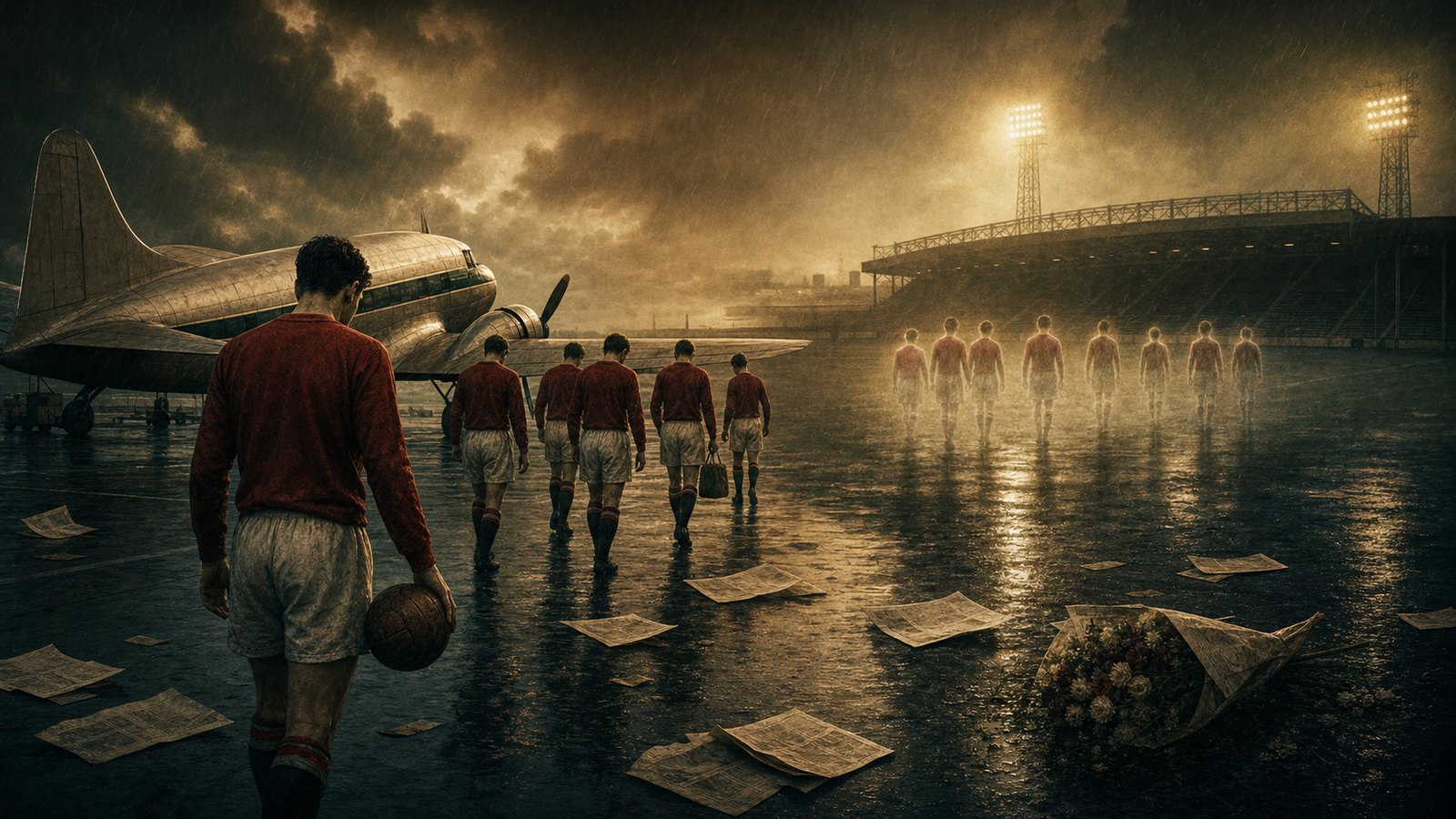
The European dream came before the tragedy
Manchester United’s Busby Babes are often remembered through the shadow of Munich, but the football mechanism was already radical before the runway at Riem became part of the club’s story. Matt Busby had pushed an English champion toward the European Cup when the Football League still treated continental competition as an irritation. The decision was not decorative. It changed travel, preparation, prestige and the way a domestic side imagined its ceiling.
The core was young because Busby’s system was young by design. Duncan Edwards, Bobby Charlton, Eddie Colman and others were not expensive ornaments fitted around an older team. They were proof that a club could use scouting, youth coaching and first-team trust as a single pipeline. In the 1956-57 European Cup United reached the semi-final, losing to Real Madrid, and that run made Europe feel like unfinished business rather than a foreign adventure.
A youth policy became a pressure policy
The Babes played with an energy that made the old English schedule look too small for them. League matches, European ties, travel delays and replay culture all pressed on a squad that was still learning how big it could become. Their power was not only in individual talent. It was in the speed with which Busby allowed talent to become responsibility. Players in their early twenties were carrying league titles, European ambition and a public idea of the future at the same time.
That is why the story cannot be reduced to a list of promising names. The method put young footballers into decisive spaces before conventional hierarchy said they were ready. It created wonder, but it also created a brutally exposed calendar. When United went to Belgrade in February 1958 and drew 3-3 with Red Star to reach another European Cup semi-final, the result belonged to the football project before it belonged to the disaster narrative.
Munich turned continuity into survival
The crash on 6 February 1958 killed twenty-three people, including eight United players. The numbers are stark enough without embellishment. They also explain why the next chapter was not a sentimental continuation. A team had to become a club survival operation. Busby was gravely injured. Jimmy Murphy, who had missed the trip because of Wales duties, had to hold together grief, fixtures and recruitment while the rest of England watched a football institution try to stand up.
The rebuilt side was not the same side with replacement parts. It carried fragments: Charlton survived; Bill Foulkes survived; the club memory remained. But the tactical and emotional problem changed. United had to prove that the European idea was not a pre-Munich luxury. The club still entered the FA Cup final that season, still played on, and still treated competition as a form of refusal.
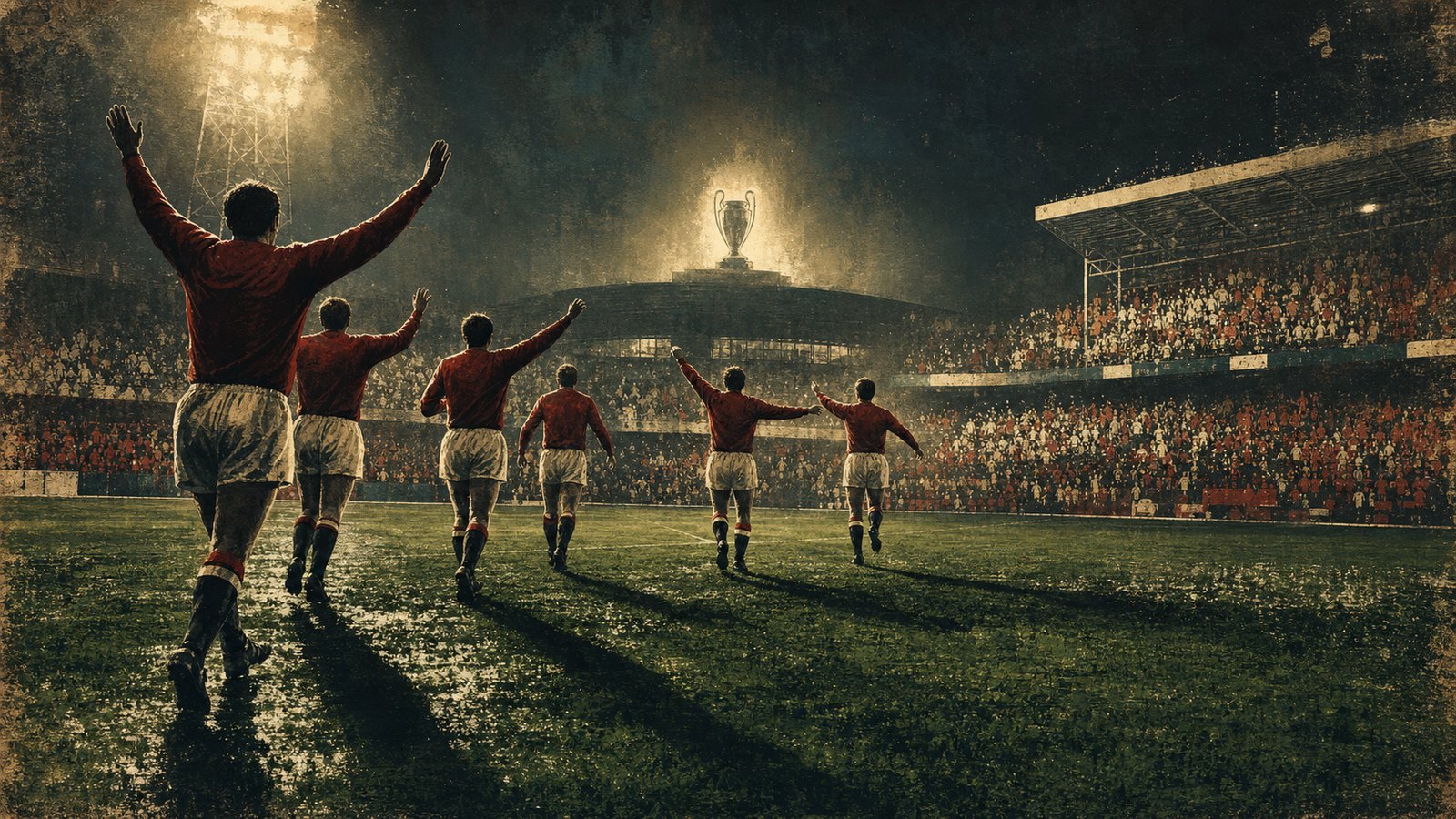
1968 was a completion, not a clean ending
When United won the European Cup at Wembley in 1968, the temptation is to close the story as destiny fulfilled. Football history is rarely that tidy. The final against Benfica arrived ten years after Munich, with Busby in charge, Charlton scoring twice, George Best bending the game with modern celebrity and Nobby Stiles giving the midfield its bite. It was a new side, not a resurrected old one, but the line between them was impossible to miss.
The victory mattered because it connected English club football to Europe through pain, persistence and institutional memory. United did not simply win a trophy. They made the European Cup part of an English club’s identity at a time when the competition was still forming its mythology. The club’s later obsession with European nights did not begin in television-era branding. It came from a decision to enter, a generation trusted too early, a catastrophe, and a refusal to let the continental ambition die.
The real lesson is about what a club protects
The Busby Babes story survives because it contains beauty and loss, but its football lesson is sharper than nostalgia. A club can build an idea powerful enough to outlive a team, yet that idea needs people, systems and stubborn continuity to survive trauma. Youth development by itself was not the miracle. European ambition by itself was not the miracle. The miracle was that both were treated as worth protecting when the easier path would have been retreat.
Seen this way, Munich is not an ending point and 1968 is not a simple happy ending. They are linked chapters in a question football still asks whenever clubs talk about philosophy. Is the philosophy just a slogan when the results hurt, or does the institution keep paying the cost? United’s answer, in that era, was written through selection sheets, hospital rooms, rebuilt squads and a European Cup lifted under Wembley lights.
Why England eventually followed the road United had taken
The broader English lesson took time to settle. In the mid-1950s, the European Cup was still new, and not every domestic authority understood that continental competition would become a measure of club greatness. United’s choice put practical strain on the side: travel by air, midweek fatigue, unfamiliar refereeing rhythms, and opponents who did not play like First Division teams. Those details sound routine now because European football has become a calendar machine. For Busby’s squad they were part of the experiment.
The club’s young players also changed the emotional contract with supporters. They were not distant stars bought fully formed from somewhere else. They looked like a future growing in public, which made the losses at Munich feel like family history as well as football history. That is one reason the later 1968 triumph landed with such force. It did not erase the names lost in 1958. It showed that the institution had kept faith with the European road those names had helped open.
Modern United mythology can sometimes flatten that into destiny, but the real sequence was made of choices. Busby chose Europe when it was inconvenient. The club chose continuity when grief made retreat understandable. A rebuilt team chose to carry an old ambition with new players. That is more interesting than fate because it gives the story a mechanism: identity survived because people kept acting as if the original idea still deserved the cost.
There is also a tactical-cultural edge to the story. United were learning that European ties could punish English assumptions about tempo, travel and status. Real Madrid did not just beat United in 1957; they showed the level of an established continental power. That defeat gave the young side a measuring stick. The Babes were not chasing Europe as tourists. They were learning how far an English champion had to move to compete with the best clubs on the continent.
Sources
- UEFA European Cup archive
- Manchester United club history
- BBC Munich air disaster archive
- David Meek and Tom Tyrrell, The Hamlyn Illustrated History of Manchester United