
Cameroon’s 1990 World Cup run is easy to remember as colour: the dancing, the green shirts, the shock on famous faces, Roger Milla by the corner flag. That memory is not wrong, but it is incomplete. The deeper importance of Cameroon in Italy was competitive. They forced the World Cup to stop treating African teams as atmosphere, novelty, or brave outsiders who might trouble one match before the tournament returned to its usual owners. Cameroon made the established powers deal with an African side as a genuine problem.
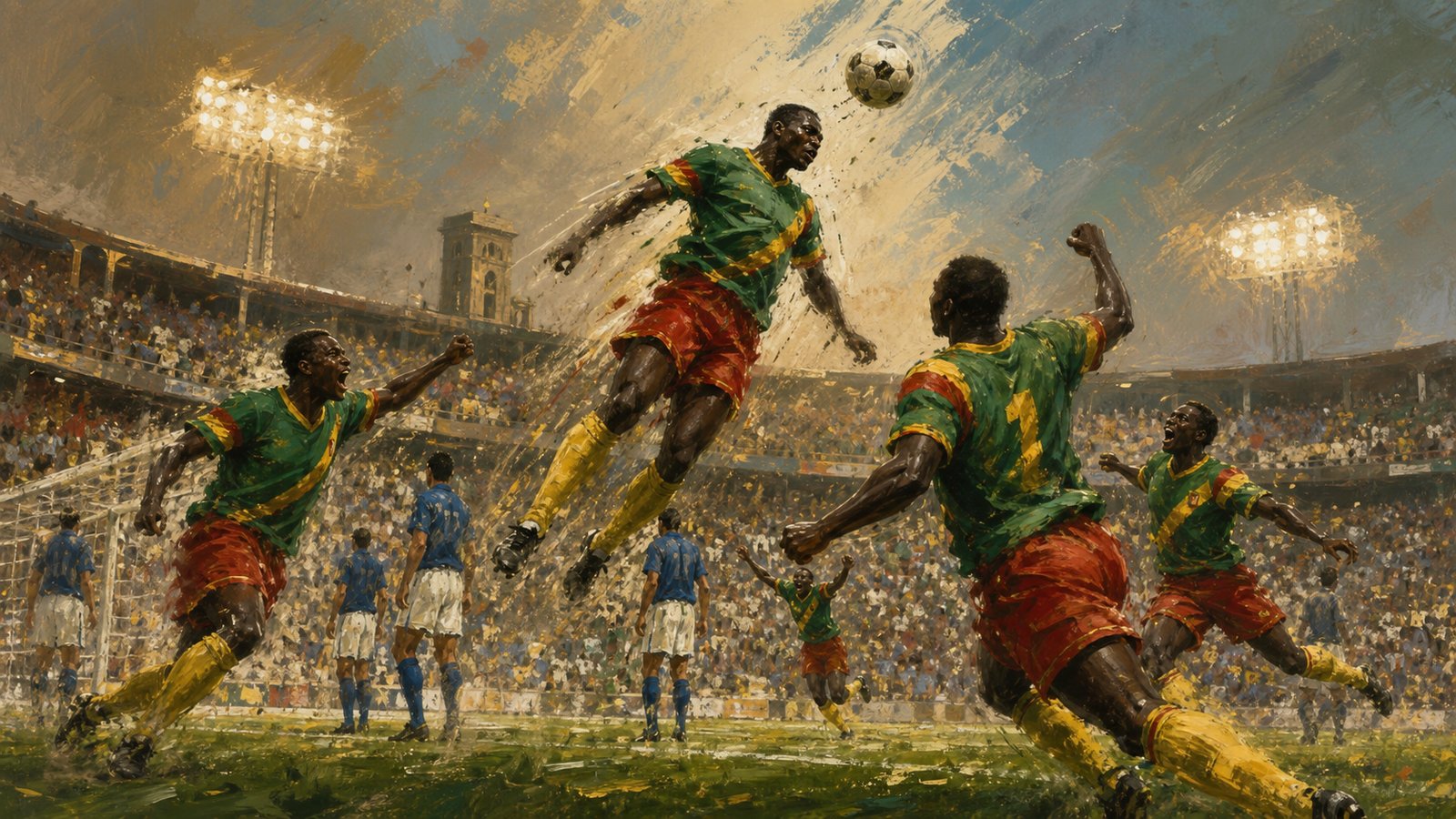
The opening match against Argentina gave the story its ignition. Argentina arrived as defending world champions, with Diego Maradona still the tournament’s central gravitational force. Cameroon arrived with a squad many viewers outside Africa knew only loosely. The match in Milan should have confirmed hierarchy. Instead, François Omam-Biyik’s second-half header beat Nery Pumpido, Cameroon won 1-0, and the tournament’s emotional map changed before most teams had played a minute.
The Argentina win was not a postcard upset
The famous scoreline can make the match sound like a lucky strike. It was rougher and more revealing than that. Cameroon had two players sent off, finished with nine men, and still protected the lead. The game was physical, tense, and messy, but that messiness is part of why it mattered. Cameroon did not charm Argentina into defeat. They competed with them, disrupted them, and lived through the pressure after taking the lead.
That distinction is important because African football had often been discussed through patronizing language: flair, raw talent, enthusiasm, unpredictability. Cameroon showed qualities that were harder to dismiss. Defensive stubbornness. Emotional courage. The ability to survive a match state that should have broken them. Once the defending champions had been beaten, every later opponent had to prepare for Cameroon as more than a story.
Milla changed the tournament’s temperature
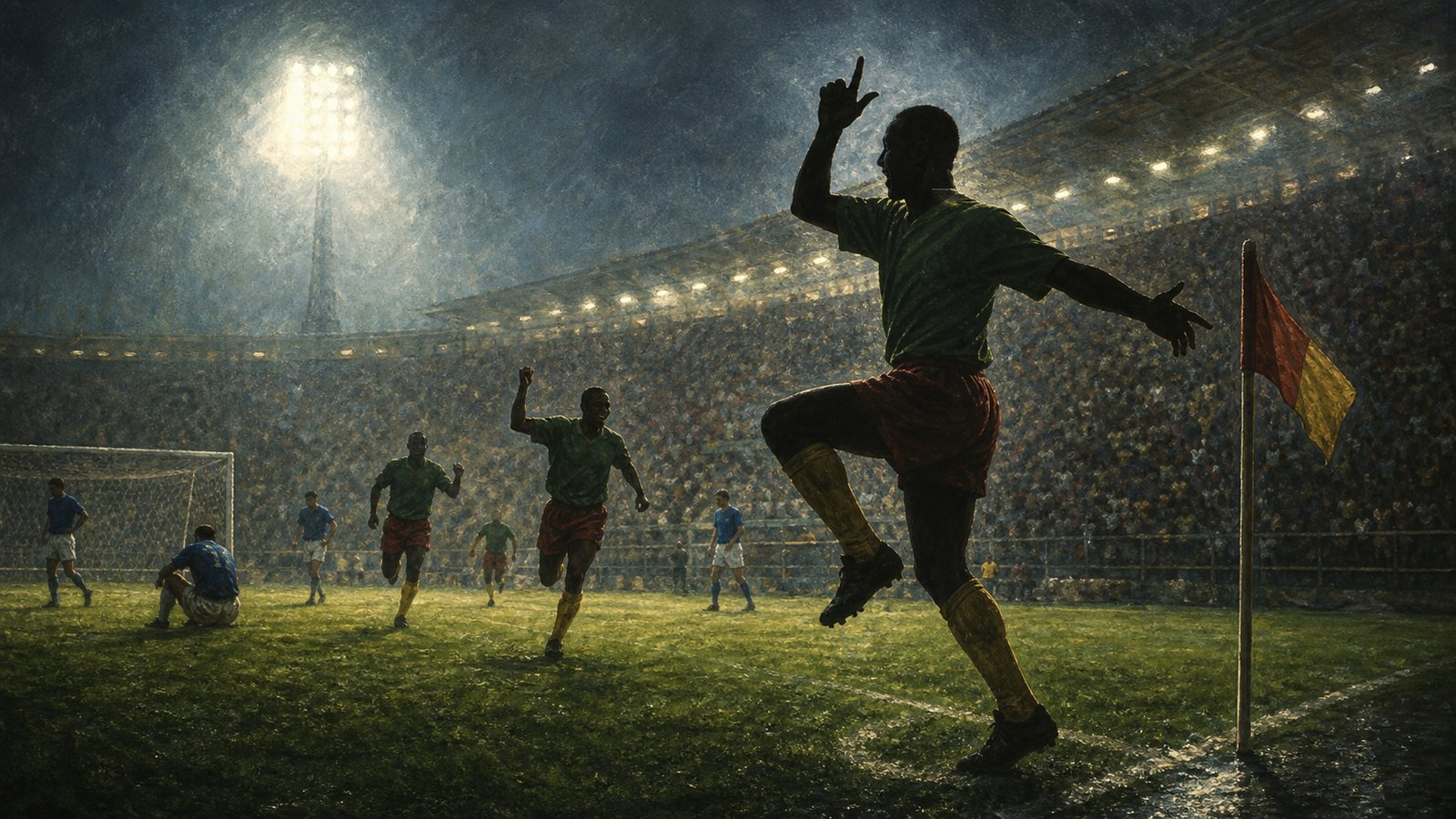
Roger Milla became the face of the run, and not only because of the goals. At thirty-eight, returning to the national team, he looked like a player entering the tournament from a different narrative. His celebrations near the corner flag turned into one of the World Cup’s most replayed images. But Milla’s importance was not merely theatrical. He gave Cameroon an attacking release point, a finisher’s timing, and a kind of joyful menace that made tired defenders feel the crowd leaning toward him before he touched the ball.
Against Romania, Milla came from the bench and scored twice in a 2-1 win. Those goals helped Cameroon reach the knockout phase and deepened the sense that the tournament had acquired a figure nobody had planned for. His movement was not based on running past everyone for ninety minutes. It was based on knowing when the defender’s concentration had dipped, when the loose ball might appear, when one touch could turn a crowded penalty area into a private stage.
The style had steel under the joy
Because the celebrations were so memorable, the team’s hardness can get flattened into folklore. Cameroon were not just expressive. They were confrontational, organized in bursts, and willing to make opponents uncomfortable. They could play with directness, challenge aerially, and turn broken passages into chances. The football was not a polished possession machine. It was a tournament weapon built from athletic duels, emotional conviction, and enough attacking quality to punish the moment opponents relaxed.
That made them difficult to categorize. Established teams often prefer outsiders who fit a familiar script: either technically naive and open, or defensive and limited. Cameroon were neither in a simple way. They could be chaotic, but not harmless. They could defend deep, but not meekly. They could celebrate with visible freedom, then compete in the next duel with a severity that made the celebration feel like another form of pressure.
The Colombia match turned myth into momentum
The round-of-16 match against Colombia gave Milla his most famous sequence. In extra time, he scored twice, including the goal where he dispossessed René Higuita far from goal and finished into an exposed net. That moment became a global image because it was funny, ruthless, and tactically revealing all at once. Higuita’s adventurous goalkeeping belonged to Colombia’s own football imagination, but Cameroon punished the risk with perfect clarity.
The win took Cameroon to the quarter-finals, the first African team to reach that stage at a World Cup. That milestone matters because it changed what future African sides were measured against. Before 1990, a good performance could be praised as promise. After 1990, the continent had a visible benchmark: not just a brave group-stage run, but a place among the final eight and a genuine chance to go further.
England found out how close the door had opened
The quarter-final against England is sometimes remembered as the moment Cameroon nearly went through the door completely. They led 2-1 in the second half, with Eugène Ekéké scoring after a move that made England look suddenly vulnerable. Gary Lineker’s penalties eventually pulled England through 3-2 after extra time, but the match did not restore old certainty. It showed how close Cameroon had come to a World Cup semi-final.
That closeness matters more than a simple defeat would suggest. England were not facing a symbolic guest. They were escaping a side with enough quality, belief, and tactical disruption to put them on the edge. The penalties were not proof that Cameroon had been exposed as pretenders. They were proof that the run had reached the thin margins where history changes direction by one tackle, one late run, one decision inside the box.
The legacy was not instant equality
Cameroon’s run did not suddenly make African football equal in resources, representation, or structural power. European clubs still controlled much of the money. African federations still faced administrative challenges, talent drain, and uneven preparation conditions. The global game did not reorganize itself overnight because one team reached a quarter-final. But memory changed, and memory is not trivial in football. It shapes scouting, fear, expectation, and the stories players carry into tournaments.
The run also complicated how African players were viewed by clubs and media. The idea that the continent produced only raw athletic talent became harder to sustain when Cameroon had beaten Argentina, managed knockout pressure, and pushed England to extra time. The tournament gave names, images, and competitive evidence to something African football insiders already knew: the continent was not waiting to be discovered. It was waiting to be taken seriously on its own terms.
Joy was part of the competitive message
The dancing near the corner flag should not be separated from the football. It mattered because it claimed space in a tournament usually choreographed by traditional powers. Milla’s celebration said that Cameroon were not borrowing someone else’s stage manners. They were bringing their own. That was cultural, but it was also tactical in the broadest sense. It changed the emotional atmosphere around the team and made opponents feel that the story was slipping away from the expected script.
That is why Cameroon 1990 still feels alive. The team did not win the World Cup, but they altered the competition’s imagination. They made African success feel less like a charming exception and more like a threat that could return. Future runs by Senegal, Ghana, Morocco, and others would each have their own shape, but Cameroon helped make the idea visible first in the modern television era.
The best way to remember the run is not as a fairy tale, because fairy tales can sound detached from work. Cameroon fought, tackled, argued, scored, celebrated, and survived. They opened a door that had been treated as decoration and made the tournament look through it. Once that happened, the World Cup could never quite pretend the room was the same.
Sources
FIFA World Cup archive; RSSSF 1990 World Cup records; CAF historical summaries; contemporary tournament reports; African football oral histories.