
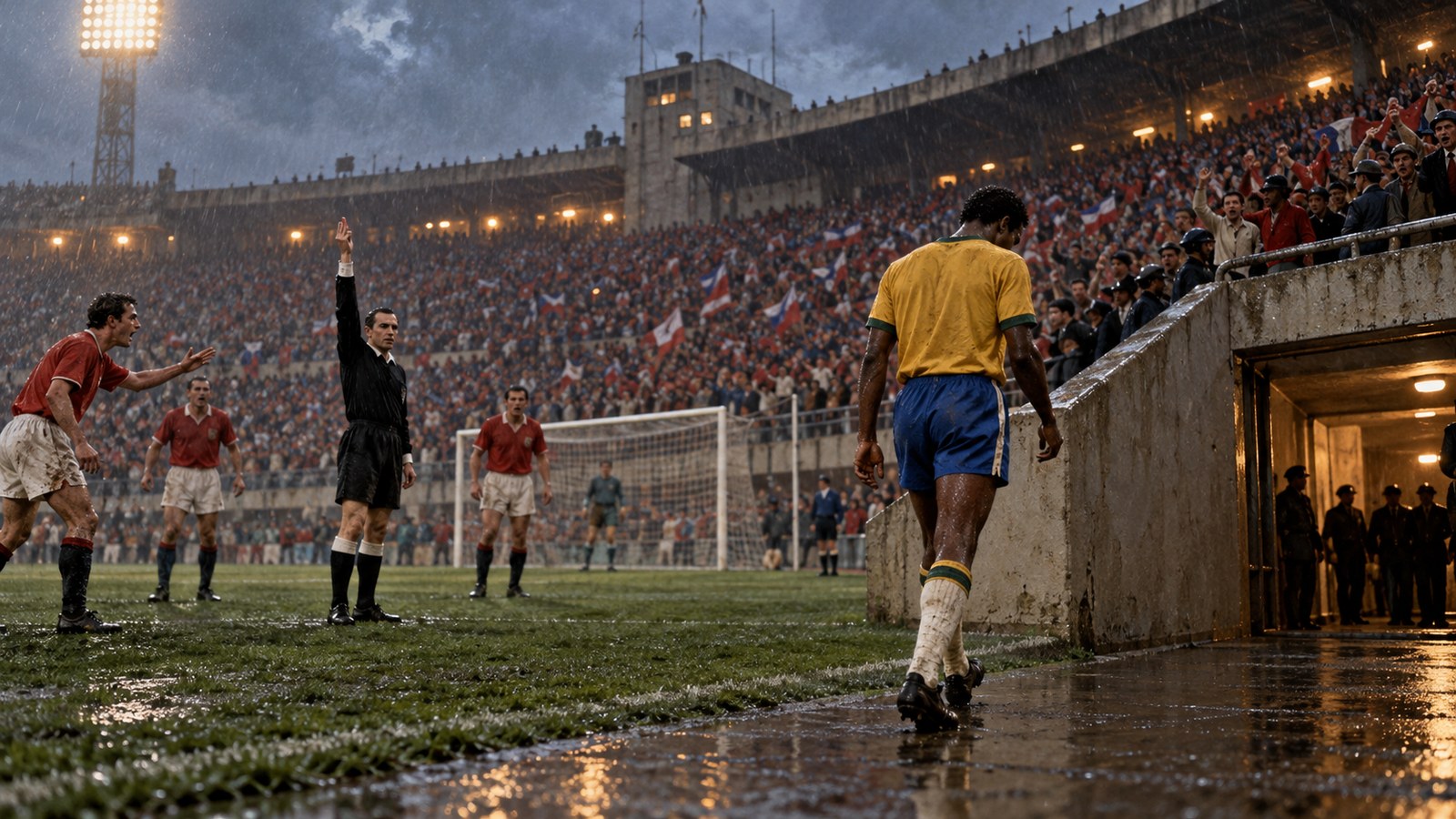
With seven minutes left in Brazil’s World Cup semi-final against Chile, Garrincha walked off the Estadio Nacional pitch after referee Arturo Yamasaki sent him off. He had already scored twice. Brazil led 4–2. The holders were close to another final, yet the player who had carried their attack there was suddenly not certain to join them.
The dismissal created a problem that the score could not settle. In 1962, a sending-off did not automatically produce a one-match suspension. A disciplinary committee still had to decide the sanction. The Uruguayan linesman who reported Garrincha’s kick was the obvious witness, but he left Chile before the hearing and did not appear.
Brazil therefore spent the day before the final defending their winger’s eligibility. Garrincha received a warning rather than a ban, played against Czechoslovakia with a fever, and finished the tournament as a champion and joint leading scorer. His week in Santiago joined two different kinds of suspense: first whether Chile could stop him on the field, then whether football’s administrators would stop him outside it.
Pelé’s injury moved the attack onto Garrincha’s wing
Brazil arrived in Chile as defending champions. The side still carried the structure that had won in Sweden four years earlier, when Garrincha’s right-wing play had helped make the 1958 team’s 4–2–4 dangerous rather than merely symmetrical. The 1962 campaign changed after the second group match, a goalless draw with Czechoslovakia, when Pelé was injured and ruled out for the remainder of the tournament.
Amarildo replaced Pelé, but replacement did not mean imitation. Brazil now needed chances to begin elsewhere. Against Spain in the final group game, Amarildo scored both goals in a 2–1 win. Garrincha supplied the second after beating defenders on the right and crossing. The move showed how the attack could be redirected without becoming static.
The quarter-final against England made that adjustment visible on the scoreboard. Garrincha headed Brazil ahead from a corner. After England equalised, his free kick led to Vavá’s goal, and then the winger scored again with a curling shot from outside the area. Brazil won 3–1. A player famous for dribbling had decided a knockout match with a header, a dead-ball delivery and a long-range finish.
Those actions mattered to the disciplinary question that followed. Garrincha was not a decorative extra Brazil could easily omit. He had become the attack’s most productive route through the tournament.
The route had also been economical. Brazil scored four times across the three group matches, then three against England. Before the semi-final began, Garrincha had participated in the move that beat Spain and in all three quarter-final goals. His influence was concentrated in the actions that changed elimination matches, rather than spread across harmless possession. Chile therefore had to defend a winger who was arriving with both rhythm and responsibility.
Two semi-final goals put the hosts under pressure
Chile had reached the semi-final by beating the Soviet Union 2–1. The hosts brought a full Estadio Nacional and a tournament already marked by confrontational football. Earlier in the competition, the Battle of Santiago had shown how quickly provocation, retaliation and weak control could overwhelm a match.
Garrincha struck first against Chile after nine minutes, driving a left-footed shot from distance. Vavá made it 2–0, but Jorge Toro reduced the margin before half-time. The semi-final had not escaped the hosts. Garrincha restored the two-goal advantage with a header in the 32nd minute, giving him four goals across Brazil’s two knockout matches.
Leonel Sánchez converted a penalty after the interval. Vavá then scored Brazil’s fourth. At 4–2, Chile needed two goals merely to force extra time, while Brazil could begin measuring the remaining minutes. That was when the match produced the incident that outlived its final goal.
Garrincha had been repeatedly challenged. In the 83rd minute he retaliated by kicking Chilean defender Eladio Rojas. Referee Arturo Yamasaki did not see the act directly; Uruguayan linesman Esteban Marino drew his attention to it. The referee sent Garrincha off. A bottle struck the Brazilian as he left the field, adding one more burst of disorder to a tournament that had already recorded several dismissals.
The dismissal did not carry an automatic final ban
Modern viewers often read a dismissal and a suspension as one event. The 1962 regulations left a gap between them. Dismissal removed Garrincha from the semi-final, but a FIFA disciplinary committee had to determine whether he would be barred from the final three days later.
That distinction shifted the contest from the pitch to testimony. Marino had supplied the information that caused the referee to act. His account could have established what happened and how the committee should treat it. Instead, the linesman departed Chile and did not attend the hearing. The committee considered a case whose principal eyewitness was absent.
Brazil argued that Garrincha had reacted after sustained provocation. That did not erase the kick, but it gave the committee a context for choosing the penalty. The winger was formally warned and allowed to play. Claims later grew around political influence and pressure on Marino, but the durable procedural facts are narrower: there was no automatic one-match ban, the reporting linesman did not testify, and the committee declined to suspend Garrincha.
The outcome exposed how differently identical acts could travel through a competition. The sending-off looked decisive in the stadium. Its consequence remained negotiable until administrators met, reviewed incomplete evidence and selected a sanction.
Czechoslovakia faced the player the semi-final had removed
The final returned Brazil to the opponent from the match in which Pelé had been injured. Czechoslovakia took the lead after 15 minutes through Josef Masopust. Amarildo equalised two minutes later, then Zito and Vavá scored in the second half to complete a 3–1 victory.
Garrincha played despite a high fever. He did not score, but his presence forced Czechoslovakia to account for the right flank that had broken England and Chile. Brazil had already proved it could survive losing Pelé. The committee’s decision meant it did not have to redesign the side again on the morning of the final.
The tournament’s scoring table finished in a six-way tie on four goals. Garrincha shared the lead with Vavá, Flórián Albert, Valentin Ivanov, Dražan Jerković and Leonel Sánchez. His total had been accumulated in two knockout matches, precisely when Brazil’s route had narrowed and Pelé was unavailable.
Brazil became the second nation to retain the World Cup, after Italy in 1938. The achievement also belongs in the longer line from the 1962 side to the sweeping team goal Carlos Alberto finished in 1970. Yet Garrincha’s final appearance came through a less elegant route: a dismissal, a missing witness and a committee ruling between the semi-final and the trophy.
The tournament left two records of the same player
The match reports preserve Garrincha as both creator and offender. Against England and Chile he scored four goals, made another, and attacked with a range that defeated simple marking. Against Chile he also retaliated and was dismissed. Removing either record produces a cleaner story than the tournament itself.
The hearing added a third record: eligibility. Brazil’s best attacking player was available because suspension required a separate judgment and because the decisive witness was absent. That does not make the final illegitimate, nor does it make the committee’s choice transparent. It shows that tournament history is shaped by regulations and evidence as well as by shots and dribbles.
When Brazil lifted the trophy on 17 June, Garrincha had crossed every boundary the week offered. He went from right wing to central scorer, from the pitch to the disciplinary room’s paperwork, and from dismissal back into the starting side. The strange route explains why his 1962 World Cup cannot be reduced to a highlight reel. His greatest tournament turned on whether football would let its most dangerous player return.
Sources
FIFA World Cup match records; RSSSF 1962 World Cup archive; Encyclopaedia Britannica; contemporary tournament accounts collected in the Garrincha and 1962 FIFA World Cup historical records.