

The argument that changed English football began with a cup tie, a complaint and a rule that no longer described what clubs were doing. Preston North End beat Upton Park in 1884, but the losing side objected to the presence of paid players in Preston’s team. The protest reached far beyond one result. It forced the Football Association to decide whether it could continue policing an amateur ideal while ambitious northern clubs recruited working men, found them jobs and quietly compensated them for playing.
Preston withdrew from the FA Cup rather than accept the ruling. Burnley and Great Lever followed, while more than 30 clubs threatened to form a rival governing body. Within roughly 18 months, the FA had changed course. Professional football became legal in England in July 1885—not because everyone suddenly agreed about wages, but because prohibition had become harder to control than regulation.

The Amateur Rule Met the Industrial Town
When the FA codified association football in 1863, its leading culture came from public schools and clubs shaped by them. Amateurism was treated as a moral principle: the gentleman played for the game itself, not for pay. Yet football’s social base expanded quickly. Factory towns in Lancashire and the Midlands supplied large crowds, competitive clubs and players who could not afford to lose wages whenever training or travel took them away from work.
The 1883 FA Cup final made that shift visible. Blackburn Olympic, a side largely composed of factory workers, defeated Old Etonians and became the first working-class team to win the competition. The result did not create professionalism, but it exposed the weakness of pretending that elite football remained a leisure pursuit. Northern clubs were already arranging employment and supplementary payments. Some jobs were real; others were convenient labels for football income.
The problem was not simply that money had entered the game. It was that money operated through concealment. A player might be recruited from Scotland, placed on a mill’s books and allowed time to train. Another might receive expenses that looked suspiciously like a wage. Clubs that obeyed the rule strictly risked losing players, while clubs that bent it could claim they had merely hired good workers who also happened to play football.
William Sudell Built Preston Through Work and Football
William Sudell sat at the centre of that blurred world. He joined Preston’s sporting club as a teenager in 1867 and eventually became its chairman. The organisation experimented with several sports before concentrating on football in 1880. Sudell then looked north for talent, recruiting Scottish players and attaching nominal jobs at the cotton mill he managed.
That method offered more than a hidden payment. It gave a player a reason to move, a regular income and enough flexibility to practise with the team. Preston could assemble ability from outside its immediate neighbourhood while maintaining the appearance of an amateur club. Supporters saw a stronger side; opponents saw a financial advantage that the written rules refused to recognise.
Scottish footballers who moved south for paid opportunities became known as the “Scotch Professors.” Their passing and experience helped northern English clubs raise standards, but their presence also sharpened the dispute. The Scottish Football Association kept its own ban after England changed course, and players based in England could lose access to the Scotland team. A recruitment decision therefore carried consequences across employment, club competition and international selection.
One Protest Threatened to Split the FA
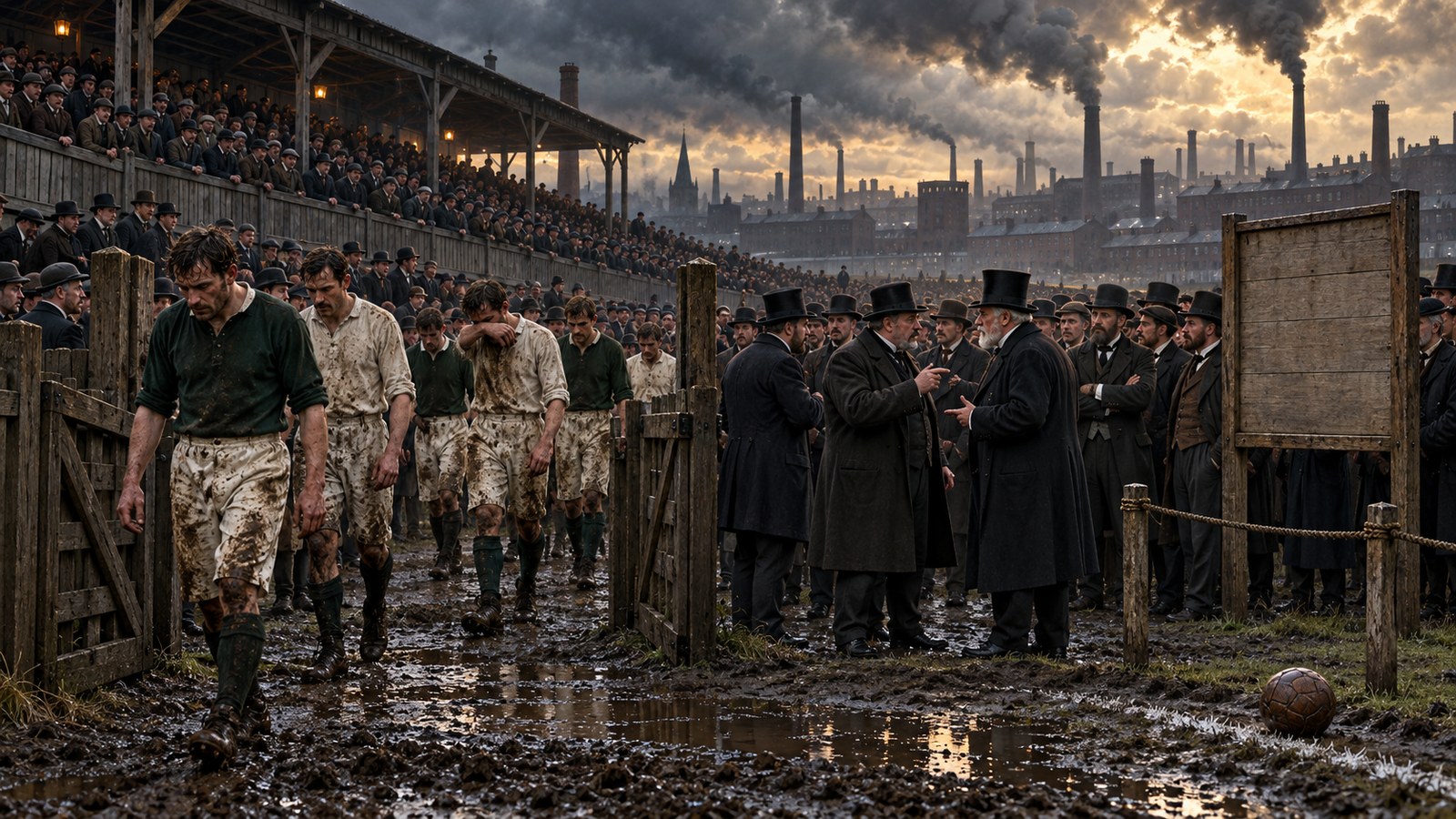
The confrontation arrived after Preston defeated Upton Park in the FA Cup in 1884. Upton Park challenged the result on the ground that Preston had used professionals. This was not an abstract complaint about football’s direction; it asked the FA to apply its rule to a particular match and remove a successful club from the competition.
Preston withdrew from the cup. Burnley and Great Lever followed, turning one disciplinary dispute into collective resistance. More than 30 clubs, predominantly from the north, indicated that they were prepared to establish a rival British Football Association if the existing FA would not permit professionalism.
That threat changed the balance of risk. Enforcing amateurism might satisfy clubs that regarded payment as corrupting, but it could also drive much of competitive northern football outside the FA. A breakaway would have divided fixtures, cups, rules and authority. The governing body had to weigh an ideal against its ability to govern the clubs that attracted players and crowds.
The pressure was different from a demand for unlimited spending. Northern clubs wanted the activity acknowledged so that all sides operated under a visible rule. Once payment was legal, the FA could define who counted as a professional and impose conditions. Continued prohibition left enforcement dependent on discovering whether a mill job, expense payment or transfer arrangement was genuine.
July 1885 Replaced Secrecy With a Category
The FA formally legalised professionalism in July 1885. The decision did not erase amateur football, nor did it instantly produce the modern transfer market. It created a recognised category inside the association’s structure. Clubs could employ footballers without disguising every payment as something else, while the governing body retained authority over competitions and eligibility.
Early restrictions showed how cautious the settlement remained. The FA initially used residency rules to limit recruitment, an attempt to prevent richer clubs from simply drawing talent across the country. Those restrictions disappeared by 1889. Meanwhile, the Scottish association continued to prohibit payment, sustaining the cross-border tension that had helped English clubs strengthen their squads.
Legalisation also changed the meaning of football labour. A working man’s skill could now be treated openly as work, even though wages and conditions remained tightly controlled. Clubs acquired clearer obligations and players acquired a named status. The compromise was imperfect, but it moved the argument from whether payment existed to how organised football would regulate it.
This is where the 1884 protest matters most. Upton Park’s complaint was intended to enforce amateurism. Instead, the chain reaction demonstrated that the rule could fracture the institution responsible for it. Preston’s withdrawal and the threatened breakaway supplied leverage that individual covert payments never could.

The League Revealed What the Settlement Enabled
Three years after legalisation, Preston became one of the 12 founding members of the Football League. The first season opened on 8 September 1888, with each club playing the others home and away. A late decision awarded two points for a win and one for a draw. What had been a landscape of cups and arranged fixtures now had a sustained competition built for clubs capable of fielding strong teams across a full campaign.
Preston finished the 22-match league season unbeaten. John Goodall led the competition with 21 goals, and the club also won the FA Cup without conceding. The first league champions therefore completed English football’s first league-and-cup Double. Their “Invincibles” season was sporting proof of the organisation Sudell had assembled under the old conflict and the new rules.
The victory did not make every part of Sudell’s model defensible. His career ended in disgrace in 1895 after he was convicted of diverting mill funds to the club, receiving a three-year prison sentence. That later crime belongs in the story because it shows that legalising player wages did not remove the need for financial oversight. Transparent employment and honest accounting were separate problems.
Preston’s role also links two different eras of cup history. The club helped force the argument over who could be paid to compete, while the competition itself later faced other practical crises, including the theft of its original trophy from a Birmingham shop window in 1895. Football’s institutions survived by replacing what no longer worked: an unenforceable labour rule in one case, a vanished cup in the other.
The Scottish recruits were equally central to the transformation. Their movement into Lancashire foreshadowed the career path explored in the story of Fergus Suter, the stonemason who won three FA Cups with Blackburn. Players crossed borders because clubs could offer opportunities that the amateur framework could not honestly explain.
The decisive act of 1885 was not a celebration of money. It was an admission that football had already become skilled labour, public entertainment and local business. Once the FA accepted that reality, it preserved a single governing structure and opened the route to league competition. The protest after one cup tie had exposed a national contradiction; the settlement allowed the game to grow without pretending its best players were never paid.
Sources
- FIFA, History of Football — The Global Growth
- Professionalism in Association Football
- William Sudell
- Preston North End F.C.
- 1888–89 Football League