
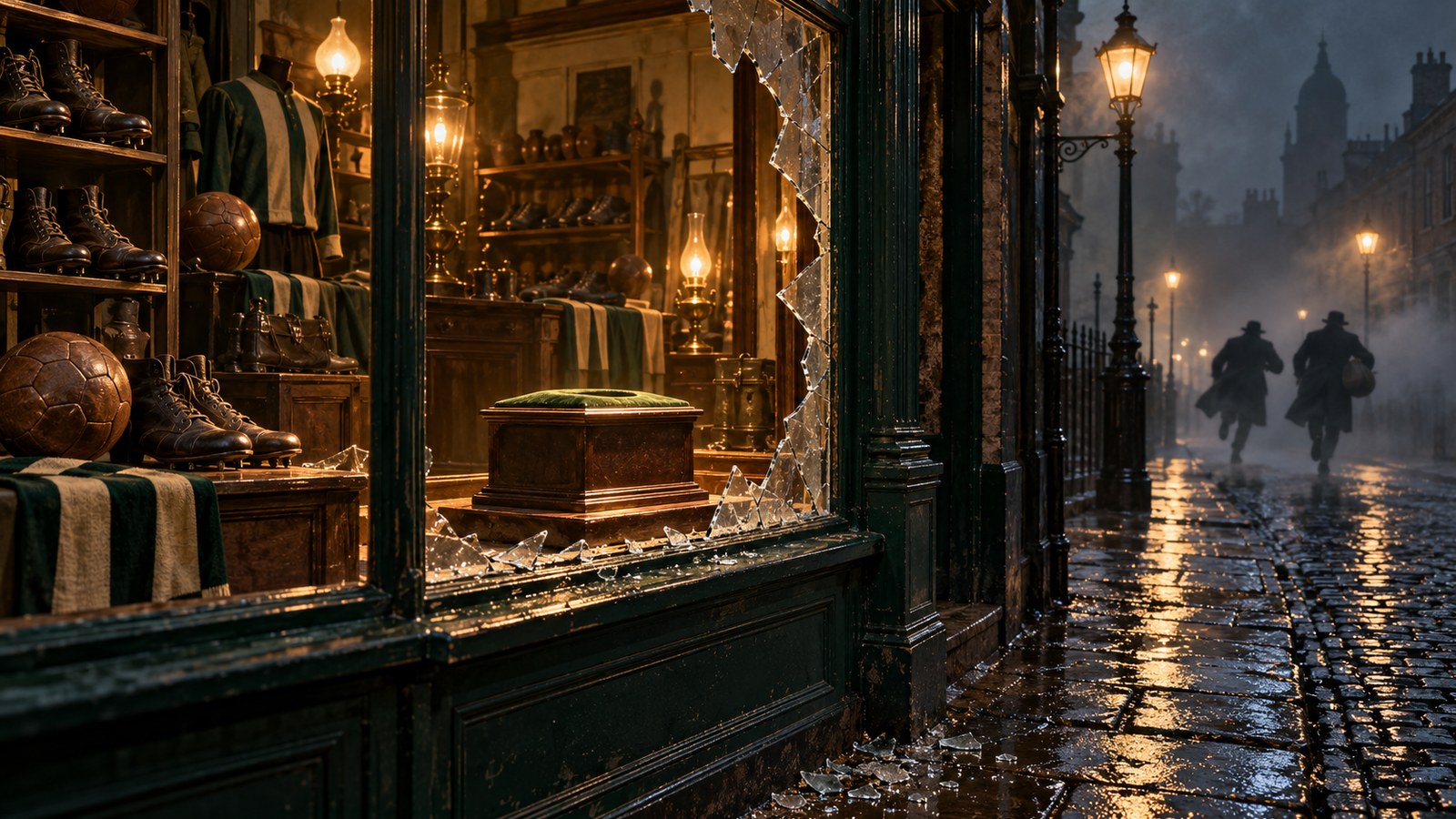
At some point during the night of 11 September 1895, the most famous object in English football ceased to be a prize and became evidence. Aston Villa had won the FA Cup five months earlier. The trophy was sitting in the window of William Shillcock’s shop in Birmingham, close enough to the street for supporters to admire the silver reward. By morning, it was gone.
The theft left no victorious photograph, no chase and no recovered cup. It left a broken display, a reward notice and a problem for a competition still young enough to lose its central symbol. The cup lifted at Wembley today is therefore not the first FA Cup, or even the second physical version of its design. Its family tree begins with a small Victorian trophy that vanished while the holders were displaying it.

The Cup Was Small Enough to Fit in a Shop Window
The first trophy did not have the scale of the modern cup. Made by Martin, Hall & Co for £20, it stood about 18 inches high and soon acquired the nickname “the little tin idol.” The description made it sound cheap, but its importance came from repetition. Each spring, the same object moved from one winning club to the next. Players, officials and supporters could connect a new final to every earlier final through a piece of silver they could actually see.
That ritual began with the competition’s first edition in 1871–72. By 1895 the cup had accumulated more than two decades of handling, travel and celebration. It belonged to the Football Association, yet spent the year in the custody of the champions. Security depended less on a permanent museum case than on the care taken by whichever club had most recently won it.
Aston Villa earned that responsibility on 20 April 1895. Bob Chatt scored after roughly 30 seconds against West Bromwich Albion at Crystal Palace, and Villa protected the lead for a 1–0 victory. It was the club’s second FA Cup success. The trophy returned to Birmingham, where a local display allowed the public to share in the achievement rather than leaving the prize hidden inside club offices.
A Celebration Display Became a Crime Scene
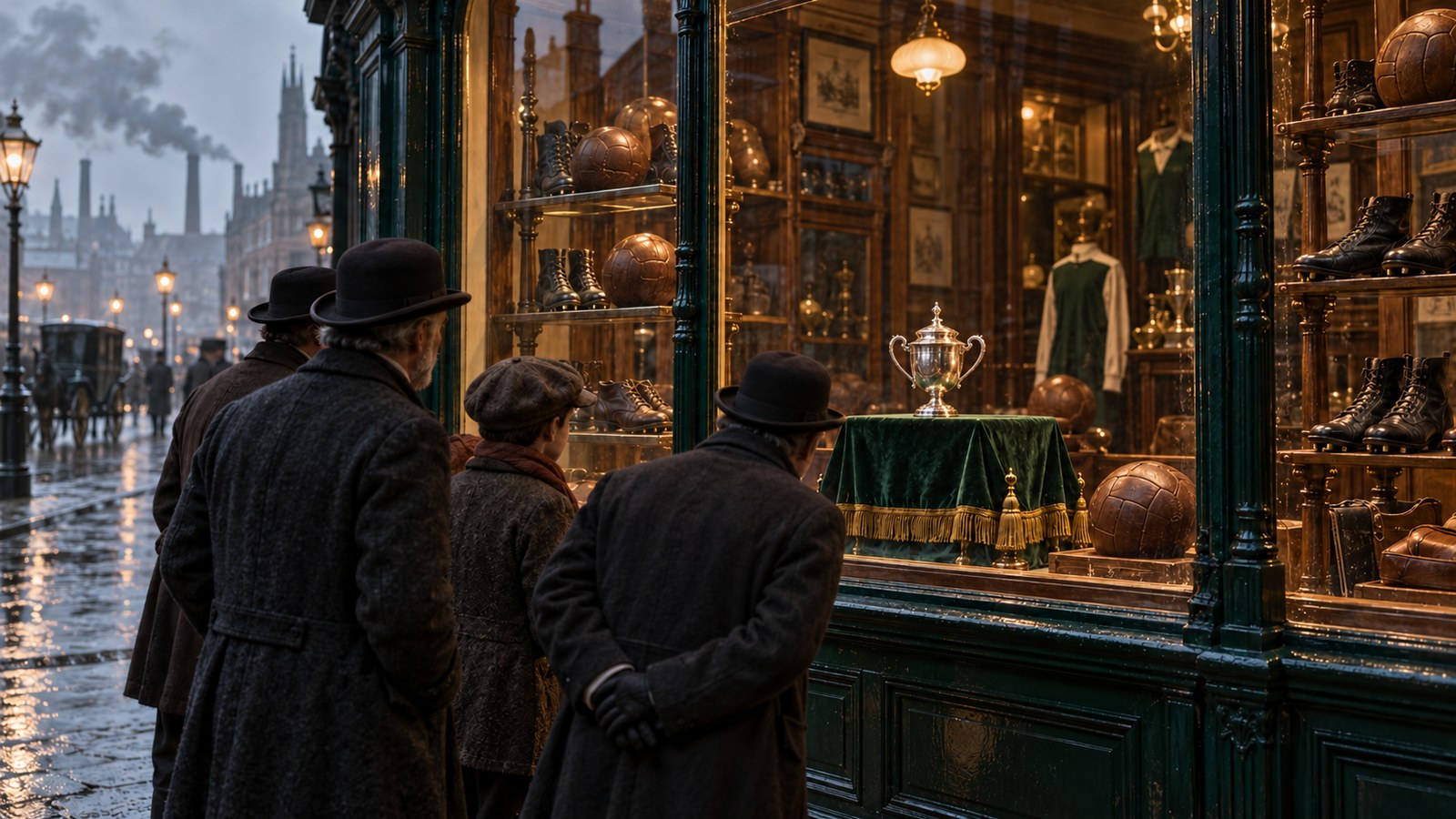
William Shillcock’s premises sold sporting goods and footwear. The cup was placed in the window as a civic attraction: Villa’s silver, won against a nearby rival, presented to the city at street level. On the night of 11 September, burglars entered the shop and removed it. Contemporary memory fixed on the missing trophy, though later accounts also mentioned stolen boots and other goods.
The physical contrast is the part that gives the story its force. A football competition could command a crowd at Crystal Palace, yet its defining object was guarded by ordinary glass, timber and a shop door. The cup’s portability had made the annual handover meaningful. It also made theft possible. There was no ceremonial replica for display and no original locked permanently away elsewhere.
A £10 reward was offered for information. The trophy did not return. Nobody was arrested or charged, and no reliable trail carried the police from the shop to the cup. Football had a winner for the 1894–95 season but no silver object to pass to the next one. Unlike the later story of Pickles finding the World Cup beneath a hedge, this missing trophy never received a public recovery scene.
Aston Villa Paid for the Missing Silver
Because the cup had disappeared while in Villa’s care, the Football Association fined the club £25. The figure exceeded the original trophy’s £20 manufacture cost. It turned custody into a financial obligation: the champions had not merely lost their own keepsake but an object that had to be available for the competition itself.
An exact replacement was produced. From a distance, the ritual could continue unchanged. The next winners could raise a cup in the same shape, and photographs would preserve the familiar outline. Yet the historical chain had been broken. The silver carried forward from 1896 was a Victorian duplicate, not the cup Wanderers first won in 1872.
The replacement remained in use through 1910. That lifespan was longer than the service of the stolen original, which makes the phrase “first FA Cup” surprisingly slippery. It can mean the first competition, the first trophy design, the missing 1871 object or the 1895 copy that completed the design’s working life. The theft created those distinctions in a single night.
When the smaller design was retired, the replacement was presented to Lord Kinnaird, the long-serving Football Association president and a major figure in the early finals. It survived in private hands and later appeared at auction. The stolen original, by contrast, remained valuable mainly because it was absent.
A Confession Arrived More Than Sixty Years Late
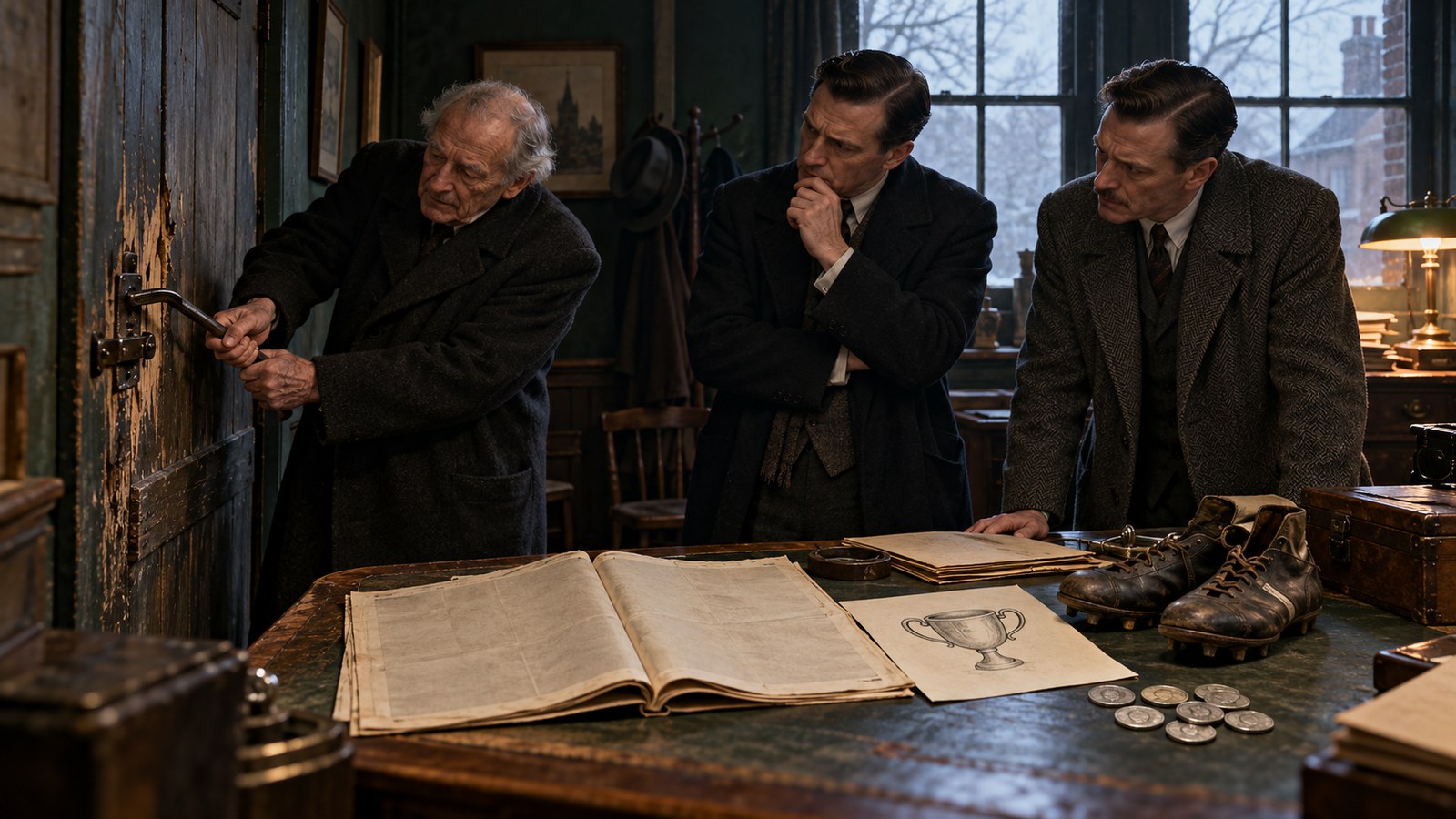
In February 1958, the Sunday Pictorial published a confession from 80-year-old Henry “Harry” James Burge. He said that he and two other men had broken into Shillcock’s shop, taken the trophy and melted it down to make counterfeit half-crowns. Burge even posed to demonstrate how the rear door had allegedly been forced with a small crowbar.
The account supplied everything a cold mystery seemed to need: a named burglar, accomplices, a method and an explanation for why the silver could never be recovered. It also arrived in a newspaper more than six decades after the event. Detectives compared Burge’s version with a contemporary Birmingham Post report and found discrepancies, including differences over entry and what had been taken.
No prosecution followed. Burge’s melting story remains the most vivid proposed ending, not a legally established solution. The distinction matters because repetition can turn a late claim into apparent fact. The secure history ends with the shop, the missing cup, the reward and the failed recovery. What happened to the metal afterwards is still an allegation.
That uncertainty separates the theft from football’s usual lost-object tales. A ball can surface in an attic; a medal can be identified at auction. If Burge was right, the trophy stopped existing as a trophy on the same night it disappeared. If he was wrong, the little tin idol might have survived for years without anyone recognising where it had gone.
The Replacement Created a Line of Successor Cups
The familiar modern design arrived in 1911. Fattorini & Sons of Bradford made the larger trophy, and Bradford City became its first winners after a replay against Newcastle United. The coincidence tied manufacturer and champion to the same city, while the new shape ended the working life of the little tin idol design.
That 1911 cup was itself retired from annual use in 1992 to protect it from wear. A replica took over, then a heavier hand-crafted version was introduced for the 2014 final after two decades of increasingly demanding handling and publicity. The object seen in current celebrations is built to endure a world of open-top buses, sponsor events, television close-ups and constant lifting that the first custodians could hardly have imagined.
Yet the principle remains recognisably Victorian. One physical cup carries memory from winner to winner. Its public life is part of its meaning. The competition could keep the original permanently behind controlled glass and hand champions a disposable token, but that would weaken the visible chain connecting seasons.
The 1895 theft explains the risk inside that choice. Football wants its symbols close to players and supporters, where they can be touched, displayed and photographed. The first Wembley final’s crowd control crisis showed the same tension on a far larger scale: public access produces the atmosphere that makes an occasion memorable, while also creating practical dangers that organisers must learn to manage.
Aston Villa’s missing cup is therefore more than an unsolved burglary. It is the moment English football discovered that tradition could not be secured by sentiment alone. The competition replaced the silver, preserved the ceremony and eventually built stronger layers of custody around its trophies. What it could not replace was the exact object that had absorbed every final from 1872 to 1895. The annual ritual survived. Its first witness did not.
Sources
- BBC News, “FA Cup reborn for 2014 final as new trophy is cast”
- Birmingham Mail, “Unsolved: Did this OAP really steal the famous FA Cup?”
- The Football Association, FA Cup history
- The Independent, report on the 1895 replica’s 2020 auction