
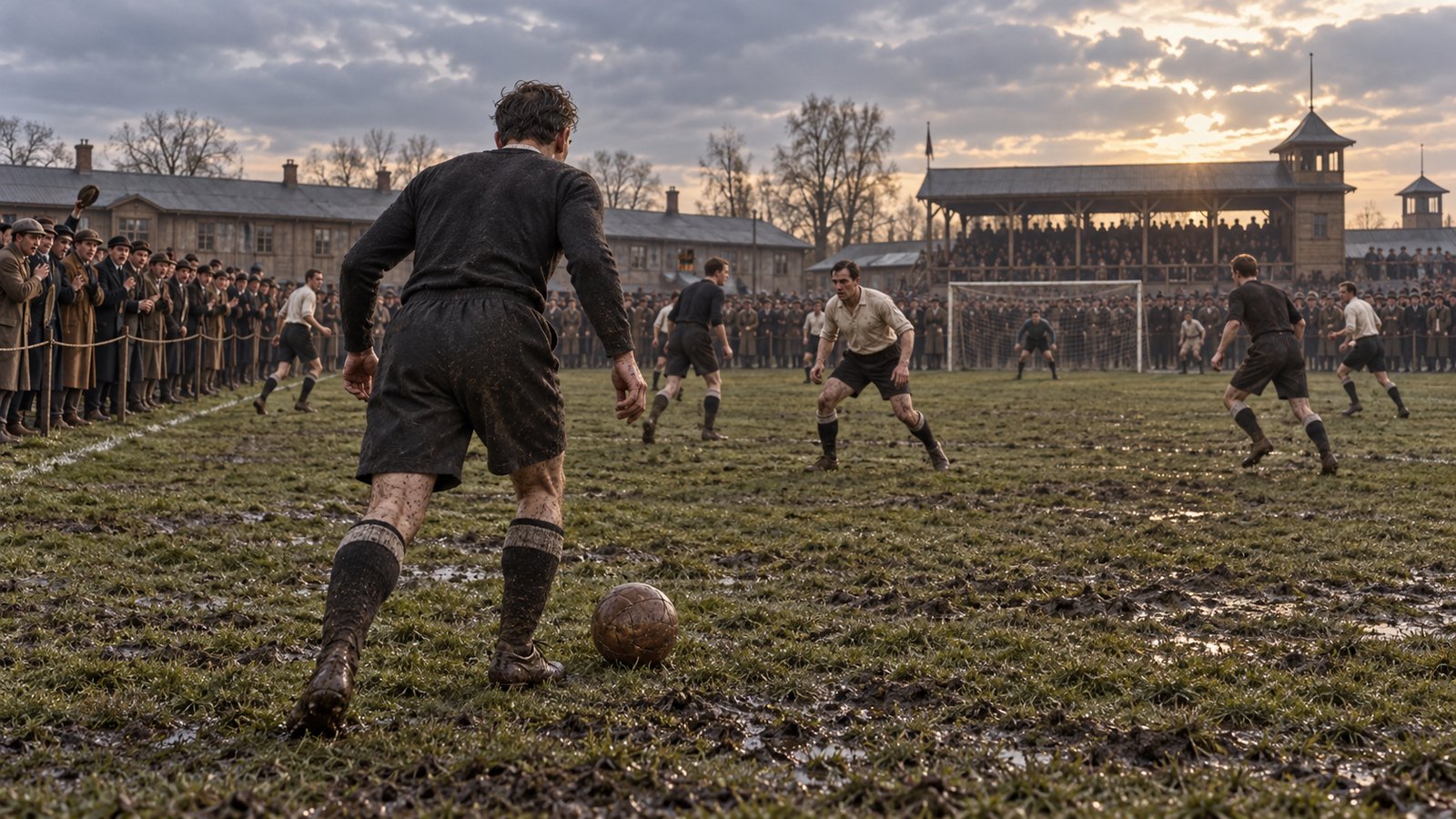
At Ruhleben, the goals began as stones and piled-up jackets. One football had to serve a camp of thousands, and even that ball was described as none too robust. The men who claimed a patch of ground were not professionals preparing for a season. They were British civilians confined at a German racecourse after the First World War cut them off from home.
Among them was Steve Bloomer, the celebrated Derby County and England inside-right. He had gone to Berlin to coach, arriving only weeks before war began. Internment removed his club, his crowd and his freedom, but it did not remove the practical knowledge accumulated across more than two decades in elite football. At Ruhleben, that knowledge helped turn improvised kickabouts into marked pitches, leagues, a cup and matches watched by roughly a thousand fellow prisoners.
The Coaching Job That Closed Behind Him
Bloomer was 40 when he accepted a coaching post with Britannia Berlin 92 in 1914. His playing reputation was already secure. England Football Online records 23 official appearances and 28 goals between 1895 and 1907, including goals in each of his first ten internationals. Derbyshire Live credits him with 331 goals in 525 games across his two spells with Derby County. Those numbers explain why his presence mattered when camp football began to organize itself.
They also sharpen the accident of timing. Bloomer reached Berlin about three weeks before the war started. A newspaper report later reproduced by England Football Online said that he wrote home after being arrested on 5 November 1914. Like other British men of military age in Germany, he was sent into civilian detention. His destination was Ruhleben, a racecourse around six miles from central Berlin.
The setting was designed for horses, not long-term human residence. Prisoners slept in converted stable buildings and barracks. A contemporary account, Israel Cohen’s The Ruhleben Prison Camp, describes horse boxes holding four military beds, a small table and four chairs, while other men slept on straw in haylofts. The camp gathered merchants, sailors, students, musicians and sportsmen into a place whose routines had to be invented under confinement.
One Ball, Jacket Goalposts and a Ban
Football appeared almost immediately. Cohen wrote that clubs sprang up within a week under borrowed names such as Tottenham Hotspurs, Manchester Rangers, Bolton Wanderers and Newcastle United. The first equipment was rudimentary: a single worn ball, stones and jackets for posts, and an open space inside the compound.
Even this first version did not last. The military authorities stopped the games because they feared broken stable windows, and part of the ground was soon needed for new barracks. Rounders temporarily occupied the available space. The interruption is important because the later league was not simply a spontaneous continuation of a kickabout. It depended on negotiation, organization and physical access to a larger part of the racecourse.
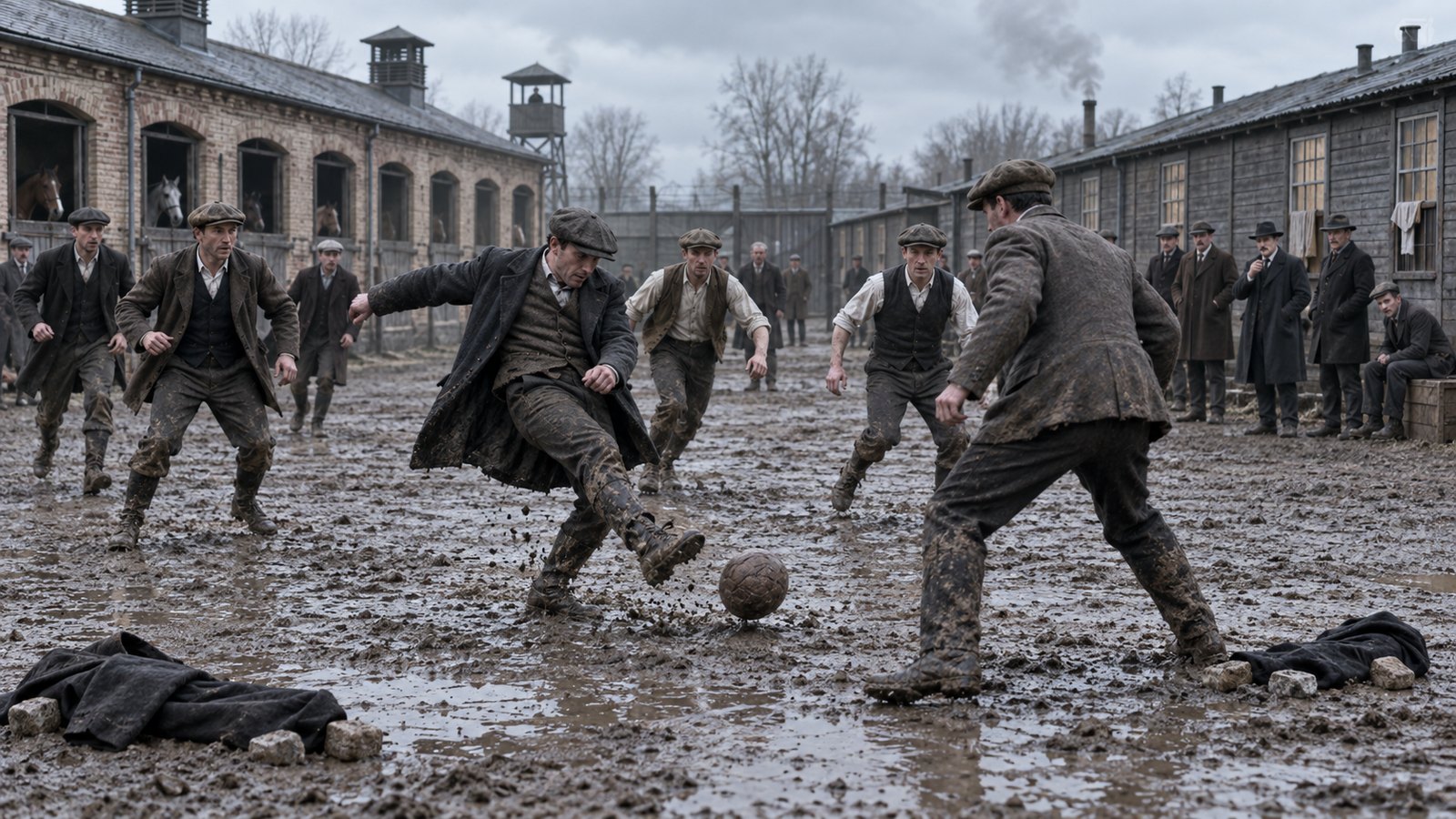
Sport carried a weight beyond amusement. Cohen called it a necessity for maintaining fitness and resisting the inertia of captivity. That distinction keeps the story from drifting into a comforting myth about war. Ruhleben remained an internment camp. The games did not make confinement benign; they gave prisoners a repeated task, a shared calendar and a reason to use their bodies in a place built around waiting.
Bloomer, Pentland and Cameron Supplied the Football Memory
Once a proper sports field became available, the camp had an unusual concentration of expertise. Bloomer was joined by Fred Pentland, another former England international who had also been coaching in Germany, and John Cameron, the former Tottenham Hotspur player-manager. Cohen credited Bloomer and Pentland’s presence and activity with much of football’s popularity, while Cameron served as secretary of the association committee.
The men brought different forms of authority. Bloomer had the scoring record and the recognizable name. Pentland brought his own playing and coaching experience. Cameron understood administration as well as the dressing room. Their work resembled football’s ordinary division of labour, but it operated without a club owner, a permanent stadium or a commercial gate.
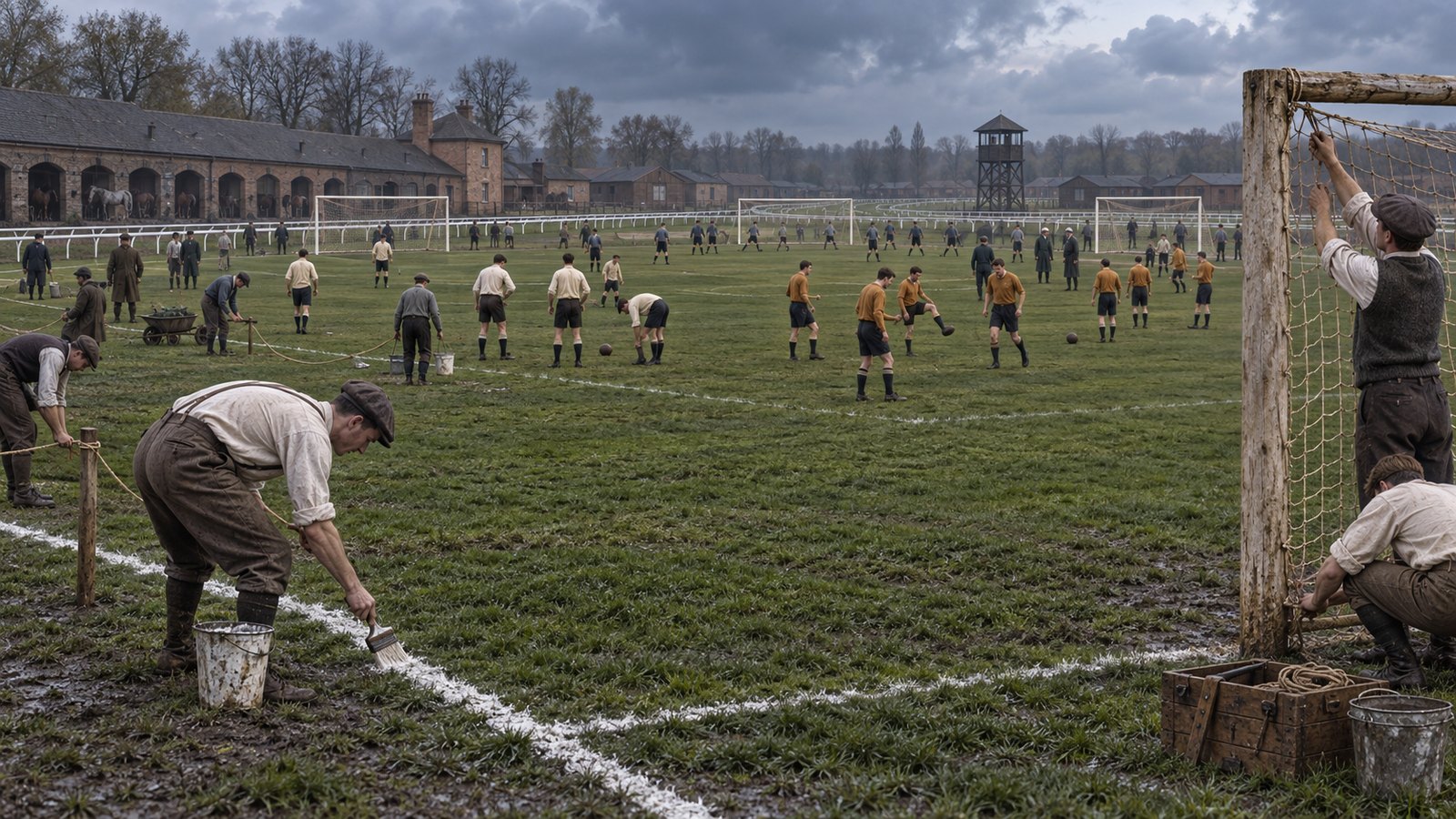
The structure spread through the barracks. Most barracks fielded two teams and adopted their own colours. Prisoners funded the clubs through subscriptions, including contributions from non-players. A prisoner ran an athletic outfitting store, while a dedicated office handled sporting affairs. Three pitches were marked with whitewashed boundaries and supplied with posts, nets and ropes.
This was more than the memorable wartime football described in accounts of the 1914 Christmas truce. Those games were fragile encounters at the front. Ruhleben’s football became a repeated civilian institution inside detention, complete with fixtures, records and rivalry.
A League Table Became the Camp’s Clock
The first representative match took place on Sunday morning, 28 March 1915. Bloomer captained “Ruhleben” against a side called “The Rest,” led by Richards. Baron von Taube, the acting commandant, performed the kick-off. The camp magazine judged the standard high enough to improve considerably with practice.
Two leagues followed and ran until the first week of May. Bloomer commanded Barrack I, winner of the first league; A. G. Belmont captained Barrack X to the second-league title. Fourteen teams entered a cup competition, with Barrack IV defeating Barrack X after what Cohen described as a stubborn final.
The competition had boundaries as well as enthusiasm. Matches were shortened to 35 minutes each way, and transfers between barrack teams were not allowed. Those choices fitted football to camp conditions while protecting the meaning of a team drawn from shared accommodation. Selection therefore carried a local identity: a player represented the barrack in which he lived, while the second divisions and reserved pitch widened participation beyond the strongest elevens.
The schedule returned in October 1915. Bloomer’s XI beat Cameron’s XI 5–2 in the opening match, again after a ceremonial kick-off by von Taube. Thereafter, each barrack played first- and second-league fixtures roughly every four days. Men outside the selected teams could use a reserved pitch for unofficial games.
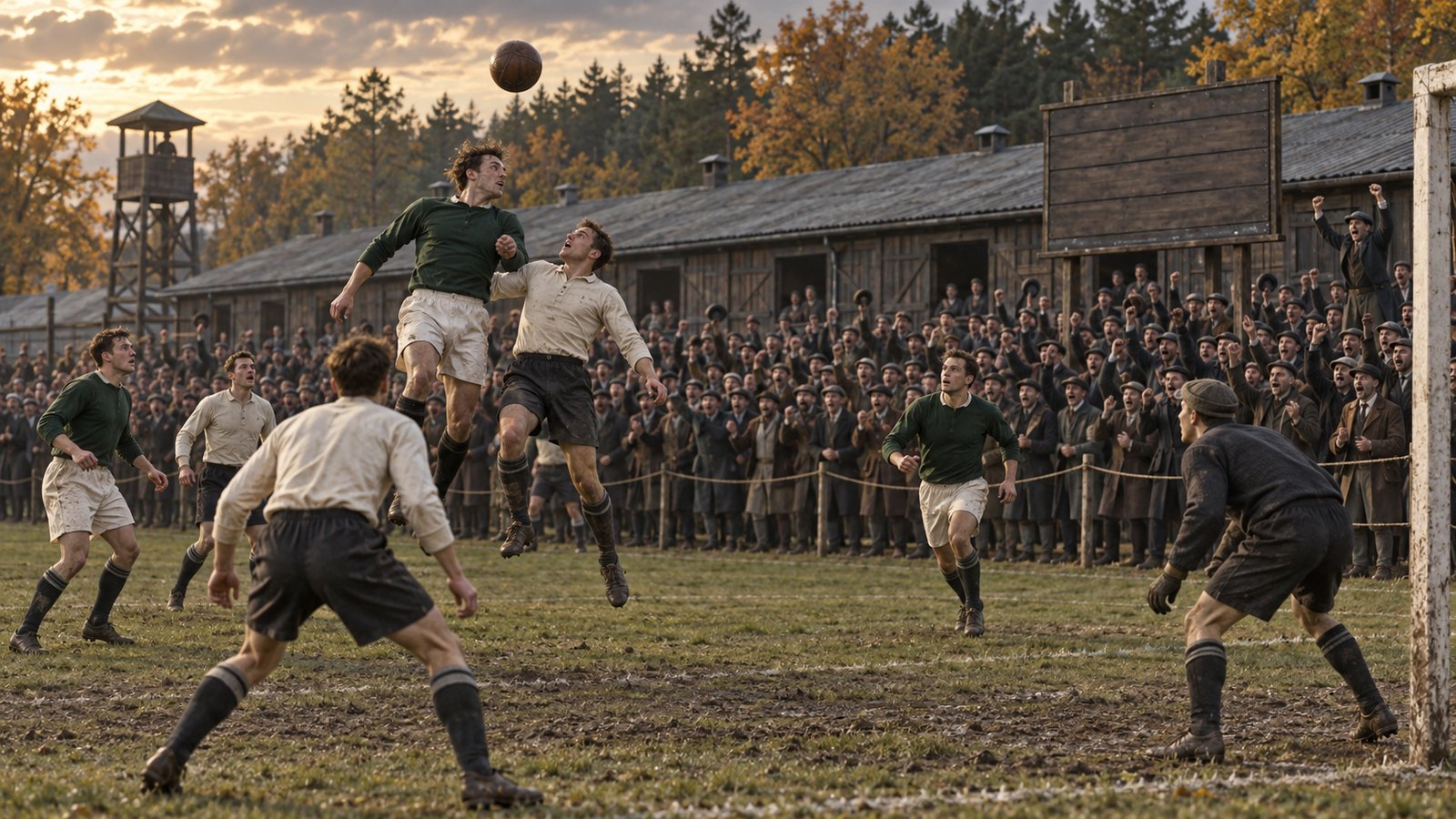
The noticeboard mattered. Results were recorded carefully and studied like league tables at home. The camp magazine carried reports, criticism, interviews and retrospectives. Significant matches drew about a thousand spectators, whose reaction to goals could be heard beyond the racecourse. In an environment where days threatened to blur, fixtures separated one date from the next.
Cohen remembered the second-season opener as carrying the feel of an English bank holiday: good ground, a large crowd and a recognizable match-day mood. The comparison did not erase the fences. It showed how thoroughly the prisoners understood the rituals around football. A fixture needed anticipation before kick-off, an audience at the ropes and an argument over the table afterward. The match occupied more than its 70 playing minutes.
The Famous Finisher Became an Organizer
Bloomer’s old identity did not disappear. He still captained, competed and won. Yet the larger achievement at Ruhleben was distributive: experienced football men helped other prisoners create enough structure for hundreds to play or watch. The point was not to reproduce professional football perfectly. It was to make limited ground, equipment and time usable again and again.
That required ordinary details. Lines had to be painted. Clubs needed colours. Someone had to keep results, arrange games and settle eligibility; the early competition allowed 35 minutes each way and prohibited transfers. Those small rules converted enthusiasm into continuity. Football became dependable because it no longer rested on whoever happened to possess the lone ball that morning.
Bloomer’s career after the war makes the camp episode look less like an eccentric detour. He later coached Blauw-Wit in Amsterdam and Real Unión in Spain, leading the latter to the 1924 Copa del Rey. His football life crossed borders before and after captivity. Ruhleben revealed another dimension of the same craft: a great scorer could also give shape to a football community when almost every normal support had been removed.
Football history often preserves Bloomer through totals, just as it remembers Billy Meredith through the extraordinary length of his career. Ruhleben offers a different measure. A fragile ball became three marked pitches. Barrack teams became two divisions and a cup. A racecourse intended to hold civilians indefinitely acquired a season.
Sources
Israel Cohen, The Ruhleben Prison Camp: A Record of Nineteen Months’ Internment; England Football Online, “Steve Bloomer”; Derbyshire Live, “All You Need to Know About the Steve Bloomer Trophy.”