
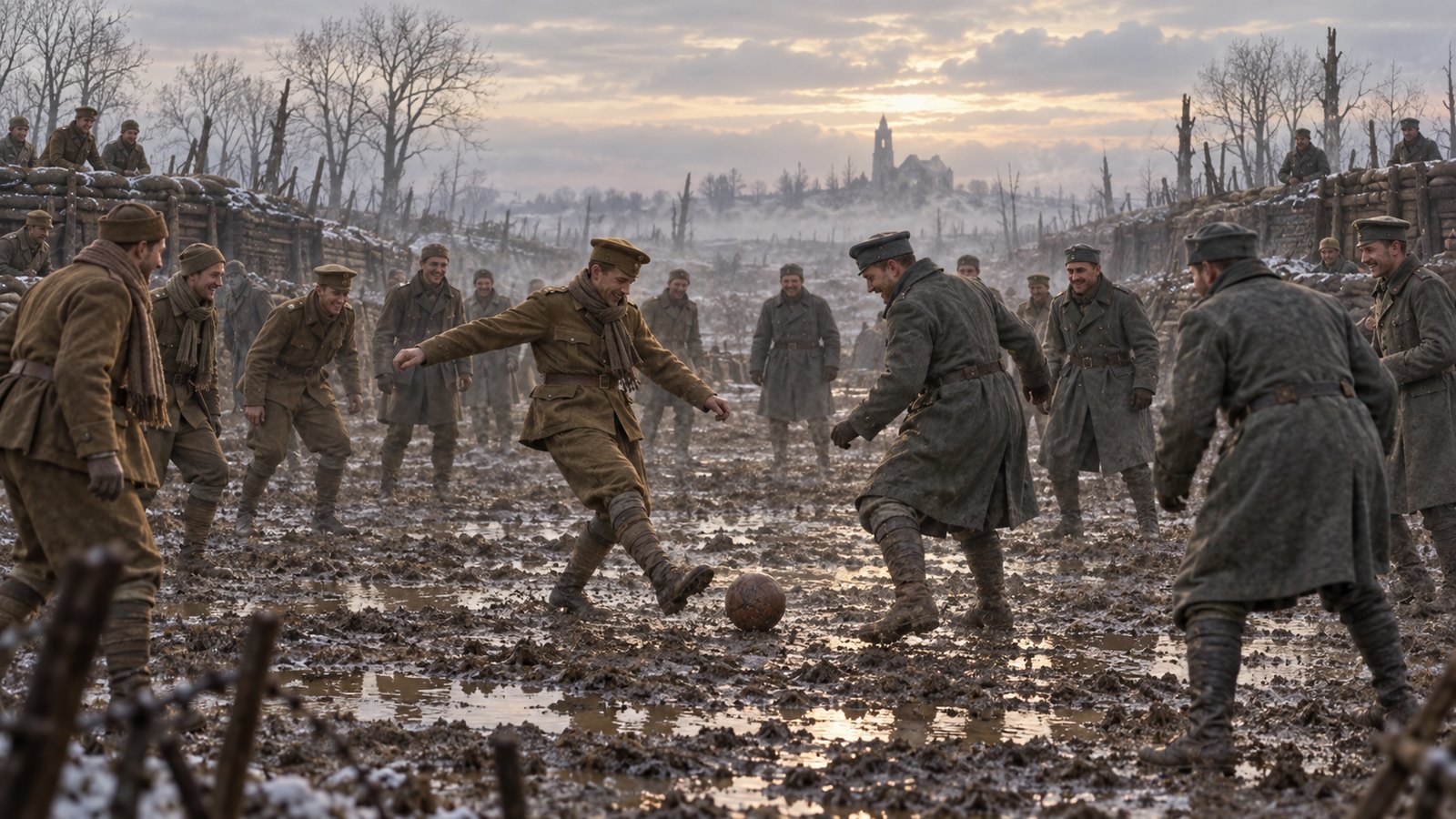
No referee called the players together on Christmas Day 1914. No official chose a pitch, counted shirts or recorded a score. Along parts of the Western Front, soldiers first tested a more dangerous question: if a man lifted his head above the parapet, would the enemy opposite him shoot?
In some sectors the answer, for a few hours, was no. Soldiers climbed out, exchanged tobacco and food, buried dead men and took photographs. Football appeared inside that unstable truce. Imperial War Museums testimony describes a proper ball and hundreds joining a kickabout, but no teams in the ordinary sense.
The Front Was a Chain of Separate Neighbourhoods
The Western Front looked continuous on a map, yet daily life was intensely local. One unit might occupy a quiet stretch opposite soldiers close enough to hear a song. A neighbouring sector could remain dangerous. Trenches also stood at very different distances. Marmaduke Walkinton remembered roughly 300 yards between his position and the Germans. Clifford Lane described German activity perhaps 100 or 150 yards away. In another recollection, opposing lines were only about 30 yards apart.
Those distances shaped what was possible. Men could shout insults, jokes or news without seeing a face clearly. They learned when rations arrived across the wire and noticed when firing paused. The academic International Encyclopedia of the First World War places the Christmas truces inside a wider pattern later called “live and let live”: local arrangements that sometimes reduced danger long enough to collect bodies, repair trenches or complete exposed work.
Nothing in that pattern guaranteed friendship. Each sector had its own officers, recent casualties and tolerance for risk. Turning Christmas 1914 into one front-wide event removes the condition that made it possible: small groups making separate decisions.
Carols Made the First Test Audible
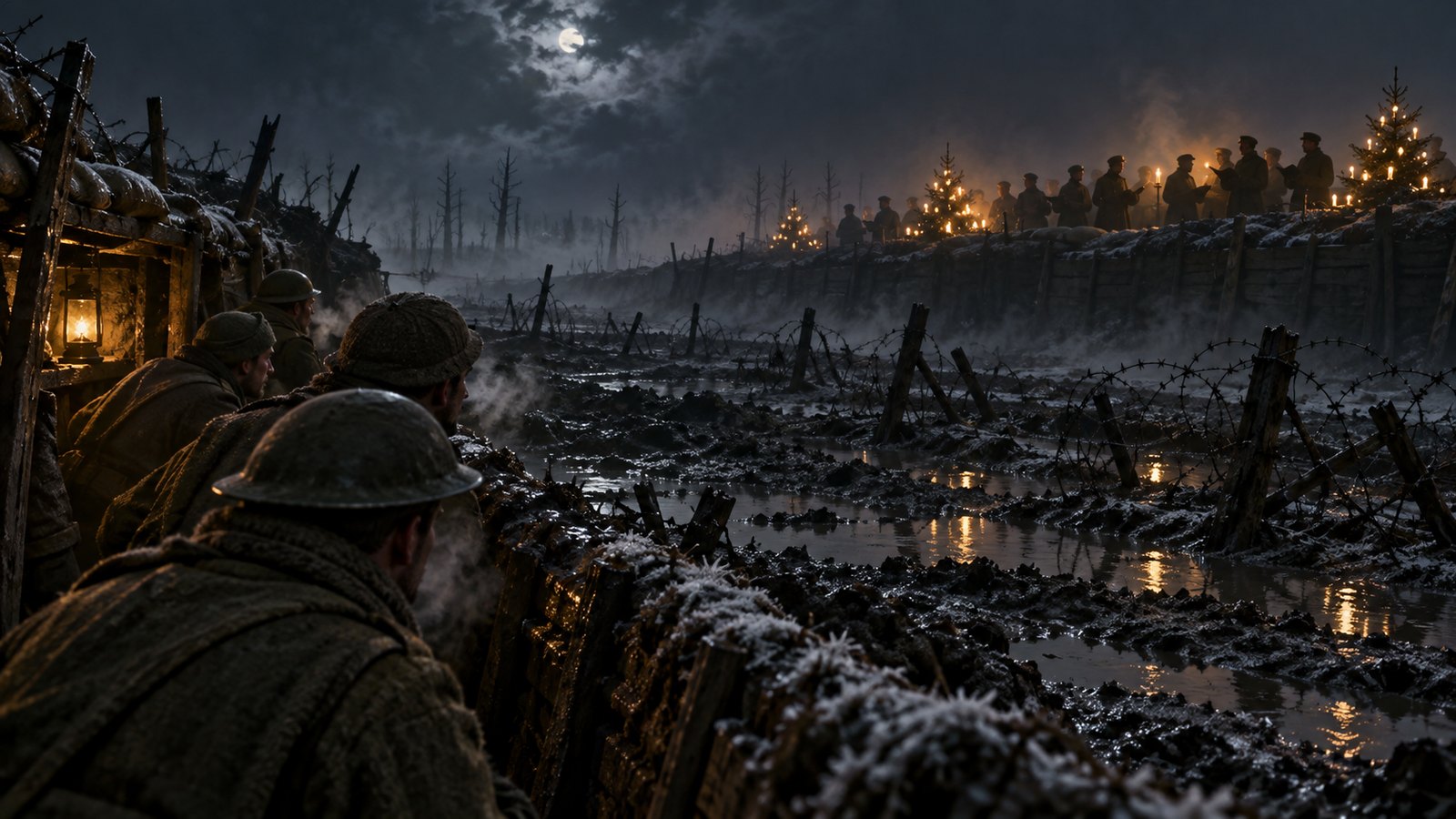
Late on Christmas Eve, British soldiers heard German carols and saw lanterns or small fir trees along some parapets. Walkinton recalled both sides singing and trading remarks before a German voice offered a simple bargain: “Tomorrow you no shoot, we no shoot.” The next morning, heads appeared cautiously. A German stood and waved. When nobody fired, the pause widened one movement at a time.
Colin Wilson of the Grenadier Guards remembered “Holy Night” coming from the German line. Christmas greetings followed. German soldiers invited the British into no man’s land, but Wilson said officers permitted only a limited number to go. This was not a spontaneous crowd forgetting all danger. Permission, watching sentries and hesitant first steps remained part of the scene.
Elsewhere, the same signals produced a different response. Lane’s 1st Hertfordshire Regiment saw lights and heard shouting from the German trench. Before any meeting developed, the British were ordered to open rapid fire. The Germans did not reply and continued celebrating. A song could begin a truce in one place and be answered by rifles in another.
Burial Parties Changed the Meaning of No Man’s Land
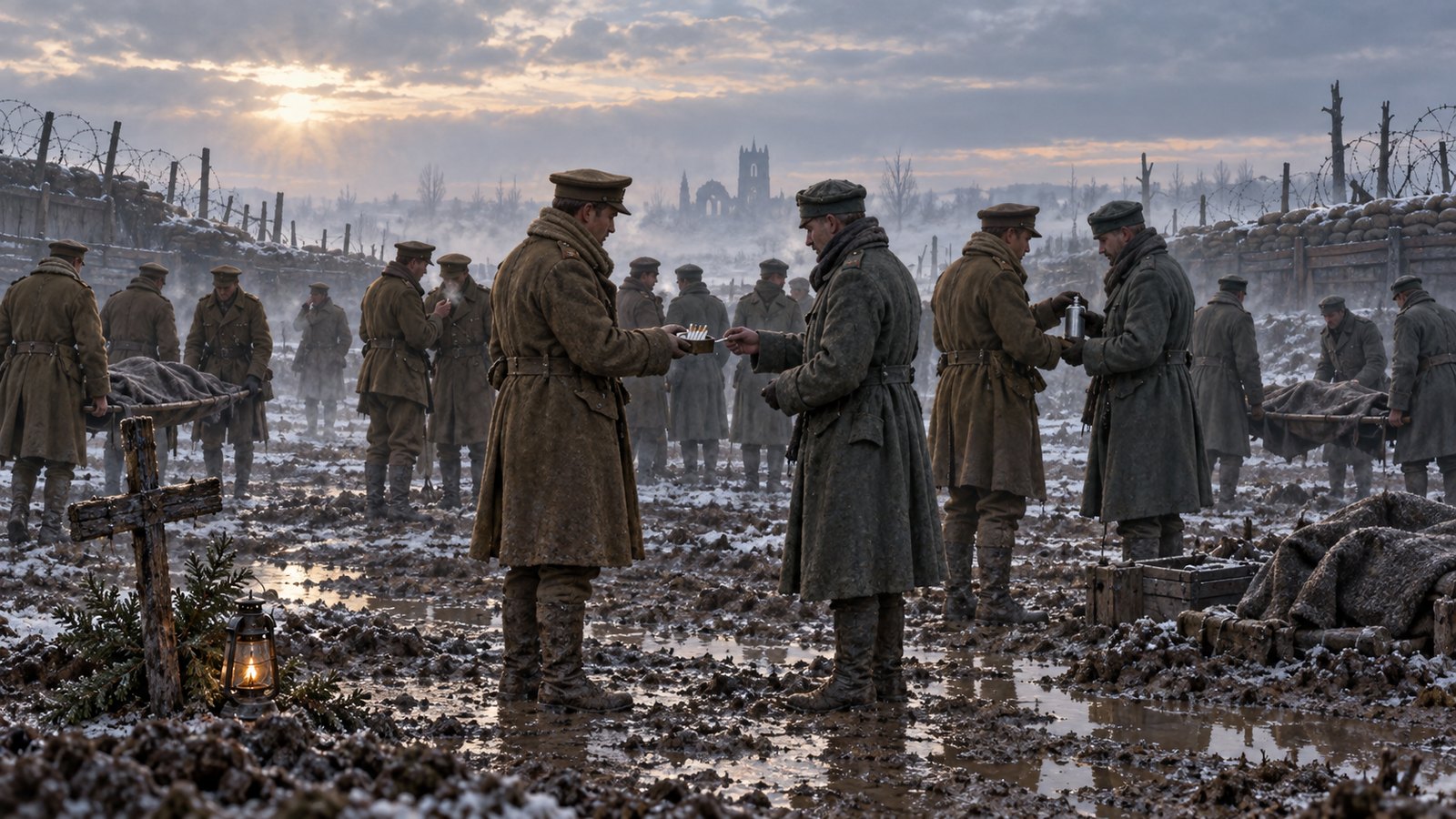
Before it could hold a football, the ground between the trenches often had a grimmer purpose. J. Reid of the 6th Gordon Highlanders recalled a truce near Sailly in which both sides came out, swapped tins of food and buried their dead. Other accounts mention joint or parallel burial work, trench repairs and exchanges of cigarettes, drink, buttons, hats and water bottles.
A soldier climbing over the parapet entered ground normally observed by enemy rifles. Wire, shell holes and frozen soil were not the markings of a sports field. Burial parties gave groups a reason to remain above ground after the first greeting, turning the separating strip temporarily into shared space.
George Jameson remembered men returning with souvenirs, including a grey Landwehr hat with a red band and a water bottle. Such objects carried proof back to soldiers who had stayed behind. Photographs performed the same function for the public. One image taken by Rifleman R. W. Turner at Ploegsteert on 25 December later helped corroborate accounts that had sounded impossible when letters first reached home.
A Proper Ball Produced an Improper Match
Ernie Williams supplied the most useful football description in the Imperial War Museums material. After cigarettes and gifts had been shared, he remembered a football appearing “from somewhere, somehow.” Asked whether it was a proper football, he said it was. Asked about the game, however, he rejected the tidy version: they did not form teams, and it was not a team match in any meaningful sense. Everybody had a go.
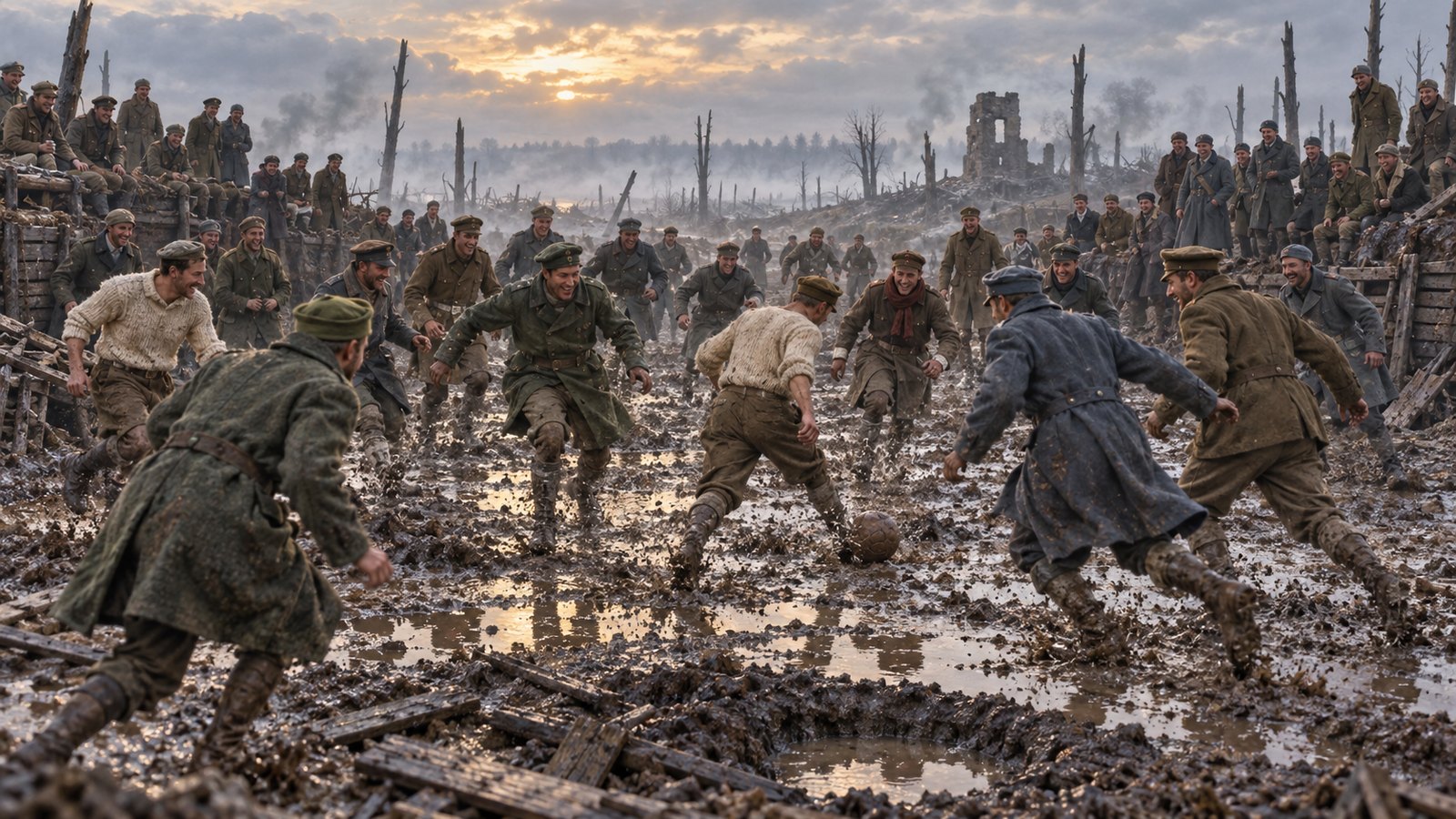
Williams estimated that at least a couple of hundred men joined the kickabout he witnessed. That scale helps explain why later memory could turn the scene into a match while also showing why a reliable score is the wrong thing to seek. Hundreds of soldiers around one ball on torn ground do not produce regulation positions, touchlines or an agreed final whistle. The action was recognisably football because men chased and kicked a ball together, not because it met competition rules.
Other soldier accounts and the international encyclopedia refer to impromptu games in more than one sector. They should not be forced into one composite fixture. A ball may have been genuine in Williams’s sector while another group used an improvised object elsewhere. Some men played, some only watched and many never left their trench. The plural—kickabouts—fits the surviving evidence better than a single scoreline.
Football worked because its rules needed little speech. The truce joined men who did not necessarily share a language, but they shared gestures and a familiar game. A kicked ball created immediate roles without requiring a conference. Someone pursued it, someone challenged and others laughed when mud or a shell hole defeated both. The rules could remain loose because the purpose was not to establish which army had the superior eleven.
That looseness made football particularly suited to the moment. A formal exchange demanded interpreters, permission and trust. A kickabout could begin with one touch. It also kept men moving on a freezing day and turned no man’s land from an abstract boundary into a surface that bodies crossed together.
The game did not cause the truce. Carols, burial needs, close trenches and the first wartime winter created the opening. Football gave some soldiers a way to use it, with participation mattering more than a result.
Some Men Never Stopped Watching the Parapet
The meetings dwindled after Boxing Day in most sectors. Orders against fraternisation hardened, and officers worried that recognising the enemy as an individual would weaken combat discipline. Later in the war, heavier losses, centralised control and near-constant artillery made a truce on the same scale far less likely.
Even during Christmas 1914, fighting continued elsewhere and casualties occurred. The men who joined a kickabout could not assume that troops beyond the next unit knew about their arrangement. Imperial War Museums testimony describes the confusion of one sector experiencing a truce while another remained ready to fire. The pause was real because it was fragile, not because the war had disappeared.
This distinction protects the football story from sentimentality. The soldiers did not settle the conflict through sport. They suspended violence locally and temporarily, often against the logic their commands required. By the end of the truce, they returned to opposed trenches with the same weapons and strategic objectives.
Several Kickabouts Became One Perfect Memory
Letters and photographs brought the truces into British and German newspapers. Over time, a complicated set of local incidents became easier to remember as one scene: two armies, one ball, peace for Christmas. The compression resembles the way a single football clip can detach itself from the pressure around it. The story of Mwepu Ilunga’s 1974 free-kick intervention, for example, changed when the surrounding threats and team crisis disappeared from repeated footage.
Another durable myth says India missed the 1950 World Cup simply because its players wanted to compete barefoot. The documented account of the meetings behind India’s withdrawal is less neat and more revealing. Christmas 1914 deserves the same care. Rejecting an invented official score does not remove football from the truce; it restores football to the conditions in which soldiers described it.
There was a proper ball in at least one eyewitness account. Men kicked it, watched, exchanged gifts and, a short distance away, kept firing. No official match is required: a couple of hundred soldiers made up a game on ground designed to keep them apart, knowing the permission could vanish with the next order.
Sources
Imperial War Museums; Voices of the First World War oral-history archive; 1914–1918 Online: International Encyclopedia of the First World War; contemporary soldier letters and photographs held by Imperial War Museums.