
Blackburn Rovers’ 1994-95 Premier League title is usually filed under football’s simplest labels: rich owner, big spending, Alan Shearer goals, unlikely champions. Those labels are not wrong, but they are incomplete. Jack Walker’s money mattered enormously. So did Shearer’s finishing. Yet Blackburn’s title was also a product of timing, local identity, recruitment, managerial clarity, and a Premier League economy that had not yet hardened into the hierarchy it would later become. The story is less a fairy tale than a narrow historical opening that Blackburn recognized before it closed.
The local owner changed the scale of ambition
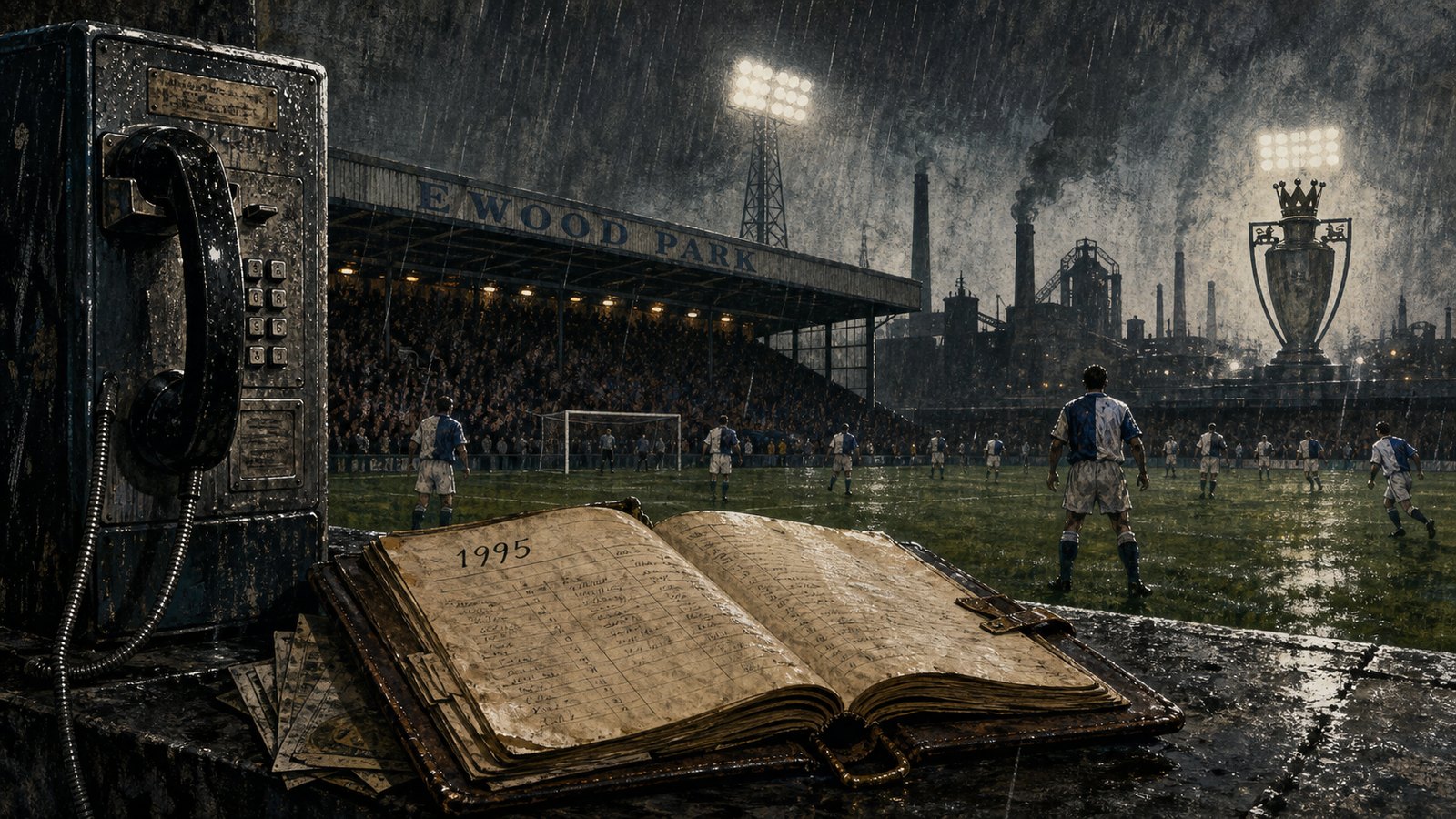
Jack Walker was not an anonymous investor using a club as a distant asset. He was a Blackburn-born steel magnate who had watched Rovers before he had the wealth to transform them. That local connection shaped the emotional grammar of the project. The spending was aggressive, but it was not presented as a floating brand exercise. It felt, to many supporters, like a town using one of its own success stories to punch upward in a league that was beginning to sell itself as modern, national, and television-ready.
Walker’s takeover in the early 1990s allowed Blackburn to act with a confidence that would have been impossible in the old Second Division environment. Ewood Park was redeveloped. Transfer ambition rose. The club appointed Kenny Dalglish, whose Liverpool pedigree gave the project credibility beyond the balance sheet. Then came the signings that changed expectations: Alan Shearer from Southampton in 1992, Chris Sutton from Norwich in 1994, and a supporting cast that made the side more than two forwards and a cheque.
The money did not remove risk. In that period, English football did not yet have the same global scouting networks, wage stratification, or Champions League revenue gap that later protected the biggest clubs. A wealthy owner could move a club quickly, but mistakes could still collapse the plan. Blackburn’s achievement was that enough expensive decisions were also coherent football decisions.
Dalglish built a team, not a spending display
Kenny Dalglish’s Blackburn were not tactical radicals in the way Hungary 1953 or Sacchi’s Milan were. Their strength was clarity. They could play directly without being crude, defend with discipline without retreating into passivity, and make the penalty area feel constantly supplied. Shearer and Sutton became the famous SAS partnership, but that nickname can make the side sound more cartoonish than it was. Tim Sherwood’s midfield leadership, Graeme Le Saux’s left-sided drive, Stuart Ripley’s delivery, Colin Hendry’s defending, and goalkeeper Tim Flowers’ security all mattered.
The physical scene of Blackburn’s title run helps explain the side’s identity. Ewood Park under rain, blue-and-white shirts driving crosses into crowded boxes, defenders attacking first contact, forwards hunting second balls: this was not a team embarrassed by English football’s older textures. It used them with better players, better preparation, and a sharper sense of what the new Premier League could reward.
Shearer’s 34 league goals in 1994-95 gave the campaign its cleanest statistic. But goals do not exist in isolation. Sutton’s movement occupied center backs, wide service arrived early, and Blackburn’s midfield often made matches feel like territory had to be earned yard by yard. The team’s football was not fashionable in later possession-era language, yet it was ruthlessly suited to its squad and its league.
The collapse at Anfield made the title feel more fragile
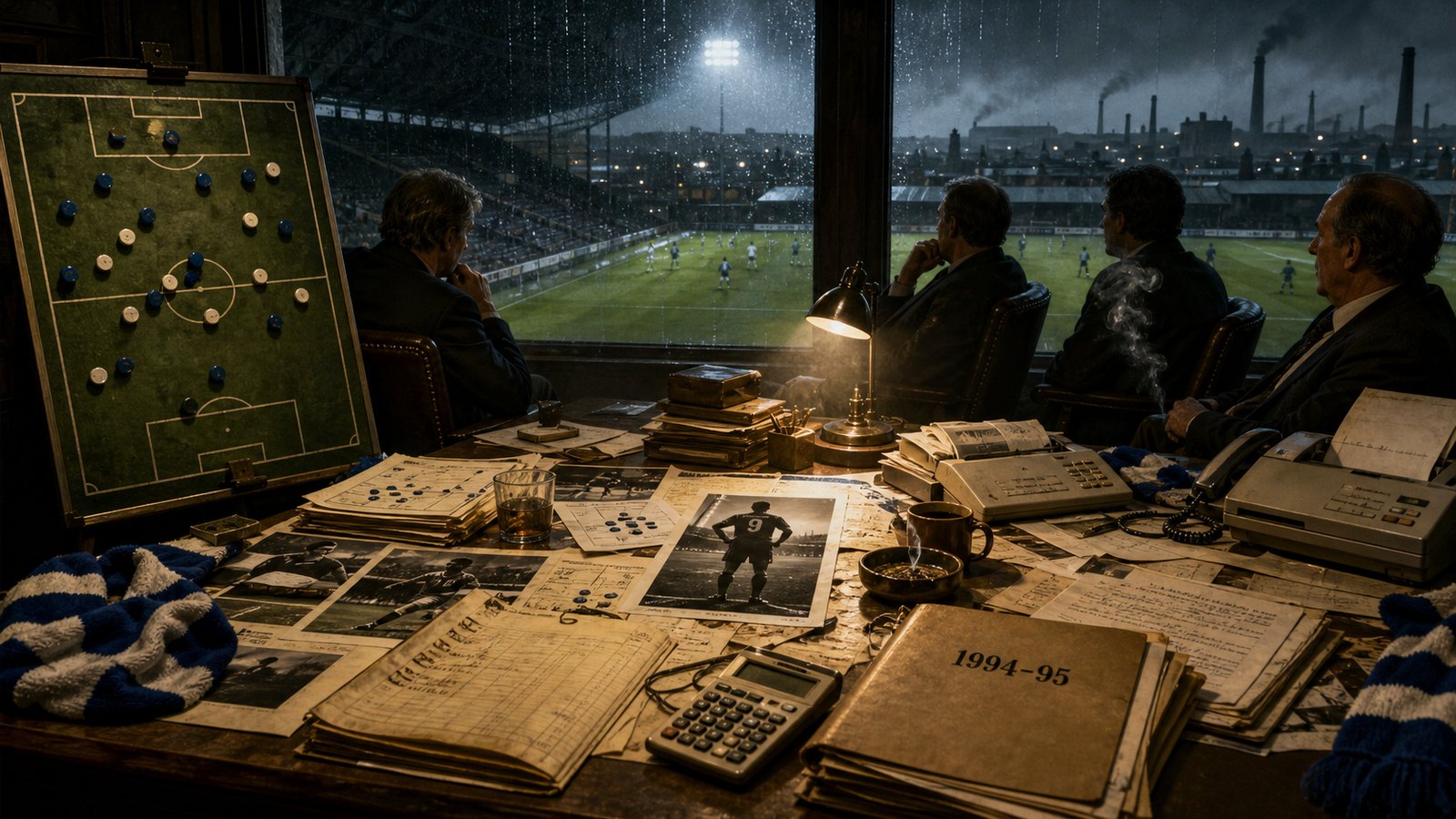
The final day of the 1994-95 season preserved Blackburn’s title in the most stressful possible form. Rovers lost 2-1 at Liverpool, Dalglish’s former club, while Manchester United drew at West Ham. Blackburn became champions because United failed to find the winner they needed. That ending is sometimes used to make the title sound stumbled into, but it actually reveals how thin elite margins were before the Premier League’s later financial layers grew thicker.
A champion can be worthy and still arrive exhausted. Blackburn had spent the season carrying expectation that was new to the club. United, already the emerging power of the 1990s, chased them with the confidence of a side used to pressure. The final whistle at Anfield did not produce the clean cinematic image of a team winning its last match and lifting destiny in both hands. It produced something more human: players waiting, listening, calculating, then realizing that the work of thirty-eight matches had survived one final wobble.
That fragility is part of the title’s meaning. Blackburn did not found a dynasty. They finished seventh the next season, Dalglish moved upstairs, and the club’s moment of maximum force passed quickly. In retrospect, the shortness of the window makes 1995 more interesting, not less. It shows how difficult it was to convert owner ambition into lasting structural power once the league’s revenue engine accelerated.
A title from the last soft edge of the new order
Blackburn’s triumph sits at a hinge in English football history. The Premier League had begun in 1992, television money was rising, stadiums were changing, and commercial language was becoming normal. But the future was not fully locked. Manchester United were powerful but not yet surrounded by the later global revenue moat. Arsenal had not yet been transformed by Arsène Wenger. Chelsea and Manchester City had not entered their later ownership eras. The Champions League had not yet become the same domestic sorting machine for English clubs.
That does not mean Blackburn were small romantics standing outside modern football. They were part of modern football’s arrival. Their spending helped prove that capital could rapidly alter competitive status. The difference was that the capital had a local face, a town story, and a squad-building plan that hit at precisely the right moment. Later versions of the model would often become bigger, more global, and more insulated from local sentiment.
So Blackburn 1995 should not be flattened into either miracle or purchase. It was both more ordinary and more remarkable: a well-funded, well-managed, locally charged project that exploited a temporary opening in the league’s structure. The title feels impossible now because the conditions that made it possible were already disappearing while Blackburn were lifting it.
The recruitment context matters because Blackburn were shopping before the Premier League became a fully global auction room. Shearer’s move from Southampton was enormous, but it was still imaginable that a club outside the established giants could persuade a rising English striker that the sporting project was credible. Sutton’s arrival two years later doubled down on that logic. Blackburn were not merely buying names after they had become untouchable global brands; they were catching players at a moment when ambition, wages, role, and domestic familiarity could still align.
There was also a useful bluntness in the team’s design. Dalglish did not ask Blackburn to cosplay as a continental possession side or to apologize for crosses, second balls, and defensive duels. The squad’s strengths were obvious, and the game plan kept returning to them. In a league full of transition, that certainty mattered. Other clubs were learning the new commercial environment while Blackburn were using an old football grammar with upgraded resources and a clearer route to goal.
The title’s afterlife is revealing. It is remembered with affection partly because it did not become normal. If Blackburn had won three in a row, the romance would have cooled and the spending would have looked like the start of another empire. Instead, 1995 remains suspended: too funded to be pure underdog myth, too local and brief to feel like corporate inevitability. That tension is exactly why the season still tells us something about how English football was changing.
Sources
Premier League historical records
Blackburn Rovers club history
Alan Shearer career statistics
Jonathan Wilson, Angels With Dirty Faces