
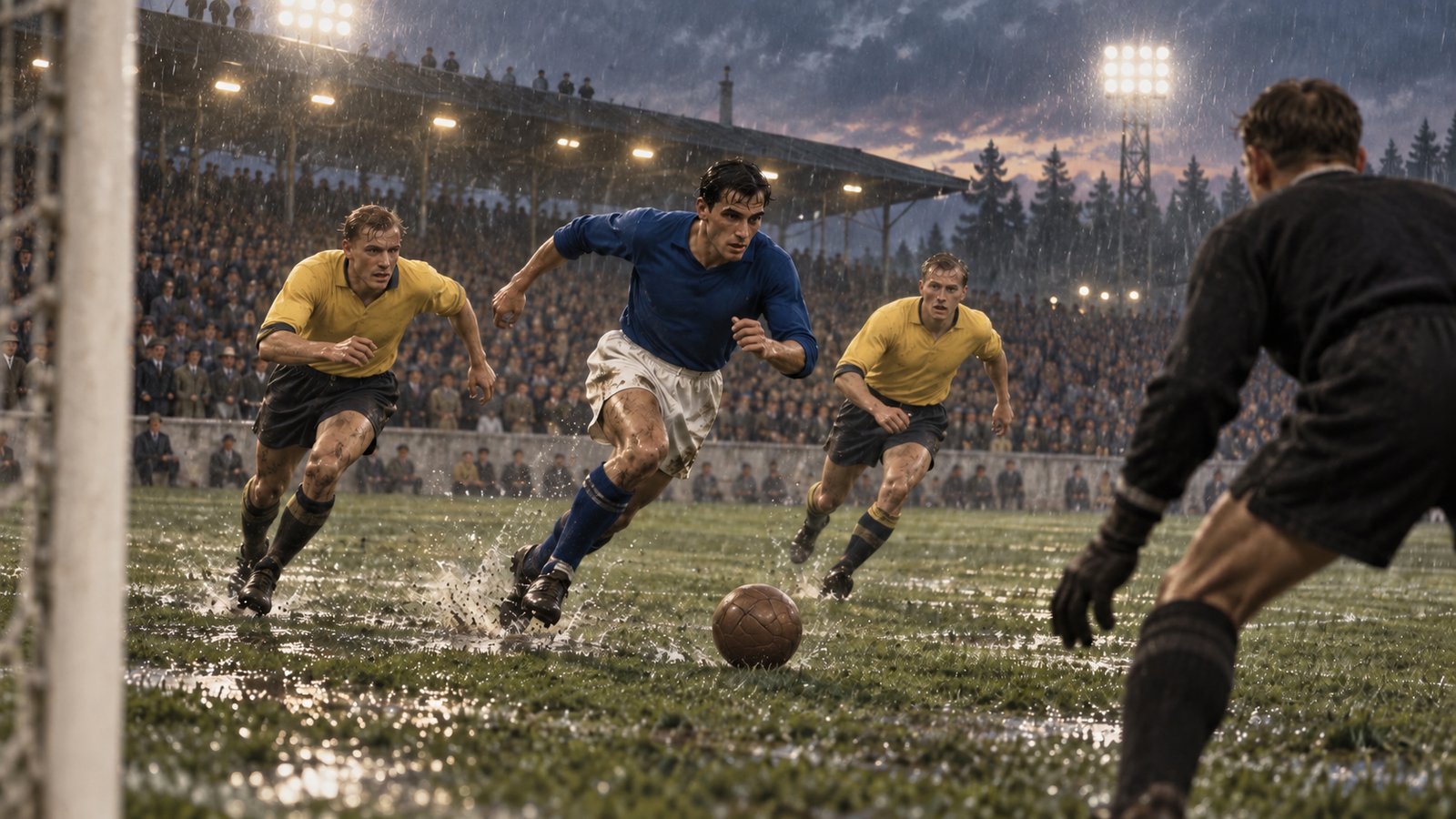
Just Fontaine arrived at the 1958 World Cup without a secure place in France’s starting attack and without boots prepared for the opening match. René Bliard’s injury in a warm-up changed the first problem. Teammate Stéphane Bruey solved the second by lending him a pair. Six matches later, Fontaine had scored 13 goals, a single-tournament total that still looks less like a hot streak than an entire international career compressed into three weeks.
The borrowed footwear makes a charming entrance to the story, but it can also shrink what followed into a lucky accident. Fontaine scored in every round France played. He found goals while his team was behind, while protecting a narrow lead, in a quarter-final rout, against Brazil, and four times after France had lost its semi-final. The record survived because it was built across changing match conditions rather than piled up in one forgiving afternoon.
A late selection opened the door in Sweden
Fontaine was 24 and already prolific at club level. Born in Marrakesh in 1933, he had begun with USM Casablanca before moving to Nice and then Reims. In the 1957–58 French season he scored 34 league goals in 26 matches as Reims completed a league and cup double. That form placed him in France’s World Cup party, yet it did not settle the centre-forward question.
France’s selectors also had René Bliard, while Raymond Kopa and Roger Piantoni supplied the craft around the striker. Bliard was injured in a warm-up and returned home. The change came late enough that Fontaine borrowed Bruey’s boots for the opener. Nothing about the equipment was tailored to make history; the more important fit was tactical. Kopa could receive the ball between midfield and defence, Piantoni could combine and finish, and Fontaine attacked the spaces their passing opened.
This was not a forward waiting for rebounds. Contemporary descriptions repeatedly show late runs, movements across the offside line and quick finishes into corners. France gave him a stream of chances, but he made those chances appear by arriving where defenders had just stopped looking. The tournament’s high scoring matters, yet so does Fontaine’s readiness when an injury promoted him at the last moment.
Paraguay led 3–2 before the first hat-trick was complete
France’s opening game was not a gentle rehearsal. Paraguay twice led and were 3–2 ahead in the second half. Fontaine had already scored once when the match began to swing. France eventually won 7–3, with Fontaine completing a hat-trick and immediately making the centre-forward debate irrelevant.
The next result demonstrated why the final total cannot be explained only by French dominance. Yugoslavia beat France 3–2, and Fontaine scored both French goals. He then struck once in the 2–1 victory over Scotland, a match that put France into the knockout stage. After three group games, his tally stood at six: three in victory, two in defeat and one in the tight contest that secured qualification.
That distribution reveals the rhythm of his tournament. He did not disappear when France lost control of a game. Nor did he need an opponent to collapse before finding the net. The partnership behind him helped: Kopa’s passing drew defenders toward the ball, while Fontaine’s runs forced them to turn. Readers who know Kopa mainly through his later challenge to football’s contract rules can follow that separate struggle in the story of his threatened suspension. In Sweden, his influence was visible in the service delivered to Fontaine.
The six group-stage goals also came without a single repeated scoreline. A 7–3 win invited constant forward running; a 3–2 defeat demanded recovery without reward; a 2–1 win made each finish carry more weight. Fontaine’s role survived those shifts because France did not ask him to conduct every attack. Kopa and Piantoni moved the ball, and the centre-forward judged the last distance. He could begin beyond the main exchange, then enter the picture as the pass escaped pressure. That division of labour kept his movements sharp across three matches in quick succession and carried the same attacking geometry into the knockout rounds.
Northern Ireland gave way; Brazil changed the conditions
France met Northern Ireland in the quarter-final and won 4–0. Fontaine scored twice, taking his total to eight. The score suggests ease, but the goals still came from the same repeatable actions: move beyond a defender’s shoulder, take the pass early, finish before the goalkeeper can reset. Four matches had now produced four different demands and at least one Fontaine goal in each.
The semi-final brought Brazil’s emerging champions. Vavá scored in the second minute. Fontaine answered seven minutes later after France worked through the pressure, making it 1–1. For a short period, the tournament’s two most dangerous attacks were level and fully exposed to each other.
Then France captain Robert Jonquet suffered a broken leg in the 36th minute. Substitutions were not permitted, so Jonquet remained on the field in pain while France effectively played short-handed. Brazil pulled away to win 5–2, with the 17-year-old Pelé scoring three. Fontaine’s ninth goal had not carried France to the final, but it had extended his scoring sequence against the best team in the competition under the hardest game state he had yet faced.
The record required three goals; Fontaine scored four
Defeat left France in the third-place match against West Germany. Fontaine entered with nine goals. Sándor Kocsis had scored 11 for Hungary in 1954, so three would be needed to move beyond the existing World Cup mark. A consolation fixture offered the opportunity, but it also tested whether France could summon another attacking performance after the physical and emotional damage of the semi-final.
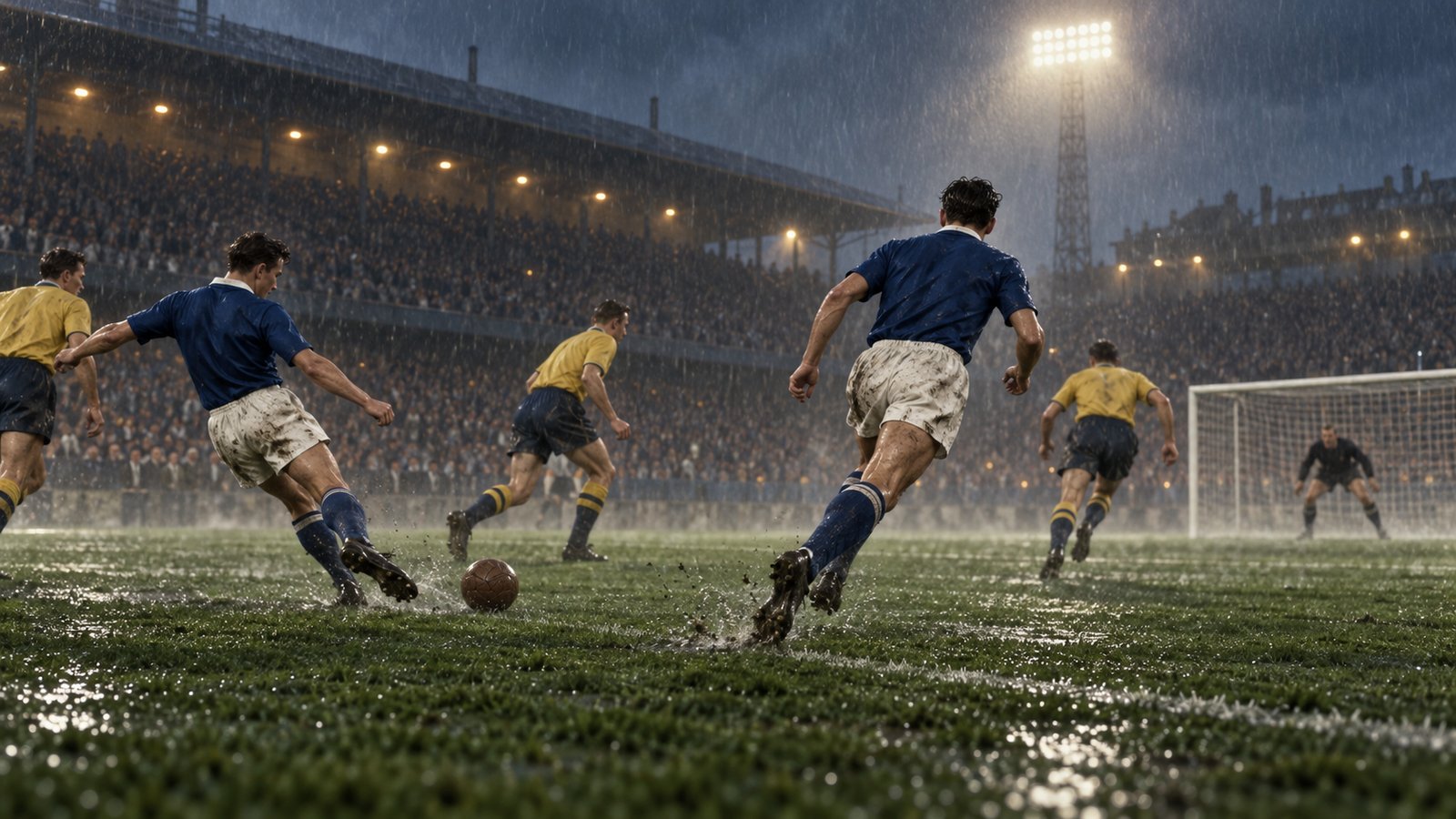
Fontaine scored four in a 6–3 victory. The sequence carried him past Kocsis and on to 13. He had now scored three against Paraguay, two against Yugoslavia, one against Scotland, two against Northern Ireland, one against Brazil and four against West Germany. The arithmetic matters because it removes the distortions of memory: no opponent supplied more than four, no round left him blank, and nine of the goals had arrived before the final afternoon.
He could even have finished higher. Fontaine hit the bar twice against Scotland and allowed Kopa to take a penalty against West Germany. Those details are not proof that every missed chance should be added to the record. They show that the 13 were produced inside a larger body of attacking work, not from 13 isolated touches that happened to go right.
An air rifle, a broken leg and a number that stayed
There was no formal Golden Boot presentation in 1958. A Swedish newspaper instead gave Fontaine an air rifle, casting the tournament’s leading scorer as a sharp shooter. The image belongs to another age of football: borrowed boots at the start, a newspaper prize at the end, and no sense that the number would need a carefully staged ceremony to become famous.
Fontaine’s career still had another European run. He scored 10 goals as Reims reached the 1958–59 European Cup final, where Real Madrid won. His international return was extraordinary too: RSSSF records 30 goals in 21 senior matches for France. Yet his playing years closed early. A broken leg in March 1960, followed by failed or aggravated comebacks, forced him to stop in 1962 at only 28.
FIFA eventually presented him with a platinum boot in 2014. By then, the object could only acknowledge what six score sheets had already established. Fontaine’s record was not merely that he reached 13 in an unusually open World Cup. It was that a late replacement wearing a teammate’s boots kept solving a different match every few days, all the way from a 3–2 deficit against Paraguay to four goals after France’s chance of becoming world champion had gone.
Sources
BBC Sport; The Guardian; RSSSF; FIFA World Cup records.