
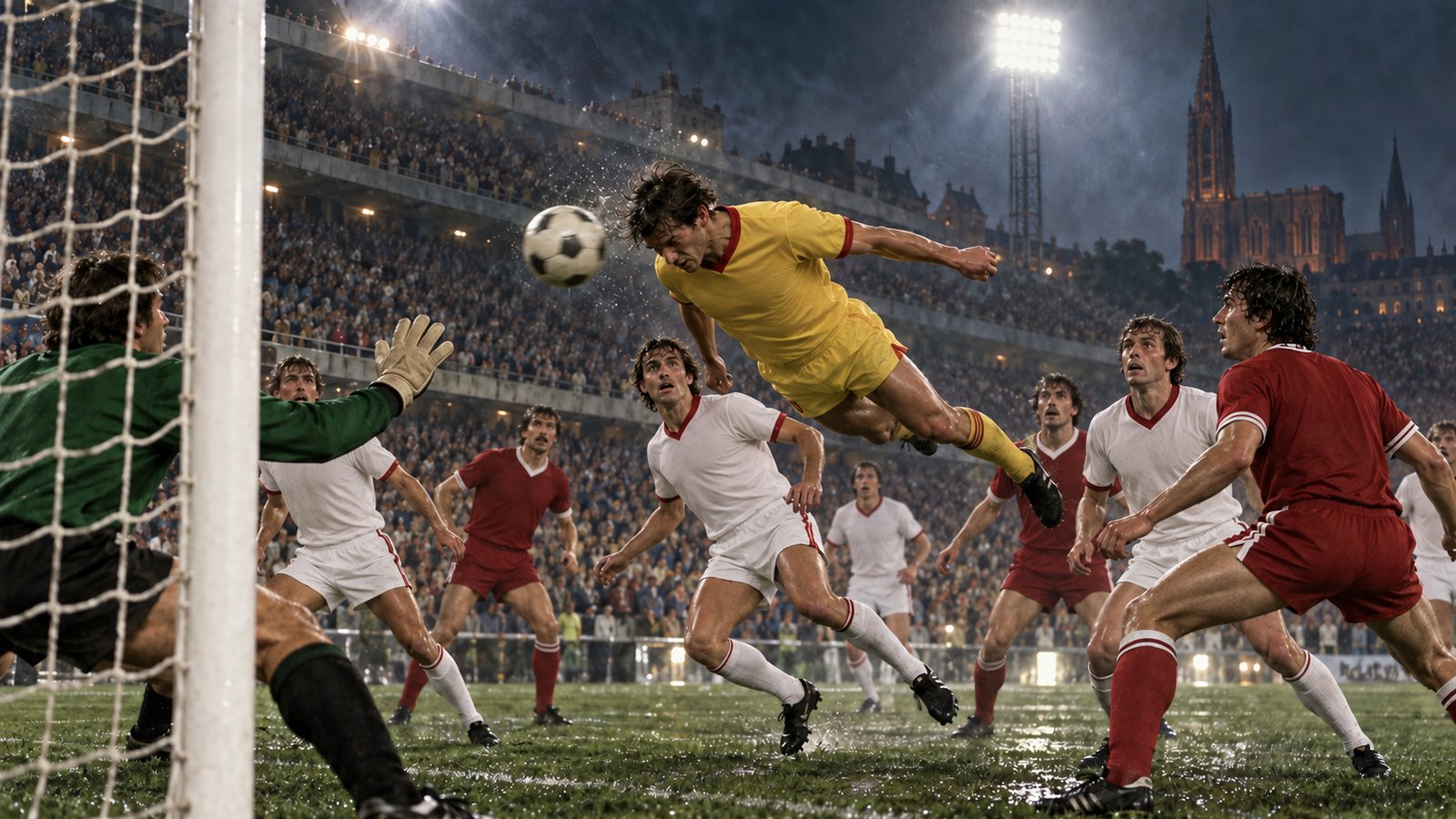
When Piet den Boer met Eli Ohana’s cross in Strasbourg, the ball did not fly into the top corner. It went down, through the crowded goalmouth and inside Stanley Menzo’s right-hand post. That single header, scored eight minutes after half-time on 11 May 1988, placed a modest Belgian club above the defending holders of the European Cup Winners’ Cup.
KV Mechelen’s victory over Ajax was not the end of an isolated cup adventure. Nine months later, the same group faced PSV Eindhoven, the reigning European champions, over two legs for the European Super Cup. Mechelen scored three times in seventeen first-half minutes at their own compact ground and protected the advantage in Eindhoven. Within one cycle, they had beaten the holders of both major European trophies.
The sequence matters more than an underdog label. Mechelen were assembled quickly, coached with uncommon clarity by Aad de Mos and anchored by players whose careers reached far beyond one final. Their rise can be measured in a precise chain: a Belgian Cup, four unbeaten European rounds, one goal against Ajax, then a 3–1 aggregate win over PSV. Europe did not catch them once. It had to confront them twice.
A Belgian Cup Opened a Door That Money Alone Could Not
KV Mechelen’s own history places the beginning in the 1986–87 season. Financial backing from businessman John Cordier gave the club resources, while De Mos supplied the sporting direction. Mechelen beat RFC Liège 1–0 in the Belgian Cup final, earning entry to the following season’s Cup Winners’ Cup. Goalkeeper Michel Preud’homme also won Belgium’s Golden Shoe that year.
Cordier’s investment was important, but the team did not resemble a collection of imported stars waiting for individual inspiration. De Mos built around a clear spine. Preud’homme commanded the penalty area. Lei Clijsters captained the side from central defence. Erwin Koeman gave the midfield international quality, Israeli forward Ohana supplied movement from the left, and Den Boer provided the penalty-box finish. Graeme Rutjes, Marc Emmers, Wim Hofkens and Pascal De Wilde completed a side with options in several positions rather than one famous axis.
The Cup Winners’ Cup also offered no soft route reserved for a fashionable name. Dinamo București were beaten 3–0 on aggregate in the first round. St Mirren held Mechelen to a goalless draw in Belgium, but lost the return 2–0. Soviet opponents Dinamo Minsk then took the only goal Mechelen conceded before the final; a 1–0 home win and a 1–1 draw away sent De Mos’s team through 2–1.
Atalanta Tested the Run in Two Different Ways
The semi-final against Atalanta stripped away any suspicion that Mechelen had simply managed favourable draws. The Italian club had reached Europe despite playing the 1987–88 season in Serie B, and its route already had the shape of a cup anomaly. Mechelen won the first leg 2–1 at home, a useful advantage but not one that allowed caution in Bergamo.
The return followed the same score. Another 2–1 victory made the aggregate 4–2 and sent the Belgian side to Strasbourg without a defeat. Across four rounds before the final, Mechelen had won six matches and drawn two. They had conceded only twice. The pattern was neither a scoring avalanche nor a desperate series of escapes. They repeatedly created a lead, then gave opponents very little room to overturn it.
That distinction separates the run from a one-night fairy tale. Smaller European clubs can reach a final through one feverish home performance or a favourable shoot-out. Mechelen arrived after controlling four separate ties against opponents from Romania, Scotland, the Soviet Union and Italy. Readers interested in another carefully rehearsed outsider can see how Malmö prepared for their 1979 European Cup run, but Mechelen’s route carried a different signature: balance across the pitch and an ability to win both at home and away.
Ajax Had the Trophy; Mechelen Took the Air From the Final
Ajax arrived at Stade de la Meinau as defending champions. Their route included a 6–0 aggregate win over Dundalk, a 3–0 elimination of Hamburger SV, two 1–0 wins over Young Boys and a 4–2 semi-final success against Marseille. The Amsterdam side also carried names that would define the era: Danny Blind, Jan Wouters, Aron Winter, Arnold Mühren and a teenage Dennis Bergkamp on the bench.
The final stayed goalless through the first half. Eight minutes after the restart, Ohana moved down the left and delivered the cross that changed the club’s history. Den Boer drove his header low into the net. The finish suited the campaign: direct, technically clean and difficult to recover from once Mechelen had the advantage.
Ajax introduced Bergkamp after 57 minutes and Henny Meijer later, but Mechelen held the line. Preud’homme was protected by Clijsters and Rutjes, while the midfield kept the match from dissolving into a sequence of uncontrolled attacks. After ninety minutes, the scoreboard still read 1–0. A crowd of 39,446 had watched Mechelen win a European trophy in the club’s first campaign in the competition.
The Super Cup Required a Second Proof
The European Super Cup paired Mechelen with PSV, winners of the 1988 European Cup. PSV’s squad included Hans van Breukelen, Ronald Koeman, Eric Gerets, Wim Kieft and Søren Lerby. The comparison was severe: one club had just completed a treble, while the other had won its first continental trophy.
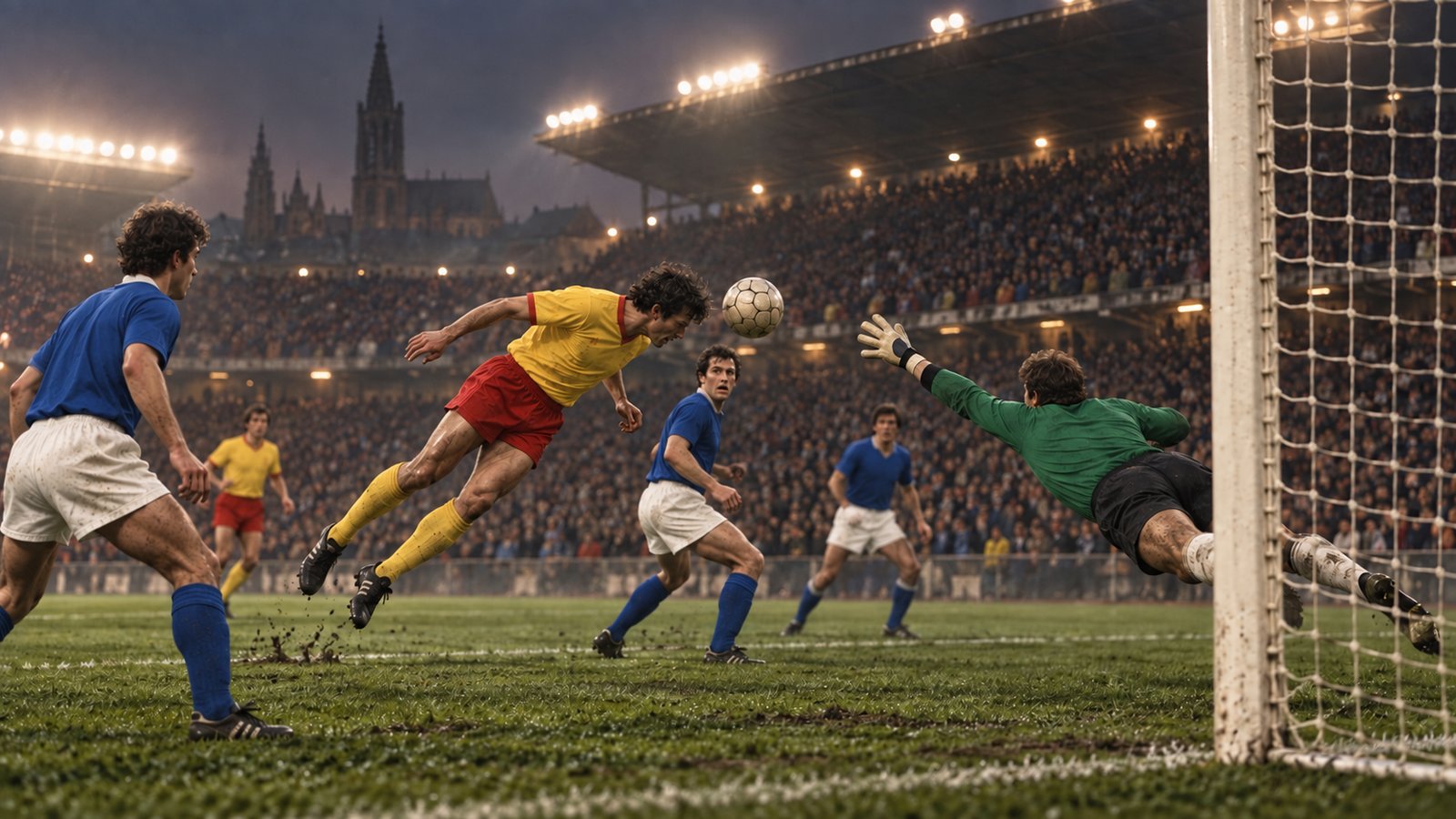
The first leg took place behind Mechelen’s Kazerne on 1 February 1989. John Bosman scored after sixteen minutes. De Wilde added another one minute later, turning the opening from a useful start into a sudden crisis for PSV. Bosman struck again in the 50th minute. Mechelen had built a 3–0 lead against the champions of Europe before the tie had reached its halfway point.
Seven days later in Eindhoven, PSV won the second leg 1–0. That result changed the evening without changing the trophy. Mechelen completed a 3–1 aggregate victory. The two games also revealed the flexibility behind the rise. The first leg demanded aggression and ruthless use of momentum; the second demanded acceptance that PSV would push forward and that the three-goal margin had to be guarded rather than decorated.
The distance between the two cities was small, but the symbolic distance was enormous. PSV represented the summit of Dutch football and had beaten Benfica on penalties to become European champions. Mechelen had now defeated PSV as well as Ajax, the two Dutch clubs holding Europe’s major cups when the Belgian run began.
The Peak Continued Into the League
The Super Cup did not close the competitive peak. Mechelen won the Belgian championship in 1988–89, the club’s first league title since 1948. In the Cup Winners’ Cup, they returned as holders and advanced through Avenir Beggen, Anderlecht and Eintracht Frankfurt before Sampdoria stopped them in the semi-final. The title defence therefore lasted six more European ties; Strasbourg had not emptied the side.
That concentration of results makes the story unusually complete. In less than two years, Mechelen won the Belgian Cup, the Cup Winners’ Cup, the European Super Cup and the Belgian league. They also reached another European semi-final. Preud’homme later became one of the defining goalkeepers of his generation. Koeman, Ohana, Emmers and Clijsters were internationals, while De Mos had already won the Cup Winners’ Cup with Ajax in 1987 before defeating his former club in the next final.
The project did not establish a permanent European power. Cordier’s money and the squad’s peak could not be reproduced indefinitely, and Belgium’s place in the club hierarchy became less forgiving in the decades that followed. Yet permanence is the wrong test. Mechelen did enough in a compressed period to remove luck as the main explanation.
The header in Strasbourg remains the clean image of the rise, but the stronger evidence surrounds it: no defeat during the 1987–88 European campaign, six wins in eight matches before the final, another victory over the European champions, then a domestic championship. One goal beat Ajax. The months on either side proved why it could happen.
Sources
KV Mechelen club history and honours; Rec.Sport.Soccer Statistics Foundation European competition records; Racingstub Strasbourg match history; UEFA match record.