
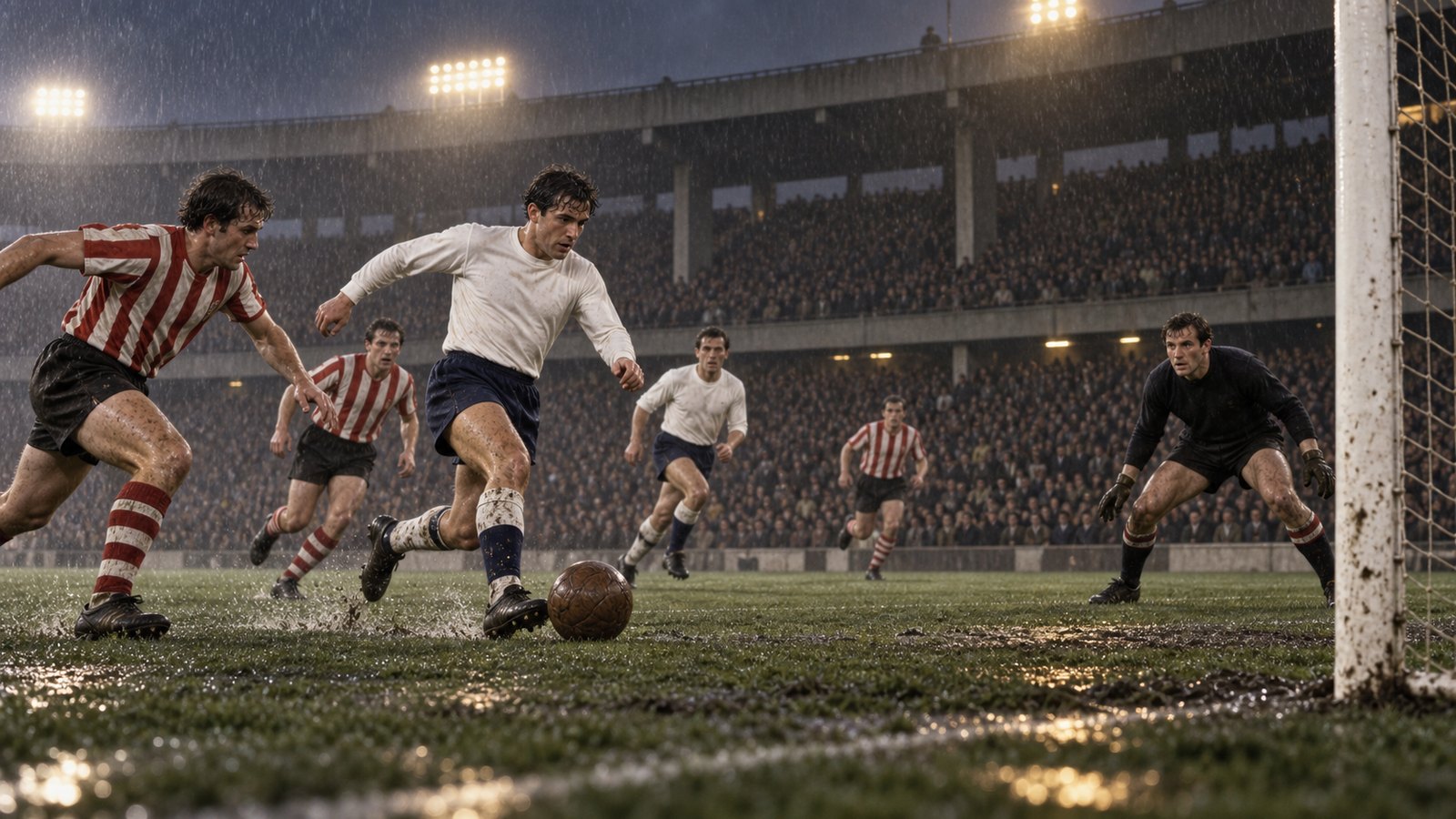
The first goal arrived after sixteen minutes in Rotterdam. Jimmy Greaves, twenty-three years old and already English football’s most feared finisher, put Tottenham Hotspur ahead against Atlético Madrid. John White added a second before half-time. Atlético pulled one back from the penalty spot after the interval, but the final did not tighten. Terry Dyson scored, Greaves scored again, and Dyson made it 5-1 with five minutes left.
Tottenham’s victory on 15 May 1963 was the first by a British club in a major European competition. The score can make it look like one dazzling night detached from everything around it. The more revealing story begins two years earlier, with a domestic double, and runs through a European campaign that repeatedly forced Bill Nicholson’s side to answer a different question: could their fast, attacking football travel, recover from setbacks and still overwhelm the defending champions?
Rotterdam began at Tottenham’s preferred speed
The final was played at Feijenoord Stadion before roughly 49,000 spectators. Atlético arrived as holders of the European Cup Winners’ Cup. Their side included captain Enrique Collar and experienced defenders Feliciano Rivilla and Jorge Griffa. Tottenham brought the core that had won the English league and FA Cup double in 1960–61 and retained the FA Cup in 1962.
Danny Blanchflower captained from midfield. Bill Brown was in goal behind Peter Baker, Maurice Norman and Ron Henry. Tony Marchi worked beside Blanchflower, with Cliff Jones, White, Bobby Smith, Greaves and Dyson forming an attacking line rich in distinct threats. Jones carried the ball at speed, Smith occupied central defenders, White found pockets behind them, and Greaves needed very little room.
That variety mattered against a side defending its trophy. Tottenham were not waiting to turn the final into a patient examination. Greaves’s opening goal established the pace; White’s 35th-minute finish rewarded the pressure. Atlético’s penalty in the 47th minute made the score 2-1, close enough to create doubt. Tottenham answered by widening the game rather than protecting the margin.
Rangers made the first round a shootout
Tottenham entered the Cup Winners’ Cup because of their 1962 FA Cup victory. They received a bye in the preliminary round, then met Rangers in the first round. The pairing gave the campaign immediate weight: two British clubs, each accustomed to domestic crowds and expectation, playing for a place in a still-young European tournament.
The first leg at White Hart Lane ended 5-2. That was not a score that invited a cautious identity in the return. Tottenham went to Glasgow and won 3-2, completing an 8-4 aggregate victory. Across two matches, the attack had scored eight while the defence had conceded four. The tie advertised both the strength and the risk of the side.
The aggregate was already 5-2 when the teams reached Ibrox, yet the return still asked a specific question. Tottenham could protect three goals and invite pressure, or keep making Rangers defend. Winning 3-2 away confirmed the second choice. Five goals in London had not been a one-night accident; the attack could create three more in Glasgow. That experience gave the campaign a useful foundation before the quarter-final presented a much harsher reversal.
It also removed any illusion that European progress required Tottenham to suppress their best quality. Nicholson could ask for control without replacing initiative with fear. The ball moved quickly toward players who understood one another from the double-winning season. European opposition changed the setting and the travel; it did not erase the combinations already learned in English competition.
Bratislava supplied the warning
The quarter-final against Slovan Bratislava opened badly. Tottenham lost the away leg 2-0. In a knockout competition without a group stage or a safety net, that margin placed the entire campaign inside the return at White Hart Lane. The response was emphatic: Tottenham won 6-0 and advanced 6-2 on aggregate.
This was a different kind of evidence from the Rangers tie. An open two-leg exchange had shown Tottenham could outscore a strong opponent. Bratislava showed they could absorb an away defeat, return home with the problem clearly defined, and score six without conceding. The European campaign was becoming a sequence of corrections rather than a smooth march.
OFK Belgrade provided the semi-final opposition. Tottenham won 2-1 away and 3-1 at home, a 5-2 aggregate result. Atlético’s route was narrower. The defending champions beat Hibernians 5-0, Botev Plovdiv 5-1 and Nürnberg 3-2 on aggregate. Both finalists had negotiated three rounds, but Tottenham had scored nineteen goals in six played matches before Rotterdam.
Greaves, White and Dyson split the final
The final’s five Tottenham goals did not come from one source. Greaves scored in the 16th and 80th minutes. White struck in the 35th. Dyson found the net in the 67th and 85th. Three scorers, separated across the match, prevented Atlético from solving the problem by containing only one forward.
Atlético’s best moment came immediately after half-time. Collar converted a penalty in the 47th minute, reducing Tottenham’s lead to one. For twenty minutes the match had a new pressure. The next goal would either restore distance or pull the holders level. Dyson supplied it in the 67th.
From there, the score expanded rapidly. Greaves’s second arrived thirteen minutes later, and Dyson’s second followed five minutes after that. Tottenham had taken a final that was still live at 2-1 and closed it with three goals from the 67th minute onward. The final aggregate totals did not matter now. There was no return leg, only a widening gap under the Rotterdam lights.
The sensory memory of the game belongs to motion: white shirts breaking into space, a dark pitch under artificial light, and repeated attacks arriving before Atlético could reset. The result was decisive without being sterile. Tottenham conceded, felt the final narrow, then made their response visible on the scoreboard.
The win completed a brief, brilliant sequence
Tottenham’s own year-by-year history places the achievement plainly: 1963, winners of the European Cup Winners’ Cup, the first British club to win a major European competition. It came after the 1961 double and the 1962 FA Cup, giving Nicholson’s side domestic proof before its continental breakthrough.
The trophy also belonged to a team near a turning point. White died the following year after being struck by lightning on a golf course. Several members of the final side retired or moved on before Tottenham’s next major trophy, the 1967 FA Cup. Greaves was the only member of the 1963 starting eleven who also played in that later final.
That compressed timeline sharpens Rotterdam’s importance. The 5-1 was neither the opening chapter of an endless dynasty nor an isolated upset by strangers. It was the European peak of a group that had already changed the scale of Tottenham’s domestic ambition. The same understanding that produced the double survived long enough to travel through Glasgow, Bratislava and Belgrade, then break open a final against the holders.
Greaves’s place in the story extends beyond his two final goals. Tottenham’s official chronology credits him with 37 league goals in 1962–63, the club’s highest league total in one season. Rotterdam therefore caught a prolific forward at full speed, but it did not reduce the side to him. White and Dyson accounted for three of the five goals, Smith occupied the central contest, and Blanchflower directed the match behind them. The spread of scorers matched the campaign’s larger theme: Nicholson had stars, yet the attack remained difficult to narrow to one route.
British clubs would collect many European trophies after 1963. Tottenham’s distinction is chronological, but the football gave the date substance. The first winner did not edge across the line through a goalless calculation. It scored five, used three different scorers and answered Atlético’s only goal with a twenty-minute burst. The route had tested recovery. Rotterdam rewarded expression.
Sources
Tottenham Hotspur year-by-year history and honours archive; Rec.Sport.Soccer Statistics Foundation; European Cup Winners’ Cup final reference chronology.