
Marseille 1993 Was Not Just a Tainted Triumph
The Triumph and the Stain Arrived Together
Marseille’s 1993 European Cup win should have been a clean coronation. A French club beat Milan in Munich, Basile Boli’s header became a national memory, and Bernard Tapie’s project seemed to have dragged Ligue 1 into a new continental age. Yet the trophy quickly became impossible to separate from the scandal that followed. The VA-OM affair did not erase the final, but it changed the way the achievement could be remembered.
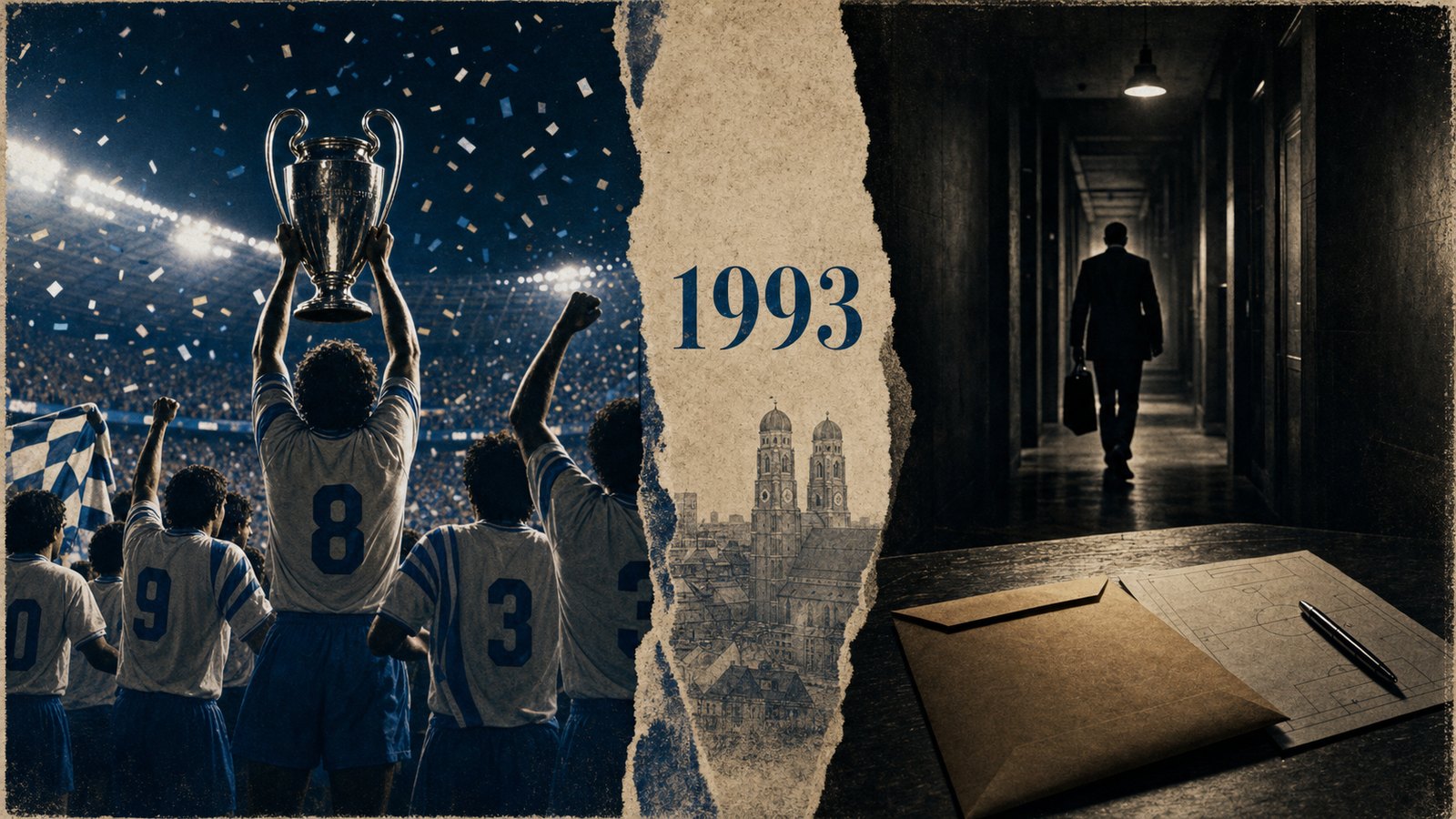
That tension is what makes Marseille 1993 more than a morality tale. On the pitch, the club had assembled a serious team with stars, experience, and tactical authority. Off the pitch, investigators examined allegations that Valenciennes players had been approached before a league match near the end of the season. The resulting case led to punishments that included Marseille being stripped of the French league title for 1992-93 and prevented from defending their European crown. Glory and institutional collapse were not separate chapters. They collided in the same summer.
Tapie’s Project Was Built to Win Now
Bernard Tapie did not treat Marseille like a slow civic project. He wanted a club capable of dominating France and challenging Europe immediately. That urgency produced a squad with the quality to beat Milan, but it also created a sense that the season was a campaign to be forced over the line. The club had lost the 1991 European Cup final to Red Star Belgrade on penalties. By 1993, patience was not the mood around the project.
The final in Munich made the sporting argument. Marseille were compact, brave, and mature enough to deny a powerful Milan side. Boli’s goal from a corner before half-time gave them something to protect, and they protected it with the concentration of a team that understood exactly what the night meant. Nothing about the final itself needs to be diminished to understand the scandal. The tragedy of the story is that the football was strong enough to stand, and the institution still managed to poison the frame around it.
The Valenciennes Match Changed the Meaning of the Season
The league match against Valenciennes came days before the European final. The accusation was not that Marseille had bribed their way through Europe, but that people connected to the club had tried to ease a domestic fixture so players could avoid injury and preserve energy before Munich. That distinction matters. It also does not rescue the season from damage. A competition’s credibility depends on ordinary matches being real, not merely on finals being dramatic.
When the affair surfaced, the question was not only whether rules had been broken. It was whether the machinery behind a champion had treated the league as something to manage rather than something to contest. The scandal turned envelopes, phone calls, and testimony into part of the football story. Supporters who wanted to remember Boli rising above Milan also had to live with the image of a domestic match being pulled into a courtroom narrative.
Why the European Cup Remained and the League Title Did Not
Marseille remain listed as the 1993 European champions. The French league title for that season was stripped. That split outcome is one reason the story remains so combustible. It lets different arguments survive at once. One side points to the final and says the team earned its European night. Another points to the domestic scandal and says the institution forfeited the right to be remembered innocently.
Football often wants verdicts to be tidy. Marseille 1993 refuses. The European run included real performances by real players against elite opponents. The scandal involved real consequences that reshaped the club’s future. The club later faced relegation to the second tier for financial irregularities, deepening the sense of a project that had spent its credibility as quickly as it had spent its money. The same ambition that made Marseille thrilling also made the collapse feel structural.
The Players Were Caught Inside an Institutional Story
One of the hardest parts of the Marseille story is separating the players’ work from the institution around them. Boli’s header was not imaginary. Fabien Barthez’s youth, Didier Deschamps’ authority, Rudi Voller’s experience, Abedi Pele’s craft, and Marcel Desailly’s power were part of a formidable side. They did not need a scandal to look like footballers capable of winning a European final.
But players do not control the whole meaning of a club season. Executives, owners, fixers, and legal bodies can change the memory attached to a match after the whistle. Marseille’s triumph feels haunted for that reason. The football image is vivid: blue and white bodies around a trophy, Milan beaten, France celebrating. The institutional image is just as strong: a corridor, an envelope, a hearing, a title removed.
A Warning About Winning Without Trust
The lesson of Marseille 1993 is not that ambition is suspicious. Football needs ambition. The lesson is that winning loses its simplest power when trust collapses around it. A club can have brilliant players, a clear tactical plan, and a historic night, yet still leave supporters arguing about the terms under which the achievement should be admired.
That warning has only become more relevant. Modern football is full of projects built to win quickly: wealthy owners, aggressive recruitment, political pressure, and legal departments never far from sporting departments. Marseille’s 1993 story sits near the beginning of that modern feeling. It is not just a scandal in old newspaper ink. It is a reminder that the scoreboard can tell the truth about a match while the institution around it makes the season impossible to read cleanly.
The Trophy Still Glitters, but Not Alone
Marseille’s European Cup remains in the record books, and it should. The final was played and won. But the trophy does not sit alone in memory. It sits beside the stripped league title, the Valenciennes case, Tapie’s fall, and the uncomfortable knowledge that football’s most powerful stories are not always decided on the pitch. Sometimes the pitch gives the image, and the paperwork gives the aftertaste.
This is why 1993 endures. It contains celebration, brilliance, corruption, punishment, and argument in one compressed season. Marseille reached the summit of Europe and then discovered that a summit can become a witness stand. The club did not simply win and fall. It won in a way that forced football to ask what victory is worth when trust has already begun to crack.
France Wanted the Night to Mean Something Larger
The first French European Cup winner carried national weight. Marseille’s victory was not only a club achievement; it was a claim that French football could stop being nearly-there in the biggest continental conversation. That is one reason the scandal cut so deeply. The country had been offered a clean symbol and then handed a file full of complications. A final that should have expanded pride instead became an argument about what could be safely celebrated.
There is also a footballing irony in the Milan result. Marseille beat a side associated with defensive control, European authority, and tactical certainty. They did not stumble into the trophy through chaos. They won a tense, narrow final by imposing enough order to make one goal decisive. The later disorder came from governance and conduct, not from the quality of the final performance. That contrast is what keeps the story from settling into a simple sneer.
The Aftermath Became Part of the Tactics of Power
The punishments and legal consequences showed that football power is never only about formations. It also lives in owners’ offices, league procedures, disciplinary committees, and public trust. Tapie’s Marseille had tried to accelerate history. When the machine broke, it revealed how many non-football mechanisms had been packed around the team. Recruitment ambition, political confidence, media attention, and legal exposure all moved together.
That is why the season still feels contemporary. Modern clubs often present winning as proof that the project is healthy. Marseille showed that a project can win while already carrying the seeds of collapse. The medal ceremony and the investigation were not rival myths; they were two views of the same institution. One was lit by floodlights. The other was lit by interrogation rooms and committee tables.
Sources
- UEFA historical records for the 1992-93 Champions League final
- Ligue de Football Professionnel records on the 1992-93 French title sanction
- Contemporary reporting on the VA-OM affair
- Simon Kuper, Football Against the Enemy