
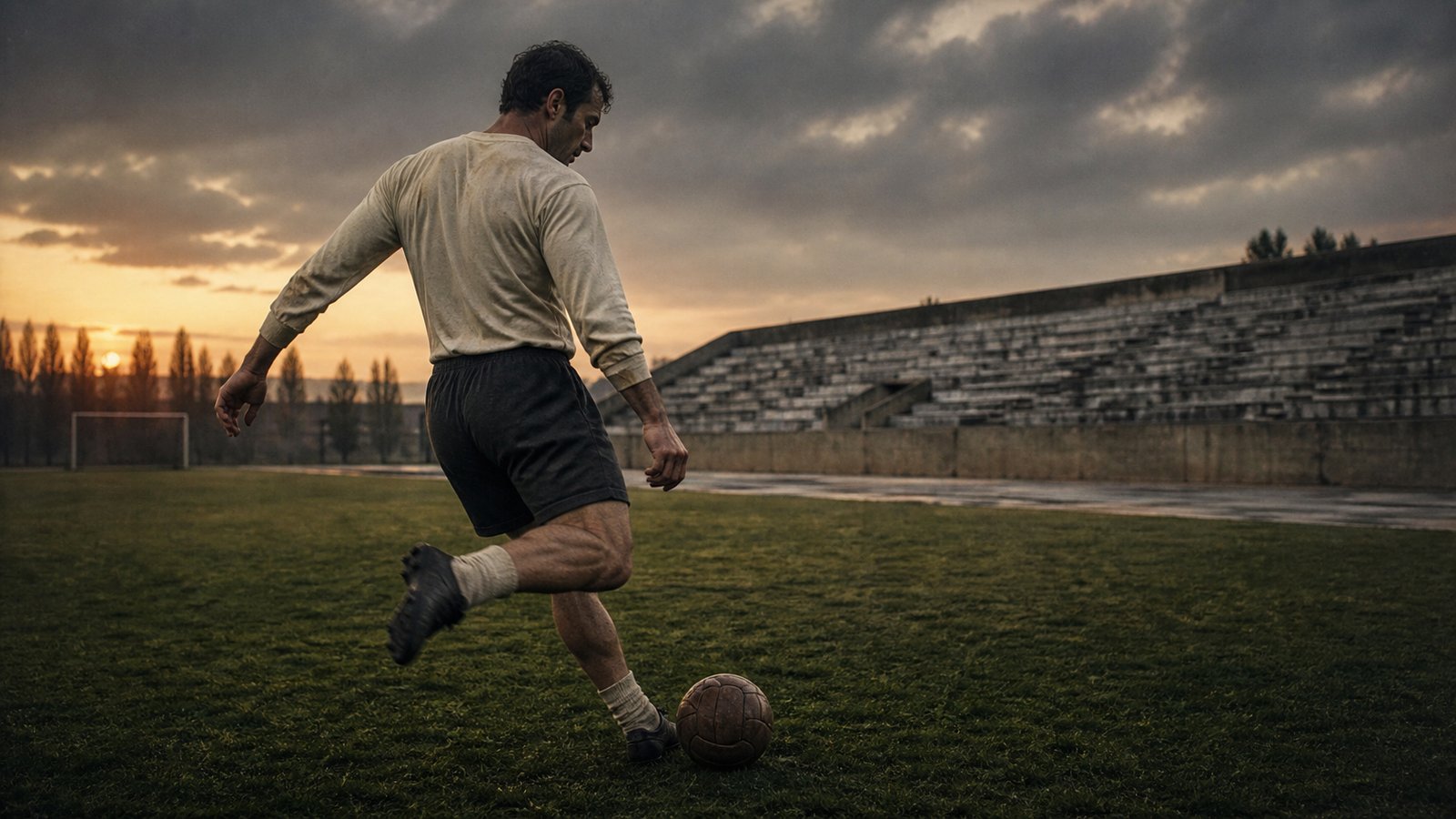
Ferenc Puskás arrived at Real Madrid carrying two incompatible reputations. One belonged to the captain of Hungary’s Olympic champions and the inside-left who had helped dismantle England at Wembley. The other belonged to a 31-year-old exile who had spent two years outside elite competition and faced doubts about his conditioning.
Real Madrid did not sign a rising prospect in 1958. They signed a footballer whose prime appeared to have been interrupted by politics, suspension and age. Puskás answered by changing his body without changing the left foot that defined him. Less than two years later, he scored four goals in a European Cup final.
The return is more revealing than a simple list of trophies. It shows how a player rebuilt a career after the usual sequence — development, peak, decline — had been broken from outside.
The first career had already reached Wembley
Born in Budapest in 1927, Puskás developed at Kispest, the club later reorganized as Honvéd. He became the attacking reference point of Hungary’s great national side. The numbers remain startling: 84 goals in 85 internationals, according to the statistical record maintained by RSSSF.
Hungary won Olympic gold in 1952. In November 1953, they beat England 6–3 at Wembley, with Puskás producing the drag-back that sent Billy Wright past the line of the ball before a fierce finish. The match announced that England’s assumptions about its own tactical authority had expired.
The peak did not end with complete reward. Hungary entered the 1954 World Cup final as favorites and lost 3–2 to West Germany after leading by two goals. Puskás played despite an ankle injury sustained earlier in the tournament. His late apparent equalizer was disallowed for offside.
By 1956, he was not an obscure player searching for recognition. He was a captain, an Olympic champion and the most visible attacker in a national team that had reshaped elite football. What followed placed that entire standing at risk.
Honvéd left Hungary and history closed behind it
Honvéd were abroad for European competition when the Hungarian uprising of 1956 was crushed by Soviet forces. The players faced decisions larger than football. Puskás did not immediately return to Hungary, and his refusal brought a suspension that kept him away from official elite matches.
Two years is a severe interruption at any stage. For a player approaching 30, it can look terminal. Clubs could remember the left foot while questioning whether the body could still create room for it. The old achievements offered no guarantee that speed of thought would survive without match rhythm.
Exile also removed the familiar structure around him. At Honvéd and with Hungary, Puskás had played among teammates shaped by shared coaching and repeated movement. In Spain, he would need to enter a different dressing room, learn new relationships and accept that his status had to be earned again.
Real Madrid made the wager in 1958. Puskás was 31. Reports of concern about his weight followed him into the move. The practical response was training: reducing the excess, rebuilding condition and preparing for a level that would expose any compromise.
Madrid asked for the left foot, not the old uniform
Puskás did not need to reproduce Hungary’s national-team structure in Madrid. Real already had Alfredo Di Stéfano, an attacker who moved across lines, organized possession and arrived in scoring positions. The challenge was to form a partnership without making either player smaller.
Their skills interlocked. Di Stéfano’s movement could pull a defense across the pitch. Puskás needed only a fraction of space to strike with his left foot. He was stocky rather than elegant in the conventional visual sense, but his balance let him shoot early and hard from angles that encouraged a defender to delay the block.
Age altered the emphasis. A younger Puskás had carried transitions and driven the national side as captain. The Madrid version concentrated his work around combinations, positioning and finishing. This was adaptation without retreat. He did less of what the interruption had made expensive and preserved what opponents still could not contain.
The partnership accumulated goals quickly. Real Madrid’s own historical record credits Puskás with 242 in 262 official matches. That rate belongs neither to a ceremonial veteran nor to a famous name protected by teammates. It records sustained production after the career had supposedly missed its window.
Hampden made the comeback measurable
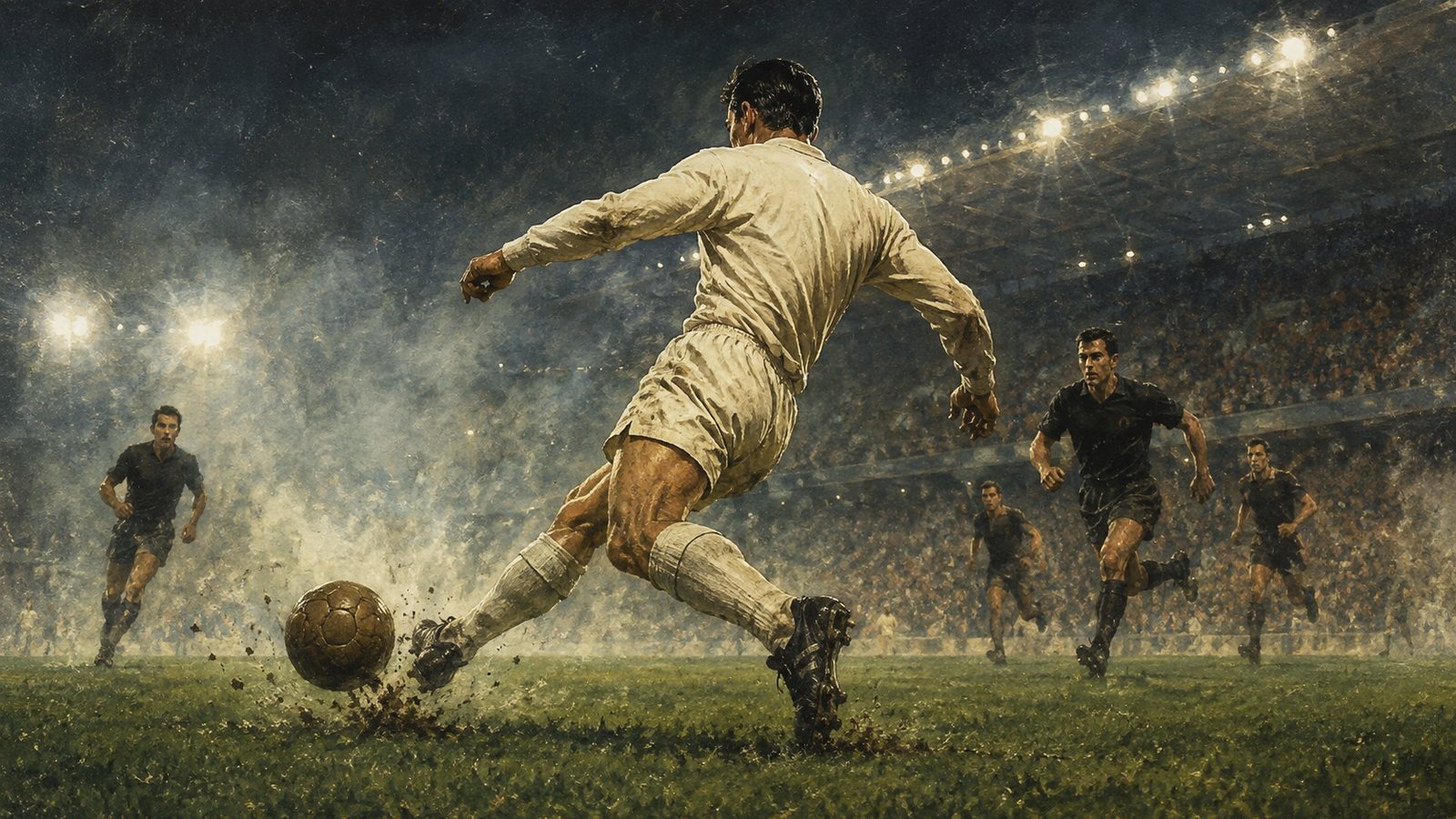
The 1960 European Cup final placed Real Madrid against Eintracht Frankfurt at Hampden Park. The German side scored first. What followed became one of the competition’s defining displays: Real won 7–3, Di Stéfano scored three, and Puskás scored four.
Four goals in a European final would stand as a complete career monument. In Puskás’s case, it also answered the specific doubts attached to his return. The match demanded repeated movement, timing and finishing against an opponent strong enough to reach the last night. He did not contribute one nostalgic flash. He kept arriving and kept converting.
The distribution between the two stars revealed the partnership. Di Stéfano’s hat-trick did not reduce Puskás’s space, and Puskás’s four did not make Di Stéfano secondary. Eintracht had to solve attacks emerging from different depths and could not lock onto one fixed source.
The setting added a historical echo. Seven years earlier, Puskás had helped Hungary overwhelm England at Wembley. Now another British stadium held the clearest proof of his second football life. For more on the match’s atmosphere and the defeated side, see the night Hampden cheered the team that lost 7–3.
The second career lasted long enough to become larger
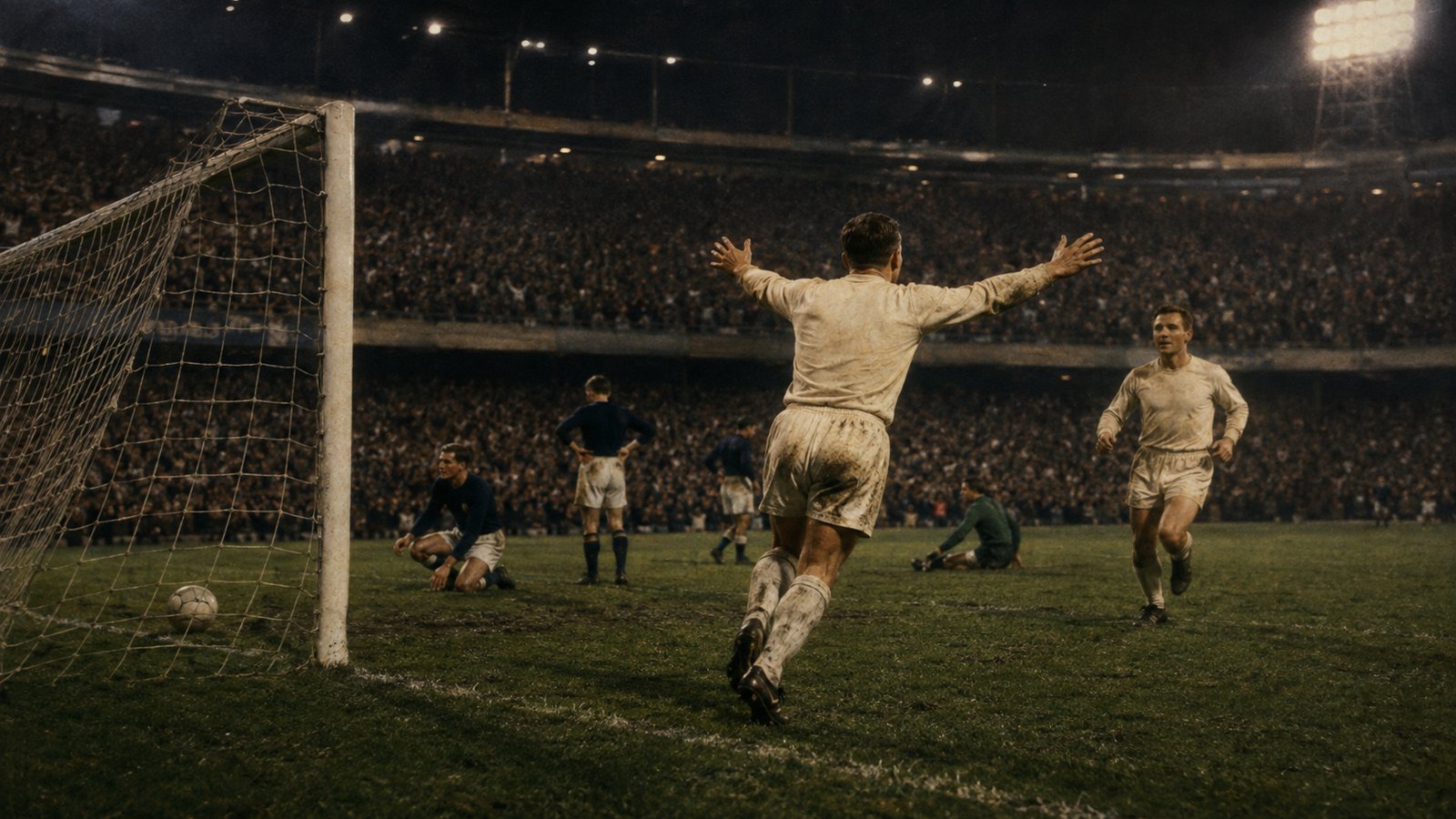
Hampden was not the final burst of an aging player. Puskás later scored three times in the 1962 European Cup final, although Benfica won 5–3. With Madrid he collected five Spanish league titles and three European Cups. He also became a Spanish citizen and represented Spain at the 1962 World Cup.
Those achievements do not replace the Hungarian career. The Olympic title, the Wembley victory and the 84 international goals belong to a distinct football world. Nor does the Madrid success erase the rupture of 1956. Exile divided Puskás’s life into before and after.
The 1962 final adds an important check against reducing his Madrid years to one perfect evening. Puskás scored three against Benfica and still left without the cup because the Portuguese side won 5–3. His finishing survived; control of the match did not. The episode separates individual production from team outcome and makes the four at Hampden look less like a single accident. He could repeat the highest-level scoring demand even when the collective result changed.
Representing Spain at the 1962 World Cup made the division in his career official as well as personal. The former Hungary captain wore another national shirt while his club work remained centred in Madrid. It was an outcome produced by exile, citizenship and continued selection-level performance, not a tidy transfer of identity. The record has to hold both national careers without pretending that the route between them was ordinary.
What makes his biography unusual is that the division remained visible while both halves became historically complete. The first Puskás was captain of a national side that altered how Europe understood movement and technique. The second was an elite club scorer who adjusted to a new country, a new partner and an older body.
Football often treats interruption as decline because time continues while competition stops. Puskás could not recover the missing seasons. He recovered the capacity to decide what the following seasons meant.
At 31, Real Madrid were buying uncertainty around a famous left foot. At Hampden, that uncertainty became four goals. The transformation was not a return to the exact player who had left Hungary. It was proof that a player could lose his setting, his rhythm and two prime years without losing the part of his game that opponents understood only after the shot had gone.
Sources
Real Madrid; The Guardian; RSSSF.