
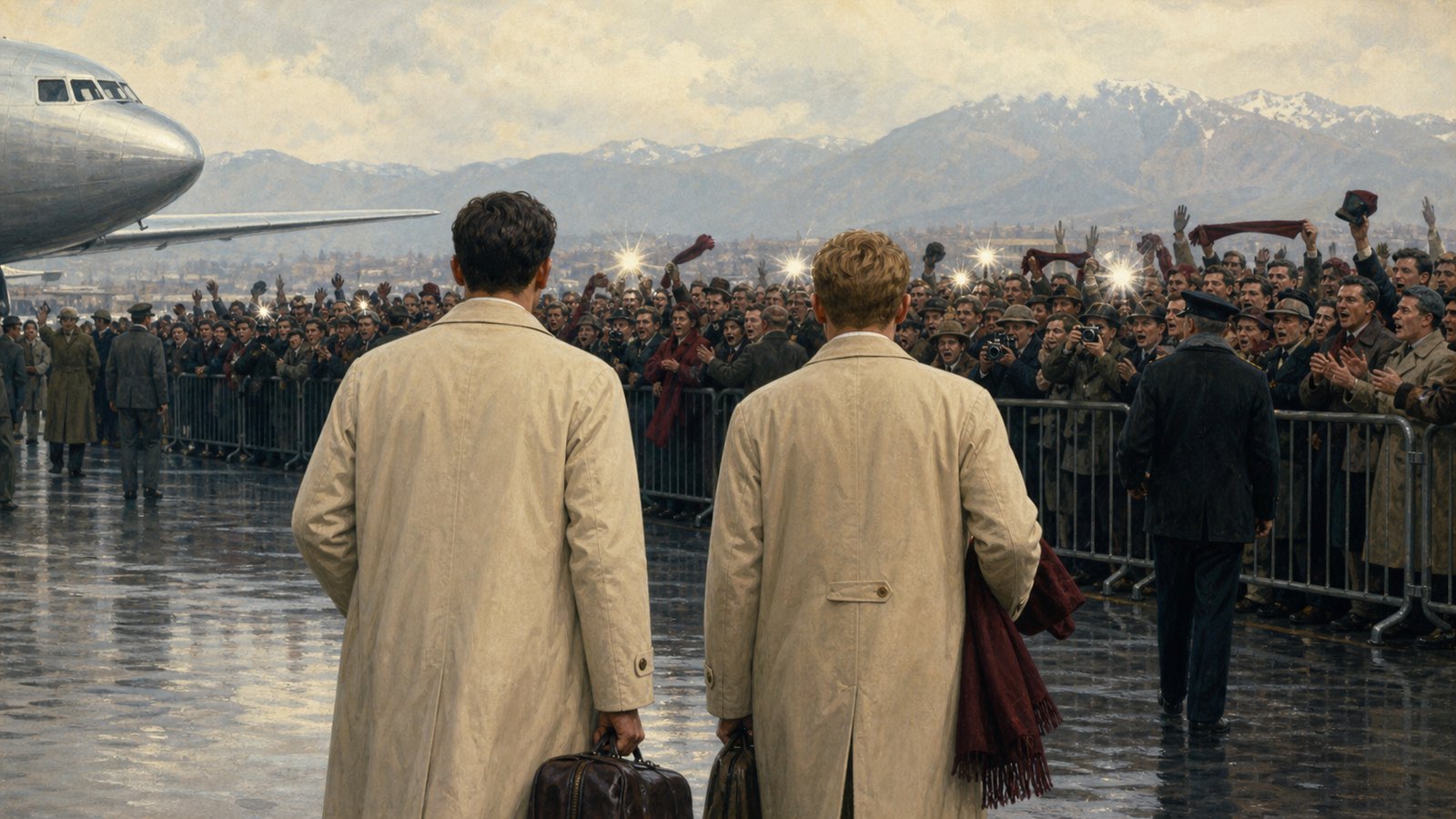
The airport crowd in Turin had come to see two young forwards step off a plane. Denis Law and Joe Baker arrived in the summer of 1961 to cheers, newspaper attention and expectations usually reserved for established stars. Both were 21. Both had left British clubs for a league that could offer more money, grander stages and a far stricter working life. Within months, one would be recovering from catastrophic injuries and the other would be looking for a route home.
Law’s Italian season is often compressed into a line between Manchester City and Manchester United. The year deserves its full shape. Torino paid a British-record fee, paired him with Baker, watched him score quickly, and then tried to control a player whose independence was part of what made him dangerous. His exit became a contest over who could decide his next club. Long before transfer sagas unfolded minute by minute on television, Law’s future was being argued across hotels, offices and airports.
£110,000 for a 21-Year-Old Forward
Law had already set one British transfer record when Manchester City bought him from Huddersfield Town. He then scored 21 league goals in 44 appearances for a struggling City side in 1960–61. Italian clubs had good reasons to look north. John Charles had flourished after leaving Leeds United for Juventus in 1957, while Serie A’s wages and spending power could outstrip what English clubs offered even after Britain’s maximum wage was abolished.
Agent Luigi Peronace recommended Law to Torino. The fee was reported as £110,000, a record for a British player. Torino also paid £75,000 for Baker, the Hibernian striker who represented England despite growing up largely in Scotland. Their joint arrival carried more than sporting ambition. Torino had lost the great Grande Torino side in the 1949 Superga air disaster, suffered relegation in 1959 and returned immediately to Serie A. The club wanted young attackers who could pull it closer to Juventus and the Milan powers.
The welcome made the scale of the bet visible. Thousands greeted the newcomers at the airport. Sports papers followed them, and Torino supporters quickly had evidence that the excitement was not empty. Law scored on his home debut against Vicenza. He struck four times in his first six league matches and seven times in his first nine. A victory over Juventus helped earn him the status of fuoriclasse, the Italian label for a player outside the ordinary class.

The Training Ground Had Different Rules
Law admired Italian training’s attention to detail, but daily life asked him to surrender freedoms he had taken for granted. Torino gathered players in a hotel 24 hours before matches. Curfews were enforced. Tactical preparation was prolonged, and defenders treated every duel as a test of patience as much as technique. Law and Baker accumulated fines when they resisted the routine.
The press made privacy almost impossible. Photographers waited outside the apartment the pair shared in central Turin. A walk could become a story; an evening out could become proof of indiscipline. In January 1962, before an away match at Venezia, photographers trailed them through the city. Baker confronted one of them, Celio Scapin, and the dispute became physical. Law stepped in to separate them, yet the photographs guaranteed front-page attention. Baker was dropped and fined. Law played as Torino won 1–0.
There was also uncertainty before Law had played a competitive minute. Internazionale claimed he had signed a pre-contract and demanded his release from Torino. The disagreement was settled, but it showed how many hands could reach into a major transfer: clubs, intermediaries and contract clauses all competed with the footballer’s own intentions. That tension would return at the end of the season.
A White Alfa Romeo and the Garibaldi Monument
On 7 February 1962, Torino’s players met for dinner. Law, his visiting brother Joseph and Baker stayed out afterward, drinking whisky and listening to music until roughly four in the morning. Baker had collected a white Alfa Romeo Giulietta that day. He drove them along Corso Cairoli, approached a roundabout too fast, clipped the kerb and overturned the car near the River Po. The vehicle finally struck a monument to Giuseppe Garibaldi.
Law escaped with comparatively minor injuries. Baker suffered a broken jaw and nose, damage to both cheekbones and the roof of his mouth, and required several operations. He had been unconscious and, when he woke, feared that he had killed both Law brothers. He never played for Torino again. La Stampa covered the crash in its news and sports pages; an image showed a shaken Law beside Baker’s hospital bed.
The episode cannot be reduced to a colourful football anecdote. A friendship, a career and three lives had come within metres of a very different ending. Torino excluded Law for several matches as punishment. When he returned, the easy promise of the airport reception was gone. His single year abroad had become physically and emotionally costly, even though his performances remained good enough to make him the club’s leading league scorer.

Ten Goals Did Not Settle Who Owned the Next Move
Law finished with 10 goals in 27 Serie A appearances. Torino’s own remembrance records him as the club’s top scorer and Serie A’s best foreign player for the season. Supporters compared his speed of thought to Valentino Mazzola and gave him the nickname “Valentino.” On sporting merit, this was no failed expedition. He had adapted quickly enough to impress a league built to frustrate forwards.
Relations around the team had nevertheless broken down. In a Coppa Italia match against Napoli on 25 April, Law ignored an instruction and took a throw-in. According to the account later reconstructed by These Football Times, his own manager asked the referee to send him off. By then Law wanted Britain, and Manchester United wanted Law.
Negotiating the return was anything but direct. Torino president Angelo Filippone’s dealings sent United representatives through meetings and missed meetings across Europe. A £115,000 move to Old Trafford was eventually arranged, setting another British record. Yet when Law went back to Italy to collect his belongings, a Torino executive told him he had instead been sold to Juventus under the terms of his contract.
Law answered with the only leverage he could apply immediately: he left. He boarded a plane to Aberdeen and waited until Juventus withdrew. The player could not write the contract by himself, but no transfer could produce a willing Juventus footballer while he refused to remain in Italy. It was an improvised veto, executed with an airline ticket.
The Year Between Two Manchester Clubs
At United, Law became “The King,” won the 1964 Ballon d’Or and spent 11 seasons at Old Trafford. Looking backward from that success can make Torino feel like a detour. It was closer to an accelerated education. He learned how foreign clubs trained, how tactical discipline could sharpen or suffocate, how fame could erase ordinary space, and how a valuable player could still struggle to direct his own career.
The contrast with Johan Cruyff’s delayed Barcelona debut is useful. Cruyff waited while registration and negotiation caught up with a completed deal. Law acted while rival clubs argued that his signature could carry him somewhere he rejected. A decade later and in a different country, the paperwork still decided when talent became available and whose plans counted.
Law’s departure also belongs beside George Eastham’s challenge to the retain-and-transfer rules. Eastham used a courtroom. Law used refusal and distance. Neither story means players suddenly controlled the market. Each shows a footballer testing the gap between contractual authority and practical consent.
The last image of the season is therefore not a goal. It is a 22-year-old leaving Italy before another club could complete a future on his behalf. Torino had paid a record fee and received ten league goals. Law had gained acclaim, survived a night that nearly killed his closest teammate, and discovered that the hardest contest of his year might begin after the fixtures ended.

Sources
Denis Law Legacy Trust; These Football Times; Football Scotland.