
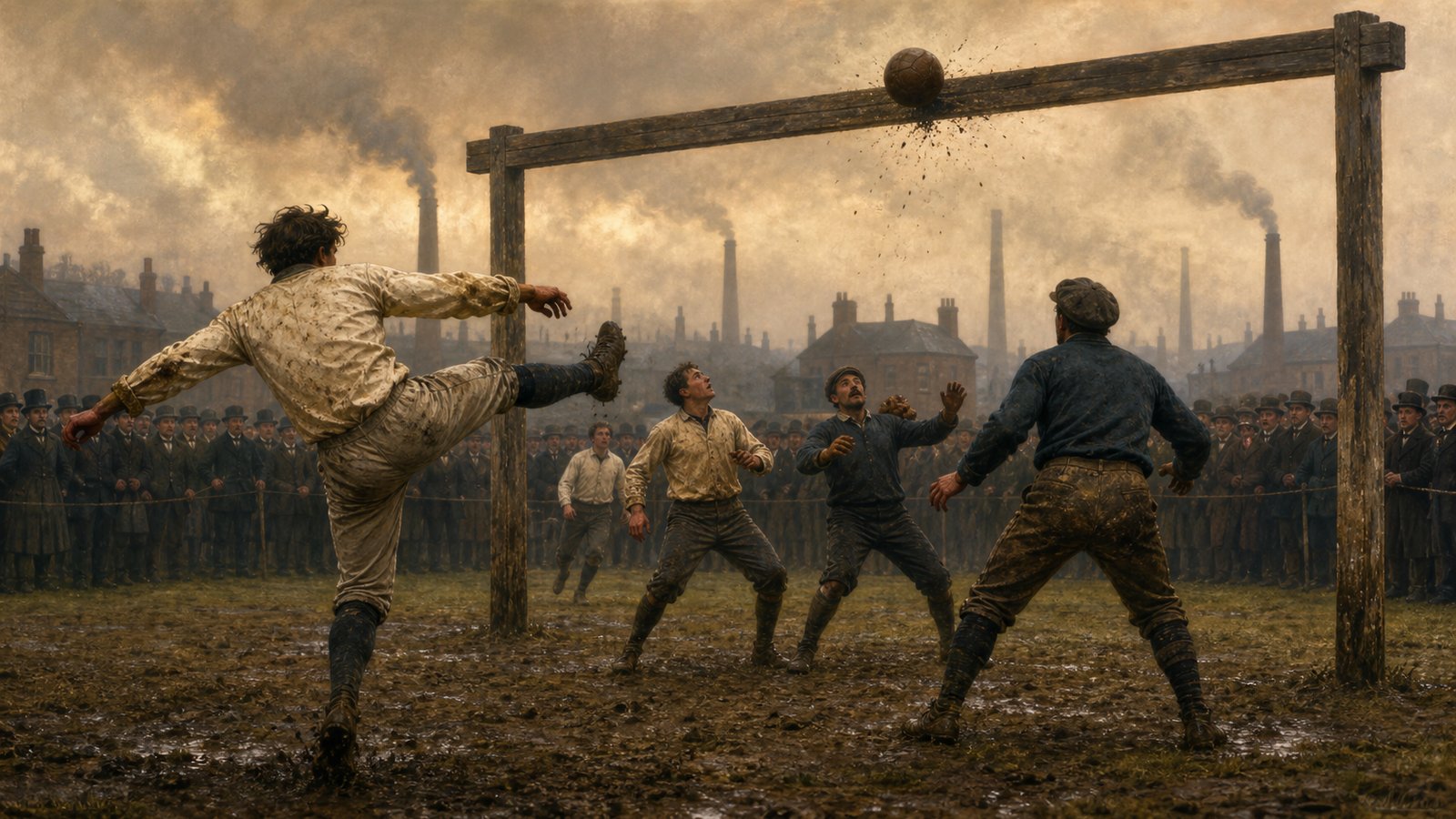
On 30 March 1865, a football report described a player named Dixon kicking “splendidly onto the crossbar” in a match between Sheffield FC and Nottinghamshire FC. The phrase sounds ordinary now. At the time, it marked a disagreement about what a goal physically was.
Sheffield football had already put a ceiling above the space between the posts. The new Football Association in London had not. Under its first code, a shot could pass between the uprights at any height and still count. One city was playing beneath a bar; the other was aiming through an opening that continued into the sky.
The eventual solution was not one brilliant invention adopted overnight. It was a sequence of argument, compromise and material change: local practice, a rejected proposal, a strip of tape, and finally a rigid beam. The crossbar became football’s most familiar boundary because rival rule-makers had to agree not only on a measurement, but on what everyone could see.
Two Posts Left One Question Unanswered
When the Football Association was formed in London on 26 October 1863, its central problem was bigger than goal furniture. Clubs and old public-school players carried different assumptions about handling, hacking and offside. Ebenezer Morley’s call for a common code brought them into the Freemasons’ Tavern, where organised association football began to take a recognizable shape.
Yet the first FA goal was incomplete by modern eyes. Two upright posts stood eight yards apart, but nothing fixed the upper edge. A ball travelling between them counted regardless of height. That definition was easy to write and easy to erect on an open field. It was much harder to judge when a rising shot passed near an imaginary line.
Earlier games had already experimented with ropes, bars and buildings. Sheffield Home of Football records an Uppington school rule from the 1850s requiring the ball to pass under a bar, while an older Surrey game asked players to kick over a “goal rope.” These were not identical sports moving in a straight line toward the modern goal. They show the same practical need appearing in different forms: players wanted a visible boundary in the air.
Sheffield Put a Ceiling on the Goal
Sheffield’s clubs were unusually early rule-makers. A December 1861 report from a Sheffield FC match at Hyde Park referred to the ball being headed under the crossbar for Hallam. The Sheffield code formally adopted a crossbar rule in 1862. By the time the London FA began writing its code a year later, Sheffield players could point to a boundary they had already used in matches.
Sheffield FC argued for the crossbar during the FA’s initial meetings in late 1863. London rejected it. The disagreement mattered because the two centres were not debating an abstract drawing. They were producing codes for clubs that needed to know whether the same shot was a goal in one match and over the goal in another.
The physical evidence in newspaper language is revealing. Bell’s Life reported Dixon striking the crossbar in March 1865. A Leeds Evening Express account later that year said a ball went within a foot of the crossbar during a match involving Sheffield Norfolk and Leeds. Those descriptions imply a horizontal object players and spectators could locate. The goal had acquired a top edge in the football culture around Sheffield, even while London’s written law still allowed open air.
London Chose Tape Before Timber
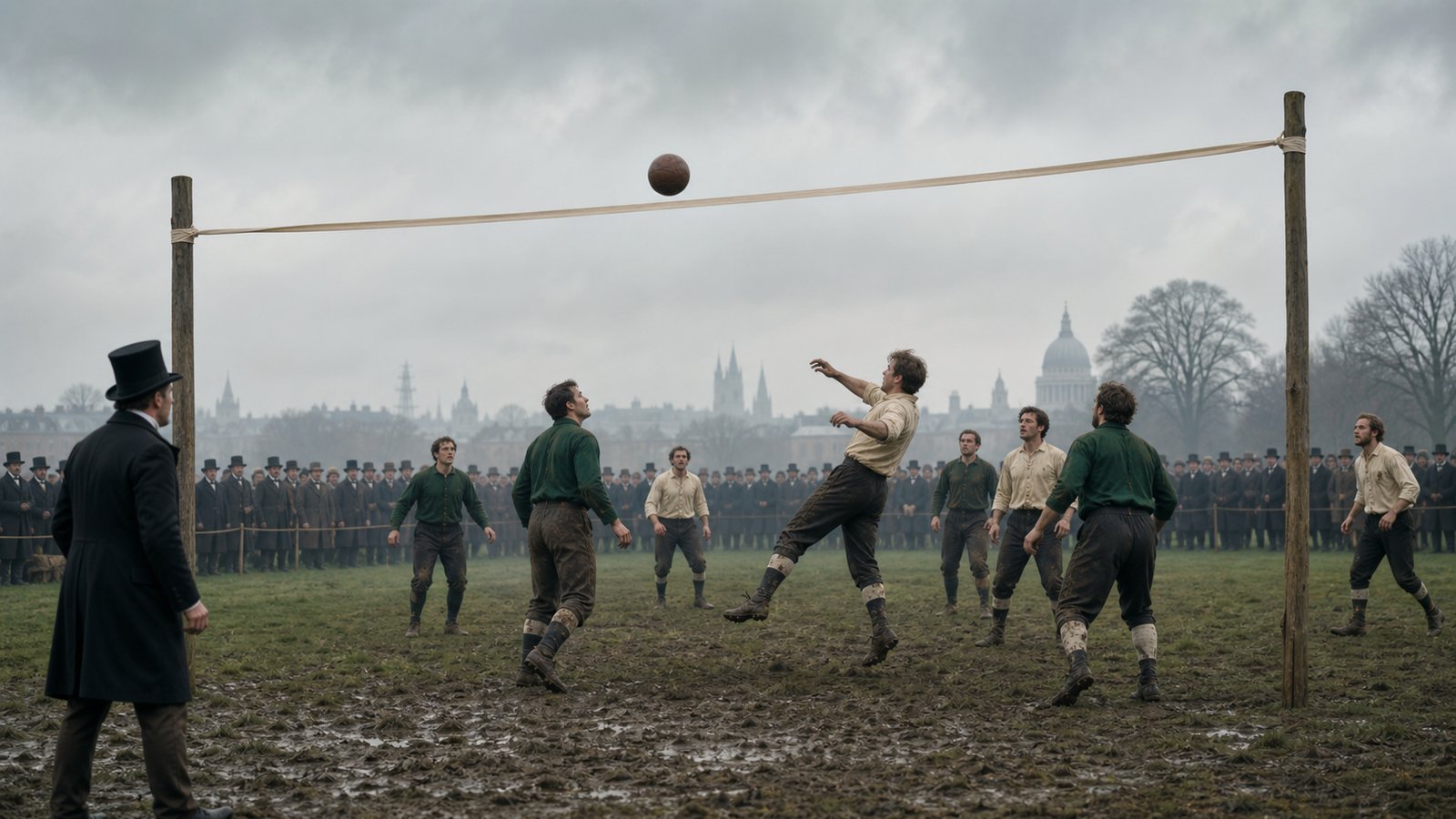
The London FA changed its law in 1866, but it did not immediately copy the solid bar. It introduced tape across the posts. Tape answered the central judging problem: it gave players and umpires a line eight feet above the ground. It was also portable, cheap and suited to clubs assembling a pitch with limited equipment.
But tape and timber behaved differently. A taut strip could sag, loosen in rain, or move when struck. A rigid bar created a rebound. The ball could hit it and return to play, producing a moment that the soft boundary could not reproduce in quite the same way. The choice of material therefore changed more than appearance; it changed what could happen after the shot reached the upper limit.
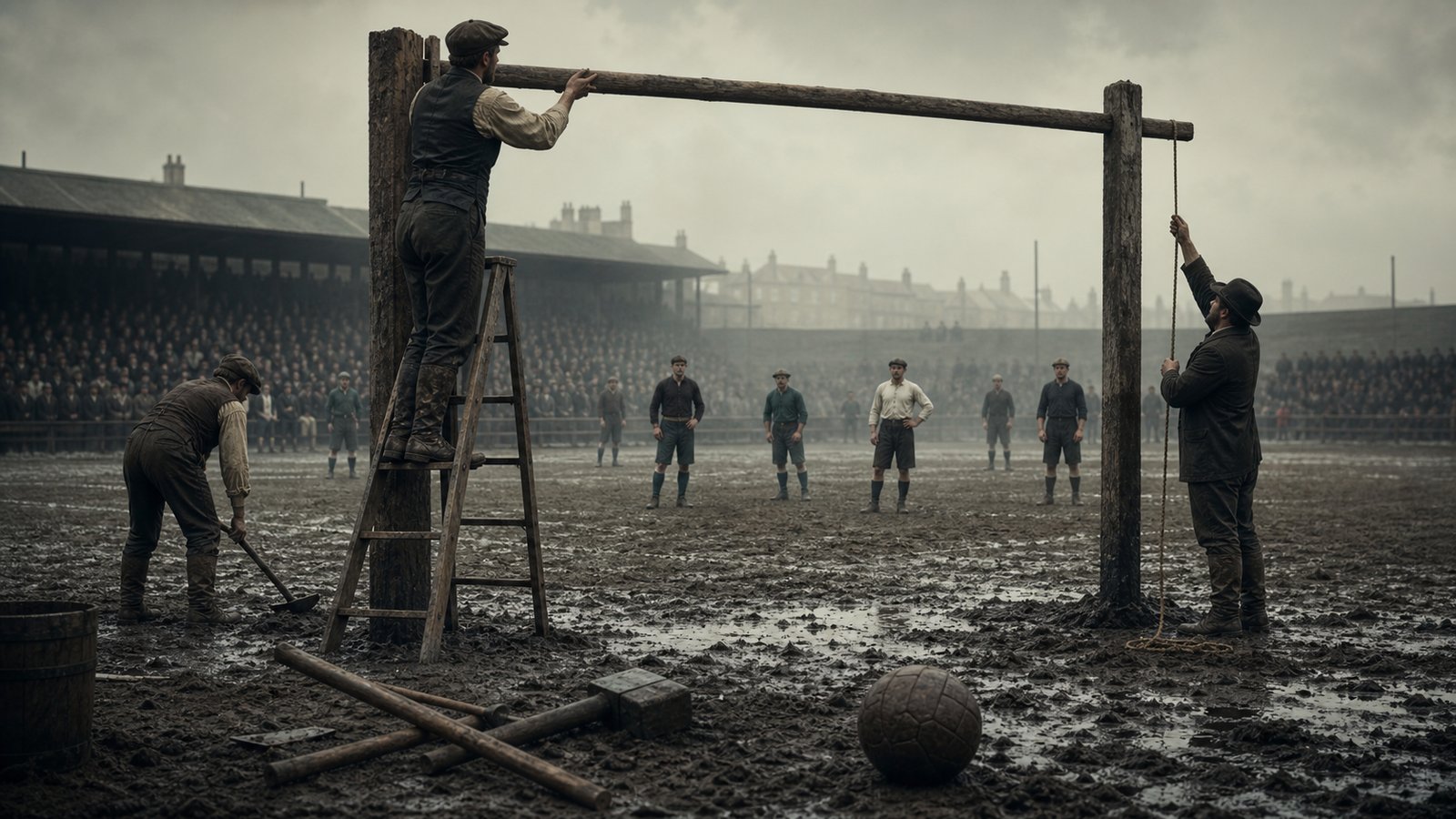
The compromise also reveals what a young governing body could demand from its clubs. A tape could be rolled up and carried with the posts to a temporary field. A fitted beam required straighter uprights, firmer anchoring and more dependable construction. Standardizing the goal therefore meant standardizing a small piece of match-day labour: measuring eight feet, keeping the posts eight yards apart, and making the structure survive contact with the ball.
This was how early football often standardized itself. A law named a distance, clubs improvised the object, and matches exposed the weaknesses. The modern game’s clean geometry was built through awkward equipment and competing local habits. The crossbar’s history belongs beside the later invention of the twelve-yard penalty kick: both turned a disputed football problem into a marked, measurable space.
The 1875 Rules Show the Boundary Becoming Solid
A surviving transcription of the 1875 Sheffield Rules captures the change in precise language. The goalposts were eight yards apart with a bar across them eight feet from the ground. Notes on the revisions record two revealing alterations: “nine feet” became “eight feet,” and “tape” became “bar.” Measurement and material were being fixed together.
The same document shows how much else remained in motion. Players could not pass the centre toward the opponents’ goal before kick-off, the goalkeeper received a specific exception, and an umpire could use a small flag to attract attention. Football was not polishing one finished code. It was assembling authority, field markings, player roles and equipment at the same time.
That context makes the crossbar more than a quaint Victorian detail. A stable upper boundary reduced the room for local interpretation. Visiting teams no longer had to ask whether the host meant an imaginary height, a rope, a strip of tape or a beam. Spectators could see the same rectangle as the players. Officials had an object against which to judge the ball.
A Beam Made the Goal a Shared Piece of Football
By 1882, according to Sheffield Home of Football’s historical account, a hard crossbar was mandatory in association matches. Nearly two decades separated the FA’s formation from that final material requirement. The delay was not evidence that the boundary was trivial. It shows how difficult it was to turn a local solution into common infrastructure across a rapidly expanding game.
The modern Laws now specify goals at the centre of each goal line: two vertical posts equidistant from the corner flagposts, joined at the top by a horizontal crossbar. The distance between the posts remains 7.32 metres, or eight yards, and the lower edge of the bar remains 2.44 metres, or eight feet, above the ground. The dimensions preserve the settlement reached in the nineteenth century even though wood has given way to approved modern materials.
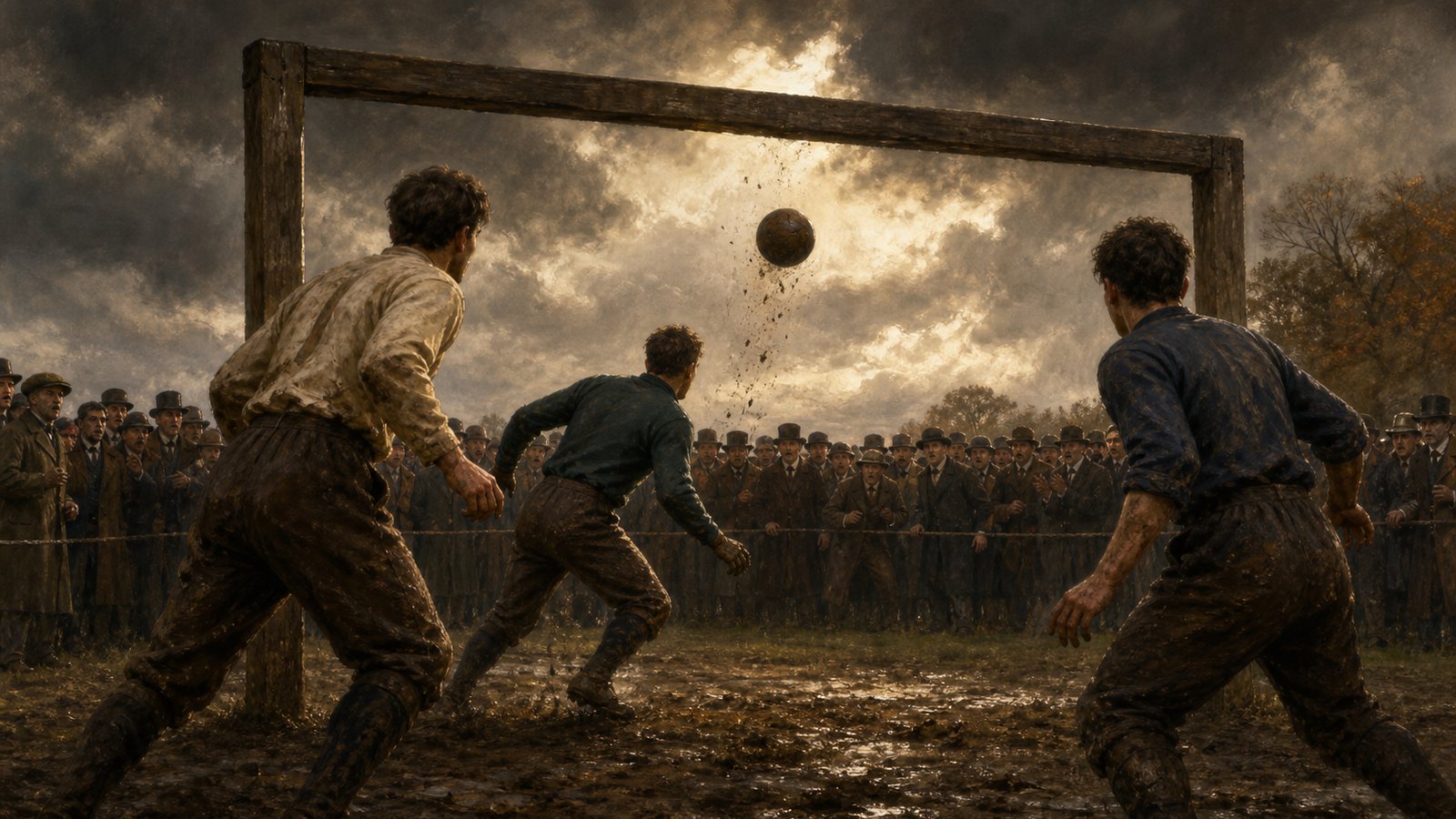
Every shot that clips the bar carries that history. The sound is dramatic because the boundary is solid; the decision is legible because the rectangle is shared. A goalkeeper can read the rebound, an attacker can chase it, and a crowd can understand in an instant why the ball stayed out. The object settles the judgement while creating another passage of play.
Sheffield supplied an early working answer, London first resisted and then adopted a lighter version, and the wider association game eventually insisted on the beam. Football did not merely draw a goal. It negotiated one into existence.
Sources
Sheffield Home of Football, A Brief History of the Crossbar; Sheffield Football Association, Sheffield Rules (1875); The Football Association, The History of The FA; The IFAB, Law 1: The Field of Play.